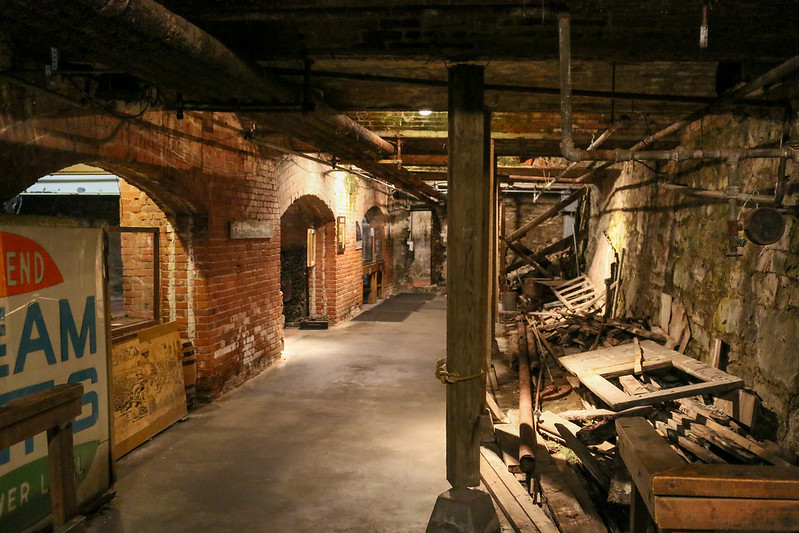
There is a city beneath Seattle. Not a metaphorical one — not some poetic musing about hidden culture or underground music scenes — but an actual, physical city. Buried streets. Abandoned storefronts. Crumbling sidewalks where people once walked, shopped, argued over the price of flour, and stumbled out of saloons. It sits roughly one to two stories below the modern street level of Pioneer Square, sealed off from daylight for more than a century, and it remains one of the most peculiar and fascinating historical sites in the American West.
The Seattle Underground is not some ancient Roman ruin or medieval catacomb. It was, until the late 1800s, the ground floor of a thriving, chaotic, and deeply flawed frontier city. The fact that it ended up underground at all is the result of a catastrophe, a bold civic decision, and the kind of collective stubbornness that defined the Pacific Northwest in its early days.
To understand how an entire neighborhood ended up buried beneath itself, you have to go back to a time when Seattle was raw, ambitious, and — quite literally — sinking into the mud.
The City That Couldn’t Stay Dry
Seattle’s Messy Origins
Before it became the tech capital of the Pacific Northwest, Seattle was a logging town built on tidal flats. The original city center sat dangerously close to sea level, and its founders chose the location not because it was ideal terrain but because it offered proximity to the waterfront. Commerce came first. Engineering would have to catch up later.
The streets of early Seattle were unpaved. When it rained — and in Seattle, it rained constantly — those streets turned into rivers of mud so deep that horses occasionally drowned in them. This isn’t legend or exaggeration. Newspaper accounts from the 1880s describe pack animals sinking into the muck on Commercial Street, unable to free themselves. Residents laid wooden planks across the worst stretches, but these rotted quickly and often gave way without warning.
The sewage situation was even worse. Seattle had installed a rudimentary sewer system, but the pipes ran at a grade that made them functional only at low tide. When the tide came in, the sewage backed up — violently, in some cases — through the plumbing of homes and businesses. Toilets became geysers. Basements flooded with waste. The city published daily tide tables not for the benefit of fishermen but so that residents would know when it was safe to flush.
It was a miserable arrangement, and everyone knew it. But Seattle was growing too fast for anyone to slow down and fix the infrastructure properly. The population was surging, the lumber trade was booming, and the general attitude was that problems could be patched over rather than solved. That attitude held right up until June 6, 1889, when the city’s luck ran out in spectacular fashion.
The Great Fire of 1889
How a Glue Pot Changed Everything
The fire started in a basement workshop on the corner of First Avenue and Madison Street. A cabinetmaker named John Back was heating a pot of glue over an open flame — a common enough practice at the time — when the pot boiled over and ignited a pile of wood shavings on the floor. Back tried to douse the flames with water, which only spread the burning glue. He then threw the entire pot out of the workshop, inadvertently splashing flaming adhesive across the wooden floor of the adjacent room.
Within minutes, the building was engulfed. Within hours, the entire commercial district was ablaze.
The fire burned for more than twelve hours. It consumed 25 city blocks, destroyed nearly every wharf along the waterfront, and reduced the commercial core to ash and rubble. The losses were staggering — an estimated $20 million in 1889 dollars, which translates to well over half a billion today. Remarkably, no one was confirmed killed in the blaze, though the chaos was so total that some historians suspect the count was never truly accurate.
When the smoke cleared, Seattle’s residents faced a choice: rebuild the city as it was, complete with its sewage problems and mud-choked streets, or start over and do it right. They chose the latter, and in doing so, they made the decision that would eventually create the Underground.
Building Up: The Radical Plan to Raise the Streets
A City Decides to Bury Itself
The city’s new engineer, R.H. Thomson, along with the city council, devised a plan that was audacious even by the standards of a place known for audacious plans. They would rebuild the commercial district, but they would raise the street grade by one to two full stories. This would solve the flooding, fix the sewage problems, and create a proper urban infrastructure on solid, elevated ground.
There was a catch, of course. Raising the streets would take time — years, in fact — and Seattle’s business owners were not willing to wait years to reopen their shops. So the city struck a compromise that was practical in the short term and deeply strange in the long term: merchants could begin rebuilding immediately at the original street level, but they had to understand that the streets around their buildings would eventually be raised. When that happened, what was currently the ground floor would become the basement, and new entrances would need to be constructed at the new, higher street level.
The result was a transitional period that lasted from roughly 1890 to 1907, during which Seattle existed as a kind of split-level city. On some blocks, the streets had already been regraded, and pedestrians walked on elevated sidewalks supported by retaining walls, looking down into what had recently been storefronts. On other blocks, the old street level remained, and people descended ladders to cross from the new sidewalks to the old ones.
It was confusing. It was dangerous. People fell. According to local lore, at least one person died after tumbling off an elevated sidewalk into the gap below. But the city pressed on, block by block, filling in the space between the old ground level and the new one with dirt, rubble, and whatever else was available.
Eventually, the city installed permanent sidewalks over the top of the old storefronts, sealing them off from the surface. Glass prisms — called vault lights — were embedded in the new sidewalks to allow some daylight to filter down into the spaces below, where businesses continued to operate for a time. But as the new street level became the norm, the underground spaces were gradually abandoned. Shop owners moved upstairs. The old ground floors were converted to storage, then to nothing at all. The entrances were sealed. And slowly, Seattle forgot about its buried past.
Life Below the Streets
What the Underground Looked Like in Its Prime
During the transitional years, the underground level was not some dark, neglected crawlspace. It was, for a time, the active commercial heart of the city. Shops operated beneath the raised sidewalks. Banks conducted business there. Hotels rented rooms at the old street level even as the world above them rose higher and higher.
The underground corridors were lit by gas lamps and, later, by the dim glow of those sidewalk vault lights. The glass prisms cast a pale, purplish light into the passageways — enough to see by, but not enough to feel like daylight. The effect was eerie and oddly beautiful, like walking through a city submerged in deep water.
But the underground also attracted less reputable enterprises. As the legitimate businesses moved to the new street level, the spaces below filled with gambling dens, opium parlors, speakeasies, and flophouses. Pioneer Square had always been Seattle’s roughest neighborhood, and the underground became a concentrated version of its worst tendencies. During Prohibition, the tunnels and sealed-off storefronts provided ideal cover for bootlegging operations. The underground became a shadow economy — literally operating in the shadows.
By the early twentieth century, city officials began to view the underground spaces as a public health hazard. Rats proliferated. The air was stale. During the bubonic plague scare of 1907, the city condemned the underground passages and ordered them permanently sealed. For the next six decades, they sat in darkness, slowly crumbling, known only to building owners who occasionally stumbled into them through their own basements.
Rediscovery: Bill Speidel and the Underground Tour
One Man’s Crusade to Save a Buried City
The Seattle Underground might have been lost entirely if not for Bill Speidel, a local journalist, author, and self-described “civic gadfly” who made it his personal mission to preserve Pioneer Square and the tunnels beneath it.
In the 1950s and 1960s, Pioneer Square was a neighborhood in steep decline. The old buildings were crumbling. The area was home to flophouses and dive bars. City planners, in the grip of mid-century urban renewal fever, proposed demolishing the entire district and replacing it with parking garages and modern office towers. Speidel was horrified.
He began writing about Pioneer Square’s history, publishing a series of books — most famously Sons of the Profits, a wickedly funny account of Seattle’s founding — that reframed the neighborhood’s shabby past as a treasure worth preserving. He also began leading informal tours of the underground passages, which he had discovered largely by talking to old-timers and poking around in basements.
The first official Underground Tour launched in 1965. It was part history lecture, part comedy show, and part urban exploration before the term existed. Speidel’s guides — and Speidel himself — led visitors through the sealed-off corridors beneath Pioneer Square, telling stories about the city’s disreputable origins with a gleeful irreverence that delighted tourists and appalled the city establishment in roughly equal measure.
The tours were an immediate hit, and they accomplished exactly what Speidel intended. Public interest in Pioneer Square surged. The demolition plans were scrapped. In 1970, the district was designated a historic preservation zone — one of the first in the Pacific Northwest — and the Underground became a protected cultural landmark.
Today, Bill Speidel’s Underground Tour remains one of Seattle’s most popular tourist attractions, drawing hundreds of thousands of visitors each year. The tour covers roughly three blocks of subterranean passageways, passing through old storefronts, beneath the original sidewalks, and past crumbling brick walls that once lined the busiest streets in the city.
What You’ll Find Down There Today
The Underground as It Exists Now
Walking through the Seattle Underground today is a study in contrasts. Some sections have been carefully preserved and lit for tourist access, with informational plaques and guided commentary explaining what each space once was. Other sections remain raw and unrestored — dark, damp corridors where the brickwork is crumbling and the air carries the musty smell of more than a century of enclosure.
The old storefronts are ghostly. You can still see the outlines of doorways and windows, the remnants of tiled floors, and in some places, the original signage painted directly onto brick walls. There are remnants of old plumbing, rusted-out fixtures, and the skeletal remains of display cases. The vault lights in the sidewalks above still exist in some areas, though many have been paved over or replaced with solid concrete. Where they survive, they cast the same faint, spectral glow they did a hundred years ago.
The tour route passes beneath several of Pioneer Square’s most recognizable buildings, offering a perspective that literally no one on the street above can access. You walk beneath the sidewalks where thousands of people pass every day, completely unaware that there is a hidden world just a few feet below their shoes.
There are also parts of the underground that the tour does not access — sealed-off sections that are considered too structurally unstable for public entry, or spaces that remain in private hands. The full extent of the underground network has never been comprehensively mapped, and local historians believe there are passages and rooms that haven’t been entered in decades.
The Ghosts, The Legends, and The Lore
Hauntings and Urban Mythology
No buried city would be complete without ghost stories, and the Seattle Underground has accumulated more than its share. The tunnels are a staple of paranormal tourism, regularly featured on television shows and in books about haunted America.
The most commonly reported phenomena include unexplained cold spots, the sound of footsteps in empty corridors, and fleeting shadows seen at the edges of vision. Some visitors have reported the smell of tobacco smoke or perfume in areas where no living person has been for years. Tour guides — who spend more time in the underground than anyone else — tend to be matter-of-fact about the reports. Most attribute the experiences to the power of suggestion combined with genuinely unsettling surroundings. A few admit to having had encounters they can’t easily explain.
One of the more persistent legends involves the ghost of a woman who allegedly operated a boarding house in the underground during the transition period. According to the story, she refused to leave when the spaces were condemned and was accidentally sealed inside. There is no historical evidence to support this tale, but it has become part of the Underground’s mythology, repeated so often that it has taken on a life of its own.
Whether or not you believe in ghosts, there is something undeniably haunting about walking through spaces that were once full of life and are now frozen in abandonment. The Underground isn’t just a historical curiosity — it’s a physical record of erasure, a reminder that cities are built in layers, and that what we walk on today was someone else’s world not so long ago.
The Underground in Context
What Seattle’s Buried City Tells Us About Urban History
The Seattle Underground is often treated as a quirky tourist attraction, a fun footnote in the city’s history. But it deserves more serious consideration than that. It is one of the most vivid examples in America of how cities are constructed, deconstructed, and reconstructed — often on top of themselves.
Every major city has layers. New York’s subway tunnels run through the foundations of buildings that predated them. Chicago raised its entire downtown by several feet in the 1850s and 1860s, using a technique that directly inspired Seattle’s own regrading. Rome is famously built on the ruins of itself, layer upon layer going back millennia.
What makes Seattle’s Underground unique is its accessibility and its relative youth. These are not ancient ruins requiring archaeological interpretation. They are recognizable spaces — shops, sidewalks, intersections — that were in active use within living memory of the oldest generation alive today. The bricks were laid by people whose grandchildren may still live in the city. The streets above were raised by workers who drank in the same saloons that now sit sealed and silent below.
The Underground also raises questions about what we choose to preserve and what we allow to disappear. Without Bill Speidel’s intervention, Pioneer Square would have been demolished and the underground filled in with concrete. The entire district — one of the most historically significant in the Pacific Northwest — would have been replaced by the kind of anonymous postwar development that gutted so many American downtowns.
Instead, it survived. And the Underground beneath it survived with it, offering a rare window into a version of the city that most residents never think about. It is a place where the past is not interpreted through museum displays or reconstructed environments but experienced directly, in the actual spaces where it happened. The walls are the original walls. The floors are the original floors. The darkness is the same darkness that settled in when the last shop owner locked the door and walked upstairs for the final time.
Visiting the Seattle Underground
Practical Matters for the Curious
Bill Speidel’s Underground Tour operates year-round out of Doc Maynard’s Public House in Pioneer Square. Tours run multiple times daily and last approximately 75 minutes, covering three underground sections connected by aboveground walks through the historic district. The tour involves stairs and uneven surfaces, and accessibility can be limited for those with mobility challenges.
Several other organizations also offer underground experiences, including after-hours paranormal tours and historically focused walks that emphasize different aspects of the city’s past. The neighborhood itself — Pioneer Square — is worth exploring on its own merits, with its Romanesque Revival architecture, independent bookshops, galleries, and some of the oldest bars in the city.
But the real draw remains what lies beneath. The Seattle Underground is not a simulation. It is not a reproduction. It is the actual, physical remnant of a city that chose to bury itself rather than accept its own flaws, and it sits there still — patient, dark, and waiting for anyone willing to descend the stairs and walk through a world that most people have forgotten exists.
The Seattle Underground stands as proof that history is not always something you read about in books. Sometimes, it’s right beneath your feet.