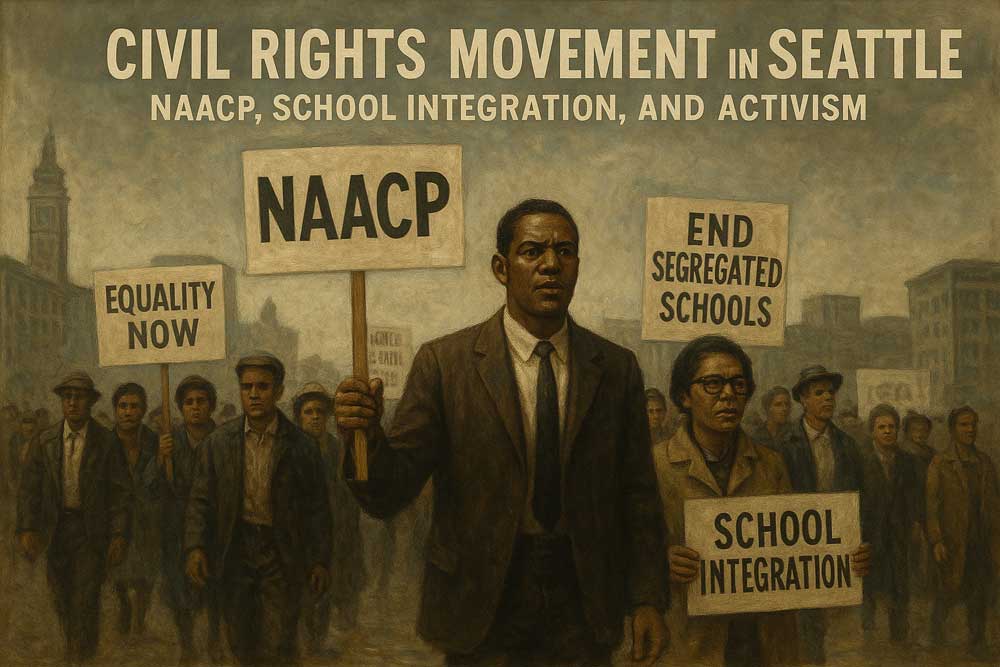
The story of America’s civil rights struggle often centers on the South—Montgomery’s buses, Birmingham’s streets, Selma’s bridge. Yet thousands of miles away, in the shadow of the Cascade Mountains and along the shores of Puget Sound, Seattle forged its own vital chapter in the fight for racial equality. This was a movement shaped by unique Pacific Northwest dynamics: wartime migration, housing discrimination, labor struggles, and a white liberal establishment that often preferred polite discussion to substantive change.
The Foundation: Seattle’s Racial Landscape Before the Movement
Seattle’s Black community remained small but resilient through the early twentieth century. By 1940, fewer than 4,000 African Americans called the city home. This changed dramatically during World War II when Boeing’s booming aircraft production and the region’s shipyards drew thousands of Black workers northward. Within just a few years, Seattle’s Black population swelled to nearly 16,000, then continued growing through the postwar decades.
These new arrivals found a city already structured by racial barriers. Restrictive covenants—legal clauses in property deeds that prohibited selling homes to non-white buyers—carved Seattle into a geography of exclusion. The Central District, initially a diverse neighborhood of Jews, Japanese Americans, and modest working families, became Seattle’s de facto Black neighborhood not by choice but by constraint.
The city’s reputation for progressive politics masked these realities. Seattle prided itself on tolerance and civic mindedness, yet this self-image rarely translated into genuine opportunity for its residents of color. Black Seattleites faced discrimination in employment, were turned away from restaurants and hotels, and found their children tracked into vocational programs regardless of academic ability. The gap between Seattle’s liberal self-conception and its racial practices would define much of the civil rights struggle to come.
Early Organizing and the Quest for Fair Employment
The Seattle chapter of the National Association for the Advancement of Colored People, established in 1913, became the earliest institutional voice for Black civil rights in the region. But the organization truly found its power in the 1940s under the leadership of figures like Philip Burton, a Pullman porter whose organizing experience with the Brotherhood of Sleeping Car Porters informed his civil rights work.
The fight for fair employment practices emerged as a central concern. Black workers might find jobs in Seattle’s wartime industries, but they faced systematic exclusion from skilled positions and union membership. The Seattle Urban League, founded in 1930 and revitalized during the war years, worked to place Black workers in jobs previously closed to them. Executive director E. June Smith became a persistent advocate, methodically documenting discrimination and negotiating with reluctant employers.
These efforts bore fruit in 1949 when Washington became one of the first states to pass fair employment legislation. The law prohibited discrimination in hiring based on race, creed, color, or national origin. Yet enforcement proved weak, and many employers simply ignored the statute. The legislation represented progress on paper while leaving daily realities largely unchanged—a pattern that would frustrate activists throughout the coming decades.
Housing Battles and the Fight Against Restrictive Covenants
Perhaps no issue proved more intractable than housing segregation. By the late 1940s, restrictive covenants blanketed Seattle’s desirable neighborhoods. A Black family with means and aspirations had virtually no legal path to purchasing a home outside the Central District, regardless of their education, profession, or financial resources.
The legal landscape shifted dramatically in 1948 when the Supreme Court ruled in Shelley v. Kraemer that racially restrictive covenants could not be enforced in courts. Seattle activists, including NAACP members and progressive attorneys, immediately began testing these new legal waters. Yet the ruling’s impact unfolded slowly. White homeowners found other mechanisms to maintain segregation, from gentleman’s agreements among real estate agents to neighborhood “improvement” associations that harassed Black families who dared to move into white areas.
The Hansberry family’s experience illustrated both progress and persistent resistance. When a Black professional family attempted to purchase a home in a previously all-white North Seattle neighborhood in the early 1960s, they faced vandalism, threatening phone calls, and social ostracism. Only through the support of a small group of white allies and the intervention of civil rights organizations could they remain in their home. Their experience was not unique—it was the price of integration.
Open housing advocates, led by activists like Reverend Mance Jackson and attorney Philip Burton, pushed for local legislation to strengthen fair housing protections. The Seattle City Council, responsive to pressure from both civil rights groups and nervous white constituents, moved cautiously. A weak open housing ordinance passed in 1968, but only after years of organizing, public testimony, and demonstrations. Even then, enforcement mechanisms remained inadequate, and housing patterns changed glacially.
School Desegregation: Seattle’s Longest Battle
While the South fought over school integration in the wake of Brown v. Board of Education, Seattle’s leaders insisted their schools operated without discrimination. After all, Washington had no laws requiring segregation. This technically accurate claim obscured a more complex reality: Seattle’s schools were deeply segregated by residential patterns, school boundary decisions, and transfer policies that allowed white students to avoid schools with growing Black enrollments.
By the early 1960s, schools in the Central District enrolled student bodies that were seventy, eighty, even ninety percent Black, while schools in North Seattle remained overwhelmingly white. The educational resources, experienced teachers, and advanced coursework followed predictable patterns, concentrating in whiter, wealthier areas.
The Central Area Civil Rights Committee, formed in 1961, made school desegregation a priority. Led by activists including Walt Hundley, Reverend John H. Adams, and Dr. Blanche Lavizzo, the committee organized pickets, sit-ins, and a dramatic 1966 school boycott that kept thousands of students home to protest segregated conditions. The boycott attracted national attention and forced the school district into uncomfortable conversations about race and educational equity.
Superintendent Forbes Bottomly commissioned studies, formed committees, and proposed voluntary transfer programs—measures that appeared responsive while accomplishing little actual desegregation. The real breakthrough came in 1977 when the school board, under pressure from civil rights organizations and facing potential legal action, approved a mandatory busing plan. The Seattle Plan, as it became known, reassigned students across the district to achieve racial balance.
The plan ignited fierce opposition. Some white parents organized resistance, filed lawsuits, and fled to suburban districts. Yet it also had supporters across racial lines who believed integration served educational and moral imperatives. The program operated for over two decades, producing mixed results: some genuine integration and cross-racial understanding, but also white flight that gradually reduced the district’s white student population and complicated desegregation mathematics.
Economic Justice and the Fight Against Redlining
Civil rights activism in Seattle extended beyond schools and housing into economic institutions. Banks and lending agencies practiced systematic redlining, marking neighborhoods with Black residents as high-risk areas unworthy of investment. This denied Black families the wealth-building opportunities that homeownership provided to white families and starved Black neighborhoods of the capital needed for business development and property improvement.
The Central Area, despite being home to vibrant businesses and working families, found itself outlined in red on lending maps. Bank branches were scarce, loan applications routinely denied, and business financing nearly impossible to secure. This economic isolation compounded other forms of discrimination, creating a self-fulfilling prophecy where disinvestment led to decline, which then justified further disinvestment.
Activists responded by creating alternative institutions. The Black Dollar Days campaign, launched in the 1960s, encouraged African Americans to support Black-owned businesses and keep money circulating within the community. Organizations like the Central Area Motivation Program worked to provide job training, business development support, and economic advocacy. These efforts built community capacity while highlighting the structural barriers that no amount of self-help could fully overcome.
The fight against redlining required changes in federal policy, eventually coming through the Community Reinvestment Act of 1977 and Fair Housing Act amendments. Local activists worked to ensure these national policies had teeth in Seattle, monitoring lending patterns and challenging discriminatory practices. Progress came slowly, measured in small increases in loan approval rates and gradual bank attention to previously ignored neighborhoods.
The Influence of Black Power and Student Activism
As the 1960s progressed, younger activists grew impatient with the NAACP’s legalistic approach and incremental gains. The Black Panther Party established a Seattle chapter in 1968, bringing a more militant rhetoric and community survival programs including free breakfast for children and health clinics. Led by Aaron Dixon and his brother Elmer, the Seattle Panthers emphasized self-defense, community control, and revolutionary politics.
The Panthers’ presence polarized Seattle. To supporters, they represented necessary militant action and community empowerment. To critics, including many establishment civil rights leaders and nearly all white politicians, they embodied dangerous radicalism. Police surveillance and harassment of Panther members intensified, culminating in dramatic confrontations and arrests that many saw as politically motivated persecution.
At the University of Washington, Black students organized the Black Student Union and demanded changes in admissions, curriculum, and campus climate. In 1968, following the assassination of Martin Luther King Jr., students occupied the university’s administration building, demanding the creation of a Black Studies program and increased recruitment of students and faculty of color. After tense negotiations, the university agreed to establish what would become the Department of American Ethnic Studies—a significant victory for student organizing.
These more confrontational tactics shifted the landscape of civil rights activism in Seattle. They demonstrated that polite requests could be ignored while direct action and political pressure produced results. They also revealed deep divisions within the Black community about strategy and tactics, with older generation leaders sometimes viewing younger militants as counterproductive even as they benefited from the political space that militancy created.
The Central Area and Urban Renewal’s Broken Promises
Urban renewal programs of the 1960s and 1970s dramatically reshaped Seattle’s Central District. Framed as necessary modernization and slum clearance, these projects displaced thousands of Black residents and destroyed established communities. Interstate 5’s construction carved through the neighborhood’s western edge. The expansion of Seattle University and Swedish Hospital consumed blocks of housing. Projects promising affordable housing replacement delivered far fewer units than demolished.
Community leaders fought these developments, but faced overwhelming political and economic forces. The language of progress and urban improvement masked what many residents experienced as destruction of their neighborhood. Property owners received compensation for demolished homes, but renters—the majority of Central Area residents—received nothing. Businesses disappeared, churches relocated, and the social fabric that had sustained community life unraveled.
Some activists turned this displacement into organizing opportunities. They demanded community input into planning processes, fought for tenant protections, and insisted that any new development include affordable housing and benefit existing residents. The Central Area Committee for Peace and Improvement became a vehicle for community voice, though often found itself negotiating from a position of weakness against powerful development interests.
The legacy of urban renewal continues shaping Seattle’s Central District today. The neighborhood lost population, commercial vitality, and stability. While framed as race-neutral improvement, the impacts fell overwhelmingly on Black residents, continuing historical patterns of dispossession and displacement under different rhetorical cover.
Legacy and Continuing Struggles
The civil rights movement in Seattle achieved genuine victories. Formal segregation ended, employment discrimination became illegal if still practiced, and Black Seattleites gained political representation previously denied. The city elected its first Black city council member, Sam Smith, in 1967, followed by other African American elected officials. Institutions that had been entirely white began, however slowly, to diversify.
Yet many of the movement’s goals remain unfulfilled. Seattle’s schools have resegregated as court-ordered integration plans ended and housing patterns shifted. The Central District, once the heart of Black Seattle, has gentrified dramatically, with Black residents priced out and displaced. Economic disparities persist across nearly every measure, from income and wealth to employment and business ownership.
The movement’s history offers lessons for contemporary struggles. It demonstrates that legal victories, while necessary, prove insufficient without enforcement and structural change. It shows that liberal rhetoric about equality means little without concrete action and resource allocation. It reveals how forms of discrimination evolve, adapting to new legal landscapes while maintaining segregation and inequality through different mechanisms.
Seattle’s civil rights activists fought with courage, creativity, and persistence against both overt racism and the particularly frustrating racism hidden behind progressive platitudes. They built institutions, won legal battles, changed hearts and minds, and expanded the boundaries of possibility for future generations. Their struggle was neither as dramatic as Selma nor as visible as Watts, but it was no less important to the people whose lives and communities hung in the balance.
The work continues. Contemporary movements for racial justice in Seattle draw on this history, learning from both victories and defeats. They recognize that the fight for true equality requires not just changing laws but transforming the economic and social structures that perpetuate racial hierarchy. The civil rights movement in Seattle did not solve racial injustice, but it created foundations, opened paths, and proved that organized people could challenge even deeply entrenched systems of power. That legacy, complex and unfinished, remains very much alive.