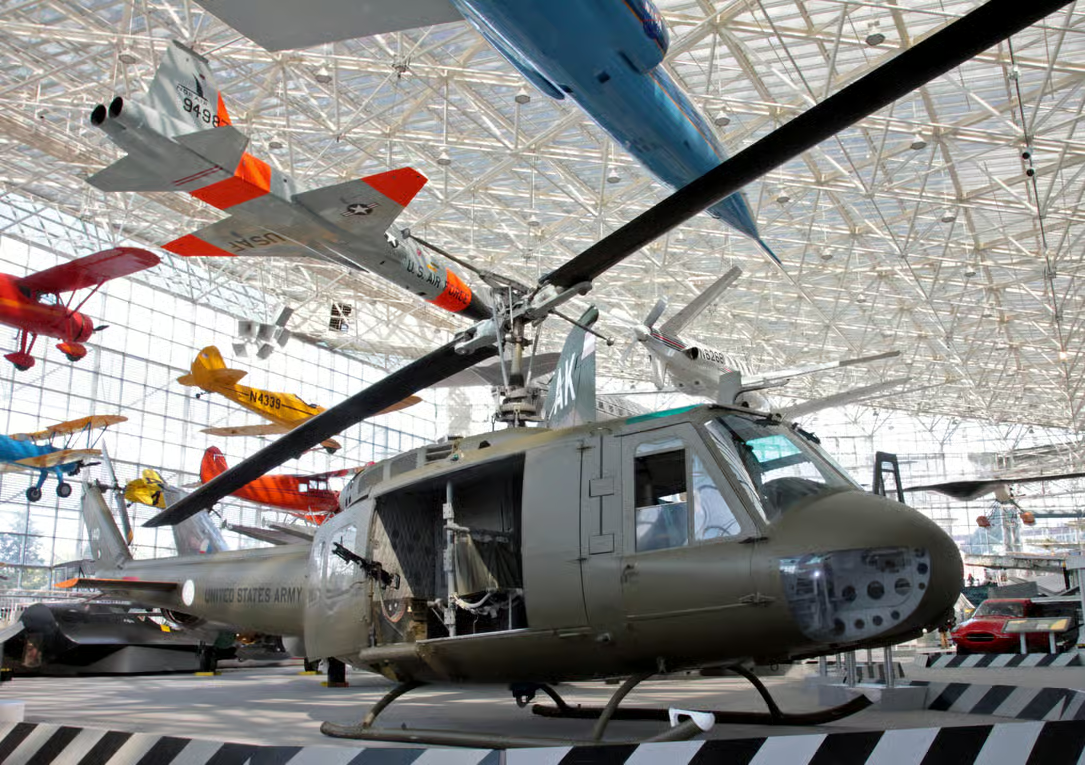
There are museums that display history, and then there are places that make you feel it in your chest. The Museum of Flight in Seattle falls firmly into the second category. Walk through its doors and you are immediately surrounded by aircraft hanging overhead, capsules that have orbited the Earth, and the lingering smell of aviation fuel and old aluminum — a sensory cocktail that does something rare: it puts the full arc of human flight into a single, breathtaking room.
Located at 9404 E Marginal Way S, Seattle, WA 98108, right on the southern edge of Boeing Field (officially King County International Airport), the Museum of Flight is not a polished corporate showroom. It is a serious institution — the largest independent air and space museum in the world, in fact — and it earns that distinction with more than 175 full-sized aircraft and spacecraft, 14 million artifacts, and an archives collection that aviation historians travel across continents to access.
If you are visiting Seattle and think of this place as a nice afternoon option, revise that estimate upward. Plan a full day. Bring comfortable shoes. And go hungry, because the cafe is decent and the awe alone will drain your energy.
How It Started: Boeing, History, and a Red Barn
The Origins of an Aviation Giant
The story of the Museum of Flight is inseparable from the story of Boeing, which is inseparable from the story of Seattle itself. Boeing’s first factory — built in 1909 — sat on the southern edge of what is now the museum’s footprint. That original structure, a red wooden building known simply as The Red Barn, still stands today and forms the emotional and historical core of the museum’s permanent collection.
Step inside The Red Barn and you are walking through a room where some of the earliest Boeing aircraft were hand-assembled by craftsmen who were, in many cases, making up aviation as they went. The wooden joinery, the exposed beams, the scale of the thing — it is modest in a way that makes the contrast with modern aircraft almost disorienting. A company that would eventually produce the 747 started here, in a drafty building that would have been unremarkable as a warehouse.
The museum itself was formally established in 1965 and moved to its current location in 1975. The Great Gallery — the massive steel-and-glass structure that defines the museum’s modern identity — opened in 1987. Since then, expansions have continued steadily, with the Space Gallery, the Personal Courage Wing, the Airpark, and the Charles Simonyi Space Gallery all added in subsequent decades.
The Great Gallery: A Room That Rewrites Your Sense of Scale
Walking Into the Cathedral
The Great Gallery is the heart of the museum and the space most likely to stop you mid-step and force you to look up. It is a six-story glass-and-steel structure housing more than two dozen full-sized aircraft suspended from the ceiling or displayed at ground level, spanning the entire history of flight from biplanes to commercial jets.
A Lockheed M-21 Blackbird hangs overhead — a variant of the legendary SR-71, the fastest air-breathing aircraft ever built. Below it, vintage fighter planes, training aircraft, and experimental designs share the airspace in a way that compresses a century of engineering progress into a single line of sight. You can stand in one spot and trace the evolution of the wing, the engine, the cockpit, and the philosophy of flight from the fragile to the ferocious.
The curators have done something clever with the layout. Rather than organizing aircraft by chronology alone, the gallery invites you to move through it the way you might wander through a great city — discovering things, doubling back, making connections you didn’t expect. A docent will tell you something about the Boeing B-17 that you will remember the rest of your life. Chances are, you’ll stop and ask a follow-up question.
The Personal Courage Wing: War Told Honestly
Where the Human Cost Lands
Two floors of the Personal Courage Wing are dedicated to World War I and World War II aviation, and they represent some of the finest military museum work anywhere in the country. This is not a glorification of war. It is a reckoning with it.
The aircraft here — including a genuine Spitfire, a Messerschmitt Bf 109, and a P-51 Mustang — are displayed alongside personal stories of the pilots who flew them, from both Allied and Axis perspectives. The museum made a deliberate choice to tell this story from multiple sides, and the effect is morally serious in a way that most war museums are not.
The Spitfire alone is worth the visit. Its elliptical wing design is visible up close, and the thinness of the aluminum skin — you can see how little stood between the pilot and the sky — is quietly devastating. These were not invincible machines. They were extraordinary machines flown by very mortal people.
Recorded oral histories from veterans play in some of the exhibit spaces. When you hear a ninety-year-old man describe the sound of flak through a fuselage in a voice still tinged with wonder and dread, something shifts in your understanding of that era.
The Space Gallery: From Earth to Orbit
The Simonyi Space Gallery
In 2012, the museum opened the Charles Simonyi Space Gallery — named after the former Microsoft programmer who became the first private citizen to travel to the International Space Station twice — and it fundamentally changed what the Museum of Flight is.
The centerpiece is Space Shuttle trainer OV-101 Full Fuselage Trainer, which is the only full shuttle trainer in the world that visitors can actually walk through. This is not a replica. This is the actual training vehicle NASA astronauts used to prepare for shuttle missions. You board through the hatch, squeeze through the mid-deck, look up through the crew hatch into the cockpit, and understand viscerally why space travel demands exceptional human beings.
The gallery also holds Mercury, Gemini, and Apollo artifacts, including an Apollo Lunar Module. A replica of Sputnik hangs overhead. The narrative arc moves from the earliest satellite launches through the Space Race and into the current era of commercial spaceflight, touching on SpaceX and the ongoing missions that the museum tracks as living history.
One artifact that generates disproportionate conversation: a piece of actual lunar sample material, displayed under glass. Something about knowing that the gray rock in front of you was collected 238,855 miles away changes the temperature of the room.
The Airpark: Aircraft You Can Actually Touch
Out on the Tarmac
Outside, the museum’s Airpark extends the experience into open air and gives visitors access to aircraft that no interior space could contain. The collection here includes:
- Air Force One VC-137B (tail number 970) — one of two aircraft that served as Air Force One, carrying Presidents Eisenhower, Kennedy, Johnson, Nixon, Ford, Carter, Reagan, and Bush. You walk through it. You sit in the seats. You stand in the presidential stateroom and try to reconcile the mundane carpeting with the decisions made above it.
- Concorde Alpha Golf — the British Airways Concorde that flew between London and New York in under three and a half hours. The cabin is unexpectedly narrow; Concorde was about speed, not comfort, and the interior reflects that trade-off honestly.
- Boeing 727 — a short-range workhorse of commercial aviation
- Boeing 737-200 — the grandfather of the world’s most popular commercial aircraft family
The Airpark is particularly good for families. Children who have been patient through interior galleries tend to come alive outside, especially when they can stand next to a Concorde and begin to form real-world understanding of just how large these machines are.
Learning Programs and the Museum’s Educational Mission
More Than an Attraction
The Museum of Flight takes its educational role seriously — arguably more seriously than most science institutions of comparable size. Its education programs serve tens of thousands of students annually, with specific curricula tied to STEM standards from elementary through high school. Summer camps run the gamut from introductory aviation to robotics to aerospace engineering.
The museum’s library and archives — located on site and accessible to researchers — hold an estimated 1.3 million photographs, 10,000 films and videos, and thousands of personal collections from pilots, engineers, and aviation pioneers. Scholars come here from around the world to access materials unavailable anywhere else.
For the casual visitor, the education manifests in the quality of signage, the depth of the docent program (many of whom are retired pilots and engineers), and the thoughtfulness of exhibit design. Very little here is dumbed down. The museum treats its visitors as people capable of handling complexity, and the experience is better for it.
Special Exhibitions and Rotating Collections
The Museum as a Living Document
Beyond the permanent collection, the Museum of Flight maintains an active calendar of temporary exhibitions that address current topics in aviation and space. In recent years, these have included deep dives into women in aviation, the legacy of the Tuskegee Airmen, and the evolving landscape of commercial spaceflight.
The Restoration Center, visible from a viewing area in the museum, is one of the more compelling ongoing features. A team of professional restorers and skilled volunteers works continuously on aircraft that are being brought back to museum-quality condition. Watching a fuselage being rebuilt by hand — stripped to its frame, every rivet visible — connects the mechanical skill of early aviation to its ongoing preservation.
The museum also hosts events: film nights, fundraising galas, corporate events (yes, you can have a dinner under a Blackbird), and the annual Seafair Weekend activities that draw aviation enthusiasts from across the Pacific Northwest.
Getting There and Practical Details
Planning Your Visit
Address: 9404 E Marginal Way S, Seattle, WA 98108
The museum is located approximately 10 miles south of downtown Seattle, making it an easy drive but a more involved public transit trip. Options:
- By car: Take I-5 south to Exit 158 (East Marginal Way), then head north approximately one mile. Parking is free and abundant — a genuine luxury in Seattle.
- By public transit: King County Metro Route 124 runs from downtown Seattle along East Marginal Way and stops directly in front of the museum. The ride takes approximately 25–30 minutes from the city center.
- By Link Light Rail: The Tukwila International Boulevard Station on the 1 Line is a viable option, with a bus transfer or rideshare for the remaining distance.
The museum is open daily from 10:00 AM to 5:00 PM, with extended hours on select days. Admission for adults runs approximately $25–$30, with reduced rates for youth, students, seniors, and military. Boeing employees and their families receive free admission — a legacy arrangement that speaks to the enduring relationship between the institution and the company.
Who Goes to the Museum of Flight?
An Honest Audience Assessment
In two decades of writing about travel and culture, the Museum of Flight is one of the few institutions I have seen successfully hold the attention of an eight-year-old, a retired airline pilot, a college student on a date, and a grandparent who remembers watching the moon landing live — all at the same time, in the same room.
That breadth of appeal is not accidental. The museum’s curators have thought carefully about layering: there is always something at eye level for a child, something technically rigorous for the expert, and something emotionally resonant for everyone in between. The signage is written at different registers throughout, and the spatial design of each gallery creates natural pauses for different kinds of engagement.
Families with children under 12 should note the dedicated Aviation Learning Center and the Kids Flight Zone, designed specifically for younger visitors. The hands-on activities here — flight simulators, building challenges, interactive displays — are genuinely educational rather than merely distracting.
Aviation enthusiasts will find the depth of the archives and the specificity of the aircraft collection more than sufficient to justify repeated visits. The museum rotates some exhibits annually, and the restoration center’s ongoing work means there is almost always something new in progress.
For general visitors — people who are curious but would not describe themselves as aviation fans — the Museum of Flight has a reliable track record of converting them. It is hard to spend three hours surrounded by evidence of what human beings have figured out and leave without some revised sense of what we are capable of.
The Emotional Argument for Going
Why This Museum Matters Right Now
There is a tendency to frame aviation history as the domain of enthusiasts — a niche interest for people who read Jane’s All the World’s Aircraft and can identify a radial engine by sound. The Museum of Flight quietly dismantles that framing.
Flight changed everything. It changed commerce, warfare, diplomacy, communication, tourism, and the fundamental human experience of distance. The first powered flight happened in 1903. Within 66 years, human beings had walked on the moon. The arc of that progress — compressed into the galleries of a museum at the southern edge of Seattle — is one of the most compelling stories in human history, and the Museum of Flight tells it without flinching from the complexity.
The military aircraft force the question of what we have used flight for, not just what we have achieved. The space artifacts force the question of what comes next. The Red Barn forces the question of where extraordinary things actually come from — and the answer, again and again, is: from people working with what they had, in buildings that were never quite big enough for their ambitions.
That is, in the end, what the Museum of Flight is about. Not hardware. Ambition. The particular human restlessness that looks at the sky and decides, with no guarantee of success, that up there is where we belong.
One Last Note Before You Go
The gift shop is actually excellent, which is not something you can say about most museum gift shops. Aviation books, archival prints, model aircraft kits, and an uncommonly good selection of historical photography collections make it worth a deliberate stop rather than an afterthought. Budget twenty minutes and expect to spend more than you planned.
The cafe, Aviator’s Cafe, serves food that is better than institutional and worse than great — reliable sandwiches, coffee that will do, and a terrace view of the airpark that makes the mediocre coffee taste considerably better.
Museum of Flight 9404 E Marginal Way S Seattle, WA 98108 (206) 764-5720 museumofflight.org
Open daily, 10:00 AM – 5:00 PM. Check the museum’s website for holiday hours, ticketing, and current special exhibitions before your visit.