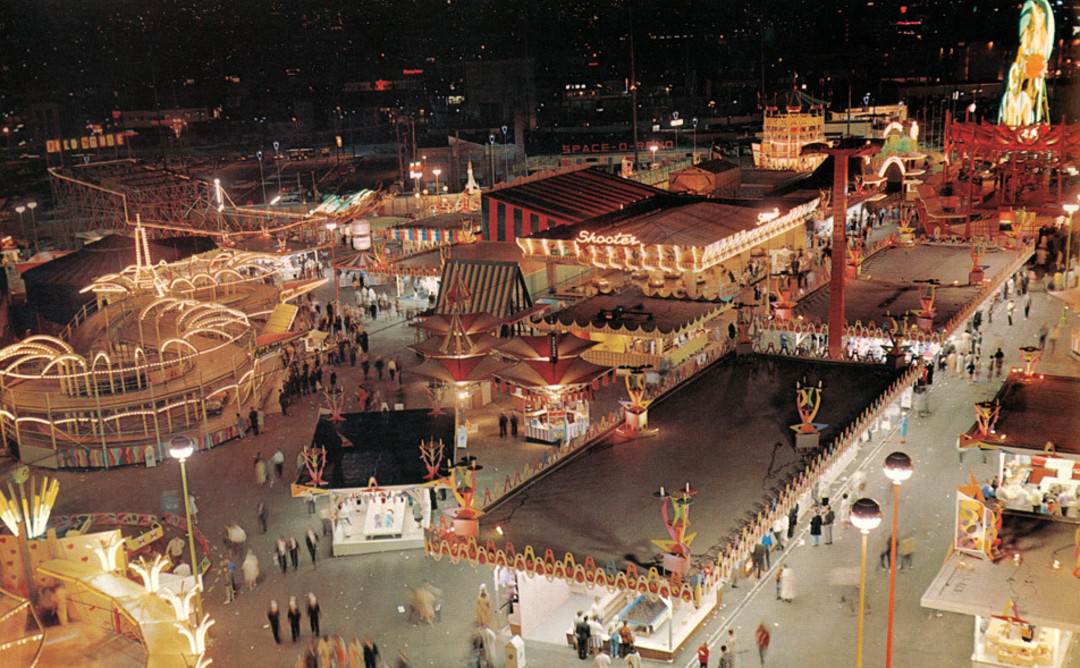
The morning of April 21, 1962, broke clear and bright over Elliott Bay. At precisely 10:00 AM, President John F. Kennedy pressed a gold telegraph key in Palm Beach, Florida, transmitting a signal that traveled 3,000 miles to Seattle, Washington. The pulse of electricity activated the carillon in the fair’s United States Science Pavilion, its bells ringing out across 74 acres of transformed landscape. The Century 21 Exposition—Seattle’s World’s Fair—had officially begun.
For the next six months, nearly 10 million visitors would stream through the turnstiles to witness what organizers promised would be a glimpse of life in the year 2000. They came to ride the Monorail, ascend the Space Needle, and contemplate humanity’s future among the stars. What they found was both a earnest vision of tomorrow and a snapshot of Cold War America’s anxieties and ambitions, all wrapped in the optimistic package of a city desperate to prove it belonged on the world stage.
A City Reaches for Relevance
Seattle in the late 1950s occupied an awkward position in the American consciousness. Too far from the centers of power and culture, too identified with logging and Boeing factories, the city suffered from what locals themselves recognized as an inferiority complex. While New York, Chicago, and Los Angeles commanded attention, Seattle remained a regional player, a place people flew over en route to somewhere else.
The idea of hosting a world’s fair emerged from this civic insecurity. Local business leaders, politicians, and civic boosters saw in the exposition format an opportunity to announce Seattle’s arrival as a modern American metropolis. The fair would showcase the city’s proximity to Asia, its technological prowess through Boeing, and its natural beauty framed by Puget Sound and the Cascade Mountains.
Early planning began in 1955, when a group of civic leaders formed the Century 21 Exposition Corporation. They faced immediate skepticism. How could a city of barely half a million people compete with the grand expositions of the past? How would they finance such an undertaking? And perhaps most pressing: what would Seattle’s fair be about?
The answer came from the zeitgeist itself. This would be a fair about the future, about space exploration, about scientific progress and the promise of technology to solve humanity’s problems. The theme “Century 21” positioned the exposition as a bridge between the present and a gleaming tomorrow, one where automation would free humanity from drudgery and atomic energy would power clean, efficient cities.
Building Tomorrow from Scratch
The site selected for the fair occupied 74 acres north of downtown, centered on the aging civic auditorium and the remnants of earlier expositions. What existed there before—a neighborhood of modest homes, small businesses, and the echoes of Seattle’s past—had to make way for the future.
The transformation proved remarkable. In less than three years, an entire landscape of futuristic structures rose from the ground. The architectural vocabulary borrowed heavily from modernism’s greatest hits: sweeping hyperbolic paraboloids, cantilevered roofs, exposed steel frameworks, and vast expanses of glass. The buildings didn’t just house exhibits; they were exhibits themselves, demonstrations of what mid-century American architecture could achieve when freed from conventional constraints.
The Space Needle became the fair’s defining icon through a combination of ambition and accident. Designed by John Graham & Company based on a sketch by Eddie Carlson drawn on a hotel cocktail napkin, the 605-foot structure rose from a foundation 30 feet deep and 120 feet across. Its tripod base supported a slender shaft crowned by a flying saucer-like observation deck and rotating restaurant. The design borrowed from Stuttgart’s television tower, but the execution was pure Seattle—a declaration that this corner of the Pacific Northwest could build something as audacious as anything in Europe.
Construction proceeded at a breakneck pace. The Needle’s foundation required concrete to be poured continuously for 12 hours, creating what was then the largest continuous concrete pour in the western United States. Workers labored in shifts around the clock, knowing the fair’s opening deadline allowed no delays. When the final bolt was secured 400 days after construction began, the Space Needle stood as the tallest structure west of the Mississippi River.
The Monorail and the Machine Age
If the Space Needle represented vertical aspiration, the Monorail embodied horizontal progress. The elevated train system, designed by Swedish company Alweg, connected downtown Seattle with the fair grounds in exactly 96 seconds. Its sleek, streamlined cars glided silently above Fifth Avenue on a concrete beam guideway, offering riders a vision of urban transportation freed from the constraints of street-level traffic.
The Monorail wasn’t merely a novelty attraction. Planners envisioned it as the prototype for a citywide rapid transit system that would solve Seattle’s growing traffic congestion. The technology seemed perfect for the era: clean, quiet, efficient, and undeniably futuristic. Visitors lined up for hours to experience the brief journey, captivated by the smooth acceleration and the elevated view of the city passing below.
Other structures contributed to the fair’s architectural legacy. The United States Science Pavilion, designed by Minoru Yamasaki (who would later design the World Trade Center), featured five graceful arches surrounding pools that reflected the sky. The Coliseum, built with a hyperbolic paraboloid roof supported by massive concrete buttresses, could seat 15,000 for sporting events or concerts. The Washington State Pavilion, with its distinctive folded plate roof, demonstrated how modern engineering could create vast column-free interior spaces.
Exhibits of Wonder and Worry
Inside these structures, visitors encountered a carefully curated vision of humanity’s future. The exhibits reflected both the soaring optimism of the early Space Age and the underlying tensions of Cold War competition.
The United States Science Pavilion presented science not as abstract theory but as lived experience. Visitors could operate a working Van de Graaff generator, observe cells through electron microscopes, and explore interactive exhibits on everything from molecular biology to space physics. The NASA exhibit drew enormous crowds, featuring Mercury space capsules, models of planned Apollo spacecraft, and detailed explanations of the nascent moon program.
The Avenue of Science featured exhibits from major American corporations, each presenting their vision of tomorrow’s lifestyle. General Motors showcased futuristic automobile concepts. Bell Telephone demonstrated picture phones that would allow people to see each other while talking across vast distances. Ford’s “Magic Skyway” transported visitors in convertibles through dioramas depicting Earth’s prehistoric past and speculative future.
The Space Needle’s eye-level observation deck offered views extending to the Olympic and Cascade mountain ranges. On clear days, visitors could see Mount Rainier’s white peak 80 miles to the south. The rotating restaurant, making one complete revolution per hour, served continental cuisine while diners slowly circled, watching Seattle spread below them like a model city.
International pavilions brought the world to Seattle. The Soviet Union, despite Cold War tensions, erected an impressive exhibit featuring Sputnik replicas, models of their space program, and displays of industrial achievement. The message was clear: the Space Race had contestants, and the outcome remained uncertain. Japan’s pavilion, just 17 years after World War II’s end, presented a vision of peace and economic progress that hinted at the industrial powerhouse it would become.
Entertainment and Spectacle
The fair understood that education alone wouldn’t sustain attendance for six months. The Gayway, the fair’s amusement zone, offered more traditional attractions: a roller coaster called the Wild Mouse, the Space Wheel Ferris wheel, and various games of chance and skill. Show Street featured theaters presenting everything from Broadway musicals to international dance troupes.
The fair’s organizers secured an impressive roster of performers. Count Basie, Duke Ellington, and Woody Herman brought jazz to the fair’s stages. The comedy team of Bob Newhart performed regularly. Elvis Presley filmed scenes for “It Happened at the World’s Fair” among the exhibits and attractions, bringing Hollywood glamour to Seattle’s showcase event.
Food concessions reflected both international cuisine and American carnival traditions. Visitors could sample Belgian waffles (making their American debut at the fair), Japanese tempura, or stick with hot dogs and cotton candy. The Space Needle restaurant offered fine dining, but most fairgoers opted for more casual fare consumed while wandering between exhibits.
The fair ran special events throughout its six-month duration. “Washington Day” celebrated state history. “Armed Forces Day” featured military displays and demonstrations. “Industry Days” highlighted specific sectors of the economy. These themed occasions provided reasons for repeat visits and helped sustain attendance through the summer and into fall.
The View from 1962
Understanding the fair requires situating it within its historical moment. President Kennedy’s challenge to reach the moon before decade’s end was less than a year old. The Cuban Missile Crisis loomed on the horizon, just months away. Civil rights protests were intensifying across the South. The postwar economic boom continued, but social upheaval simmered beneath the surface of suburban prosperity.
The fair’s vision of the future reflected establishment assumptions about progress. Technology would solve problems. Economic growth would continue indefinitely. Scientific advancement would improve lives. The nuclear family would remain intact, albeit living in automated homes and driving flying cars. Women would still cook dinner, but in kitchens featuring push-button appliances. Men would still commute to work, but via monorail or helicopter.
This future, presented with genuine conviction by the fair’s creators, now seems both charmingly naive and revealing in its blind spots. Environmental concerns barely registered. Questions of social justice remained largely unaddressed. The possibility that technology might create new problems even as it solved old ones went largely unexamined.
Yet the fair’s earnestness remains striking. The exhibits didn’t present a dystopian future or warn of technological dangers. Instead, they offered unalloyed optimism about human ingenuity and progress. This reflected genuine belief, not propaganda, in an era when faith in institutions, science, and progress still commanded broad support.
Financial Realities and Political Wrangling
Behind the fair’s gleaming facade lay considerable financial and political complexity. The total cost reached approximately $80 million, raised through a combination of public bonds, private investment, and federal grants. Voters in King County approved a $7.5 million bond issue, demonstrating public support despite skepticism about the fair’s viability.
Federal funding proved crucial but politically fraught. Seattle’s congressional delegation, led by Senator Warren Magnuson, lobbied intensively for government support. They framed the fair as a Cold War cultural weapon, an opportunity to showcase American innovation and prosperity to international visitors. This argument eventually secured federal appropriations, though less than organizers had hoped.
The fair’s financial structure required careful management. Admission prices were set at $1.50 for adults and 75 cents for children, with additional charges for specific attractions and the Monorail. Organizers needed attendance projections to meet revenue targets while keeping prices affordable enough to ensure broad participation.
Corporate sponsorships supplemented gate receipts. Major companies paid substantial sums for prime pavilion space and the right to associate their brands with the fair’s futuristic themes. Boeing, headquartered in Seattle, played a particularly prominent role, using the fair to showcase its aerospace expertise and cement its identity as more than merely an aircraft manufacturer.
The Aftermath and Legacy
When the fair closed on October 21, 1962, final attendance figures showed 9.6 million visitors had passed through the gates. The number exceeded initial projections and made the exposition a qualified success. More importantly, the fair had achieved its larger goal: Seattle would never again be dismissed as a provincial backwater.
The immediate legacy proved tangible. Rather than demolishing the fair buildings, the city transformed the site into Seattle Center, a 74-acre civic campus that continues to serve as a cultural and entertainment hub. The Space Needle, which many assumed would be temporary, became Seattle’s most recognizable landmark. The Monorail continued operating, though plans for system expansion never materialized. The structures designed by Yamasaki, Graham, and others found new purposes as theaters, museums, and performance venues.
The Pacific Science Center emerged from the U.S. Science Pavilion, continuing the fair’s educational mission. KeyArena (originally the Coliseum) hosted basketball games, concerts, and hockey matches for decades. The Experience Music Project, later renamed the Museum of Pop Culture, eventually occupied new space within Seattle Center, extending the site’s cultural programming.
The fair’s economic impact on Seattle proved harder to quantify but undoubtedly substantial. Tourism infrastructure developed for the exposition—hotels, restaurants, transportation—served the city long after the gates closed. The fair put Seattle on mental maps for millions of Americans who had never considered visiting the Pacific Northwest. Boeing’s profile rose, helping establish Seattle’s identity as a center of aerospace innovation.
Culturally, the fair influenced how a generation of Americans thought about the future. Children who rode the Monorail in 1962 grew up to become architects, engineers, and designers whose work reflected the optimism and ambition they had encountered at the exposition. The fair appeared in films, television shows, and literature, becoming a reference point for early 1960s futurism.
Reflections from the Twenty-First Century
More than six decades later, the 1962 Seattle World’s Fair invites reflection on how visions of the future reveal the values and assumptions of the present. The fair’s exhibits predicted some developments with remarkable accuracy—video telephony, space stations, automated homes—while missing entirely the computer revolution, the internet, and the environmental movement that would transform the century.
Walking through Seattle Center today, vestiges of the fair’s optimism remain visible. The Space Needle still draws tourists, now renovated with glass floors that allow visitors to look straight down. The Monorail still runs its brief route, now more nostalgic curiosity than transportation solution. The architectural language of the fair’s structures—those sweeping curves and dramatic cantilevers—has weathered changing tastes to achieve a kind of mid-century dignity.
The fair represents a specific moment in American culture, when faith in progress, science, and technology seemed justified by recent history and unlimited by foreseeable constraints. World War II had been won. The economy was booming. Antibiotics and vaccines had conquered diseases that had plagued humanity for millennia. Atomic energy promised clean, abundant power. Space beckoned as the next frontier.
This confidence, this certainty that tomorrow would be better than today, pervaded the fair’s exhibits and rhetoric. Whether such confidence was warranted remains debatable, but its sincerity seems beyond question. The fair’s creators genuinely believed they were offering visitors a glimpse of a better world, one where technology and human ingenuity would combine to solve the challenges facing civilization.
Seattle’s transformation from regional city to global metropolis began in those six months when the world came to Elliott Bay. The Space Needle’s silhouette would grace postcards, souvenirs, and the city’s official iconography. The Monorail would become a symbol of paths not taken, of future visions that never quite materialized. And Seattle Center would evolve into what the fair’s creators hoped it might become: a gathering place for community, culture, and continued contemplation of what tomorrow might hold.
The 1962 Seattle World’s Fair didn’t predict our present with perfect accuracy. It couldn’t foresee smartphones, climate change, or social media. But it captured something essential about American ambition and optimism in the early 1960s, that brief moment when the future seemed both knowable and bright, when progress appeared inevitable and technology promised liberation rather than complication. In that sense, the fair succeeded not as prophecy but as time capsule, preserving for future generations a vision of tomorrow as imagined from yesterday.