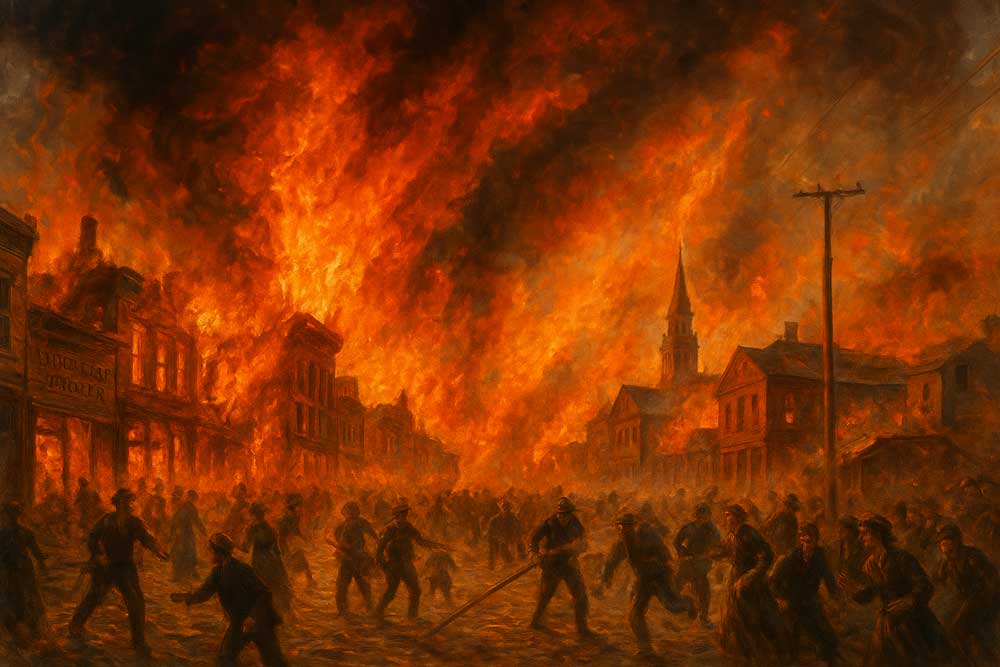
The afternoon of June 6, 1889, began like any other in the bustling waterfront city of Seattle. Loggers hauled timber down muddy streets. Ships crowded Elliott Bay, their holds stuffed with Pacific Northwest lumber bound for San Francisco. In the workshops along Front Street, craftsmen bent over their work, including a young cabinet maker named John Back who was heating a pot of glue in his basement shop.
What happened next would consume 25 city blocks, destroy the entire business district, and paradoxically transform Seattle from a rough frontier town into one of the Pacific Coast’s most important cities. The Great Seattle Fire stands as one of American history’s most transformative urban disasters—a catastrophe that simultaneously erased a city and created the conditions for its spectacular rebirth.
A Tinderbox Waiting for a Spark
Seattle in 1889 was a city living dangerously. After decades of explosive growth fueled by the timber industry, fishing, and the recent completion of railroad connections to the East, the young city had grown too fast and too carelessly. Nearly every building downtown was constructed of wood, from the grandest hotels to the humblest storefronts. The wooden structures sat on wooden pilings driven into the mudflats, with wooden boardwalks connecting them across streets that turned to soup with every rain.
The city had already survived several close calls with fire. Just a year earlier, flames had threatened the business district before firefighters managed to contain them. City leaders talked about fire safety, about building codes and brick construction, but talk was cheap and wood was plentiful. Why spend extra money on stone and brick when the forests of the Pacific Northwest offered an endless supply of cheap timber?
The fire department, such as it was, consisted of volunteers equipped with hand-pulled pumpers and hose carts. Water pressure in the city’s system was notoriously unreliable. During the previous summer, the pressure had been so weak that streams from fire hoses barely reached second-story windows. Engineers had warned city officials about the inadequacy of the water system. Those warnings went largely unheeded.
Adding to the danger, Seattle’s downtown sat at the edge of Elliott Bay, built on filled tidelands. At high tide, parts of the business district flooded. The combination of wooden construction, inadequate water pressure, and a layout that made firefighting difficult created perfect conditions for disaster. The city just needed an ignition source.
The Glue Pot That Changed History
Shortly after 2:30 p.m. on that Thursday afternoon, John Back’s glue pot boiled over in his basement workshop at the corner of Front Street and Madison. The overheated glue spilled onto the wood floor and ignited. Back grabbed a bucket of water and threw it on the flames, but water and boiling glue don’t mix well. The fire spread rapidly.
Within minutes, the flames had consumed the basement and roared up into the building above, the Pontius Building, which housed several businesses. Back and his assistant fled. Someone pulled the fire alarm. The volunteer fire department responded quickly, but they faced an immediate problem: the water pressure was almost nonexistent. When firefighters connected their hoses to hydrants, only a weak trickle emerged.
The city’s water supply came from a system of wooden pipes, and this particular Thursday was during low tide, when pressure was at its weakest. Firefighters watched helplessly as streams of water that should have shot 50 feet into the air barely managed 10 feet. They might as well have been spitting at the flames.
The fire spread to adjacent buildings with terrifying speed. The structures were packed together so tightly that flames jumped from one to the next with ease. A stiff breeze from the south pushed the fire north and west, directly into the heart of Seattle’s business district. Black smoke billowed over the city. Church bells rang out warnings. People rushed into the streets to watch the growing conflagration.
The City Burns
By 3:00 p.m., the fire had consumed an entire block. Merchants frantically tried to save their goods, hauling merchandise into the streets only to watch the flames advance and force them to move everything again. The heat grew so intense that buildings across the street from the fire began smoking and then bursting into flames. Plate glass windows exploded. Wooden facades peeled away like paper.
The Seattle Post-Intelligencer building caught fire. Newspaper employees worked frantically to save what they could, including the press itself, which they managed to roll into the street. The newspaper’s editor continued taking notes on the fire’s progress even as flames consumed his office. He would later publish an account of watching his own workplace burn while gathering the story.
The city’s most prominent buildings fell one after another. The Opera House, where Seattle’s elite had gathered for concerts and theatrical performances, became a towering inferno. The three-story Occidental Hotel, considered one of the finest establishments in the Pacific Northwest, burned so hot that its brick chimneys crumbled. Banks, saloons, brothels, stores, restaurants—the fire made no distinctions.
Mayor Robert Moran, who also ran an iron works, took command of firefighting efforts. He ordered buildings in the fire’s path to be dynamited in hopes of creating firebreaks, but the flames simply jumped the gaps. Fire departments from nearby Tacoma and Portland were telegraphed for help, but everyone knew they would arrive too late.
As afternoon turned to evening, the fire continued its relentless march through downtown. Burning embers carried by the wind started new fires blocks away. The waterfront’s wooden wharves and piers caught fire, lighting up Elliott Bay with an orange glow visible for miles. Ships in the harbor cut their moorings and sailed into deeper water to avoid the flames. On the hills surrounding downtown, residents gathered to watch their city burn.
A City in Ashes
The fire burned through the night and into the early morning hours of June 7. Only when it reached the tideflats and areas where buildings were more widely spaced did it finally begin to exhaust itself. By the time the last flames were extinguished around 3:00 a.m., more than 25 city blocks had been destroyed. The entire business district was gone.
In the morning light, Seattle’s citizens confronted the full scope of the disaster. The downtown area resembled a war zone. Brick walls stood in isolated patches amid acres of ash and charred timber. The streets were littered with safes and iron stoves, the only items to survive the inferno. Twisted metal frameworks marked where buildings had stood. The smell of smoke hung thick over everything.
The damage totaled approximately $20 million in 1889 dollars—roughly equivalent to half a billion dollars today. More than 100 acres had burned. Approximately 5,000 people were homeless. Nearly every business in the city had been destroyed. Yet remarkably, not a single person had died in the fire itself. The only recorded fatality was a man who died when a wall collapsed on him during cleanup operations the next day.
The city’s newspapers, operating from borrowed premises and using salvaged equipment, rushed to publish accounts of the disaster. The Post-Intelligencer produced a special edition describing the fire and calling for immediate reconstruction. The message was clear: Seattle would rebuild, and rebuild quickly.
Rising from the Ashes
What happened next defied conventional wisdom about disaster recovery. Instead of succumbing to despair or abandoning the burnt city for greener pastures, Seattle’s citizens embarked on one of the most ambitious reconstruction projects in American history. Within 24 hours of the fire’s end, property owners were already laying new foundations.
But this time, things would be different. City leaders moved quickly to implement building codes that had been discussed but never enforced before the fire. All new construction in the downtown core would be required to use brick, stone, or iron. No more wooden buildings in the business district. The new ordinances also mandated wider streets, better water mains, and improved fire protection systems.
The reconstruction of Seattle became a feeding frenzy of development. Property values, which some expected to plummet, actually increased as investors recognized the opportunity. The city had been given a blank slate to rebuild properly. Within a year, more than 400 buildings had been constructed, most of them significantly larger and more substantial than what they replaced.
The rebuilding effort attracted workers, craftsmen, and entrepreneurs from across the country. Seattle’s population exploded. The city that had been a modest frontier settlement was transforming into a genuine metropolis. The new buildings were grander, the streets better laid out, the infrastructure more robust. In a real sense, the fire forced Seattle to mature overnight.
The Underground City
One of the most fascinating aspects of Seattle’s reconstruction involved the solution to a problem that had plagued the city since its founding: the tides. The original downtown had been built at sea level on mudflats, which meant parts of the city flooded with every high tide. The new city would be built higher.
City engineers developed an ambitious plan to raise the streets one to two stories above their previous level. This created a bizarre situation where the ground floors of new buildings were actually below street level. For years during reconstruction, pedestrians walked on a confusing mix of old wooden sidewalks at the original level and new sidewalks and streets built above them.
Eventually, the space between the old ground level and the new raised streets was filled in, but the old storefronts and sidewalks remained below ground. This created Seattle’s famous Underground, a network of subterranean passages, old storefronts, and basements that exists to this day beneath the modern city. Tourists now walk through these underground spaces, seeing the original street level of pre-fire Seattle preserved like a time capsule.
Lessons in Ash and Brick
The Great Seattle Fire taught lessons that echoed far beyond Puget Sound. The disaster demonstrated the catastrophic vulnerability of wooden cities—a lesson that had been learned and forgotten repeatedly throughout American history. After Seattle burned, other Western cities took note and began strengthening their own fire codes and building requirements.
The fire also revealed the critical importance of adequate water systems for firefighting. Seattle’s rebuilt water infrastructure became a model for other growing cities. The new system included multiple reservoirs, improved pressure, and redundant connections that ensured firefighters would never again face a major blaze with barely a trickle from their hoses.
Perhaps most significantly, the fire showed that disaster could paradoxically create opportunity. Seattle’s aggressive, almost manic rebuilding effort turned catastrophe into competitive advantage. While other cities grew incrementally, constantly working around existing infrastructure, Seattle got to redesign itself completely. The new city was more modern, more efficient, and more impressive than the old one had ever been.
The City That Fire Built
Within a decade of the fire, Seattle had utterly transformed. The population had nearly quadrupled. The rebuilt downtown featured substantial brick and stone buildings that wouldn’t have looked out of place in Chicago or New York. The port had expanded dramatically. When gold was discovered in the Yukon in 1897, Seattle positioned itself as the primary gateway to the Klondike goldfields, a role it could never have fulfilled as the wooden frontier town it had been before the fire.
The fire became part of Seattle’s mythology and identity. The city that rose from the ashes saw itself as tougher, more resilient, and more ambitious than its competitors. This self-image would drive Seattle’s development for generations. The same spirit that rebuilt the city in record time after the fire would later attract the Boeing Company, Microsoft, Amazon, and countless other enterprises that made Seattle a global economic powerhouse.
Today, visitors to Seattle can still see remnants of the fire’s impact. The Underground tours take people through the buried first floor of the old city. Historical markers indicate where the fire started and how far it spread. Some buildings constructed during the frenzied rebuilding period still stand, their thick brick walls and iron fixtures testament to the determination to never let such a disaster happen again.
The Glue Pot’s Legacy
The Great Seattle Fire of 1889 stands as a pivotal moment in the history of the American West. A single overheated pot of glue triggered a chain of events that destroyed a city and built a metropolis. The disaster could have ended Seattle’s brief story, turning it into a cautionary tale of frontier hubris. Instead, it became the crucible in which modern Seattle was forged.
The fire’s lessons about urban planning, building codes, fire safety, and disaster preparedness remain relevant. Cities still struggle with balancing growth and safety, with weighing the costs of prevention against the costs of recovery. Seattle’s experience suggests that sometimes the most transformative improvements come not from careful planning but from catastrophic necessity.
John Back’s glue pot is long gone, as is nearly everything else from pre-fire Seattle. But the city that rose from those ashes endures, built on foundations laid in the desperate weeks and months following the disaster. Every skyscraper in Seattle’s modern skyline, every business that calls the city home, every person who lives there exists in a city that was quite literally forged by fire. The Great Seattle Fire didn’t just destroy a city—it created the conditions for one of America’s great urban success stories.