

Write it down. Commit it to memory. Because this address — at the corner of Second Avenue and Yesler Way in Pioneer Square — is where Seattle’s identity was permanently altered. It’s where Lyman Cornelius Smith, a typewriter magnate from Syracuse, New York, decided to plant his name into the Pacific Northwest skyline and dare the city to grow up around it.
He succeeded beyond anything he could have calculated. Smith Tower opened on July 4, 1914, and the date was no accident. Independence Day felt exactly right for a building designed to announce something.
Smith Tower — Seattle’s Original Statement
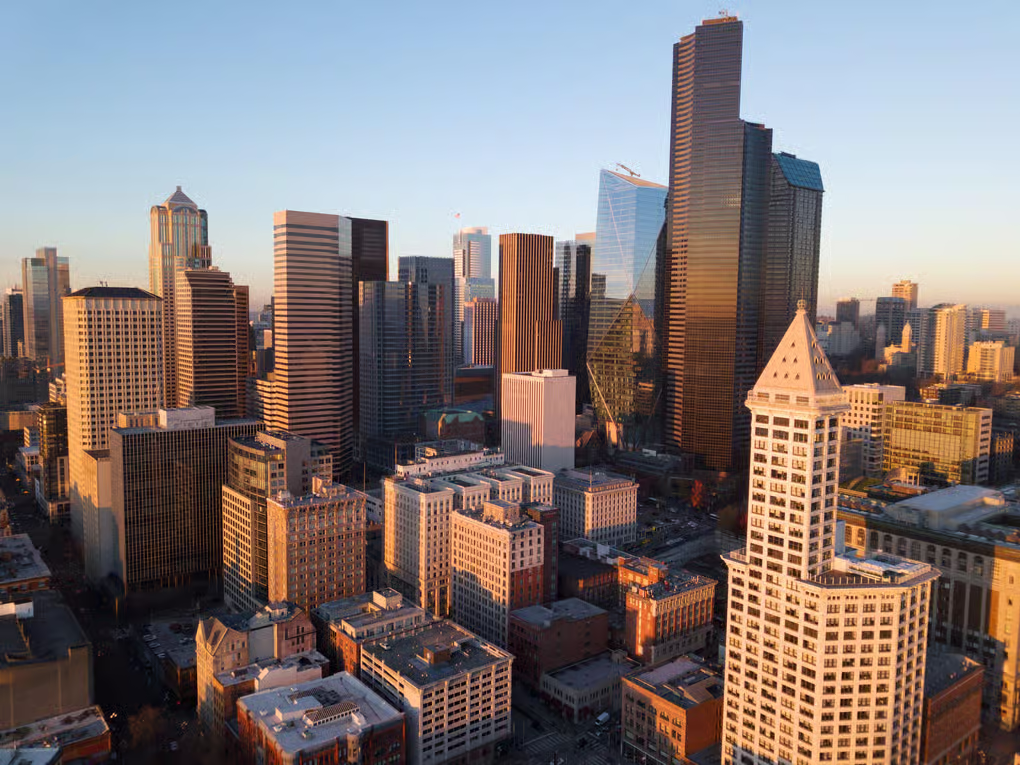
Before the Space Needle. Before Columbia Center. Before Amazon’s glass spheres and the glass towers of South Lake Union reshaped the skyline into something out of a science fiction quarterly, there was Smith Tower — 462 feet of white terra-cotta-clad steel reaching into the grey Pacific Northwest sky like an argument no one had asked for but everyone had to respond to.
When it was completed, Smith Tower was the tallest building west of the Mississippi River. That distinction held for 11 years, and in a region that was still very much figuring out what it wanted to be, those 11 years mattered enormously. Smith Tower didn’t just change the Seattle skyline. It told Seattle what kind of city it could be.
Now, more than a century later, the building at 506 Second Avenue sits in the middle of one of the most contested, transformed, and historically layered neighborhoods in the American West. Pioneer Square — Seattle’s oldest neighborhood, its birthplace, its most complicated inheritance — wraps around the tower’s base like an argument about time itself.
And Smith Tower just keeps standing there, making its point.
The Man Behind the Marble — Who Was L.C. Smith?
Lyman Cornelius Smith never lived to see his tower finished. He died in 1910, four years before the building’s completion, which means Smith Tower is in some ways a monument to ambition without arrival — a man who commissioned a skyscraper knowing he would never ride its elevators.
Smith made his fortune through typewriters. The L.C. Smith & Bros. Typewriter Company eventually merged with the Corona Typewriter Company to form Smith Corona, a name that persisted well into the 20th century and exists in various forms today. But Smith wanted something permanent, something that would outlast the mechanical clickety-clack of typewriter keys. He wanted to put his name on the sky.
His son, Burns Lyman Smith, completed the project after his father’s death, and the building was dedicated in a ceremony befitting a city that was learning to take itself seriously. The construction itself was remarkable: 1,000 workers, 35,000 tons of steel, and 700,000 pounds of ornamental bronze and brass. The building has 38 floors, 72 offices per floor at peak capacity, and an observation deck on the 35th floor that remains one of the most intimate and humanly-scaled viewpoints in the entire city.
The architectural firm Gaggin & Gaggin, based in Syracuse, designed the building in a neo-classical style that drew heavily from New York’s Beaux-Arts tradition. The result is a building that feels like it traveled from another city entirely and simply refused to leave.
Pioneer Square and the Geography of Ambition
You cannot understand Smith Tower without understanding Pioneer Square, and you cannot understand Pioneer Square without accepting that Seattle is a city built on a very complicated relationship with its own past.
Pioneer Square, bounded roughly by First Avenue to the west, Fourth Avenue to the east, Columbia Street to the north, and South King Street to the south, is where Seattle was born. It’s where the Duwamish people had established seasonal camps. It’s where Henry Yesler built his steam-powered sawmill in 1853, creating what may be the original “Skid Road” — a log-skidding path down what is now Yesler Way, a term that would eventually enter the American vocabulary as “skid row.”
The Great Seattle Fire of 1889 burned most of the original city to the ground in 18 hours, and the rebuilt Pioneer Square — raised a full story above the old street level to solve a chronic sewage problem — became the architectural heritage district that still exists today. The red brick buildings, the pergola at First Avenue and Yesler Way, the underground city tours that explore the buried original street level — all of it creates a neighborhood with more historical texture per square foot than almost anywhere else in the Pacific Northwest.
Into this neighborhood, Smith Tower arrived like an exclamation point at the end of a very long sentence. Its white terra-cotta exterior stood in deliberate contrast to the warm brick tones of the surrounding buildings. The effect, then as now, is architectural conversation — a building that acknowledges its context while refusing to be contained by it.
The 35th Floor — Where Seattle Comes Into View
The observation deck at Smith Tower’s 35th floor is one of the city’s genuine secrets, hidden in plain sight at the most visible address in Pioneer Square.
At 484 feet above Second Avenue, the outdoor observation deck wraps around the tower’s pyramid-topped upper floors and offers views that no glass-enclosed elevator pod can replicate. You stand outside. The wind off Puget Sound comes at you without apology. Elliott Bay spreads west toward the Olympic Mountains, which appear on clear days like something a child drew with white chalk against blue paper. To the north, the Space Needle rises from the Seattle Center grounds, looking — from this vantage — almost modest, almost human-scaled.
This is the perspective that changes things. From ground level in Pioneer Square, Smith Tower announces itself as a relic, a gorgeous old thing surrounded by the noise and coffee and creative industry of a neighborhood in perpetual reinvention. But from the 35th floor, the building is suddenly the frame through which Seattle becomes comprehensible. The water. The mountains. The bridges connecting neighborhoods across Lake Washington. The ferries cutting white lines across the sound toward Bainbridge Island and Bremerton.
The Chinese Room, also located on the 35th floor, adds another layer to the experience. The room’s name derives from the hand-carved furniture and decorative elements gifted by the Empress Dowager of China — a detail that feels almost impossible to verify and yet perfectly suited to a building that has accumulated legends the way old buildings do. The carved wooden ceiling, the antique pieces, the general atmosphere of accumulated history: it all reinforces what Smith Tower has always been, which is a place where Seattle’s relationship with the rest of the world comes into focus.
The 20th Century — Fame, Decline, and the Long Wait
Smith Tower’s first half-century was triumphant. It was a genuine civic landmark, the address on thousands of business cards, the backdrop for countless photographs of a city growing into its ambitions. The Puget Sound Savings Bank occupied the ground floor. The upper floors housed businesses that represented the commercial energy of early 20th century Seattle — shipping companies, law firms, insurance agencies, the entire apparatus of a port city doing serious business.
But history has a habit of being unkind to things that were once spectacular. By the 1960s, as Seattle began its next wave of vertical ambition, Smith Tower started to seem quaint. The Space Needle went up in 1962, built for the World’s Fair, and suddenly the city had a new icon — futuristic, deliberately strange, unencumbered by 50 years of history. Then Columbia Center rose 76 stories in 1984, making Smith Tower look positively modest. Seattle’s skyline was transforming into something Smith could not have anticipated, and his tower was being slowly absorbed into the background.
The building changed hands several times over the decades, and there were periods when its future seemed genuinely uncertain. Seattle’s boom-and-bust cycles — gold rush money, timber money, aerospace money, tech money — played out around the tower at 506 Second Avenue, and not all of those cycles were kind to Pioneer Square.
The Rehabilitation — A Building Finds Itself Again
The modern chapter of Smith Tower’s story begins with a significant renovation and repositioning effort that brought the building back to genuine relevance. Invested Group acquired Smith Tower in 2016 and undertook a restoration that respected the building’s architectural integrity while making it functional for a 21st-century tenant mix.
The renovation work was extensive but philosophically careful. The goal was not to make Smith Tower feel new — that would have been both impossible and wrong. The goal was to make it feel like itself, only better maintained. Original details were restored. The lobby, with its elaborate bronze elevator doors and ornate plasterwork, was treated as the architectural artifact it is. The building’s systems were modernized without betraying the exterior appearance that makes Smith Tower one of the most recognizable silhouettes in the Pacific Northwest.
Today, Smith Tower operates as a mixed-use building with office space across its upper floors and a ground-level experience that includes tours, the observation deck, and a bar and restaurant concept that has made the building a destination again in a way it hadn’t been since its early decades. The building hosts events, welcomes visitors, and continues to anchor the corner of Second Avenue and Yesler Way with the quiet confidence of something that has simply outlasted every argument about its relevance.
Pioneer Square Today — The Neighborhood Smith Built Around
Walk from Smith Tower north along Second Avenue and you pass through one of Seattle’s most layered experiences. The neighborhood that grew up around the tower has itself become a destination for art galleries, restaurants, bars, and the general creative energy that tends to collect in neighborhoods with historical character and affordable (relatively speaking) commercial rents.
The Klondike Gold Rush National Historical Park maintains a visitors center in the neighborhood, honoring the role Pioneer Square played as the departure point for thousands of prospectors heading to Alaska and the Yukon in 1897 and 1898. The neighborhood’s underground tour operations lead visitors through the buried first floor of old Seattle, exploring the story of the post-fire rebuild and the strange decision to simply leave the old street level in place beneath the new one.
Occidental Square, just a block east of Second Avenue at the intersection of Occidental Avenue South and South Main Street, provides a plaza that serves as an informal gathering point and hosts weekend markets and community events. The totem poles in the square — replicas of works created by the Tlingit people — represent a complicated piece of Seattle history, including the original theft of a Tlingit pole in 1899 and the carving of a replacement as partial restitution in 1940.
All of it — the galleries, the underground tours, the park, the plaza, the totem poles — exists in proximity to Smith Tower in a way that makes Pioneer Square feel less like a neighborhood and more like an argument about what Seattle has been and what it owes its past.
Architecture as Identity — What Smith Tower Actually Tells Us
There is something almost stubbornly honest about Smith Tower’s architecture. The building does not try to disappear into its surroundings or blend with the cityscape. It announces itself. It uses height, white terra-cotta cladding, and a pyramidal top to say: here is a building that intends to be noticed.
This kind of architectural confidence is rarer than it should be. The 20th century produced a lot of buildings that seemed designed to be as inoffensive as possible — glass boxes of modest ambition that neither disturbed nor delighted. Smith Tower belongs to a different tradition, one that believed architecture was a form of civic communication, that the way a city built its structures said something about what the city valued and what it intended.
The Beaux-Arts neo-classical style that Gaggin & Gaggin employed drew from a tradition that saw buildings as expressions of civic aspiration. Column-like pilasters running the height of the tower’s facade, ornate details at the entrance level, the decorative treatment of the upper floors — all of it reflects a conviction that public-facing architecture should be beautiful and that beauty is a form of respect for the people who have to look at a building every day.
In the current Seattle skyline, dominated by glass and steel structures of varying degrees of sculptural ambition, Smith Tower’s white solidity reads as radical. It is the most visible argument in the city for a kind of architecture that cared about permanence.
How to Visit Smith Tower — Practical Information
Address: 506 Second Avenue, Seattle, WA 98104
Smith Tower is located in the heart of Pioneer Square, roughly a 10-minute walk from Seattle’s downtown core and easily accessible via public transit. The First Avenue streetcar stops nearby, and multiple bus routes serve the Pioneer Square area. King Street Station, Seattle’s Amtrak hub, is located just three blocks southeast at 303 South Jackson Street, making Smith Tower an easy stop for visitors arriving by train.
The building’s observation deck and Chinese Room are open to visitors with purchased tickets. Hours vary seasonally, and the deck operates weather-depending — which, in Seattle, means you should always check before you go and should not let an overcast day deter you. Grey skies over Puget Sound have their own particular drama, and the views from the 35th floor work in nearly any light condition.
The ground floor bar offers cocktails and a food program that has become a destination in its own right, with a design aesthetic that leans into the building’s history rather than against it. Office visitors and building tenants access the upper floors through the original lobby, which functions as a kind of living museum — a daily reminder that the building they’re walking into has been welcoming people through those bronze doors for over 100 years.
Smith Tower in the Age of the Algorithm — Why SEO Finds This Building Interesting
Here’s a thing that would have mystified L.C. Smith: a century after his tower opened, people searching the internet for things like “best views in Seattle,” “Seattle historic landmarks,” “things to do in Pioneer Square,” and “Seattle observation decks” find Smith Tower returned in their results, competing with much newer and better-funded attractions for attention.
And Smith Tower holds its own. Not because of a marketing budget or a social media strategy — though those exist — but because the building has accumulated the thing that search engines and humans both value more than almost anything else: genuine history, actual stories, and a specific address in a specific neighborhood that has been meaningful for long enough to become irreplaceable.
The building at 506 Second Avenue is the answer to a question Seattle keeps asking itself, which is: what do we keep? In a city that has torn down and rebuilt itself with remarkable regularity, that has converted railyards into parks and factories into tech campuses, that has watched entire neighborhoods transform within a decade, Smith Tower represents a choice to hold something still.
It is not a museum piece. The offices are occupied. The bar serves drinks. The observation deck welcomes visitors who take photographs and post them to platforms that didn’t exist when the building was already half a century old. Smith Tower participates in the present while remaining rooted in a past that gives the present meaning.
The Legacy Question — What Does 111 Years Buy You?
The honest answer to what 111 years of standing on a corner in Seattle buys you is this: authority. Not the aggressive authority of a building demanding attention, but the quieter authority of a building that has simply been there through everything.
Smith Tower was standing when Seattle’s waterfront burned and rebuilt. It was standing during the Depression, when Pioneer Square fell into hard times that lasted decades. It was standing during the Boeing bust of the early 1970s, when Seattle’s economy contracted so sharply that a billboard appeared near the airport reading “Will the last person leaving Seattle — Turn out the lights.” It was standing when Microsoft changed the region’s economic character entirely, when Amazon arrived and began transforming South Lake Union, when the tech industry made Seattle one of the most expensive cities in North America.
The building at 506 Second Avenue has been a constant in a city that has rarely stood still, and that constancy has become its own form of value. There is something Smith Tower offers that no new construction can replicate, which is the simple fact of having been here first and stayed.
When you stand on the 35th floor observation deck and look out at a skyline that includes the Space Needle, Columbia Center, the Amazon towers, and all the glass high-rises of a city in full economic bloom, Smith Tower is beneath your feet. And the feeling that produces — of standing inside a century of history and looking out at everything that came after — is the feeling the building has always been trying to give you.
L.C. Smith died before his tower was finished. But the tower has made good on his ambition in ways that would probably surprise him. Not just by standing — any well-built structure can stand — but by remaining relevant, by continuing to mean something to the city around it.
That’s the harder thing. That’s what 506 Second Avenue, Seattle, Washington 98104 actually represents.
Not just height. Not just age. But the stubborn, ongoing insistence that some things are worth keeping exactly because they were here first.
Smith Tower is located at 506 Second Avenue, Seattle, WA 98104. The observation deck is open to the public with ticketed entry. King Street Station, the nearest major transit hub, is located at 303 South Jackson Street, Seattle, WA 98104. Pioneer Square is served by multiple Metro bus routes and is within walking distance of Seattle’s downtown core.