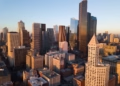
The skyline of Seattle tells two stories. There’s the obvious one—cranes, glass towers, tech campuses spreading across South Lake Union like a digital archipelago. Then there’s the quieter narrative, visible only to those who know what they’re looking for: the story of a city reimagining what buildings can be. Seattle’s commitment to sustainable architecture has transformed it into one of North America’s most ambitious laboratories for green construction, where every new project becomes an argument about humanity’s relationship with the natural world.
Washington state ranks fourth nationally in LEED-certified gross square footage, a statistic that barely captures the scale of transformation underway. From the Bullitt Center’s composting toilets to the Amazon Spheres’ living walls, Seattle’s green buildings represent more than environmental responsibility—they’re physical manifestations of a philosophy that insists sustainability and prosperity need not be opposing forces.
The Bullitt Center: Redefining What “Green” Means
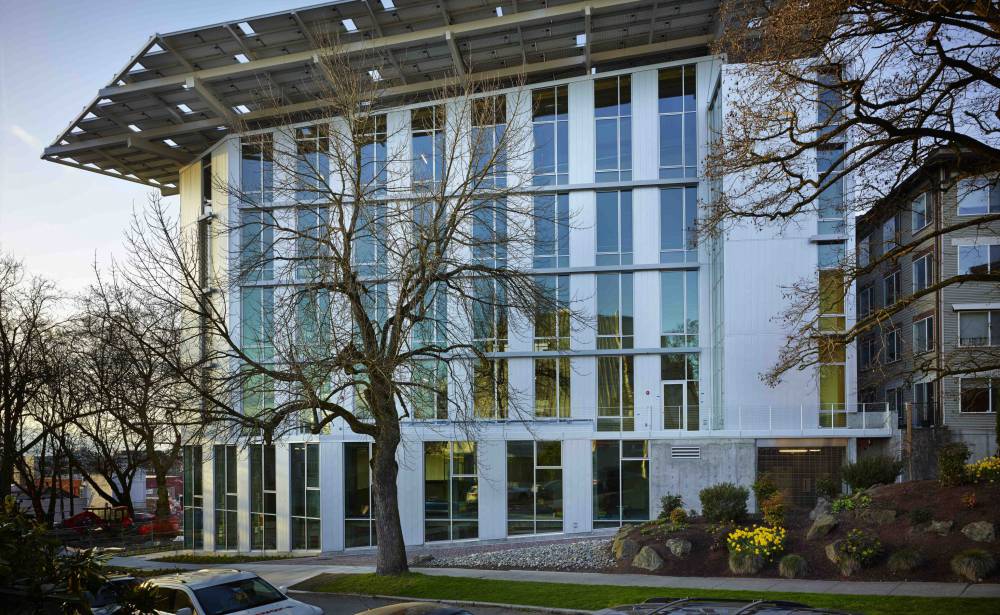
At the intersection of Capitol Hill and the Central Area stands a six-story building that cost $32.5 million to construct and has fundamentally challenged how architects think about commercial real estate. The Bullitt Center, completed in 2013, wasn’t designed to be merely sustainable—it was engineered to function as a living organism, a structure that produces more energy than it consumes and treats rainwater as a resource rather than a problem to be managed.
Denis Hayes, CEO of the Bullitt Foundation and co-founder of Earth Day, conceived the project as an existential challenge to the construction industry. If a net-zero building could be built in Seattle—the cloudiest major city in the contiguous United States—then similar structures could and should be built everywhere. The building’s performance has validated Hayes’s audacity. Operating with an Energy Use Intensity of just 10 kBtu per square foot per year, the Bullitt Center achieves 83% greater efficiency than typical Seattle office buildings.
The 242-kilowatt rooftop photovoltaic array generates approximately 244,000 kilowatt hours annually, roughly 60% more than the building requires. This surplus gets sold back to Seattle City Light, creating revenue while reducing strain on the municipal grid. But the solar panels tell only part of the story. The building’s envelope—triple-paned windows, advanced insulation, airtight construction—reduces heating and cooling demands so dramatically that the photovoltaic array can meet all energy needs despite Seattle’s notoriously gray skies.
The water systems operate with similar ambition. A 56,000-gallon cistern captures rainwater, which undergoes filtration and treatment to become potable water for drinking fountains, kitchens, and bathrooms. Greywater gets reclaimed and reused. The composting toilets, initially controversial and the subject of extensive negotiation with city regulators, eliminate connection to Seattle’s sewer system while transforming human waste into fertilizer.
Heavy-timber framing constructed from Forest Stewardship Council certified wood gives the building structural integrity while sequestering carbon. This approach to framing hadn’t been used in a downtown Seattle office building since the 1920s, requiring Hayes and his team to navigate building codes written with steel and concrete in mind. The “irresistible staircase,” a light-filled stairwell with stunning views of the Seattle skyline, encourages occupants to take stairs rather than elevators, reducing energy consumption while promoting physical health.
The Bullitt Center achieved Living Building certification in 2015, becoming the first office building to meet the International Living Future Institute’s rigorous standards. This certification requires 12 months of demonstrated performance—buildings must prove they actually achieve their sustainability goals rather than merely designing for them. Only about 40 buildings worldwide have fully met the Living Building Challenge’s seven performance areas: place, water, energy, health and happiness, materials, equity, and beauty.
The Amazon Spheres: When Corporate Architecture Meets Cloud Forest
Three glass domes rise from the Denny Triangle neighborhood, their pentagonal hexecontahedron panels catching Seattle’s intermittent sunlight and reflecting it back onto the surrounding streets. The Amazon Spheres, which opened in 2018, represent something unprecedented in commercial architecture—a workspace designed around the premise that human productivity and wellbeing improve when surrounded by biodiversity.
The three interconnected structures house more than 40,000 plants representing over 400 species from cloud forest regions across five continents. A 49-foot Ficus rubiginosa tree named Rubi anchors the space. A 4,000-square-foot living wall—one of the largest in the United States—contains more than 25,000 individual plants. Orchids from Ecuador, carnivorous plants, a 40-foot Australian fern, and species rare or extinct in the wild create an environment that feels simultaneously primordial and futuristic.
The engineering required to maintain this botanical collection while keeping the space comfortable for human occupants pushed NBBJ architects into uncharted territory. Traditional conservatories become hot and humid—pleasant for plants, miserable for people working on laptops. The solution came from observing natural cycles. During daytime, the temperature stays between 68 and 72 degrees Fahrenheit with humidity slightly above Seattle’s 62% average. At night, temperature drops to 55 degrees while humidity rises to 85-90%, creating optimal conditions for cloud forest species.
This diurnal cycle required sophisticated climate control systems. Waste heat from a nearby data center gets piped underground to the Spheres’ central utility plant—a solution that’s four times more efficient than traditional heating while eliminating harmful emissions. The innovative heating system helped the Spheres achieve LEED Gold certification while demonstrating that sustainability initiatives can serve multiple functions simultaneously.
The use of Holcim’s ECOPlanet low-carbon concrete reduced CO2 emissions by more than 80% compared to industry averages, saving approximately 400 tons of carbon dioxide. This materials choice, combined with energy-efficient systems and recycled energy utilization, shows how sustainability can be embedded at every stage of construction rather than applied superficially.
Six buildings on Amazon’s Seattle campus have earned LEED Gold certification, while 20 additional structures were built using LEED standards. Green roofs on the Doppler building and Meeting Center capture and filter rainwater while reducing heating and cooling loads. These roofs also moderate the urban heat island effect—the tendency of cities to become significantly warmer than surrounding rural areas due to heat-absorbing surfaces like asphalt and concrete.
Seattle’s Regulatory Framework: Making Green Building Standard Practice
The Seattle Department of Construction and Inspections has transformed sustainability from voluntary aspiration into standard practice through carefully designed permit incentives. Projects can gain additional height or floor area in exchange for meeting specific green building goals and certification. This approach recognizes a fundamental truth about development: builders respond to economic incentives, and making sustainability profitable makes it ubiquitous.
The Green Building Standard allows additional development capacity in specific zones for projects meeting green building requirements. The Living Building Pilot Program offers height increases, expanded floor area ratios, and Design Review departure requests for projects achieving aggressive energy and water requirements plus Living Building Petal Certification. Two projects have completed this certification so far—the Bullitt Center and Stone34, a mixed-use commercial building in Fremont housing Brooks Running’s headquarters.
Thirteen additional projects currently work through the Living Building Challenge pipeline, putting Seattle on track to meet its goal of 20 certifications by 2030. Expanding the pilot beyond 20 buildings will require Seattle City Council action, a political test of whether the city’s commitment to sustainability extends beyond symbolic gestures into systemic change.
The one-year evaluation period required for certification distinguishes Seattle’s approach from programs that certify based on design intentions rather than operational performance. This emphasis on demonstrated results addresses a persistent problem in green building: the gap between predicted and actual performance. Buildings that look sustainable on paper often fail to achieve promised energy and water savings once occupied and operated.
University of Washington: Educating While Demonstrating
The University of Washington’s Seattle campus encompasses approximately 170 buildings totaling more than 19 million square feet. The UW Green Building Standard ensures all construction and renovation projects follow guidelines maximizing energy and water efficiency, reducing embodied carbon, and aligning with principles of equity, ecological harmony, and health and wellbeing.
The standard requires new buildings to achieve minimum LEED Gold certification—a requirement that treats exceptional sustainability as baseline expectation rather than aspirational goal. Five buildings currently hold LEED Gold status, each demonstrating different approaches to sustainable design.
The Rosling Center achieved LEED Platinum, the highest certification level, through comprehensive sustainability strategies across all performance categories. Founders Hall models sustainable construction and collaborative learning while serving as a living laboratory where students can observe green building principles in practice. The Life Sciences Building features vertical fins with embedded solar panels, generating renewable energy while providing shade that reduces cooling demands.
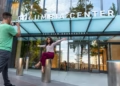
The Jim and Janet Sinegal Center for Science and Innovation, certified LEED Gold in June 2022, includes a rooftop solar array, daylight sensors that automatically turn lights off when natural illumination suffices, and all-electric heating and cooling systems. This elimination of natural gas connections reflects a broader trend in Seattle’s newest buildings toward total electrification powered by Seattle City Light’s carbon-neutral electricity.
Seattle City Light became the first electric utility in the United States to achieve zero net greenhouse gas emissions in 2005, maintaining carbon-neutral status every year since. Hydroelectric resources provide the majority of power, supplemented by wind, landfill methane, and wood biomass energy. This means buildings connected to Seattle’s grid can achieve dramatically lower operational carbon emissions than structures in cities dependent on coal or natural gas for electricity generation.
The University’s commitment to sustainability extends beyond individual buildings into comprehensive campus planning. The Resource Conservation program works to ensure existing structures operate as efficiently as possible through retrofits, operational improvements, and behavioral change campaigns. This attention to existing building stock matters enormously—new construction represents only a tiny fraction of total building stock, meaning climate goals depend heavily on improving structures already built.
Port of Seattle: Green Infrastructure at Scale
SEA Airport achieved LEED Campus certification, meaning the entire airport has documented and adheres to LEED requirements across its campus. This designation enables individual building projects to leverage credits pre-approved at the campus scale, streamlining certification while ensuring consistency in sustainability standards.
Eleven Port of Seattle projects totaling more than one million square feet have pursued or received LEED certifications. The SEA Airport Rental Car Facility, built in 2012, was the Port’s first LEED-certified building and the largest consolidated rental car facility in the nation to achieve LEED Silver. Natural ventilation, high-efficiency lighting, regionally sourced construction materials, Forest Stewardship Council certified wood, and construction materials with recycled content all contributed to certification.
The International Arrivals Facility was designed for LEED Silver certification, incorporating sustainable features that improve both environmental performance and passenger experience. The N Concourse Modernization project achieved LEED Silver through innovations including harvesting rainwater and heating the facility with renewable natural gas. These features demonstrate that sustainability initiatives can be integrated into airport infrastructure despite the unique challenges airports face—24/7 operations, high energy demands, complex security requirements, and the need to accommodate millions of passengers annually.
Terminal 91, currently undergoing improvements, includes stormwater upgrades replacing aged infrastructure with effective management controls, water quality treatment bringing the terminal into full compliance with Port and City of Seattle standards, and a new sewer system supporting existing and future development. Plans include improved lighting, electrical, communications, and circulation infrastructure plus new bike commuter facilities.
The S Concourse Evolution project, targeting LEED Silver certification for completion in 2033, involves modernizing building systems in a concourse constructed in the early 1970s. Seismic updates will improve earthquake resilience while design and amenities will be upgraded with art focused on user wellbeing and comfort. This project illustrates how green building principles apply to renovation as well as new construction.
Seattle Aquarium Ocean Pavilion: LEED Gold Underwater
The Seattle Aquarium’s Ocean Pavilion expansion earned LEED Gold certification in 2025, demonstrating that even buildings dedicated to housing marine life can achieve the highest sustainability standards. The certification recognizes implementation of practical, measurable strategies in sustainable site development, water savings, energy efficiency, materials selection, and indoor environmental quality.
For an aquarium, water management presents unique challenges and opportunities. The building must maintain precise water chemistry for diverse marine species while minimizing freshwater consumption and wastewater generation. Energy demands are substantial—maintaining water temperature and quality requires constant circulation, filtration, and climate control. Yet the Ocean Pavilion met LEED Gold standards by prioritizing efficiency at every design stage.
The certification proves buildings serving specialized functions can embrace sustainability without compromising their primary mission. Critics sometimes suggest green building works only for simple structures like office buildings or residences, but the Ocean Pavilion joins a growing list of specialized facilities—hospitals, laboratories, airports—that achieve exceptional environmental performance while meeting complex operational requirements.
Seattle University: Five Gold Stars and Counting
Seattle University requires all new buildings to achieve LEED Gold certification, a policy that has produced five certified structures demonstrating various approaches to sustainable design. The renovation of a warehouse into Student Center, completed in 2010, featured Energy Star rated office equipment, GreenGuard Certified furniture, and extensively reused furniture—proving that adaptive reuse of existing buildings can meet the same standards as ground-up construction.
The Lemieux Library addition, certified LEED Gold in 2011, includes a rain garden capturing stormwater runoff, a chilled beam cooling system for the computer lab, and raised floors supplying warm air near occupants’ feet. These features show how sustainability strategies can be tailored to specific building functions—libraries have different requirements than residential structures or laboratories.
The William F. Eisiminger Fitness Center achieved LEED Gold through features including windows providing natural light and views, parking for 50 bicycles encouraging non-automotive transportation, and 30% more outdoor air ventilation than code requires. The emphasis on bicycle infrastructure and enhanced ventilation addresses sustainability broadly—not just energy and water but also air quality and transportation patterns.
The campus includes solar panels on the Student Center and the Sinegal Center for Science and Innovation. These installations serve dual purposes: generating renewable electricity and providing visible reminders of the university’s commitment to sustainability. Students walking across campus see solar arrays daily, normalizing renewable energy as unremarkable background infrastructure rather than exotic technology.
Seattle University’s connection to Seattle City Light’s carbon-neutral grid means electricity-related emissions are zero, but the university continues investing in energy conservation to reduce overall consumption. A Personal Appliance Use policy discourages energy-intensive personal devices in favor of communal spaces with appropriate shared appliances, demonstrating how behavioral interventions complement technological solutions.
The Performance Gap: When Green Buildings Underdeliver
Not all green building initiatives deliver promised results. A 2020 study from Oberlin College examining energy use in thousands of buildings across ten U.S. cities found LEED-certified buildings in Seattle produced only 5% fewer greenhouse gases than uncertified buildings—far below the 25-30% reductions typically promised. Nationally, LEED-certified buildings achieved approximately 7% average reduction.
The study examined 459 buildings in Seattle, 50 of which held LEED certification. These certified buildings reduced CO2 emissions by an average of 2.6 kilograms per square meter annually, totaling 5,720 metric tons of avoided emissions across all 50 buildings. Seattle City Light pays approximately $7 to reduce one metric ton of CO2 through methane reduction projects, meaning the total annual climate benefit of these 50 buildings could be matched for less than $1,000 per building per year through other interventions.
This performance gap raises uncomfortable questions about green building certification. The U.S. Green Building Council requires LEED-certified buildings to provide annual energy data for the first five years of operation yet has neither made these data public nor published scientific analysis of performance. This lack of transparency suggests the organization knows actual performance often disappoints.
The gap between modeled projections and actual results stems from multiple factors. Building energy models make assumptions about occupant behavior that rarely match reality—people open windows, leave lights on, use space heaters, and generally interact with buildings in ways designers don’t anticipate. Systems that work perfectly when tested often degrade as components age or maintenance lapses. Controls get overridden, settings drift, and nobody notices until energy bills become obviously excessive.
This doesn’t mean green building certification is worthless, but it does suggest current systems need reform. Performance-based certification that requires demonstrated results over extended periods addresses this issue more effectively than design-based certification trusting that actual operations will match predictions. The Living Building Challenge’s requirement for 12 months of operational data before certification represents one model for closing the performance gap.
Beyond LEED: Alternative Sustainability Frameworks
While LEED dominates green building certification, alternative frameworks offer different approaches. The Living Building Challenge sets more ambitious standards, requiring net-zero energy and water plus attention to materials, equity, and beauty. Only about 40 buildings worldwide have achieved full certification, including Seattle’s Bullitt Center and Stone34.
The Built Green program, administered by the Master Builders Association in partnership with King and Snohomish Counties, provides residential-focused certification with three-star, four-star, five-star, and Emerald ratings. This program emphasizes accessibility—checklists and guidelines written for builders rather than sustainability consultants, making certification achievable for smaller projects without dedicated green building staff.
Energy Star certification focuses specifically on energy performance, providing a simpler alternative for buildings prioritizing operational efficiency over comprehensive sustainability. The Port of Seattle’s Rental Car Facility holds both LEED Silver and Energy Star certifications, showing how multiple frameworks can complement rather than compete with each other.
Passive House certification, originating in Germany, emphasizes building envelope performance—insulation, air sealing, high-performance windows—to minimize heating and cooling demands. While less common in Seattle than LEED, Passive House principles increasingly influence design even when formal certification isn’t pursued.
The Financial Equation: Does Green Building Pay?
The Bullitt Center cost approximately $355 per square foot to construct—higher than typical commercial construction but within range of quality conventional buildings. Financial modeling estimates a 25-year loan payback period based on equipment lifespan, but this calculation ignores several factors that improve the actual financial picture.
Energy cost savings accumulate over decades. As utility rates rise, buildings with minimal energy consumption become increasingly valuable. The Bullitt Center sells excess electricity back to the grid, generating revenue that conventional buildings can’t access. Premium rents reflect tenant demand for high-quality, healthy workspaces with abundant natural light and superior air quality.
Marketing value matters too. Companies increasingly seek LEED-certified space to demonstrate environmental commitment to customers, employees, and investors. The Amazon Spheres function as recruitment tools, differentiating Amazon from competitors in the competition for engineering talent. Sustainability certification has become a signal of quality and forward-thinking management that extends well beyond environmental performance.
Insurance companies and lenders increasingly favor green buildings, recognizing that structures designed for resource efficiency and resilience face lower long-term risks. As climate change intensifies, buildings that can operate during heat waves without mechanical cooling, that capture and filter their own water, and that generate their own electricity become less vulnerable to infrastructure failures and extreme weather events.
The Cultural Impact: Changing How Seattle Builds
Seattle’s green building ecosystem extends beyond individual projects into a network of expertise, standards, and expectations that shape development across the region. When the University of Washington requires LEED Gold for all new buildings, it creates demand for architects and engineers fluent in sustainable design. These professionals carry that expertise to other projects, spreading best practices throughout the industry.
Manufacturers respond to demand by developing products meeting green building requirements. When the Bullitt Center required materials free from hundreds of red-list chemicals, manufacturers altered formulations to comply—changes that benefit all future projects and consumers. Market transformation happens when sustainability requirements become common enough that manufacturers find it easier to reformulate products than to lose market share.
The International Living Future Institute’s Declare program requires manufacturers to disclose all ingredients in building products, creating transparency that enables informed materials selection. This initiative started with Living Building Challenge requirements but now influences product development far beyond certified projects.
Seattle’s building codes evolve to incorporate lessons from green building demonstrations. Features once requiring special exceptions—like the Bullitt Center’s composting toilets—become accepted precedents that streamline approval for subsequent projects. Code officials gain comfort with innovative approaches, reducing friction for future sustainable development.
The Road Ahead: Challenges and Opportunities
Climate change poses both challenges and opportunities for green building. Rising temperatures reduce heating demands but increase cooling needs. More intense storms require more robust stormwater management. Sea level rise threatens coastal infrastructure. Buildings designed today must function in a climate significantly different from what Seattle currently experiences.
The construction industry faces a skills shortage as experienced tradespeople retire and younger workers enter other fields. Green building requires specialized knowledge—installing triple-pane windows properly differs from traditional glazing, air sealing demands meticulous attention to detail, and renewable energy systems need regular maintenance. Attracting talent requires competitive wages, safe working conditions, and career paths that offer advancement opportunities.
Material costs and supply chains affect green building feasibility. Sustainable materials sometimes cost more or face longer lead times than conventional alternatives. The COVID-19 pandemic exposed supply chain vulnerabilities that persist years later. Building projects require reliable material availability and predictable pricing to maintain budgets and schedules.
Building electrification—replacing natural gas with electric heating, cooling, and appliances—accelerates as Seattle and other jurisdictions move toward fossil fuel phase-outs. This transition depends on grid capacity, renewable energy generation, and electrical infrastructure upgrades. Seattle City Light’s carbon-neutral electricity makes electrification particularly effective locally, but success requires coordination between utilities, building owners, and policymakers.
Embodied carbon—emissions from manufacturing, transporting, and installing building materials—receives increasing attention as operational carbon declines through efficiency and renewable energy. Materials like concrete and steel carry substantial embodied carbon footprints. Wood construction sequesters carbon while providing structural integrity, but forest management practices matter enormously. Life cycle assessment tools help quantify total climate impact beyond just operational energy.
Lessons Carried Forward
Seattle’s green building movement demonstrates several principles applicable beyond the Pacific Northwest. First, regulatory frameworks matter—permit incentives, certification requirements, and code updates shape development patterns more effectively than voluntary guidelines. Second, demonstration projects like the Bullitt Center prove what’s possible, providing templates others can adapt and improve upon. Third, performance verification matters more than design intentions—buildings must prove they actually achieve promised results.
Integration across systems produces better outcomes than optimizing individual components in isolation. The Bullitt Center succeeds because solar generation, efficient envelope, natural ventilation, daylighting, and water harvesting work together synergistically. The Amazon Spheres balance human comfort and plant health through coordinated climate control rather than treating each as separate challenge.
Transparency accelerates progress. Publishing energy data, sharing lessons learned, and acknowledging failures enables the industry to improve more rapidly than when each project treats successes and shortcomings as proprietary information. The U.S. Green Building Council’s reluctance to share performance data from LEED-certified buildings slows progress and undermines confidence in certification.
Beauty and sustainability need not conflict. The Bullitt Center’s heavy timber framing and abundant natural light create an environment people want to inhabit. The Amazon Spheres inspire awe while demonstrating biophilic design principles. Buildings that sacrifice aesthetics for efficiency ultimately fail because nobody wants to replicate them.
Equity belongs in sustainability conversations. Green building has sometimes produced luxury amenities for wealthy tenants while low-income communities get conventional construction. The Living Building Challenge’s equity requirements—including universal access, democratic decision-making, and just compensation—attempt to address this imbalance. Seattle’s affordable housing developments increasingly incorporate green building principles, proving sustainability works across income levels.
The greenest building is the one already built. Renovation, adaptive reuse, and operational improvements in existing structures often deliver greater environmental benefits than new construction marketed as sustainable. Seattle University’s conversion of a warehouse into LEED Gold Student Center exemplifies this principle. Preserving embodied carbon in existing structures while improving performance through retrofits deserves equal attention with ground-up green building.
Every building built today shapes tomorrow’s options. Structures designed for 50 or 100-year lifespans lock in energy consumption patterns, material choices, and urban form that persist for generations. The Bullitt Center was designed with a 250-year lifespan in mind, with separable building technology, envelope, and structure that can be updated independently as needs change and technology advances. This long-term thinking represents perhaps the most radical sustainability strategy of all—building for permanence rather than obsolescence.