The Seattle Central Library looks wrong from every angle. Eleven floors of glass and steel wrapped in diamond-grid exoskeleton lean at angles that violate architectural common sense. The thing bulges and recedes unpredictably. Floors protrude beyond floors below them, creating cantilevers that seem to dare gravity. The whole structure appears to be mid-collapse, frozen in moment of catastrophic failure—except it’s been standing since May 23, 2004, when 25,000 people queued for first day admission to what New York Times critic Herbert Muschamp called “the most exciting new building it has been my honor to review.”
Time Magazine’s assessment captured the visual dissonance: “If Picasso ever painted a library, it would look like this.” Others called it “odd-shaped legos,” a “crystal frog,” a “lumpy Christmas package.” The 362,987-square-foot building at 1000 Fourth Avenue—third library structure on this downtown Seattle site—defies every traditional library image. No hushed reading rooms with dark wood paneling. No marble columns suggesting permanence and authority. No reassuring symmetry promising order among chaos. Instead: chartreuse escalators, baby blue metal structure, fluorescent lime-colored stairways, and 9,994 exterior glass panels creating transparent skin showing everything happening inside.
Dutch architect Rem Koolhaas of Office for Metropolitan Architecture (OMA), working with Seattle’s LMN Architects, designed the library to celebrate information in all forms while questioning assumptions about what libraries should be and how they should look. The result divided critics, confused users, and created one of 21st century’s most photographed and debated public buildings. It also transformed how cities thought about library architecture—proving libraries could be architectural statements without sacrificing function, though whether it succeeded at both remains contested twenty years later.
The Democratic Mandate: $196.4 Million and 70 Percent Approval
Seattle voters approved the “Libraries for All” bond measure November 3, 1998 with unprecedented 69-70 percent majority—largest library bond issue ever submitted in United States at that time. The $196.4 million package proposed comprehensive library system makeover: new Central Library on existing Fourth Avenue site, three new branches in underserved neighborhoods (Delridge, International District/Chinatown, Northgate), and replacement, expansion, or renovation of all 22 existing branches.
The timing reflected dot-com economy peak. Circulation had surpassed 5 million items annually by mid-1990s. Annual donations topped $1 million. Seattle’s tech-fueled prosperity created appetite for infrastructure investment and civic ambition. The 1960 Central Library—five-story International Style building designed by Bindon & Wright—had become inadequate. Two-thirds of materials sat in storage inaccessible to patrons. Earthquake concerns about aging structure’s seismic resistance added urgency.
But the bond measure represented more than building replacement. Seattle declared libraries essential civic infrastructure deserving major investment during prosperity. The 70 percent approval suggested broad consensus transcending political divisions—conservatives and progressives, techies and humanities scholars, longtime residents and newcomers all saw value in publicly funded knowledge institutions.
The mandate came with accountability. Voters approved specific spending for comprehensive system improvement, not just prestigious downtown monument. The Central Library consumed significant portion of funding, but every neighborhood would see improvements. The democratic bargain required delivering quality facilities across entire system.
Chief Librarian Deborah Jacobs spearheaded project from library perspective, serving as primary client voice. Betty Jane Narver served as Library Board president. Their insistence on genuine library functionality—not just architectural statement—shaped design process and constrained Koolhaas’s more extreme impulses.
The Competition That Almost Wasn’t: Joshua Prince-Ramus’s Mother
OMA was not invited to compete for project. Seattle Library Board conducted organized selection process among established firms with library design experience. Then Joshua Prince-Ramus—Koolhaas’s partner at OMA and former Seattle resident—learned from his mother one day before mandatory public meeting for interested firms. He flew in. OMA entered competition and won.
The selection shocked Seattle architectural establishment. Koolhaas had no library design experience. OMA specialized in provocative theoretical projects and unconventional buildings that challenged norms. The firm’s portfolio emphasized experimentation over user comfort. Critics questioned whether Koolhaas understood libraries or cared about patron experience versus architectural statement.
Jacobs and library board selected OMA anyway, betting on Koolhaas’s research-intensive approach and willingness to fundamentally rethink library typology. Before designing, Koolhaas met with Microsoft, Amazon, and other organizations discussing future of books and libraries in digital age. The conventional wisdom predicted book obsolescence—why build massive book storage when information would migrate entirely online?
Koolhaas’s research concluded books remained vital. Print offered advantages digital couldn’t replicate: no screen fatigue, no file formats becoming obsolete, no batteries required, no terms-of-service agreements controlling access, tangible ownership creating different relationship with content. The library needed accommodating both print and digital rather than choosing. This conclusion shaped fundamental design decision: make books visible and accessible throughout building, celebrating rather than hiding print collections.
Prince-Ramus served as partner in charge, managing day-to-day design work. Bjarke Ingels (later founding his own firm BIG—Bjarke Ingels Group—becoming major architect himself) designed interior boxes. Seattle’s LMN Architects handled local coordination, code compliance, construction documentation, and practical details OMA’s conceptual approach sometimes overlooked.
The Book Spiral: Continuous Knowledge Without Floor Breaks
The Books Spiral became building’s signature innovation. Nonfiction collection occupies four continuous floors (Levels 6 through 9) arranged in gradually spiraling ramp, organizing 1.45 million volumes according to Dewey Decimal System without floor breaks interrupting classification sequence. Traditional libraries spread collections across multiple floors, severing intellectual connections—biology books on third floor, chemistry on fourth, physics on fifth. Patrons traversing related subjects must navigate elevators and stairs, disrupting research flow.
The Spiral eliminates those barriers. A patron researching climate science starts at one end and walks gently sloping ramp through meteorology, oceanography, geology, environmental science, finding adjacent topics physically adjacent. The 4-degree slope provides wheelchair accessibility while feeling nearly flat. The continuous shelf arrangement allows collection growth without reorganization—new books slot into Dewey sequence wherever appropriate, expanding outward. Traditional libraries reach capacity and face expensive reorganizations shuffling entire collections to create space.
The architectural challenge involved creating stable floor structure supporting massive book weight while maintaining gentle spiral without disrupting floor-to-ceiling height or creating awkward transitions. The solution: concrete slab floors poured at precise angles, with steel framing accommodating slope while maintaining structural integrity. The visual effect from interior is surprisingly subtle—patrons experience gradual ascent without noticing ramp until they’ve gained significant elevation.
Critics noted the Spiral’s practical problems. Finding specific books requires understanding Dewey Decimal System and navigating signage. Traditional libraries’ clearly marked floors (Science: 3rd Floor) provide simpler wayfinding. The Spiral’s openness creates acoustic challenges—conversations and movement on one level carry to adjacent levels. The continuous space lacks quiet zones for concentrated study. And despite universal accessibility via ramped surface, the sheer walking distance—four floors’ worth of spiral—exhausts some patrons who would prefer elevator to specific floor.
Defenders argue the Spiral encourages browsing and serendipitous discovery impossible when collections are segregated. Walking climate science to chemistry requires passing related fields, potentially sparking unexpected connections. The open visual access shows collection scope, making knowledge visible rather than hidden behind floor divisions. The architectural drama of spiraling through book-lined space creates memorable experience reinforcing libraries’ cultural importance.
The Platforms and Voids: Function Determining Form
Koolhaas organized library into distinct programmatic zones—five “stable” platforms requiring fixed infrastructure (Books Spiral, meeting rooms, staff areas, parking) and four “unstable” spaces defined by movement and flexibility (Mixing Chamber, Living Room, Reading Room, headquarters). The building’s irregular exterior reflects these internal functions—each platform appears as distinct geometric volume, creating the stacked-blocks-out-of-alignment appearance.
Level 1 houses entry, Living Room rising 50 feet to Level 3 along Fifth Avenue, and parking garage accommodating 143 vehicles. The dramatic glass-walled Living Room provides public gathering space visible from street, with collection of current magazines and newspapers, computer access, comfortable seating. The transparency invites street-level engagement while protecting interior from weather.
Level 3 continues Living Room and includes staff workspace. The 50-foot ceiling height creates cathedral-like volume announcing library’s civic importance through spatial generosity.
Level 4 (the Red Floor due to bright red flooring) contains meeting rooms painted vivid red throughout—conference rooms, auditorium, staff support areas. This platform’s stable function (enclosed rooms requiring fixed walls and doors) allowed creating solid volume within glass structure.
Level 5 (the Mixing Chamber) provides technology-heavy zone: 400+ public computers, staff assistance, language learning center with 669 square meters of maple wood flooring designed by visual artist Ann Hamilton. The “mixing” concept envisions patrons blending different media, staff support, and peer interaction in flexible technology-oriented space.
Levels 6-9 form Books Spiral’s continuous nonfiction collection.
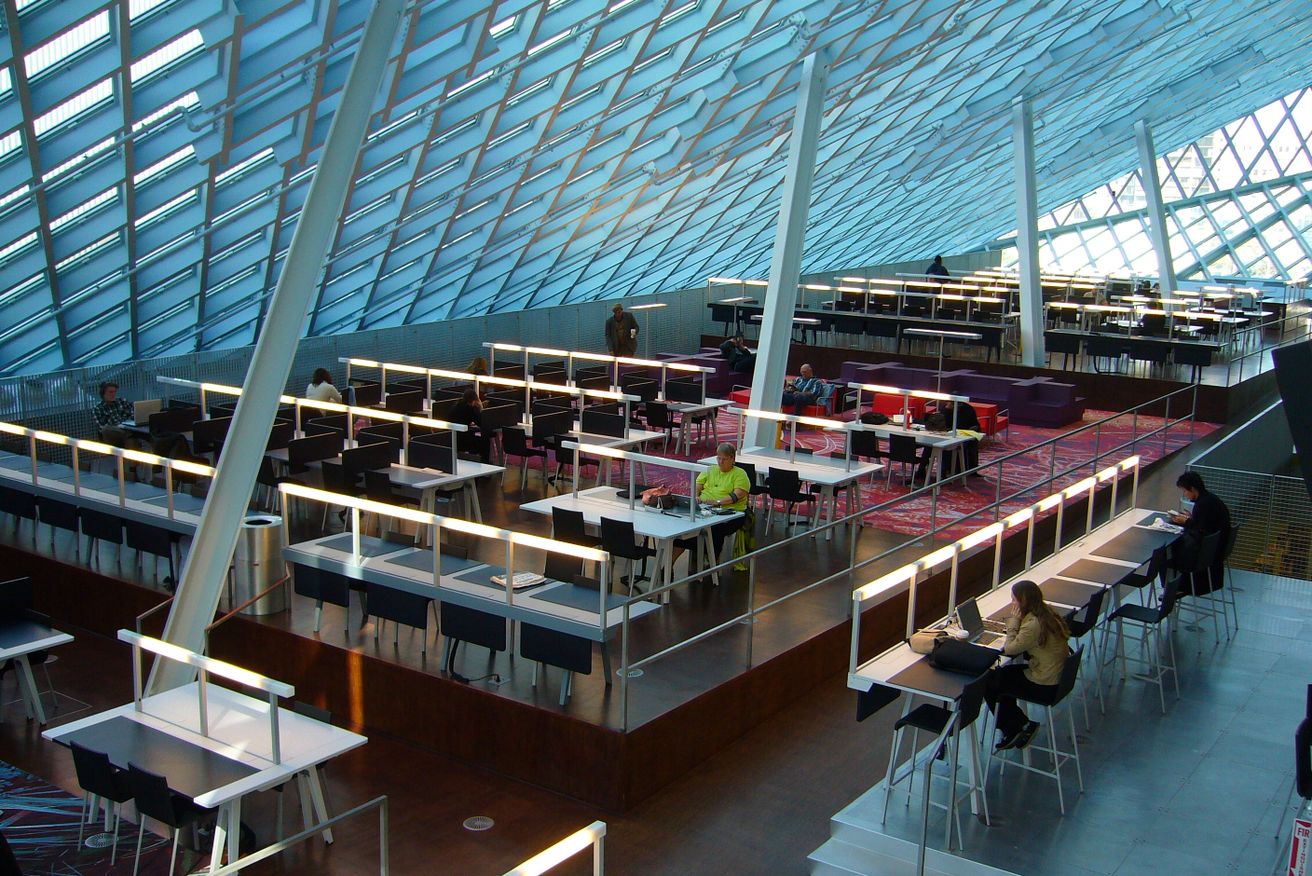
Level 10 houses Betty Jane Narver Reading Room—quiet study space with commanding city views, natural light from glass exterior, and scholarly atmosphere contrasting with lower floors’ activity.
Level 11 contains administrative offices and mechanical systems.
This programmatic stacking creates building’s distinctive silhouette. Each platform’s required floor area differs based on function—Books Spiral needs maximum area for shelving, Reading Room requires less area prioritizing quality over quantity, meeting rooms need enclosed spaces creating solid volumes. Rather than forcing all functions into rectangular box with uniform floor plates, Koolhaas expressed functional differences through exterior form. The result looks chaotic from outside but reflects internal logic.
The diamond-grid steel exoskeleton wrapped around glass skin serves multiple purposes: earthquake resistance (adding structural strength against lateral forces), wind bracing (Seattle’s location creates significant wind loads), shading (reducing solar heat gain while allowing natural light), and visual unity (wrapping disparate programmatic volumes in coherent skin). The diagonal steel members create dramatic exterior while solving engineering challenges.
The Materials and Colors: Koolhaas’s Bright Palette
Koolhaas loves bright colors, and Seattle Central Library showcases that affection unapologetically. Chartreuse escalators link floors in fluorescent lime brilliance, lined with backlit panels creating glowing circulation paths. Stairways connecting public areas glow red and yellow. Interior metal structure is painted baby blue. The Red Floor lives up to its name with saturated crimson throughout meeting rooms. Even fire insulation gets sprinkled with glitter.
The color serves wayfinding function—color-coding helps patrons navigate complex interior. Important elements (stairs, escalators, elevators forming vertical circulation system) are painted bright hues impossible to miss. The chartreuse specifically provides visual cue: vertical movement happens here. The red identifies meeting platform. The approach treats architecture as three-dimensional signage system where color communicates function.
Materials range from mundane to refined. Aluminum floors feature minimalist grid patterns referencing Carl Andre’s minimalist work. Recycled wood pieces are chipped and stained in solid colors creating durable flooring. Most carpets use metal wires allowing direct water cleaning—practical choice for high-traffic public building. Some areas feature concrete covered with thick colored polyurethane, creating seamless easily-maintained surfaces.
The 9,994 exterior glass panels create building’s transparent character. Approximately half are three-layer construction with expanded aluminum mesh trapped between outer layers. The mesh—aluminum sheet cut and stretched—reduces heat and glare while maintaining transparency. The diamond-grid steel exoskeleton visible from exterior creates geometric pattern overlaying glass, breaking up massive glazed surfaces into comprehensible scale.
Koolhaas’s material approach emphasizes creative use of ordinary materials economically. Rather than expensive exotic materials suggesting luxury, he specifies standard construction products deployed inventively. The bright colors and unusual applications transform mundane materials into architectural expression. Critics call it cheap or garish. Defenders praise honest functionality avoiding pretentious luxury inappropriate for public building.
The Reception: Unprecedented Praise and Scathing Criticism
Herbert Muschamp’s New York Times review established critical consensus among architecture elite: the building represented breakthrough achievement. Architectural journals published extensive features. The American Institute of Architects ranked it #108 on list of Americans’ 150 favorite structures. Architectural tours began June 2004 and continue today. Over two million people visited first year—double the 1960 building’s average attendance. The library became tourist destination attracting international visitors, architecture students, and photography enthusiasts.
But dissenting voices emerged. Lawrence Cheek, Seattle Post-Intelligencer architecture critic, revisited building in 2007 and recanted earlier praise, finding it “confusing, impersonal, uncomfortable, oppressive” with features “decidedly unpleasant,” “relentlessly monotonous,” “badly designed and cheesily detailed,” “profoundly dreary and depressing,” and “cheaply finished or dysfunctional.” He called his initial positive review a “mistake.”
Project for Public Spaces condemned building’s urban disconnect: “If the library were a true ‘community hub,’ its most active areas would connect directly to the street, spinning off activity in every direction. That is where Koolhaas’s library, sealed away from the sidewalks and streets around it, fails completely.” The criticism targeted fortress-like ground level lacking direct street engagement—patrons enter through controlled access points rather than permeable street-level connections activating sidewalks.
Users reported practical problems. Signage proved insufficient—the building’s complexity requires extensive wayfinding, but Koolhaas’s design minimized traditional signage relying on color-coding and supergraphics that confused many patrons. Homeless populations gravitated to warm public space with bathrooms and seating, creating social service challenges library staff weren’t equipped to handle (eventually prompting library system to create Social Services Team providing housing, food, transportation, and health services access). Acoustics in open areas carried sound unpredictably. Natural light created glare on computer screens. The dramatic architecture overwhelmed the library’s actual content and services.
Koolhaas himself acknowledged shortcomings in later interviews, particularly inadequate signage and insufficient social service solutions for homeless patrons. The admission that world-renowned architect designing purpose-built library for specific site and program still couldn’t solve basic usability problems raised questions about architectural profession’s priorities—form versus function, architectural statement versus user experience, critic-pleasing design versus patron-serving building.
The Legacy: Twenty Years and 1,500 Daily Visitors
The Seattle Central Library celebrates twentieth anniversary in 2024, still attracting approximately 1,500 visitors daily. Families visit Children’s Center (seven times larger than previous facility). Photographers capture Red Floor images for social media (building called “world’s most Instagrammable library”). Students use Books Spiral. Musicians practice in music rooms. Community members attend author events. The building functions as intended despite criticisms—perhaps not perfectly, but adequately for two decades of heavy use.
The architectural influence extends beyond Seattle. Libraries worldwide reconsidered traditional library architecture after Central Library’s success. Projects from Netherlands to China to United States embraced architectural experimentation, contemporary materials, transparency, technology integration, and programmatic complexity rather than defaulting to classical or conservative designs. Architectural photographer Lara Swimmer, who documented Central Library construction, notes in 2024 book “Reading Room: New and Reimagined Libraries of the American West” that Central Library “remains iconic example of modern library’s ability to pivot and become curator of information and community.”
The “Libraries for All” bond measure’s broader impact matched Central Library’s architectural influence. The comprehensive system improvement—27 branches built or renovated, three new branches in underserved neighborhoods, preservation of five historic Carnegie branches (Columbia, Fremont, Green Lake, University, West Seattle)—demonstrated voters’ willingness to fund quality public infrastructure system-wide, not just flagship monuments. The 2012 $122 million levy and 2019 $219.1 million seven-year levy renewal continued commitment, funding expanded hours, more materials, improved technology, building maintenance, and 2020 elimination of daily overdue fines reinstating 52,000 accounts.
The Carnegie Foundation: Seattle’s Library Architecture Before Koolhaas
The 2004 Central Library represents third iteration on same Fourth Avenue site, but Seattle’s library architecture story begins with Andrew Carnegie’s philanthropy transforming American library landscape early 20th century. Between 1906 and 1917, Carnegie funded eight Seattle library buildings—the 1906 Central Library and seven branches, five of which still operate as historic landmarks.
Carnegie initially dismissed Seattle as “hot air boom town” when city requested library funding in 1890s. The mysterious January 2, 1901 fire destroying Yesler Mansion (library’s temporary home) and 25,000 books changed his mind. Four days after fire, Carnegie pledged $200,000 for new Central Library plus $20,000 for furnishings. Suspicion fell on city librarian Charles Wesley Smith, who had complained about cramped quarters for year and was spotted near building minutes after flames erupted. The oddly convenient timing suggested arson motivated by desire for better facility—though nothing was ever proved.
German-born Chicago architect P.J. Weber won 1903 design competition with classic Beaux-Arts design. The 55,000-square-foot structure featured massive pillars, spacious interiors, marble and grandeur signaling knowledge’s cultural authority. December 19, 1906 dedication drew excited 1,000-person crowd. First-year results justified excitement: registered borrowers skyrocketed 94 percent to 19,229, circulation increased 50 percent to 454,735 books. The building succeeded beyond expectations.
Carnegie’s Seattle branch funding created neighborhood library network. The 1907 Ballard annexation yielded library system’s first full-scale branch when Carnegie provided $15,000 for Classic Revival building designed by Henderson Ryan. The structure opened June 24, 1904 (before annexation) featuring radiating stacks, men’s smoking room, ladies’ conversation room, and 500-seat upstairs auditorium.
The $105,000 Carnegie grant in 1908 produced three more buildings. West Seattle Branch opened July 23, 1910—first permanent Seattle branch, still operating same location. University Branch followed August 1910 with auditorium (contingent on Watson and Cornelia Allen’s land donation), serving remote location surrounded by unpaved roads. Green Lake Branch completed the trio.
Additional $70,000 donation funded Queen Anne Branch (1914) and Columbia Branch (1915). The 1917 Fremont Branch—last Carnegie building—cost $35,000 with city paying for land, books, and staff. Architect Daniel R. Huntington designed unusual mission-style “Italian Farmhouse” with stucco, red tile roof, arched windows, high-gabled open-beamed ceilings. The distinctive design earned National Register of Historic Places designation and remains Fremont neighborhood landmark.
Carnegie library era ended 1917. Three decades passed before new library construction, reflecting Depression, World War II, and postwar priorities. The 1950s-1960s libraries embraced modern architecture—North East Branch (Paul Thiry’s modernist design), 1960 Central Library (Bindon & Wright’s International Style). The dramatic shift from Carnegie’s classical vocabulary to mid-century modernism demonstrated architecture’s role signaling cultural change.
The 1984 voter-approved bond renovated five surviving Carnegie branches (Columbia, Fremont, Green Lake, University, West Seattle), preserving historic buildings while upgrading function. West Seattle’s 1987 renovation restored skylights (painted black in 1942 against WWII air raid threat), replaced composition shingle roof with imported slate, added wheelchair ramp blending with original ironwork. The $4.6 million project across all five branches received National Trust for Historic Preservation honor, demonstrating Seattle’s commitment to architectural heritage.
“Libraries for All” continued that commitment. New buildings replaced outdated facilities, but five Carnegie branches received careful 2000s renovations preserving historic character while adding technology, accessibility, improved lighting, climate control. The 2007 University Branch renovation ($996,210) added electrical connections, computer access, upgraded ventilation, accessibility improvements. Artist Dennis Evans created “Seven Liberal Arts Suite”—two mixed-media paintings for each of five Carnegie branches exploring classical liberal arts themes through contemporary visual language.
This architectural legacy informed Central Library design debate. Seattle had tradition of building libraries that mattered—Carnegie’s Beaux-Arts monuments, mid-century modernist statements, careful historic preservation, contemporary interventions respecting past while serving present. Koolhaas’s radical design challenged that tradition, risking beloved architectural heritage for uncertain architectural experiment. The 70 percent bond approval suggested voters trusted library system’s architectural judgment based on century of building wisely.
The Contradiction: The Building That Works Despite Everything
Seattle Central Library shouldn’t work. The architecture is too bold, the colors too bright, the interior too confusing, the exterior too aggressive. Serious libraries should be quiet, orderly, conventional—repositories of civilization not chaos. Glass buildings are energy hogs, expensive to maintain, hostile to comfortable reading. Spiral ramps waste valuable square footage. Chartreuse escalators are absurd.
And yet: 1,500 people daily visit two decades later. The Books Spiral houses 1.45 million volumes and allows continued collection growth. The transparency activates downtown street life showing knowledge production happening inside. The meeting rooms host community gatherings. The Children’s Center serves families. The Reading Room provides contemplative space. The technology infrastructure supports digital access. The building functions as library—imperfectly, sometimes frustratingly, but genuinely.
The contradiction suggests architecture’s complexity. Buildings can be simultaneously successful and flawed, celebrated and criticized, functional and dysfunctional. The Seattle Central Library works not despite its controversies but partly because of them—the bold design demands attention, the unusual spaces create memorable experiences, the architectural ambition signals cultural importance of public libraries in digital age.
Koolhaas’s gamble was that architecture could defend libraries’ relevance when technology threatened obsolescence. By creating building that couldn’t be ignored, that celebrated information in all forms, that made visible the intersection of print and digital, he argued libraries remained vital civic institutions worth major investment and architectural excellence. The 25,000 people queuing opening day, the two million first-year visitors, the twenty years of sustained use, and the international influence all vindicate that argument—even if the building remains uncomfortable, confusing, and controversial.
The question wasn’t whether libraries would survive digital age. The question was whether cities would invest in libraries as essential infrastructure or allow decline through neglect. Seattle answered with 70 percent yes vote and $196.4 million commitment. Koolhaas answered with glass building that looks perpetually about to collapse but keeps standing, keeps serving, keeps reminding everyone that knowledge institutions matter enough to design buildings that look like nothing else.