

There is a particular quality of light in the Pacific Northwest — that gray, diffuse luminescence that filters through cedar canopy and bounces off Puget Sound — that seems almost purpose-built for glass. It does not bleach or overwhelm. It reveals. It finds the interior of things. And so it makes perfect sense that the world’s most celebrated glass artist grew up here, in Tacoma, Washington, a port city that smelled of pulp mills and saltwater and ambition, before he exported his vision to every major museum and institution on the planet and eventually came home.
Dale Chihuly’s relationship with the Pacific Northwest is not simply biographical. It is geological. His work did not emerge despite this landscape but because of it — because of the light, the water, the volcanic legacy of a region that reminds you, constantly, that the earth is molten just below the surface and that transformation is always imminent.
Tacoma: The City That Made Him
You cannot tell the Chihuly story without beginning on the tideflats.
Dale Chihuly was born on September 20, 1941, in Tacoma, Washington — a working-class city with grand civic ambitions and a waterfront that never quite shook its industrial identity. The city sits 32 miles south of Seattle on Commencement Bay, framed by the imposing silhouette of Mount Rainier. It is a city of bridges, of Scandinavian fishermen and railroad workers, of immigrant neighborhoods layered like sedimentary rock.
Chihuly studied interior design at the University of Washington before eventually making his way to the University of Wisconsin-Madison, where he first encountered glass as an artistic medium. But Tacoma never left his nervous system. The colors he would later pull from molten glass — the deep ambers, the oceanic teals, the bruised purples — are all visible in a Tacoma autumn, on a Puget Sound afternoon, in the industrial metalwork that frames the city’s waterfront.
The Museum of Glass at 1801 Dock Street, Tacoma, WA 98402, is the most direct monument to this relationship. Opened in 2002, it sits at the edge of the waterfront with its signature conical Hot Shop chimney visible from the Chihuly Bridge of Glass — a 500-foot pedestrian walkway that connects the museum to the Washington State History Museum and downtown Tacoma. The bridge itself is Chihuly: 2,364 hand-blown glass spheres float in Seaform Pavilions overhead, a Venetian Wall runs 100 feet along its length, and the Crystal Towers anchor its northern end.
Walking that bridge on a cloudy morning is to understand something fundamental about what Chihuly does. He does not make art that hides inside galleries, waiting patiently for educated viewers. He makes art that colonizes public space, that insists on being witnessed.
The Chihuly Garden and Glass: A Cathedral in Seattle’s Shadow
If Tacoma is origin, Seattle is legacy.
Chihuly Garden and Glass, located at 305 Harrison Street, Seattle, WA 98109 — right at the base of the Space Needle at Seattle Center — opened in 2012 and represents the most complete single-site presentation of Chihuly’s work anywhere on earth. The exhibition is, in a word, overwhelming. In the best possible sense.
The installation covers more than 46,000 square feet and is divided into eight interior galleries, a glasshouse, and a garden. Each section presents a different chapter of Chihuly’s artistic vocabulary, but the effect of moving through them is cumulative — by the time you emerge into the outdoor garden with Mount Rainier appearing and disappearing through the clouds behind you, the experience has become almost sensory overpowering.
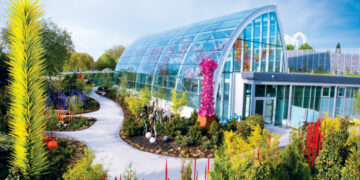
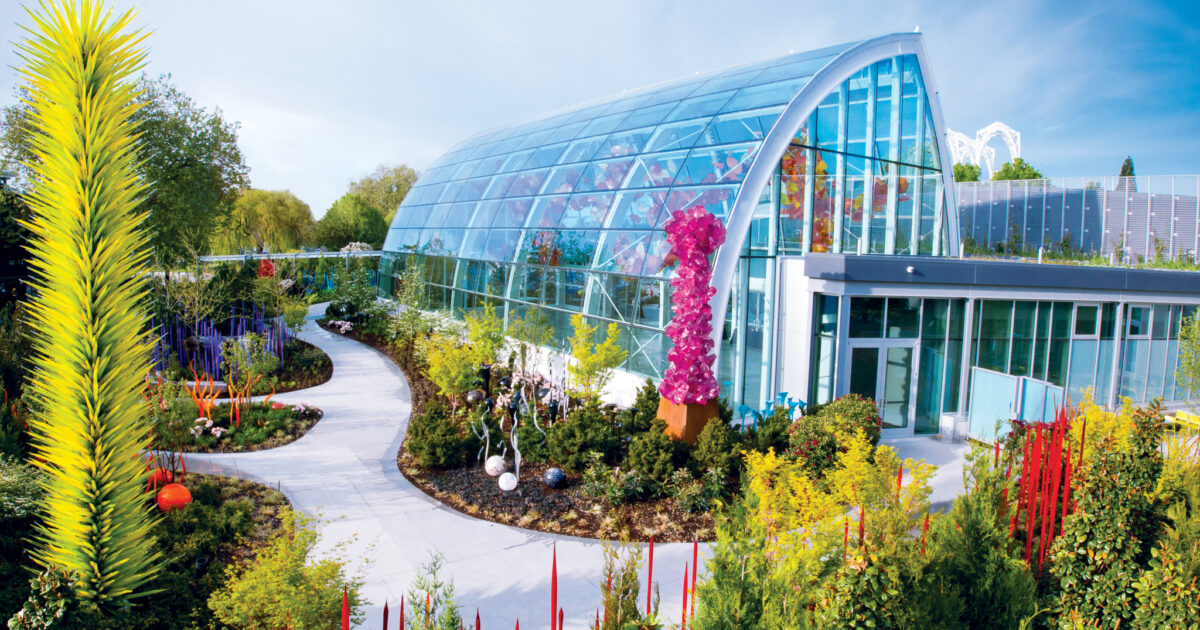
The Glasshouse is the centerpiece: a 4,500-square-foot structure of steel and glass beneath which hangs a 100-foot-long suspended sculpture in vivid reds, oranges, and yellows that looks simultaneously like the sun, a coral reef, and something from a fever dream. Natural light catches it differently every hour. On an overcast Seattle day, the effect is particularly striking — the sculpture seems to generate its own warmth, as if the glass is still molten, still in the act of becoming.
The garden outside is where Chihuly’s relationship with the natural world becomes most explicit. Towers of hand-blown glass rise among Pacific Northwest plantings — hostas, ferns, ornamental grasses. The scale is theatrical and the juxtaposition intentional. These forms reference sea anemones, desert plants, flowers seen under extreme magnification. They are organic and alien at once.
Seattle Center itself — 74 acres of civic space built for the 1962 World’s Fair — has a particular genius loci, a sense that this is where the city comes to celebrate itself. The Space Needle at 400 Broad Street rises just steps away. The Pacific Science Center, the Seattle Children’s Museum, the Armory, the Seattle Center Monorail — all of it contributes to an environment that feels simultaneously nostalgic and forward-looking. Chihuly Garden and Glass fits this context perfectly. It is monumental but not ponderous, serious but accessible, rooted in tradition and relentlessly contemporary.
Glass as Language: Understanding the Work
To appreciate a Chihuly installation is to require some understanding of the medium — not technical mastery, but a felt sense of what glass does and what it refuses to do.
Glass is material contradiction. It is liquid and solid simultaneously, a supercooled fluid that gives the impression of rigidity while retaining, at the molecular level, the disordered structure of a liquid. At working temperature — around 2,100 degrees Fahrenheit — it flows like honey. Remove it from heat and it becomes brittle, permanent, finished. The artist has perhaps three minutes with molten glass before the material makes its own decisions.
Chihuly understands this not as limitation but as collaboration. His working method — developed after a serious injury to his left eye and a subsequent shoulder injury that made him step back from the gaffer’s bench — is essentially orchestral. He designs, directs, gestures, shouts over the roar of the furnace. A team of skilled glassblowers, sometimes a dozen or more, executes his vision in real time. The glass remembers every breath, every pull, every rotation. The finished piece carries the physiological trace of its making.
His major series — the Seaforms, Macchia, Persians, Venetians, Ikebana, Chandeliers, Towers — each explore a different facet of what glass can do. The Seaforms reference the tidepools and sea creatures of Puget Sound with an almost anthropological fidelity. The Macchia (Italian for “spotted”) pieces are explosions of color, made by layering up to 300 colors in a single work. The Chandeliers — the most theatrically ambitious — are accumulations of individual hand-blown elements assembled into forms that can weigh thousands of pounds and stretch across entire museum atriums.
The Bridge Between Worlds: Chihuly and the Venice Connection
No discussion of Chihuly is complete without Venice — and Venice, in this context, refers to both La Serenissima itself and to the Venetian glassblowing tradition that has defined the medium for six centuries.
In 1968, Chihuly received a Fulbright Fellowship and traveled to the island of Murano, just off Venice, where the great glass masters had been sequestered since 1291 to prevent their trade secrets from spreading to the mainland. He became the first American glassblower to work in the Venini Fabrica, absorbing not just technique but philosophy — the idea of glass as a fine art tradition with its own lineage and ambition.
The Venetian Series that resulted in the late 1980s was a deliberate synthesis — American scale and improvisation grafted onto Italian formal elegance. The pieces look like objects from a 16th-century Doge’s palace reimagined by someone who had also spent time in a Tacoma hardware store. They are opulent and slightly unhinged, which is to say, perfectly Chihuly.
This transatlantic exchange matters for understanding the homecoming. When Chihuly returned his focus to the Pacific Northwest — through the Museum of Glass, through Chihuly Garden and Glass — he was not retreating from international dialogue. He was proposing that the Pacific Northwest could hold its own in that conversation. That Tacoma and Seattle could stand alongside Venice and Prague and Jerusalem as sites of glass culture. That the landscape that formed him was worthy of the art it had produced.
Pilchuck: Where the Movement Was Born
Any serious engagement with Chihuly’s Pacific Northwest legacy requires a visit — or at minimum an awareness — of Pilchuck Glass School.
Pilchuck Glass School is located at 1201 316th Street NW, Stanwood, WA 98292, about an hour north of Seattle in the foothills of the Cascade Range. Chihuly co-founded the school in 1971, along with patrons John and Anne Gould Hauberg, on a tree farm donated for the purpose. It began as a summer session with a handful of students and has become one of the most influential art schools in the world.
The Pilchuck model was radical in 1971 and remains distinctive today: an intensive residency format, set in a working landscape, where students and visiting artists from around the world share studio space, ideas, and meals. The physical setting — Douglas fir forest, filtered light, the silence of distance from any city — is inseparable from the work produced there. Artists who come to Pilchuck from Barcelona or Tokyo or Johannesburg describe being changed by the place itself, not just by the instruction.
More than 8,000 artists have studied or taught at Pilchuck over five decades. The school has been central to what might fairly be called the studio glass movement — the transformation of glass from a craft medium, practiced industrially, into a fine art form practiced by individual artists with individual voices. Chihuly did not do this alone, but he did more than anyone else to make it happen. And he did it in the Pacific Northwest, on a hillside in Stanwood, Washington.
The Boathouse: Where the Work Happens
In Seattle’s Eastlake neighborhood, on the shores of Lake Union, sits the Chihuly Studio, commonly known as The Boathouse, at 1111 NE Boat Street, Seattle, WA 98105. This is Chihuly’s primary working studio — a complex of buildings that includes a hot shop, a cold shop, archives, and support spaces.
The Boathouse is not a museum. It is not, generally, open to the public. But it matters to the story because it locates the work in Seattle in the most literal way: the pieces that appear in museums around the world are made here, on Lake Union, where floatplanes still land and houseboats rock gently in the wake of kayakers.
Lake Union itself is one of Seattle’s most distinctive geographic features — a freshwater lake connected to Puget Sound by the Lake Washington Ship Canal, surrounded by a mix of industrial marine activity, residential neighborhoods, and biotech campuses. It is a working waterfront, not a tourist one. That Chihuly chose to base his studio here rather than in some more glamorous neighborhood says something about his continued relationship with the functional, non-precious side of the city.
Reading the Light: Chihuly and Pacific Northwest Ecology
There is an argument to be made — and it is worth making explicitly — that Chihuly’s work is, at its core, ecological. Not in the activist sense, but in the perceptual sense. His forms are overwhelmingly derived from natural observation: the nested cups of the Seaforms mirror tidepools precisely; the Persians reference desert succulents with botanical accuracy; the Chandeliers hang like bioluminescent creatures from the deep ocean.
The Pacific Northwest ecosystems — temperate rainforest, saltwater intertidal zones, alpine meadows, volcanic geology — are among the most visually complex environments on earth. The density of color, form, and texture in even a small stretch of Pacific Coast tideline exceeds most formal art education. Growing up inside this sensory richness is not a neutral experience. It trains the eye in ways that are difficult to articulate and impossible to fully shed.
When Chihuly makes a massive Seaform piece — those shallow, ribbed, layered bowls that seem to breathe — he is making something that would be immediately comprehensible to any child who had crouched over a Puget Sound tidepool at low tide. The forms are familiar. The material is transformed. This is the essential move.
A Homecoming That Never Really Ended
The framing of “homecoming” can be misleading. Chihuly never truly left. He has maintained his studio in Seattle continuously. The Museum of Glass in Tacoma opened with his active involvement. Pilchuck has been a constant. The homecoming, if we must use the word, refers less to a physical return than to a growing critical recognition that his work is inextricably rooted in this specific geography.
For decades, the critical conversation around Chihuly focused on his relationship with Murano, with the art historical lineage of European decorative glass, with his role in the American crafts movement. The Pacific Northwest was background, biography, context. More recent critical writing has begun to foreground it — to treat the region not as an interesting footnote but as a structuring condition of the work itself.
This shift matters. It invites a different kind of looking. When you stand in the garden at Chihuly Garden and Glass, 305 Harrison Street, Seattle, with Rainier making one of its periodic appearances on the southern horizon, and you look at the glass towers rising among the ferns, you are not looking at glass that happens to be in Seattle. You are looking at Seattle, made glass.
What to Visit, and How to See It
For anyone who wants to engage with Chihuly’s Pacific Northwest legacy seriously, the sequence matters.
Begin in Tacoma. Walk the Chihuly Bridge of Glass — it is free and open always, connecting 1801 Dock Street to the broader waterfront. Then enter the Museum of Glass (open Tuesday through Sunday, 10 AM to 5 PM, with extended Friday hours). Watch the Hot Shop Amphitheater demonstrations if you can — seeing glass worked live, in real time, fundamentally changes how you look at finished pieces.
Then go to Seattle. Allow three to four hours for Chihuly Garden and Glass at 305 Harrison Street. Do not rush the garden, and do not leave before you have sat with the Glasshouse in multiple light conditions if the day gives you that opportunity.
If you can arrange it, drive north to Stanwood and take the turn toward Pilchuck Glass School, even if you cannot get onto the campus. The landscape — the logged and regrowing hillsides, the filtered light, the particular Pacific Northwest quality of green and gray and damp — tells you something about why the school exists where it does.
Finally, walk the Eastlake neighborhood in Seattle. Stand near the shoreline of Lake Union and look toward the cluster of buildings that includes The Boathouse at 1111 NE Boat Street. You cannot go in. But knowing that the work is being made there, right now, by teams of artists and glassblowers who have trained their entire careers for this specific collaboration, changes the quality of the light on the water.
The Permanent Argument
Every significant artwork is, at some level, an argument. Chihuly’s work makes several simultaneously: that beauty is not trivial, that craft can sustain fine art ambitions, that the vernacular forms of the natural world are endlessly generative, that collaboration is not compromise, that color is a primary rather than decorative element of visual experience.
But there is a geographic argument underneath all of these, quieter and more insistent. It goes something like this: the Pacific Northwest, which the rest of the country has sometimes dismissed as peripheral, provincial, too wet and too far from the centers of cultural power — this place has produced an artistic vision of genuine world consequence. Not despite its distance from New York and Paris and Venice, but because of its specific character: the light, the water, the volcanic geology, the tidepool ecology, the immigrant working-class cities that smelled of mills and salt and ambition.
Glass under the needle — under the Space Needle, but also under the needles of the Douglas fir, under the volcanic needle of Rainier — is not glass that has been imported from somewhere more important. It is glass that grew here. It is the Pacific Northwest, liquified at 2,100 degrees and caught at the moment of becoming permanent, which is the moment all great art is caught.
That is the homecoming. That is the argument. And on a gray Seattle morning, standing in a garden where glass towers glow among the ferns, it is an argument that is very hard to refute.
Dale Chihuly’s work is on permanent view at Chihuly Garden and Glass, 305 Harrison Street, Seattle, WA 98109; the Museum of Glass, 1801 Dock Street, Tacoma, WA 98402; and in major collections worldwide. Pilchuck Glass School, 1201 316th Street NW, Stanwood, WA 98292, offers summer programs and periodic public events.