There is a moment, somewhere around the 73rd floor of Columbia Center, when the city stops being a city and becomes something else entirely. Puget Sound stretches to the west like hammered pewter, Mount Rainier floats above the cloud deck to the southeast, and the Olympic Mountains hold down the horizon on the far side of the water. Below you, the streets of downtown Seattle look like a circuit board — impossibly ordered, impossibly small.
This is what Seattle built when it decided to reach for the sky.
Columbia Center stands at 701 Fifth Avenue, Seattle, Washington 98104, in the heart of downtown, and it remains the tallest building in the Pacific Northwest at 933 feet — a record it has held since 1984. But the structure itself is only part of the story. The Sky View Observatory, perched on the 73rd floor, is where the building earns its reputation as one of the great urban observation experiences in the United States.
The Architecture: Why This Building Looks Different
Before you ride the elevator up 902 feet to the observation floor, it helps to understand what you’re looking at from the outside — because Columbia Center is not your typical rectangular glass tower.
The building was designed by Chester L. Lindsey Architects and completed in 1985. Its most distinctive feature is a series of stacked cylindrical forms that taper as they rise, giving the structure an almost biological quality, as if it grew organically from the bedrock rather than being assembled by cranes. The black glass exterior absorbs light rather than reflecting it, which makes the building look dramatic against Seattle’s famously overcast skies — a deliberate contrast to the silver-toned towers that surround it.
At 76 stories, it contains roughly 1.5 million square feet of office space and has served as a corporate address for some of the largest companies operating in the Pacific Northwest. Amazon, before its campus sprawl redefined South Lake Union, had offices here. Major law firms, financial institutions, and tech companies have all taken floors over the decades.
The building sits at the geographic center of Seattle’s downtown financial district, bordered by Fifth Avenue and Columbia Street. If you’ve walked Seattle’s downtown grid, you’ve passed it. If you’ve ever looked up from Pike Place Market toward the skyscrapers inland, it’s the dark monolith that anchors the southern end of the skyline.
Getting to the Sky View Observatory
Address: Columbia Center Sky View Observatory, 701 Fifth Avenue, 73rd Floor, Seattle, WA 98104
The observatory is accessible directly from the building’s lobby. You purchase tickets at the ground-floor desk — or in advance online, which is worth doing on weekends and during summer months when lines can back up. The ride up takes roughly 40 seconds in a high-speed elevator, and the pressure change is noticeable. When the doors open, you’re standing at 902 feet above sea level.
Hours vary seasonally, but the observatory generally operates daily from 10 AM to 9 PM, with extended evening hours on weekends. Checking the official website before visiting is advisable, as private events occasionally close the floor to the public.
Getting here from the rest of the city is straightforward. The building is a five-minute walk from Westlake Station, serviced by the Link Light Rail, the streetcar, and multiple bus lines. If you’re driving, the Columbia Center garage entrance is on Fourth Avenue. Parking in downtown Seattle is never cheap, but the garage offers validation for observatory visitors.
The View: What You Actually See
Let’s be specific, because vague descriptions of “stunning panoramas” don’t do this place justice.
Looking West: Puget Sound and the Olympic Peninsula
From the western windows, the view sweeps across Elliott Bay to the ferry terminals at Colman Dock — the white boats look like toys from up here, though each one carries hundreds of people across the water to Bainbridge Island and beyond. Past the bay, the Kitsap Peninsula rises in dark green hills, and then the Olympic Mountains rear up behind it. On clear days — and Seattle has more clear days than its reputation suggests, particularly from July through September — the Olympics appear close enough to study their individual ridgelines and snowfields.
Looking East: The Cascades and Mount Rainier
This is the view that stops people cold. Mount Rainier, sitting 90 miles to the southeast, appears as a massive white cone rising well above everything else on the horizon. At 14,411 feet, it is the most heavily glaciated peak in the contiguous United States, and from 73 floors up in downtown Seattle, the scale of it becomes comprehensible in a way that it simply isn’t from ground level. On particularly clear days — typically in late summer and early fall — you can also see Mount Adams to the south and occasionally the tip of Mount St. Helens. The Cascade Range forms a continuous white-capped wall along the eastern horizon, and the communities of the Eastside — Bellevue, Redmond, Kirkland — are visible in the valley between.
Looking North: Lake Union and the Ship Canal
The view north tracks across the dense retail core of downtown, past Seattle Center (you can see the Space Needle from here, and the comparison is instructive — the Needle is shorter), through the South Lake Union tech campus that Amazon built, to Lake Union itself. The lake is ringed with houseboats, seaplane terminals, and boatyards. On busy mornings, you can watch float planes taking off for the San Juan Islands or Victoria, British Columbia.
Looking South: The Industrial District and Sodo
South of downtown, the view opens up to the Port of Seattle’s container terminals, where enormous cranes unload cargo ships from Asia. Beyond the port, CenturyLink Field (now Lumen Field) and T-Mobile Park sit side by side — Seattle’s football and baseball stadiums, visible in full from this height. On game days, you can see the crowds flowing in from the stadiums to the transit corridors leading north.
Sky View at Night: A Different Experience Entirely
The observatory draws most of its visitors during daylight hours, which is understandable. But the evening experience — from about an hour before sunset through the 9 PM closing — offers something qualitatively different.
As the sun drops toward the Olympics, the water turns to copper and then to ink. The city lights come up gradually, then all at once, and Seattle’s grid becomes a glittering sprawl that runs from the airport in the south to the northern neighborhoods stretching toward Shoreline. The Space Needle, lit in changing colors, sits at eye level to the northwest, which gives you a perspective on it that almost nobody else ever sees — you’re looking across at it rather than up at it.
The Aurora Bridge and the Lake Union drawbridges are visible from here, their lights reflecting on the water below. On clear winter nights, with cold air that sharpens visibility to a knife edge, the city spread out below Sky View is one of the more beautiful urban sights in the American West.
Weekend evenings in particular are popular. The observatory hosts occasional private events — corporate receptions, proposal dinners — but when it’s open to the public, the evening crowd tends to be a mix of date-night couples, photographers with tripods, and families from the suburbs who have driven in specifically for this.
The Visitor Experience: Practical Details
The 73rd floor is configured as an enclosed observation deck with floor-to-ceiling windows that wrap around most of the building’s circumference. There is no outdoor terrace — the wind at this altitude would make that impractical — but the windows are large and clean, giving clear sightlines in most directions.
There is a café on the observation floor that serves coffee, light snacks, and a small selection of cocktails and wine for adults visiting in the evening hours. The food is not the reason to come, but the café makes it possible to spend an extended period on the floor without rushing through.
Binoculars are available for rent at the ticket desk, and there are information panels around the perimeter that identify landmarks, mountains, and neighborhoods visible from various windows. The panels are useful for first-time visitors trying to orient themselves; regulars tend to head straight for their preferred window.
Photography is both permitted and encouraged. The reflections from the interior lights can create challenges for photographers on sunny days, but the staff are accustomed to helping visitors find angles that minimize glare. For serious photographers, the best interior light conditions occur around golden hour, when the sun is low enough to illuminate the mountains and water without washing out the glass.
The Competition: How Sky View Compares
Seattle’s other major observation option is the Space Needle, located at 400 Broad Street, Seattle, WA 98109, at Seattle Center approximately 1.5 miles to the north. The two experiences are genuinely different, and most Seattleites who have thought about it will tell you that Sky View is the better pure observation experience while the Needle has the edge on architectural iconography.
The Needle’s outdoor observation deck at 520 feet offers an open-air experience that Sky View cannot match — you can feel the wind, hear the city more directly, and there is something viscerally thrilling about standing on a ring of steel 50 stories up with nothing between you and the sky. The Needle’s glass floor, added in a recent renovation, is a legitimately striking feature that has no equivalent at Sky View.
But Sky View is significantly higher — 902 feet versus 520 feet — and the additional 382 feet of elevation meaningfully changes the view. From the Needle, you look at downtown Seattle. From Sky View, you look down at it, and the sense of scale is different. The Cascade Range appears larger from Sky View. Mount Rainier appears closer. The geographic context of the city — its relationship to Puget Sound, to the mountains, to the islands — is clearer at greater altitude.
The two are also priced similarly, and visitors with time and budget can reasonably do both in a single day. Many do.
Neighborhood Context: What’s Around Columbia Center
The Financial District blocks surrounding Columbia Center are worth exploring before or after your visit. The building is within easy walking distance of several significant Seattle landmarks and institutions.
Pioneer Square, Seattle’s oldest neighborhood, begins approximately three blocks to the south of Columbia Center along First and Second Avenues. The underground tours that explore the subterranean streets buried beneath the modern city begin at 608 First Avenue, Seattle, WA 98104, about a ten-minute walk from the tower.
Pike Place Market, the city’s defining public market, is a twelve-minute walk to the northwest at 85 Pike Street, Seattle, WA 98101. Visiting the market before heading to Sky View gives the observation experience additional texture — from the 73rd floor, you can actually see the market building on the hillside above the waterfront, and knowing that you were just there among the fish stalls and flower vendors creates a pleasing sense of urban scale.
Seattle Art Museum sits at 1300 First Avenue, Seattle, WA 98101, four blocks from Columbia Center. It regularly mounts exhibitions that are worth a separate visit.
For dining near the tower, the financial district has options in every direction. Purple Café and Wine Bar at 1225 Fourth Avenue serves a broad wine list and solid Pacific Northwest cuisine in a distinctive circular format around a central wine tower. Il Bistro in Pike Place Market is worth the walk for dinner after a sunset visit to Sky View.
When to Visit: Seasons and Conditions
Seattle’s weather is the central variable in any Sky View visit, and it is worth understanding honestly rather than optimistically.
The city averages about 152 sunny days per year, which is actually not dramatically fewer than many American cities — the reputation for constant rain is somewhat exaggerated. However, the rainy season runs roughly from November through May, and during those months, overcast skies frequently obscure the mountain views and reduce visibility over the water.
July, August, and September are unambiguously the best months for Sky View. Temperatures are mild, skies are frequently clear, and the mountain views are spectacular. Summer Saturdays can be crowded, and lines for the elevator can develop by midday. Visiting on a weekday morning is the smoothest experience during peak season.
October and late June are transition months that can offer excellent conditions, particularly in the early weeks before the fall rains arrive in earnest.
Winter visits have their own appeal. When cold fronts sweep through and clear the air, winter visibility can actually exceed summer visibility — the snow-covered Olympics and Cascades appear in high contrast against blue skies, and the city looks scrubbed clean. But clear winter days are less predictable and require some luck or flexibility in scheduling.
The observatory posts a webcam image from the 73rd floor on its website, updated regularly, so you can check conditions before making the trip. This is a simple tool that many visitors overlook and then regret.
The Larger Story: What Columbia Center Says About Seattle
A building’s observation deck is always, in part, a civic statement. Cities build them to show you what they have made — and what they have chosen to be.
From 902 feet above Fifth Avenue, Seattle’s particular achievement becomes legible. This is a city built on a narrow isthmus between salt water and fresh water, hemmed in by mountains and perpetually in conversation with the wilderness that surrounds it. The density downtown — the towers, the transit, the compressed urban core — gives way almost immediately to the water, the hills, and the forests. There is no suburban sprawl in the view from Sky View in the sense that dominates the observation deck experience in cities like Houston or Los Angeles. The edge of the city is visible, and beyond it, the wild.
Columbia Center has stood at the center of this view for four decades now. It has watched the tech economy reshape South Lake Union from a light-industrial district into a corporate campus. It has watched the waterfront seawall rebuilt after a century of deterioration. It has watched the light rail extend from the airport through downtown and onward to the University District, Northgate, and eventually to the Eastside.
The building changes, too — tenants come and go, lobby renovations come in cycles, the observatory has been refreshed since its original opening. But the view from the 73rd floor has been the same since 1985, which is itself a remarkable thing in a city that rarely holds still.
Before You Go: A Few Final Notes
Tickets for Columbia Center Sky View Observatory can be purchased at the building or online at the observatory’s official website. Adults typically pay in the range of $25–$35 depending on the season and time of day, with reduced rates for children and seniors. The observatory validates parking for visitors using the Columbia Center garage.
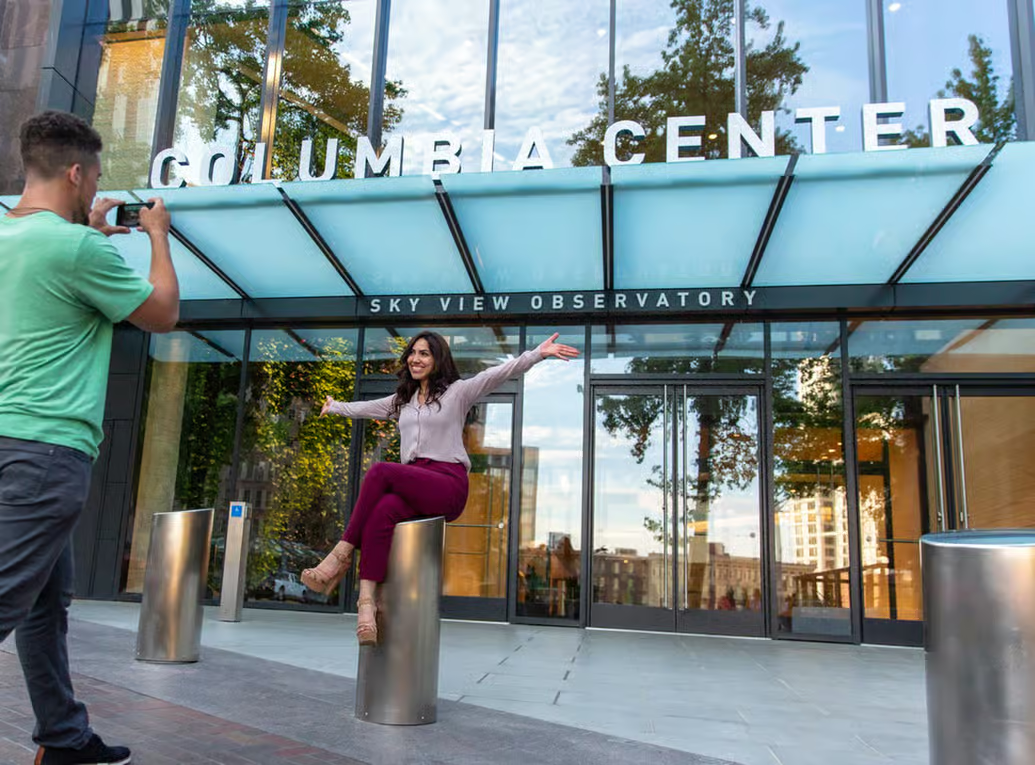
The building lobby at 701 Fifth Avenue is open during standard business hours and is worth a look in its own right — the lower floors contain retail and the infrastructure of a major corporate tower, and the scale of the atrium space gives you a sense of the building’s ambition before you’ve ridden a single floor up.
Photography equipment including tripods is generally permitted during non-peak hours. For professional shoots or commercial photography, the observatory management should be contacted in advance.
Accessibility: the observatory is fully accessible via elevator, and the observation floor itself is step-free throughout. The café has accessible seating and standard restroom facilities.
Final Word
There is no shortage of ways to experience Seattle. You can eat your way through Pike Place Market, kayak on Lake Union, hike the trails above Discovery Park, ride the ferry to Bainbridge, or spend an afternoon at the Seattle Art Museum. These are all worthy things.
But there is something clarifying about seeing a city from directly above it, from high enough that the noise drops away and the geography becomes visible all at once. Columbia Center’s Sky View Observatory gives you that. It gives you Seattle as a whole — the water, the mountains, the neighborhoods, the islands, the industry, and the wilderness pressing in from every side.
At 701 Fifth Avenue, the elevator waits. The 73rd floor is 40 seconds away.
The view lasts considerably longer than that.