

The Emerald City is about to become the center of the football universe. Here’s everything you need to know before the world arrives.
The Moment Seattle Has Been Waiting For
There are cities that host major sporting events, and there are cities that become them. Seattle is about to do the latter.
This summer, the Emerald City joins 15 other North American host cities in staging the largest FIFA World Cup in history — a tournament that for the first time spans three nations (the United States, Canada, and Mexico), fields 48 teams, and delivers 104 matches to a planet hungry for football. The new format makes the 2026 edition the biggest competition that has ever taken place, with 16 host cities sharing the load.
For a city that has spent two decades building one of the most passionate soccer cultures in the country — the city that gave birth to the Seattle Sounders’ green-and-blue faithful, who regularly pack the stands at more than 40,000 per game — this moment is not an accident. It’s a culmination.
Seattle earned this. And now the world gets to find out why.
Lumen Field: The Cathedral in SoDo
All six World Cup matches will be played at Lumen Field, officially renamed “Seattle Stadium” for the duration of the tournament under FIFA’s commercial naming-rights policy. The address is 800 Occidental Ave S, Seattle, WA 98134, in the SoDo district just south of downtown.
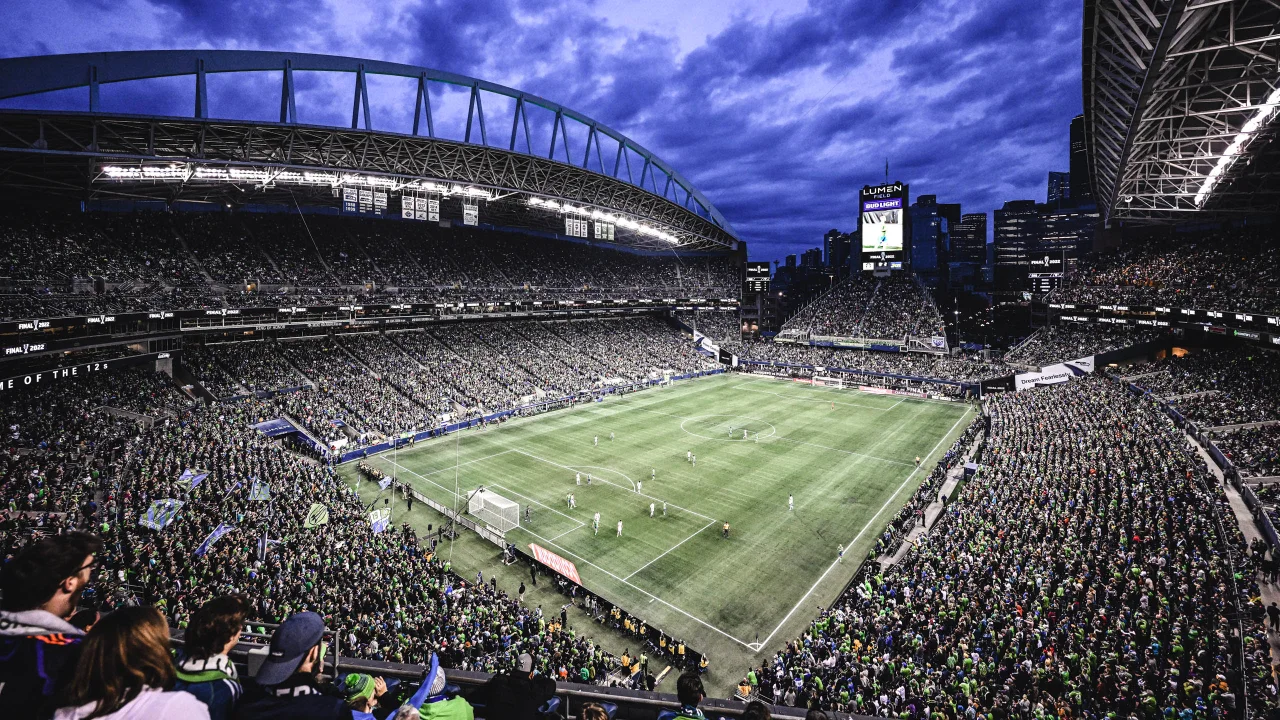
The stadium itself needs little introduction in North American sports circles. Opened in 2002, Lumen Field is home to the Seattle Seahawks’ legendary 12th Man — a fanbase that holds the Guinness World Record for the loudest crowd ever recorded at an outdoor stadium, hitting 137.6 decibels in 2013. Three home teams share this turf — the NFL’s Seahawks, MLS’s Sounders FC, and the NWSL’s Seattle Reign — and all three have contributed to a matchday atmosphere unlike almost anything else in American sport.
Located just blocks from the Puget Sound waterway, the stadium features a unique design with an open north end that provides a stunning view of the downtown Seattle skyline. When 69,000 people rise together in that open-air bowl, with Elliott Bay shimmering behind the goalline and Mount Rainier cutting a white triangle above the horizon on clear days, football stops being sport and becomes something closer to spectacle.
For the 2026 FIFA World Cup, Lumen Field will have a seating capacity of nearly 69,000 fans, with an additional 5,000 seats available beyond its standard setup for major events.
The Six Matches: Mark Your Calendar
Seattle is excited to welcome the US Men’s National Team, along with fans and players from Australia, Belgium, Qatar, Iran, Egypt, and the Winner of European Play-off A. Here is the full schedule of what is happening, and when:
Group Stage
- June 15 (3 p.m. ET / Noon PT): Belgium vs. Egypt — Group G
- June 19 (3 p.m. ET / Noon PT): USA vs. Australia — Group D
- June 24 (3 p.m. ET / Noon PT): Qatar vs. Bosnia and Herzegovina — Group Stage
- June 26 (11 p.m. ET / 8 p.m. PT): Egypt vs. Iran — Group Stage
Knockout Rounds
- Round of 32 (Match 82) on July 1 at 1:00 p.m. PT
- Round of 16 (Match 94) on July 6 at 5:00 p.m. PT.
The June 19 match deserves a word of its own. The United States takes on Australia — a match that lands on one of America’s most significant cultural holidays and doubles as a kickoff to Pride weekend. The symbolism is deliberate and fitting for a city that wears its values publicly. Seattle’s streets will be electric that day in ways that go well beyond football.
Getting There: The Smartest Ways to Reach the Stadium
Getting 69,000 people in and out of any urban stadium is a logistical undertaking. Seattle’s compact geography and robust transit network make it more manageable than most cities — provided you plan ahead.
Take the Link Light Rail. Full stop, this is the recommended choice for nearly everyone. Seattle Link Light Rail provides direct access to Lumen Field via two stations: Stadium Station (approximately 300 feet from the gates) and ID/Chinatown Station (about 1,200 feet away). Trains run every 10–15 minutes on match days. The light rail connects seamlessly to Seattle-Tacoma International Airport (SEA), meaning you can theoretically land, board a train, and be at your seat within 45 minutes.
Sounder commuter rail is another excellent option for fans coming from Pierce County (Tacoma) or Snohomish County (Everett). Sounder trains serve King Street Station, a short walk from the stadium, and extra service will be added on match days.
On foot: You can walk to Lumen Field in under 20 minutes from Downtown, Pioneer Square, or the Waterfront. For fans staying in the city center, this is genuinely the simplest option — and it lets you soak in the pre-match atmosphere along the way.
By car: Lumen Field is accessible from I-5 and I-90, but traffic will be heavy on matchdays. Parking options exist nearby, though they come at a premium and should be booked well in advance. Most regulars will tell you driving is the worst option. Heed their advice.
Rideshare: Uber, Lyft, and taxi services will have designated drop-off and pick-up zones close to the stadium for convenient access. If you’re coming from a neighborhood not well-served by rail, this is a reasonable fallback.
Where to Stay: Hotels Near the Action
The question of where to base yourself during the tournament comes down to a simple trade-off: proximity to the stadium versus space and price.
Top accommodation options include luxury hotels in Downtown Seattle, mid-range stays near Pioneer Square, and budget-friendly properties in Lower Queen Anne.
A few specific anchors:
Four Seasons Hotel Seattle (99 Union St, Seattle, WA 98101) sits on the waterfront with views across Elliott Bay. It’s a 15-minute walk from the stadium and a few minutes from the fan zones at Pier 62. This is the choice for visitors who want to be in the heart of it all without the SoDo grit.
Embassy Suites by Hilton Seattle Downtown Pioneer Square (255 S King St, Seattle, WA 98104) is the closest major hotel to Lumen Field. It’s located right next to the stadium, so on game days you’re practically in the action before you even leave the building.
Lotte Hotel Seattle (809 5th Ave, Seattle, WA 98104) is a high-end property in the Financial District — central, refined, and an easy walk or single rail stop from the ground.
For fans on tighter budgets, Lower Queen Anne and Capitol Hill offer competitive rates with clean Light Rail connections to Stadium Station. Book now. The window for reasonable pricing on these properties is closing fast.
Beyond the Stadium: Fan Celebrations Across the City
One of the most interesting decisions the Seattle organizing committee made was to reject the single-location fan fest model and instead distribute the World Cup energy across the city’s best public spaces. The result is a patchwork of experiences that collectively amount to one of the more ambitious community activations any host city has attempted.
Beginning June 11, fans can experience World Cup excitement at multiple locations along Seattle’s “Unity Loop,” including Seattle Center, Waterfront Park, Pacific Place, and Victory Hall in SoDo. All fan experiences are free and open to the public.
Seattle Center (305 Harrison St, Seattle, WA 98109): The campus anchoring the Space Needle is transforming into the city’s cultural nerve center for the tournament. The Armory will serve as the primary hub, featuring a large-format indoor screen and a comfortable, all-weather gathering space with food, seating, and amenities. Additional free fan experiences will take place across campus, including the Mural Amphitheatre with views of the Space Needle and Pacific Science Center arches. The International Fountain will feature DJs and artists from Seattle and around the world.
Pier 62 / Waterfront Park (1301 Alaskan Way, Seattle, WA 98101): This might be the single most visually spectacular place in North America to watch a World Cup match. Seattle Soccer Celebration is described as a first-of-its-kind waterfront fan experience — floating on Elliott Bay at Pier 62 in the heart of downtown Seattle. A floating mini pitch, waterfront watch parties, music, and food from across the city are all part of the experience, hosted by Seattle Sounders FC and Seattle Reign FC. Fans can watch matches on a massive 18′ x 30′ LED wall, set against the iconic backdrop of Puget Sound with the Olympic Mountains rising just beyond. Ten free watch parties are included at this venue, with sign-ups opening June 2.
Pioneer Square (near 1st Ave S and S Jackson St, Seattle, WA 98104): The historic heart of Seattle gets its own transformation on match days. On the six days Seattle hosts matches, Pioneer Square will become a car-free, pedestrian-only zone starting four hours before kickoff. South Jackson Street will feature a stage, an all-ages friendly beer garden, and a 20-foot by 15-foot LED screen broadcasting every game. A digital QR-code ordering system will allow fans to order food directly to the plaza from local Chinatown-International District restaurants.
Pacific Place (600 Pine St, Seattle, WA 98101): Not to be overlooked. The Seattle Soccer House at Pacific Place features a recently completed spectacular 4-story, high-resolution interior LED screen constructed within a 5-story interior mall. It’s downtown, it’s indoors (a genuine advantage in a city where June weather can surprise you), and it’s right on the monorail line.
The Seattle Difference: Why This City Gets It
Most American cities love their teams. Seattle loves the game.
The distinction matters. When MLS launched in 1996, Seattle wasn’t even in the league yet. When the Sounders joined in 2009, they immediately attracted average attendances that left every other MLS club in the dust. This is a city that doesn’t need the World Cup to validate its relationship with football. The World Cup gets to come here and learn something.
Seattle is known for its coffee culture, tech hub status, music heritage, and natural beauty — and it brings all of those identities to how it hosts. The city has specifically framed its World Cup vision around the principles of Soccer, Innovation, and Everyone — a slogan that actually reflects policy. Community activations are planned in neighborhoods across the city, from the Chinatown-International District and Capitol Hill to Fremont, Beacon Hill, Columbia City, the University District, and beyond.
There are events celebrating Indigenous culture, events rooted in Black Seattle’s creative traditions, soccer-themed arts programming, neighborhood markets, and street performances. This isn’t a tournament imposed on a city. It’s a city using a tournament to say something about who it is.
Practical Intelligence: What Every Visitor Needs to Know
Weather: Seattle in June and July is mild and pleasant, with average highs around 23°C (73°F). That said, the Pacific Northwest keeps its meteorological options open. Bring a light layer. The open-air north end of the stadium means wind can factor during evening matches.
Stadium policies: Expect a clear-bag policy, airport-style security screening, and cashless concessions — consistent with FIFA venue standards. Leave the oversized bags at the hotel and bring your phone or a prepaid card.
Getting from the airport: Seattle-Tacoma International Airport (SEA) is located roughly 20 minutes south of downtown. The Link Light Rail’s airport station connects directly to the Stadium Station stop — no car, no taxi, no stress. Follow the signs to the light rail at arrivals. It runs frequently and costs a fraction of a rideshare.
Tickets: The official ticket platform is FIFA.com/tickets, where hospitality packages including game tickets can still be purchased. Secondary-market tickets will circulate on Ticketmaster and other verified platforms, but prices will be high, particularly for the USA vs. Australia match on June 19, which is one of the most anticipated group-stage games of the tournament anywhere in North America.
Food and drink: Pioneer Square and the broader SoDo neighborhood have matured significantly as dining destinations in the last decade. The Chinatown-International District, a literal five-minute walk from the stadium, is one of the most culturally rich food corridors in the American West. Plan your pre-match meal there. For post-match, Capitol Hill’s bar scene is a 20-minute ride on Link or a short rideshare from the ground.
The Bigger Picture: What Seattle’s Turn Means
The 2026 World Cup final will be played on July 19 at MetLife Stadium in East Rutherford, New Jersey. The quarterfinals, semifinals, and the championship match all happen elsewhere. Seattle gets the group stage and two knockout rounds — which is exactly the moment when the tournament is at its most alive with possibility.
In the group stage, every match carries a sense of fate being written. Every result reshuffles the table. Nations that traveled thousands of miles to be here are fighting for the chance to stay. The atmosphere at this stage of a tournament is arguably more raw, more desperate, and more joyful than the later rounds, where attrition and caution tend to dominate.
Seattle gets Belgium and Egypt on June 15. It gets the United States against Australia four days later — a match with genuine narrative stakes, the Americans playing in front of one of the most soccer-educated crowds on the continent. It gets a Round of 32 on July 1, and a Round of 16 on July 6. Six matches. Six chances for moments that become memories.
For the Sounders fans who have spent years telling anyone who would listen that Seattle is a real football city — June 15 is the moment the argument ends. The world is coming. The world will see.
Key Addresses at a Glance
- Lumen Field (Seattle Stadium): 800 Occidental Ave S, Seattle, WA 98134
- Seattle Center Fan Celebration: 305 Harrison St, Seattle, WA 98109
- Pier 62 / Seattle Soccer Celebration: 1301 Alaskan Way, Seattle, WA 98101
- Pioneer Square Fan Zone: S Jackson St & 1st Ave S, Seattle, WA 98104
- Pacific Place / Seattle Soccer House: 600 Pine St, Seattle, WA 98101
- King Street Station (Sounder Rail): 303 S Jackson St, Seattle, WA 98104
- Seattle-Tacoma International Airport (SEA): 17801 International Blvd, SeaTac, WA 98158
Final Word
Cities change during a World Cup. Streets that were routine become stages. Strangers share jerseys and translated jokes and photographs that will outlast any result on any scoreboard. Food vendors sell things you’ve never heard of to people who’ve never tried them. A whole city, for a few weeks, speaks the same language.
Seattle is ready for all of it. It has the stadium, the transit, the neighborhoods, the food, the culture, and most importantly, the genuine love of the game that separates a host city from a host venue.
The beautiful game is coming to the Pacific Northwest. And the Pacific Northwest was born for this.