Seattle has never had a simple relationship with getting from Point A to Point B. Other cities built their transportation networks with some degree of rational planning. Seattle, on the other hand, built its network the way a raccoon builds a nest—grabbing whatever was available, stuffing it into an unlikely space, and defending it with feral intensity when anyone suggested doing things differently.
The result is a city where ferries share commuting duties with light rail, where a defunct monorail from a World’s Fair still putters along a single track like a retiree who refuses to leave the office, and where the ghosts of torn-up streetcar lines haunt every traffic jam on Capitol Hill. It’s a transportation story defined not by grand vision but by geography, capitalism, neighborhood feuds, and the uniquely Pacific Northwestern impulse to do things the hard way just to prove a point.
This is the story of how Seattle learned to move. Slowly. Expensively. And with a lot of arguing.
The Water Came First
Before Seattle was Seattle, it was a collection of settlements perched on the edge of Elliott Bay, surrounded by forests so dense that walking between towns was less a commute and more of an expedition. The Duwamish people had been navigating the region’s waterways by canoe for thousands of years before the first white settlers showed up in the 1850s, took one look at the hills and the mud, and decided that boats were the only sane option.
Water wasn’t just Seattle’s first transportation network—it was the only one that made geographic sense. The city sits on a narrow isthmus between Puget Sound and Lake Washington, carved up by steep hills and bisected by waterways. Early settlers moved timber, people, and goods by boat because the alternative was hacking through old-growth forest and scrambling up grades that would make a mountain goat think twice.
The “Mosquito Fleet,” a swarm of small, privately operated steamboats, became the region’s de facto public transit system in the late 19th century. These weren’t glamorous vessels. They were scrappy, often dangerously overloaded, and run by captains who treated scheduling more as a loose suggestion than a binding commitment. But they connected communities across Puget Sound—from Tacoma to Bremerton to the San Juan Islands—in an era when roads between these places simply didn’t exist.
The Mosquito Fleet was pure entrepreneurial chaos. Competing operators would race each other to docks, sometimes literally ramming rival boats out of the way to pick up passengers first. Fares fluctuated wildly. Service was unreliable. And yet, for decades, it worked. Or at least it worked well enough that nobody bothered building an alternative.
This spirit—functional disorder dressed up as frontier independence—would become Seattle’s unofficial transportation philosophy for the next century and a half.
Rails, Robbery, and the Great Regrade
The arrival of the railroad changed everything, as it did for most American cities in the late 1800s. But Seattle’s relationship with rail was, from the very start, combative.
The Northern Pacific Railway had originally chosen Tacoma as its western terminus in 1873, a snub that Seattle took with all the grace of a jilted lover finding out their ex was dating their neighbor. The city spent years lobbying, scheming, and eventually building its own rail connections out of sheer competitive rage. When the Great Northern Railway finally arrived in 1893, choosing Seattle over Tacoma, the victory felt less like civic planning and more like winning a bar fight.
Rail brought explosive growth. Seattle’s population ballooned from around 3,500 in 1880 to over 80,000 by 1900. And with that growth came the city’s first real internal transit challenge: how do you move tens of thousands of people across a landscape that looks like a crumpled bedsheet?
The Cable Cars and Streetcar Era
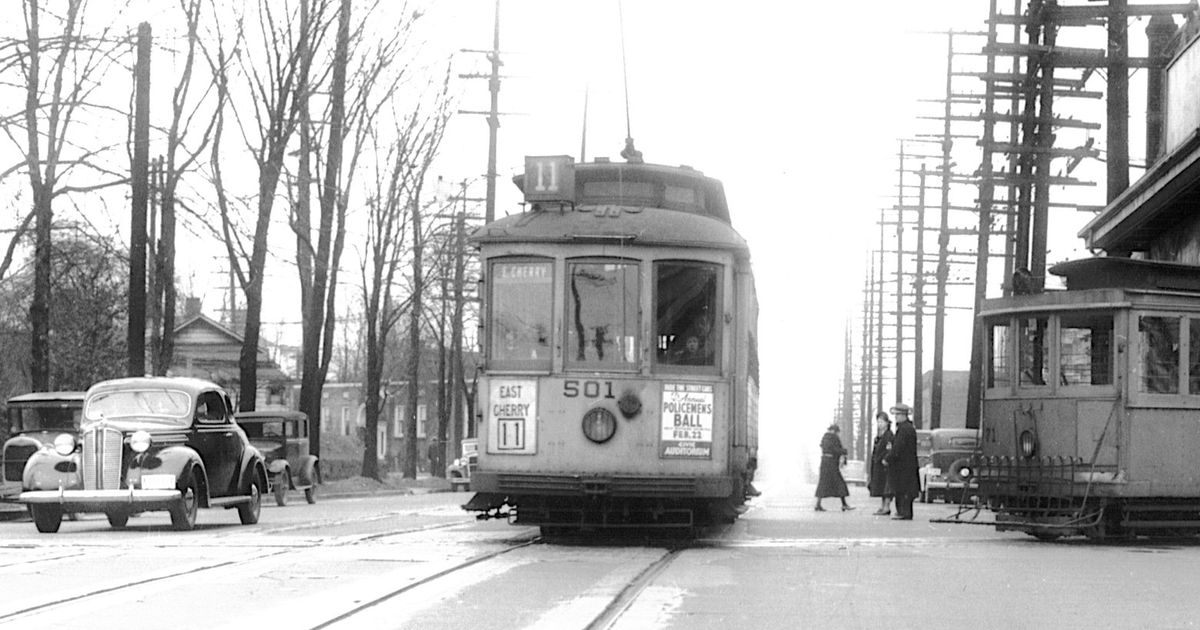
Seattle’s answer, starting in the 1880s, was streetcars. Lots of them. The city’s streetcar network eventually grew to become one of the most extensive in the western United States, with over 200 miles of track winding through neighborhoods from Ballard to Rainier Beach.
But here’s the critical detail that explains so much about Seattle’s later transportation woes: the streetcar lines weren’t built as public infrastructure. They were built by real estate developers.
The business model was elegant in its ruthlessness. A developer would buy cheap land on the outskirts of the city, build a streetcar line connecting that land to downtown, and then sell the now-accessible lots at a massive markup. The streetcar itself didn’t need to be profitable—it was a marketing expense for the real estate venture. Lines were routed not where people most needed to go, but where developers owned property they wanted to sell.
This meant Seattle ended up with a transit network that was extensive but fundamentally irrational. Some neighborhoods had redundant service while others had none. Lines zigzagged to serve specific developments rather than following efficient routes. And because the streetcar companies were really real estate companies, they had little incentive to maintain or improve service once the surrounding lots were sold.
It was, in other words, a perfect preview of every transportation debate Seattle would have for the next hundred years: private interests shaping public infrastructure, short-term profit overriding long-term planning, and everyone blaming everyone else when the system didn’t work.
Meanwhile, They Flattened the Hills
Seattle’s terrain was—and remains—a serious obstacle to efficient transportation. The city’s original hills were so steep that some streets required ladders to climb. The solution was one of the most audacious civil engineering projects in American history: the Denny Regrade.
Starting in 1898 and continuing in phases until 1930, the city literally washed away entire hills using high-pressure water hoses, sluicing millions of cubic yards of earth into Elliott Bay to create flat, buildable land. Denny Hill, which once rose to over 200 feet, was erased from the landscape entirely. The neighborhood that sits there today—Belltown and the Denny Triangle—exists because Seattle looked at a geographical obstacle and said, “We’ll just get rid of it.”
This was not a transportation project per se, but it was a transportation philosophy: rather than adapting to the landscape, force the landscape to adapt to you. It’s the same energy that would later produce floating bridges, underground bus tunnels, and a deep-bore highway tunnel that took seven years and billions of dollars more than planned.
The Great Undoing: Cars Kill the Streetcar
By the 1930s, Seattle’s streetcar network was in trouble. The cars were aging, the tracks needed repair, and the private companies operating the lines were hemorrhaging money. Ridership was declining as automobiles became affordable, and the city’s hilly terrain—even after the regrades—made bus service more flexible than fixed rail.
What happened next in Seattle mirrors what happened in cities across America, though the local flavor adds its own bitter seasoning. Between 1940 and 1941, Seattle’s streetcar lines were systematically dismantled and replaced with buses and trolleybuses. The last streetcar ran on April 13, 1941.
The conventional narrative blames General Motors and the “Great American Streetcar Scandal”—a conspiracy by auto and oil companies to buy up and destroy streetcar systems nationwide. The reality in Seattle was more complicated and, honestly, more depressing. The streetcar companies were failing on their own. The city government didn’t want to take on the cost of maintaining them. And the public, seduced by the freedom and modernity of the automobile, didn’t fight particularly hard to save them.
The tracks were ripped up. The rights-of-way were paved over for cars. And Seattle entered the automobile age with the same lack of foresight that had characterized every previous transportation decision: full speed ahead, worry about consequences later.
The consequences arrived on schedule. By the 1950s and 1960s, Seattle was choking on traffic. The city that had destroyed its rail network to make room for cars discovered that cars, given enough of them, create their own kind of paralysis.
The Freeway Wars and the Road Not Taken
The post-war era brought the interstate highway system, and with it, a battle over Seattle’s soul that still echoes in every zoning meeting and transit vote.
The plan was ambitious: a network of freeways crisscrossing the city, connecting suburbs to downtown and making car-based commuting fast and frictionless. Interstate 5, the spine of the system, was completed through Seattle in 1967, cutting a massive trench through the city center that severed neighborhoods and created the concrete canyon that still defines the city’s geography.
But the rest of the freeway plan met fierce resistance. A proposed cross-town freeway through the Central District and along the waterfront was killed by community opposition in the late 1960s and early 1970s. The R.H. Thomson Expressway, which would have plowed through the Arboretum and several residential neighborhoods, was defeated after years of protest.
These victories were genuine triumphs of community organizing. They saved neighborhoods. They preserved green space. They prevented the kind of freeway-driven destruction that gutted cities like Detroit and St. Louis.
But they also left Seattle with half a freeway network. The city had just enough highway infrastructure to encourage car dependency but not enough to actually accommodate the traffic that dependency produced. It was the worst of both worlds: a city built around cars that couldn’t handle its own cars.
This is the paradox at the heart of Seattle’s transportation story. The city has repeatedly shown the political will to reject bad infrastructure projects. What it has struggled with—for decades—is summoning the same will to build good ones.
The Monorail: A Love Story in Five Failed Votes
No discussion of Seattle transportation is complete without the monorail, which functions as both a functioning transit line and a cautionary tale about civic ambition.
The original Seattle Center Monorail was built for the 1962 World’s Fair, a sleek, futuristic mile-long line connecting downtown to the fairgrounds. It was supposed to be the beginning of a citywide system. Instead, it became a tourist novelty—a monument to a future that never arrived.
But Seattle couldn’t let the monorail dream die. In 1997, a grassroots movement called the Elevated Transportation Company began pushing for a citywide monorail system. The proposal went to the ballot five separate times between 1997 and 2005. Voters approved it four times. The city council and various institutional opponents tried to kill it repeatedly. The project’s financing fell apart. Costs ballooned. Political support evaporated. By 2005, voters finally put it out of its misery.
The monorail saga is Seattle transportation politics distilled to its essence: an idea that everyone kind of liked but nobody could make work, destroyed not by opposition but by the city’s inability to execute. The original World’s Fair monorail still runs its one-mile route today, carrying tourists back and forth like a ghost whispering about what might have been.
Ferries Forever: The Washington State Fleet
While Seattle was tearing up streetcar tracks and arguing about monorails, one piece of its original transportation DNA remained stubbornly alive: the ferries.
The Washington State Ferry system, established in 1951 when the state took over failing private operators (there’s that pattern again), grew into the largest ferry system in the United States. Today, it operates over 20 vessels serving routes across Puget Sound, carrying over 24 million passengers a year.
The ferries are essential infrastructure for communities on the Kitsap Peninsula, Whidbey Island, and the San Juans, where they function not as a charming tourist experience but as a daily commuter lifeline. They are also chronically underfunded, perpetually behind on maintenance, and subject to service disruptions that strand entire communities.
And yet, the ferries endure. They endure because they are, in the most literal sense, irreplaceable. You cannot build a bridge to every island in Puget Sound. You cannot tunnel under every waterway. The ferries exist because the geography demands them, and they persist because the people who depend on them refuse to let them fail—even when the state government seems determined to test that resolve.
The Mosquito Fleet would recognize the dynamic instantly.
Sound Transit and the Long Road Back to Rail
Seattle’s most significant modern transportation story is the slow, expensive, politically agonizing return of rail transit.
Sound Transit, the regional transit authority, was created in 1993 and began building light rail in 2003. The first segment of Link Light Rail opened in 2009, connecting downtown Seattle to the airport—a modest 15-mile line that had taken over a decade to plan and build.
Since then, the system has expanded steadily, if not quickly. The University of Washington extension opened in 2016. Northgate Link followed in 2021. Voter-approved expansions will eventually extend the system to Tacoma, Everett, Redmond, and beyond, creating a 116-mile regional rail network.
The irony is thick enough to spread on toast. Seattle spent the first half of the 20th century ripping out 200 miles of rail. It is now spending the first half of the 21st century—and tens of billions of dollars—putting rail back, at a fraction of the coverage and many multiples of the cost.
Every delay, every cost overrun, every political fight over station placement is haunted by the ghost of the streetcar network that preceded it. The city tore out functional rail infrastructure because it believed the future was cars. Two generations later, it is rebuilding rail infrastructure because the future turned out to be traffic jams.
The Big Dig, Seattle Edition: The SR 99 Tunnel
No modern Seattle transportation story captures the city’s capacity for ambition, dysfunction, and stubbornness quite like the replacement of the Alaskan Way Viaduct.
The Viaduct, a double-decked elevated highway along the waterfront, was damaged in the 2001 Nisqually earthquake and deemed seismically unsafe. The debate over what to replace it with consumed Seattle politics for nearly a decade. The options—a new elevated highway, a surface boulevard, or a deep-bore tunnel—each had passionate supporters and furious opponents.
The tunnel won, eventually. And then the real problems began.
Bertha, the tunnel boring machine, was the largest in the world when it began drilling in 2013. It broke down almost immediately, spending two years stuck underground while costs climbed and timelines shattered. The tunnel finally opened in 2019, six years late and roughly $1.4 billion over budget.
The finished product is genuinely impressive—a two-mile, double-decked highway tunnel that replaced an aging eyesore with a waterfront that is, for the first time in decades, reconnected to the city. But the process of getting there was so painful, so prolonged, and so expensive that it became a national punchline.
Seattle, naturally, shrugged it off. The city has been building impossible things in impossible places since the Denny Regrade. A stuck tunnel boring machine was just the latest in a long line of obstacles that Seattle dealt with the same way it always has: by throwing money, time, and obstinacy at the problem until it went away.
The View from 2026
Today, Seattle moves on water, on rail (again), on buses, on bikes, on ferries, on a single mile of monorail, and on a staggering number of single-occupancy vehicles driven by people who are absolutely furious about traffic while contributing to it.
The city’s transportation network is a palimpsest—layers of decisions, mistakes, victories, and compromises stacked on top of each other like geological strata. The Mosquito Fleet became the state ferry system. The streetcars became buses that are now becoming light rail. The freeways that were supposed to solve traffic created the congestion that justified the rail that replaced the streetcars that were torn out to make room for the freeways.
It is circular. It is maddening. It is, if you squint, kind of beautiful.
Because underneath all the dysfunction, there is a city that has never stopped trying to figure out how to move. Seattle’s transportation history is not a story of good planning. It is a story of a place so geographically challenging, so politically fractious, and so stubbornly independent that every transportation solution has been hard-won, bitterly debated, and arrived at only after every other option was exhausted.
Other cities got rational transit networks. Seattle got a ferry system, a zombie monorail, a tunnel that nearly ate a boring machine, and a light rail line that is the most expensive apology letter in American infrastructure history.
It’s not elegant. But it moves. Mostly. And for Seattle, that has always been enough.
The next time you’re stuck in traffic on I-5 watching a Link train glide past on elevated tracks while a ferry crosses Elliott Bay in the distance and the monorail hums overhead on its eternal one-mile loop, remember: every single piece of that scene was fought over, voted on, debated to exhaustion, nearly canceled, brought back from the dead, and delivered late and over budget. That’s not dysfunction. That’s Seattle.