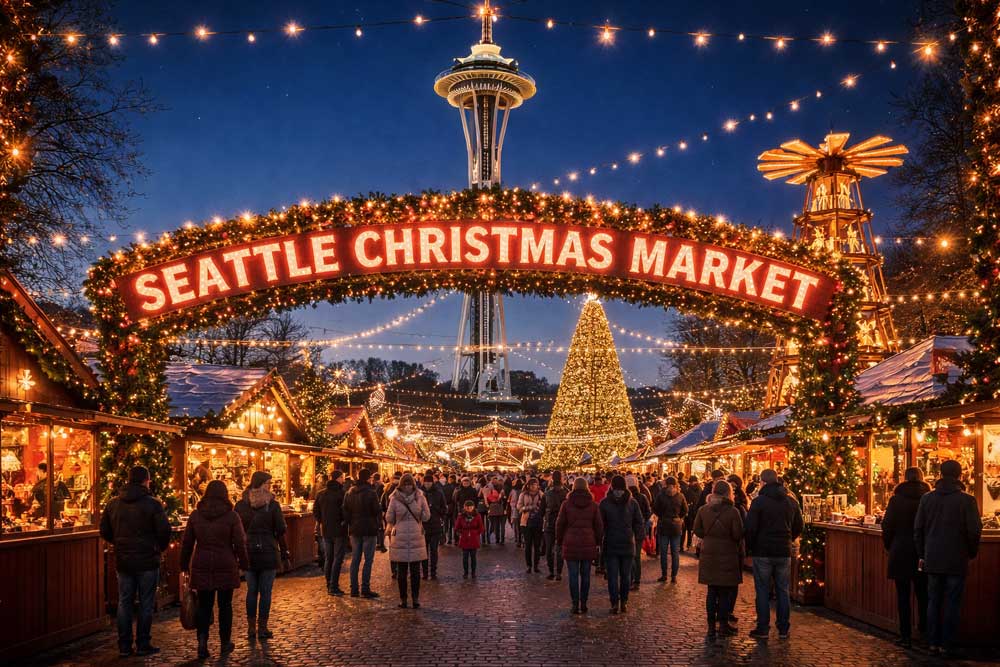
Seattle Center’s transformation each November signals the arrival of the city’s newest holiday tradition. Wooden vendor huts spring up around the South Fountain Lawn and Fisher Pavilion, strung lights create canopies of golden warmth, and the smell of mulled wine and roasted chestnuts fills the air. The Seattle Christmas Market, founded in 2023, brings centuries-old European tradition to the Pacific Northwest—complete with all the charm, complications, and cultural dissonance that such transplantation entails.
The market’s founder, Malte Kluetz, built his reputation on the Vancouver Christmas Market, which debuted in 2010 and became what organizers describe as a beloved Canadian tradition. The formula seemed straightforward: recreate the atmosphere of German Christmas markets—those centuries-old festivals that transform European town squares into winter wonderlands—and transplant them to North American cities hungry for holiday experiences.
Seattle represented the next logical expansion. A city with strong German heritage roots, a progressive urban population seeking cultural experiences, and Seattle Center—that 74-acre campus built for the 1962 World’s Fair—provided the perfect venue. From November through Christmas Eve, the market would offer what press releases promised as “authentic” European Christmas tradition, complete with Glühwein, handcrafted ornaments, and daily entertainment.
The reality has proven more complex than the marketing suggests.
The European Origins
To understand what Seattle’s Christmas Market aspires to be, one must first understand what it’s imitating. German Christmas markets trace their lineage to the Late Middle Ages, when December markets allowed citizens to stock up on meat and winter necessities before the coldest months arrived. Vienna held what’s described as a December Market as early as 1298, though whether these early gatherings resembled modern Christmas markets remains debatable.
The markets evolved significantly during the Reformation. Martin Luther, seeking to shift focus from Catholic saints, encouraged giving children gifts on Christmas Eve rather than on St. Nicholas Day. This change created demand for holiday shopping just before Christmas, and markets responded by specializing in gifts and festive items. The term “Christkindlmarkt”—Christ Child Market—emerged during this period, referring not to baby Jesus but to an angel-like figure who brought gifts to children.
By the 17th century, Christmas markets had become established traditions in German-speaking regions. Nuremberg’s Christkindlesmarkt, first documented in 1678, evolved into one of the most famous, drawing millions of visitors annually even today. Dresden’s Striezelmarkt, dating to 1434, claims the title of oldest, while Frankfurt’s market attracts over three million people each year.
These markets developed regional specialties reflecting local industries and cultures. The Erzgebirge mountain region became known for wooden carvings and Christmas pyramids. Nuremberg specialized in Lebkuchen gingerbread. Lübeck produced marzipan. Each market maintained distinct character shaped by centuries of local tradition, architecture, and community customs.
What made these markets culturally significant wasn’t primarily their commercial function but their role as community gathering spaces during the darkest, coldest season. They provided light, warmth, social connection, and sensory pleasure—the smell of roasted almonds, the taste of mulled wine, the sight of handcrafted ornaments, the sound of Christmas carols—during a period when most people lived without reliable heat or electric light.
The markets also carried darker history. During the 1930s, the Nazi regime co-opted Christmas market traditions for propaganda purposes, transforming them from religious celebrations into nationalist displays of German heritage. After World War II, when markets resumed in devastated cities, organizers worked to distance them from this history while maintaining many traditions the Nazis had institutionalized, creating complex cultural legacies that persist today.
Modern German Christmas markets attract tens of millions of visitors annually, generating billions in economic activity. They’ve spread globally, with versions appearing across Europe, Asia, and North America. But transplanting a tradition rooted in medieval European town squares, evolved over centuries within specific cultural contexts, into contemporary North American cities creates inevitable tensions.
Seattle’s Version: Year One
The Seattle Christmas Market opened on November 24, 2023, occupying Seattle Center’s Fisher Pavilion and surrounding lawns. Organizers promised more than 60 vendors, daily live entertainment, a 50-foot walk-through Christmas tree, a Christmas pyramid serving as a central gathering point and stage, and that essential element of authentic German markets: Glühwein, or spiced mulled wine.
The market required paid admission—a departure from traditional European markets, which generally allow free entry with vendors earning money through sales. Single-entry tickets started around $20 at the gate, with season passes available for $36. This immediately created controversy. Seattle residents accustomed to free public events questioned why they should pay to access a market in a public park, especially when the act of spending money at vendor stalls would already support the event economically.
Market organizers defended the ticketing system as necessary for managing crowds, maintaining quality vendor selection, and funding the market’s elaborate decorations and entertainment. The model worked in Vancouver, they argued, where the Christmas Market had become successful enough to expand. Seattle would surely embrace the same approach.
Early reviews proved mixed. Visitors appreciated the festive atmosphere—the twinkling lights, the decorated vendor huts, the Christmas pyramid with its musical performances. The market genuinely created visual and sensory experiences distinct from typical Seattle holiday offerings. Local artisans sold handcrafted goods rarely found elsewhere: traditional German nutcrackers, hand-carved wooden ornaments, European-style pottery and textiles.
But complaints surfaced quickly. The admission fee felt steep, particularly for families. Once inside, food and drink prices struck many as exorbitant—$12 beers, $25 schnitzel plates. The market’s fenced boundaries created what critics described as a “cattle corral” atmosphere rather than the open, welcoming feeling of European markets integrated into public squares. Lines formed at popular food vendors, with wait times stretching to 30 minutes or more for items like raclette or Hungarian goulash.
Transportation proved problematic. Seattle Center sits in the Uptown neighborhood, served by multiple bus routes that quickly bog down in traffic generated by simultaneous events. Monorail service from downtown helps, but limited capacity means long waits during peak times. Parking costs $30 or more in nearby garages, and exiting the area after events can take 30 minutes of sitting in gridlock. For a market attempting to evoke the walkable, accessible charm of European town squares, the car-dependent reality of American urban geography created jarring dissonance.
The Urbanist, a Seattle-based publication covering urban policy and culture, published a scathing critique titled “A Christmas Market That Doesn’t Suck Is Still Elusive for Seattle.” The piece argued that Seattle had failed to capture what makes European Christmas markets special: their integration into daily urban life, their accessibility, their emphasis on community gathering over commercial transaction. The Seattle version felt like a cash grab—admission charged for access to overpriced vendors in a fenced-off section of public park.
Market organizers pushed back against such criticism, noting that operating costs for the elaborate decorations, daily entertainment, insurance, and vendor management required revenue beyond what vendor fees alone could support. The Vancouver model had proven sustainable, they insisted, and Seattle would too once residents understood what the market offered.
Year Two: Expansion and Evolution
The Seattle Christmas Market returned for 2024 with significant changes. Running from November 21 through December 24 (closed Thanksgiving), the market expanded to five weeks rather than its inaugural four-week run. Organizers increased vendor count to more than 80 craft, food, and drink vendors—20 additional stalls beyond the previous year.
New attractions included a double-decker carousel offering unlimited free rides to ticket holders, a Winterdeck entrance area atop Fisher Pavilion providing photo opportunities and housing Santa’s Snow Globe where children could meet St. Nick, and a Fairy Tale Forest featuring displays inspired by classic German stories. The 50-foot walk-through Christmas tree returned, along with the Christmas pyramid stage hosting daily live music performances.
Food offerings expanded, with new vendors joining traditional favorites. Visitors could find raclette (melted cheese scraped over potatoes and pickles), spätzle (German egg noodles), perogies, various sausages, chimney cakes (hollow pastries coated in cinnamon sugar), hot chocolate, and of course Glühwein served in collectible mugs. The Alpen Haus provided indoor dining space with ski chalet-inspired décor, offering refuge from Seattle’s winter rain.
Craft vendors sold products ranging from one-of-a-kind charcuterie boards and hand-stitched leather goods to custom-designed hats, aromatic candles, traditional nutcrackers, hand-crafted greeting cards, luxurious artisan soaps, and locally-made functional mushroom products. The market deliberately blended European imports with Pacific Northwest artisans, creating hybrid offerings that reflected Seattle’s multicultural population.
Special themed evenings attempted to broaden appeal beyond traditional Christmas market demographics. Wine Wednesdays featured specialty pours and karaoke competitions. Themed Trivia Thursdays drew competitive crowds. Yappy Hours welcomed dogs, acknowledging Seattle’s famous dog-friendly culture. These additions recognized that straight replication of European tradition wouldn’t satisfy Seattle audiences who expect events to reflect contemporary urban culture.
The market also introduced a Lantern Festival parade on December 1, adding Chinese cultural elements to the predominantly German-inspired event. This fusion approach—mixing traditions from different cultures—departed from the “authentic” European Christmas market model but better reflected Seattle’s Asian and Pacific Islander populations, who constitute significant portions of the city’s demographics.
Admission pricing remained controversial. Early-bird presale tickets started at $6.99 including taxes and fees, significantly lower than gate prices, encouraging advance purchase. Children six and under entered free, subsidized by German airline Lufthansa. Season passes allowed unlimited visits throughout the market’s run. Still, the fundamental question persisted: why charge admission to a market in a public park when traditional European Christmas markets don’t?
The Authenticity Question
The Seattle Christmas Market markets itself using words like “authentic,” “traditional,” and “centuries-old tradition.” Press materials reference Nuremberg’s famous Christkindlesmarkt, Dresden’s historic Striezelmarkt, and the general atmosphere of German Christmas markets. But how authentic can a two-year-old market in the Pacific Northwest really be?
True German Christmas markets exist within specific contexts: medieval and Renaissance architecture providing dramatic backdrops, walkable city centers where markets integrate into daily urban life, regional craft traditions developed over centuries, food and drink recipes passed through generations. They’re embedded in cultural practices around Advent, winter solstice, and religious observance that differ significantly from American holiday customs.
Seattle’s market operates in a modernist park built for a World’s Fair, surrounded by Interstate 5, in a city where most residents drive rather than walk to events. The architecture is mid-century modern, not Gothic or Baroque. The “traditional” items sold often come from international wholesalers rather than local craftspeople working in centuries-old regional traditions. And the entire enterprise runs as a for-profit commercial operation rather than a community-organized cultural celebration.
What the Seattle Christmas Market does offer is atmospheric approximation. It creates sensory experiences—lights, decorations, seasonal food and drink, live music—that evoke feelings associated with European Christmas markets even if the actual cultural context differs entirely. For many visitors who’ve never experienced markets in Germany, Austria, or Switzerland, these approximations satisfy perfectly well. The market delivers what they expected: festive atmosphere, unique shopping, seasonal treats.
For others, particularly European immigrants or travelers familiar with original markets, the Seattle version feels like themed entertainment—a Christmas market costume worn by a commercial event. The admission charge, the inflated prices, the commercial emphasis over community gathering, the disconnection from daily urban life—these elements contradict what makes European markets culturally significant.
The Vancouver Christmas Market, upon which Seattle’s is modeled, faced similar criticism during its early years. Over time, as it became established and embedded in Vancouver’s annual rhythms, some of that criticism faded. Traditions, after all, must start somewhere. What feels contrived and commercial initially can evolve into genuine community tradition given time and cultural adoption.
Whether Seattle’s market will follow that trajectory remains uncertain.
The Business Model Problem
The Seattle Christmas Market’s commercial structure creates inherent tensions with its stated cultural mission. European Christmas markets typically operate as non-profit community events, often organized by municipal governments or cultural organizations. Vendor fees cover basic costs, with surplus funding community services. The emphasis falls on community gathering, cultural celebration, and supporting local artisans rather than profit maximization.
The Seattle market operates as a commercial enterprise by the same organization that runs Vancouver’s Christmas Market. It must generate sufficient revenue to cover substantial operational costs while providing return on investment. This inevitably shapes every decision about pricing, vendor selection, crowd management, and event programming.
Admission fees generate predictable revenue independent of weather, vendor sales, or attendance fluctuations. They also allow crowd control, limiting attendance to comfortable levels and creating urgency through timed-entry windows. From a business perspective, the model makes sense. From a cultural perspective, it undermines the market’s claim to authenticity and community focus.
The high prices charged by food and craft vendors similarly reflect business realities. Vendors pay substantial fees for premium spots within the market. They must recoup those costs while generating profit during a limited five-week window. This economic pressure pushes prices upward, particularly for prepared food requiring on-site cooking and serving.
Seattle Center, the market’s landlord, charges rental fees for space usage. The organization must carry insurance, hire security, contract entertainment, purchase and install elaborate decorations, handle marketing and ticketing systems, and manage dozens of other operational expenses. These costs total hundreds of thousands of dollars, requiring substantial revenue to maintain financial viability.
None of this is inherently problematic—businesses must cover costs and generate returns. But it does mean the Seattle Christmas Market operates according to different incentives and constraints than the European markets it emulates. Decisions prioritizing profitability may contradict decisions that would best serve community engagement, accessibility, or cultural authenticity.
The Seattle Context
Seattle’s Christmas Market doesn’t exist in isolation. It competes for attention and dollars with numerous other holiday events and traditions: Pike Place Market’s Magic in the Market celebration, Enchant’s light maze at T-Mobile Park, Seattle Center’s broader Winterfest programming, neighborhood light displays, and countless other seasonal offerings.
The city’s holiday season has evolved dramatically over recent decades. Seattle’s population has grown younger, wealthier, and more diverse. Tech workers with high disposable incomes seek novel experiences worth posting on social media. Immigrant communities bring holiday traditions from dozens of countries, creating demand for cultural celebrations beyond the Anglo-American Christmas norm.
Yet Seattle also struggles with severe income inequality, homelessness, and housing affordability crises. The average Seattle resident faces financial pressures that make $20 admission fees plus expensive food and drinks at a Christmas market feel tone-deaf. When public parks host private commercial events requiring payment for access, questions arise about equitable use of shared community resources.
The Seattle Christmas Market reflects these tensions. Its existence demonstrates demand for curated holiday experiences among Seattle’s affluent residents. Its controversies reveal discomfort with commercialization of public space and cultural traditions. The fact that it returns annually despite criticism suggests enough people find value to sustain its business model, even as others reject what they see as holiday profiteering.
Weather also shapes Seattle’s Christmas market experience in ways that differ dramatically from European counterparts. German markets operate in cold, often snowy conditions where hot drinks and warm food provide necessary comfort. Seattle winters are wet but mild—temperatures rarely drop below freezing, snow is exceptional rather than expected, and rain falls persistently. The market’s covered areas help, but they can’t fully replicate the cozy-against-the-cold feeling central to European market atmosphere.
Looking Forward
The Seattle Christmas Market enters its third year in 2025, running from November 20 through December 24. Organizers promise continued evolution based on previous years’ feedback, though fundamental aspects of the business model—paid admission, commercial operation, premium pricing—remain unchanged.
The market faces a challenging question: will it become an established Seattle tradition, woven into the city’s annual rhythms the way Pike Place Market or the Fremont Solstice Parade have become? Or will it remain a commercial novelty, attended once out of curiosity but not integrated into how Seattle residents actually celebrate the holidays?
Several factors will influence this trajectory. First, competition intensifies annually. Other holiday markets have emerged, some free-admission, others offering different cultural experiences. Enchant’s massive light maze at T-Mobile Park provides Instagram-worthy spectacle that appeals to similar demographics. Neighborhood street fairs and community celebrations offer accessible alternatives without entry fees.
Second, economic conditions shape attendance. During recessions or periods of financial uncertainty, discretionary spending on holiday entertainment faces scrutiny. Families choosing between multiple holiday activities may opt for free alternatives over paid experiences, particularly if previous visits left them feeling the value didn’t justify the cost.
Third, cultural evolution in Seattle may favor or disadvantage European-themed holiday markets. As the city’s Asian American population continues growing, as Latino cultural influence expands, as younger generations develop different holiday celebration preferences, a market emphasizing German and European tradition may feel increasingly disconnected from Seattle’s actual demographics and values.
What the Market Reveals About Seattle
Beyond its specific successes and failures, the Seattle Christmas Market reveals broader truths about contemporary urban life in the Pacific Northwest.
It demonstrates strong appetite for curated experiences and atmospheric entertainment. Seattle residents will pay substantial sums for events that provide Instagram-worthy moments, sensory richness, and perceived cultural authenticity—even when that authenticity is largely theatrical. The market sells not just food and crafts but the feeling of having experienced something special, something transportive, something worthy of sharing and remembering.
It also exposes discomfort with commercialization of public space and tradition. Many Seattle residents hold progressive values emphasizing public goods, community access, and resistance to corporate commodification. When public parks become venues for private commercial enterprises, when cultural traditions become profit centers, when admission fees create economic barriers to participation, backlash follows predictably.
The market highlights tensions between Seattle’s aspirational identity and its actual character. The city imagines itself as European in sensibility—walkable, cultured, environmentally conscious, communitarian. Reality proves more complicated: car-dependent urban form, extreme wealth inequality, tech industry dominance, and development patterns that prioritize real estate values over community cohesion. A Christmas market requiring driving, charging high prices, and operating for corporate profit rather than community benefit reflects Seattle’s actual structure more than its self-image.
It reveals hunger for ritual and tradition in a rapidly changing city. Seattle has transformed dramatically over the past two decades, with newcomers far outnumbering longtime residents in many neighborhoods. This population churn makes establishing shared traditions difficult. People seek anchors of continuity and ritual in environments that feel perpetually in flux. Holiday markets offer this—repeated annual events that create seasonal rhythms and shared experiences, even if recently invented rather than historically rooted.
The Other Christmas Markets
Seattle’s holiday market landscape extends beyond the Christmas Market at Seattle Center. These alternatives illuminate different approaches to seasonal celebration and commerce.
Pike Place Market’s Magic in the Market, celebrating 30 years in 2024, remains free to attend and integrated into the Market’s daily operations. The November event features Santa photos, live reindeer, wand-making demonstrations, a scavenger hunt, and a market lighting ceremony with performances. It feels less like a special event requiring dedicated visits and more like Pike Place Market dressed up for the season—accessible, informal, woven into the urban fabric.
The Alliance Française de Seattle hosts a European Holiday Market each December at the Chapel of the Good Shepherd Center in Wallingford. This free-admission event brings together European communities to share food, merchandise, and culture. Choirs perform, local vendors sell imported goods, and the emphasis falls squarely on cultural celebration rather than commercial transaction. Scale is modest—a few dozen vendors, local rather than professional production values—but authenticity in the sense of community organization and cultural mission feels stronger than at commercial alternatives.
Neighborhood markets proliferate throughout December. The Phinney Ridge Neighborhood Association’s 45th annual holiday market, various craft fairs at community centers, church bazaars, and school fundraisers—these smaller gatherings lack elaborate production values but offer local goods, community connection, and accessibility without admission charges. They serve different functions than large commercial markets, emphasizing neighborhood cohesion over tourist attraction.
Each model reflects different values and serves different audiences. No single approach is inherently superior—large commercial markets, community-organized celebrations, and neighborhood gatherings all have legitimate places in urban holiday landscapes. The question is what balance serves the city best.
The Verdict Remains Out
Whether the Seattle Christmas Market succeeds long-term depends on how one defines success. As a commercial enterprise, it appears viable—organizers returned for year two with expanded offerings, suggesting first-year revenues justified continued investment. Attendance numbers remain proprietary, but the market’s return and expansion indicate sufficient customer interest to sustain operations.
As cultural tradition and community celebration, the verdict is less clear. Many Seattle residents have never attended and likely never will, viewing it as tourist attraction or commercial enterprise unworthy of their time and money. Among those who do attend, opinions divide sharply between people who find it delightful and those who feel disappointed or ripped off.
The market’s ultimate significance may lie not in its own success or failure but in what it reveals about how contemporary American cities attempt to manufacture tradition and create communal experiences. We live in an era of invented traditions, commercial appropriation of cultural practices, and consumption-based identity formation. Holiday markets represent one manifestation of these broader phenomena.
European Christmas markets evolved organically over centuries, shaped by specific geographic, economic, and cultural contexts. They carry complex histories—medieval origins, Reformation influences, Nazi appropriation, postwar reconstruction—that inform but don’t determine their contemporary meaning. They function as genuine community traditions because they emerged from and serve those communities.
American Christmas markets are different creatures entirely. They’re commercial products designed to evoke feelings and generate revenue. Some succeed in creating meaningful experiences despite their commercial nature. Others feel hollow—all aesthetic surface with no cultural depth. Most fall somewhere in between, offering pleasant enough diversions without achieving genuine cultural significance.
The Seattle Christmas Market exists in this ambiguous middle space. It provides what many attendees want: festive atmosphere, seasonal shopping, Instagram opportunities, and holiday cheer. It fails to deliver what others seek: authentic tradition, community celebration, accessible public enjoyment, and genuine cultural connection.
Perhaps expecting more is unreasonable. Perhaps a two-year-old commercial Christmas market in the Pacific Northwest shouldn’t be judged against centuries-old European traditions or held to standards of community service rather than profit generation. Perhaps it’s enough to offer people pleasant holiday experiences, even at premium prices, even without deep cultural roots, even in public parks converted to private commercial use for five weeks each December.
Or perhaps we should demand more from our public spaces, our holiday traditions, and our seasonal celebrations. Perhaps we should insist that community gathering spaces remain accessible across economic divides. Perhaps we should resist commercialization of cultural traditions and expect better integration of holiday markets into the daily life of our cities rather than treating them as ticketed attractions.
The Seattle Christmas Market doesn’t answer these questions. It embodies them. Every December, when wooden vendor huts appear at Seattle Center and the smell of Glühwein fills the air, when admission fees are charged and prices posted, when lights twinkle and crowds gather, the market poses a question to the city: What do we want our holiday traditions to be? Who are they for? What values should they reflect?
So far, Seattle hasn’t reached consensus on the answers.