In the heart of Seattle’s bustling Pike Place Market, where the air carries the salty tang of the Puget Sound and the vibrant chatter of vendors, stands a beacon of artisanal excellence: Beecher’s Handmade Cheese. Since its inception in 2003, this company has transformed the landscape of American cheesemaking, blending old-world techniques with modern innovation to produce cheeses that captivate palates across the nation. Founded by Kurt Beecher Dammeier, a visionary entrepreneur with a passion for pure, flavorful foods, Beecher’s has grown from a single market stall into a beloved brand synonymous with quality and transparency.
This post delves deep into the story of Beecher’s, exploring its rich history, meticulous production methods, standout products, welcoming locations, prestigious accolades, commitment to philanthropy, and inspiring culinary applications. Through it all, one theme emerges: Beecher’s is not just about cheese; it’s about fostering a deeper connection to the food we eat.
The Origins: A Family Legacy and Entrepreneurial Spirit
Kurt Beecher Dammeier’s journey into cheesemaking began not in a dairy farm but in the world of business and fine dining. Descended from his great-grandfather Beecher McKenzie, after whom the company is named, Dammeier carried a familial appreciation for wholesome, farm-fresh ingredients. Before Beecher’s, he had already made his mark in the food industry, owning Pasta & Co., investing in Pyramid Breweries, and launching ventures like Bennett’s Pure Food Bistro and the quirky food truck Maximus/Minimus. Yet, it was a pivotal moment in 2003 that sparked the creation of Beecher’s. When Molbak’s nursery closed its doors in Pike Place Market, Dammeier seized the opportunity to secure the lease, envisioning a space where cheese could be made right before customers’ eyes.
Lacking direct experience in cheesemaking, Dammeier recruited Brad Sinko, a microbiologist with roots in a family cheese business in Oregon. Together, they set out to craft cheeses that honored tradition while pushing boundaries. The flagship location opened its doors amid the market’s iconic fish-throwing spectacles and flower stalls, quickly becoming a tourist draw and local favorite. What set Beecher’s apart from the start was its commitment to transparency—glass-walled kitchens allowed visitors to witness the entire process, from milk arrival to curd formation. This openness wasn’t just a gimmick; it reflected Dammeier’s core philosophy that consumers deserve to know exactly what goes into their food.
Over the years, Beecher’s expanded its footprint. In 2011, a second flagship store debuted in New York City’s Flatiron District, bringing West Coast artisan cheese to the East Coast. Though that location closed in October 2022 amid shifting market dynamics, it left an indelible mark, including a full-service restaurant called The Cellar. Today, Beecher’s operates primarily in the Pacific Northwest, with cafés in Pike Place Market, Bellevue, Paine Field Airport, and Overlake. These expansions weren’t mere replications; each site adapted to its environment, offering unique experiences like cheesemaking classes, wine pairings, and history lessons on dairy production.
Dammeier’s influence extends beyond cheese. His 2007 cookbook, *Pure Flavor: 125 Fresh All-American Recipes From The Pacific Northwest*, showcases Beecher’s products in everyday meals, emphasizing seasonal ingredients and simple preparations. This holistic approach has positioned Beecher’s as a leader in the artisan food movement, proving that small-batch quality can scale without sacrificing integrity. As of 2026, the company remains privately held, headquartered in Seattle, and continues to innovate under Dammeier’s guidance, blending heritage with forward-thinking sustainability.
The Art and Science of Cheesemaking at Beecher’s
At the core of Beecher’s success lies its cheesemaking process—a harmonious blend of artistry, science, and unwavering attention to detail. Unlike many artisan producers who rely solely on raw milk from a single source, Beecher’s employs mostly pasteurized milk from multiple family-owned farms, ensuring consistency in flavor year-round. To maintain quality, the company has invested in its own herds, including Green Acres Farm in Duvall, Washington, where Holstein and Jersey cows provide hormone-free, antibiotic-free milk. The Jersey cows contribute high butterfat for creaminess, while Holsteins add a natural sweetness, creating a balanced base for their cheeses.
The process begins in the wee hours of the morning. Fresh milk arrives by truck and is immediately pumped into holding tanks. Pasteurization follows, heating the milk to 161°F using the High Temperature Short Time (HTST) method, which eliminates pathogens while preserving flavor. From there, the milk transfers to open Make Vats, where cheesemakers add proprietary bacterial cultures—a unique mix of Cheddar and Gruyere strains that impart sharpness and nuttiness. Rennet, a natural enzyme, is stirred in to coagulate the milk, transforming it into a custard-like mass over about 45 minutes.
Once set, the curd is cut using square metal wireframes, releasing whey and creating smaller pieces. Temperature and pH are meticulously monitored; too hot, and the curd toughens; too acidic, and flavors skew. The mixture then moves to the Cheddaring Table, where whey drains away, and the curds knit into slabs under their own weight. Cheesemakers slice these into loaves with machete-like knives, stacking and flipping them to expel more moisture—a step known as cheddaring, which develops the cheese’s texture.
Next comes milling, where loaves are chopped into bite-sized curds via a hopper, followed by salting for dehydration, flavor enhancement, and preservation. These salty curds are the fresh cheese curds sold at Beecher’s locations, prized for their squeaky bite. For aged cheeses, curds are hooped into molds—40-pound blocks for varieties like Flagship or 16-pound truckles for clothbound options—and pressed overnight to form solid wheels.
Aging, or affinage, is where magic happens. Cheeses mature in controlled environments, developing complexity over months or years. Flagship ages for up to 18 months, gaining a moist, creamy crumb with a sweet finish. No artificial preservatives or colors are used; purity is paramount. Beecher’s produces over 500,000 pounds annually, operating 24/7 in high-volume facilities that still emphasize hand-stirring and precise control. A raw milk variant of Flagship offers an earthier profile, appealing to purists.
This method isn’t static; Beecher’s experiments with seasonal cultures and pairings, ensuring each batch reflects the milk’s terroir. The result? Cheeses that stand out in a crowded market, embodying the company’s values of flavor, purity, and transparency.
Signature Offerings: From Flagship to Seasonal Delights
Beecher’s product lineup is a testament to versatility and innovation, with cheeses that range from everyday staples to gourmet indulgences. The star is undoubtedly Flagship, a semi-hard cheese aged around 15 months (though publicly stated as 12). Crafted in 40-pound blocks, it boasts a creamy texture with nutty, caramel notes and a subtle sharpness—everything a cheddar should be, but elevated. Milk from Holstein-Jersey blends gives it a balanced richness, perfect for grating over pasta or enjoying solo. A raw milk version adds grassy undertones, while Extra Aged Flagship, matured for four years, intensifies the nuttiness for connoisseurs.
Flagship Reserve takes tradition further, aged in cheesecloth for a shorter period but rubbed with butter to enhance rind development. It loses up to 12% of its weight during aging, resulting in a sharper, crumblier profile with pronounced nutty flavors. Ideal for cheese boards, it pairs beautifully with crisp apples or robust reds.
For milder tastes, Just Jack offers a Monterey Jack-style cheese, smooth and meltable with a buttery essence. Blank Slate, their cream cheese, is tangy and spreadable, free of stabilizers for a pure taste. Seasonal varieties keep things exciting: Marco Polo infuses black peppercorns for a spicy kick, New Woman adds Jamaican jerk spices, and Flagsheep blends sheep’s milk for a gamy depth. Brie-like soft cheeses appear occasionally, showcasing Beecher’s experimental side.
Beyond wheels, Beecher’s excels in prepared foods. Their “World’s Best” Mac & Cheese combines undercooked pasta with a béchamel sauce featuring Flagship and Just Jack, baked to golden perfection. Frozen sides like Cheese Curd Lasagna and Chicken & Vegetable Soup incorporate fresh curds, while crackers—developed in-house—complement the cheeses with flavors like herb or sesame.
All products adhere to strict standards: no artificial additives, only real ingredients. Available nationwide through partners like Murray’s Cheese, they ship via specialized services to maintain freshness. Whether snacking on cheese sticks or building a charcuterie, Beecher’s offerings invite exploration.
Locations: Where Cheese Meets Community
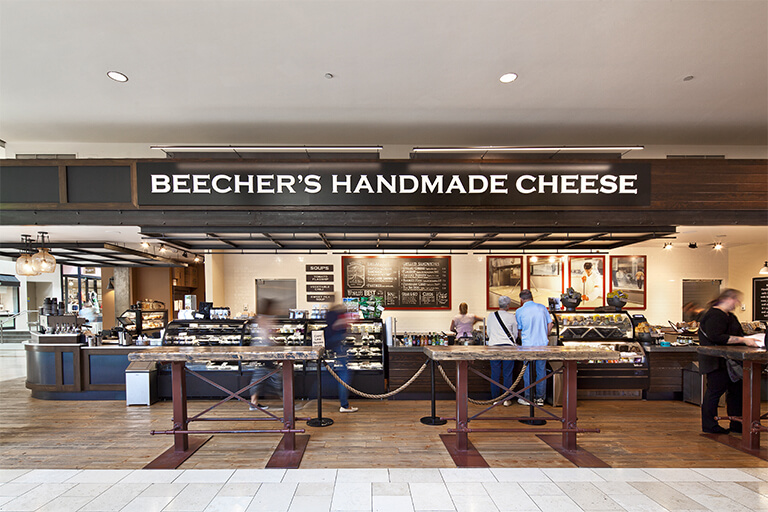
Beecher’s locations serve as vibrant hubs that blend retail, production, and dining, creating immersive experiences that connect customers directly to the cheesemaking process. The flagship spot at Pike Place Market in Seattle, located at 1600 Pike Place, remains the pulsating core since 2003. Amid the market’s lively vendors and tourists, its glass-enclosed kitchen lets visitors watch artisans craft cheese in real time, from curd cutting to pressing. The adjoining café buzzes with offerings like gooey grilled cheese on artisan bread baked fresh daily, hearty tomato flag soup laced with Flagship cheese, and the legendary mac & cheese that often sees queues snaking down the block. Fresh cheese curds, still warm and delightfully squeaky, are a top seller here, alongside annual sales exceeding 200,000 pounds of Flagship. Open from 9 a.m. to 7 p.m. daily, it also hosts pop-up events and tastings that celebrate local Pacific Northwest flavors.
Shifting eastward, the Bellevue Square café at 575 Bellevue Square brings an upscale suburban flair to the mix, nestled within the Bellevue Collection shopping center. This location emphasizes educational pairings, such as cheese and wine flights featuring Washington varietals, and regularly schedules cheesemaking classes where participants learn to create their own batches. The menu mirrors Pike Place but adds seasonal salads and charcuterie boards, catering to shoppers and families. Hours run from 10 a.m. to 9 p.m. most days, making it a go-to for after-work gatherings.
Further afield, the Paine Field Airport outpost in Everett provides convenient grab-and-go options for travelers at the Everett Paine Field Passenger Terminal. Here, the focus is on portability: think pre-packaged cheese flights, quick soups like the tomato bisque, and portable snacks infused with Beecher’s varieties. It’s ideal for those catching flights, with extended hours from 5 a.m. to 10 p.m. to accommodate early birds and late arrivals.
The Overlake site, situated at 1035 116th Avenue Northeast in Bellevue’s Overlake Medical Center, targets a professional crowd in the tech-heavy neighborhood. Open weekdays from 6 a.m. to 7 p.m. and weekends from 7 a.m. to 6 p.m., it specializes in efficient lunches like paninis and salads, plus corporate gifting services with customized cheese assortments. Local sourcing shines through, incorporating Northwest produce and Washington wines into pairings.
Beecher’s has expanded its reach to airport locations beyond Washington, including Los Angeles International Airport (LAX) at Terminal B, Gate 148, where travelers can snag quick bites amid layovers, and Salt Lake City International Airport (SLC) at Concourse A, Gate 6, offering similar grab-and-go cheeses and meals. Though the New York City Flatiron District store closed in 2022, its influence persists through robust online sales and a user-friendly app for mobile ordering and recipe suggestions. Nationwide distribution via grocers like Murray’s Cheese and Whole Foods ensures accessibility, while each physical space hosts community events— from cheese history lectures to kid-oriented workshops on dairy origins—reinforcing Beecher’s ethos of education and local ties.
Accolades: Recognition on the Global Stage
Beecher’s cheeses have amassed a formidable collection of honors, affirming their place among elite artisan producers and highlighting the brand’s consistent excellence. Early triumphs set the tone: In 2007, Flagship clinched the Best Cheddar award at the American Cheese Society (ACS), while Marco Polo secured gold at the World Cheese Awards for its peppercorn-infused innovation. That same year, Beecher’s earned first place at the American Cheesemaker Awards and a prestigious runner-up for Best in Show at the ACS conference, standing out among 1,207 entries. Marco Polo followed up with another top honor in 2008 at the World Cheese Awards.
The momentum continued with Flagship Reserve emerging as a perennial favorite, winning its category 12 times in 18 years at the ACS and nabbing second place Best of Show in 2007. In 2009, it took second at the ACS, and by 2012, Beecher’s was hailed as the nation’s best by outlets like The Seattle Times. Media endorsements amplified the buzz—Oprah Winfrey spotlighted the mac & cheese in her “Favorite Things” list, praising its unparalleled creaminess, while The New York Times and The Washington Post lauded its rich texture. Cheese expert Laura Werlin described Flagship as “everything a cheddar should be—and more” in her writings, and appearances on The Martha Stewart Show further elevated the brand’s profile.
Recent years have brought fresh victories: In 2024, Flagship Reserve was named the top U.S.-made cheese by the ACS and placed third in Best of Show overall, competing against international entries including those from Quebec. By 2025, Beecher’s racked up over 66 ACS awards, including first place for plain cheese curds, multiple category wins, and bronzes for varieties like SheepSheep in hard ewe’s milk. The World Cheese Awards in 2025 recognized SheepSheep with bronze as well. These accolades, spanning from bronzes in 2005 for early offerings to ongoing innovations like New Woman, underscore founder Kurt Beecher Dammeier’s vision: proving that high-volume, transparent artisan cheesemaking can rival small-batch specialists on the world stage.
Philanthropy: Nourishing Minds and Bodies
Beecher’s extends its impact far beyond the cheese counter through The Beecher’s Foundation, which channels a portion of sales into meaningful community initiatives. At its heart is the Food Detectives program—formerly known as Pure Food Kids—a free, interactive nutrition education effort launched in 2005 that has engaged over 15,000 students, initially in Seattle but now expanding nationwide. Designed for fourth graders, it uses STEM-based workshops with animations, puzzles, and “secret missions” to teach critical skills like reading nutrition labels, scrutinizing ingredients, and spotting deceptive marketing tactics from the food industry.
The program’s reach addresses pressing issues: With childhood obesity affecting one in five U.S. kids (a rate that has tripled since the 1970s), and nearly 70% of children’s calories coming from highly processed foods amid $2 billion in targeted marketing, Food Detectives empowers participants without judgment or fad diets. Teachers report transformative outcomes—students checking labels at home, discussing sugar content during lunch, and applying lessons to real-world choices. Available for classrooms via easy online login for smartboard-compatible lessons, it also includes an upcoming at-home STEM game for families to analyze foods interactively.
Testimonials from educators in places like South Milwaukee, WI; the Bronx, NY; and various Washington locales highlight its effectiveness, fostering lifelong habits. Aligning with Beecher’s pillars of flavor, purity, transparency, and community, Dammeier’s portfolio of businesses donates 1% of sales annually, ensuring sustained support. As of 2026, the foundation continues to evolve, with blog resources offering bonus experiments and tools to promote critical thinking about food in schools and homes.
Culinary Inspirations: Recipes That Shine
Beecher’s sparks creativity in the kitchen with a repertoire of recipes that showcase their cheeses’ versatility, turning simple ingredients into elevated dishes. The iconic “World’s Best” Mac & Cheese starts with penne pasta in a velvety sauce of grated Flagship cheese, milk, flour, butter, and a hint of chipotle chili powder for subtle heat, baked until bubbly and golden for ultimate comfort.
For a spicy twist, Mariachi Mac & Cheese amps up the base recipe by incorporating roasted poblano and jalapeño chilies, corn, and bell peppers, with Flagship melting into a creamy, veggie-packed delight that’s perfect for gatherings. Butternut Squash Mac & Cheese adds autumnal flair, blending pureed squash into the Flagship sauce for a naturally sweet, nutritious variation that balances richness with veggie goodness.
Pesto Mac & Cheese infuses fresh basil pesto into the mix, creating a herbaceous, garlicky profile where Flagship’s nuttiness complements the greens for a summery spin. On the bolder side, Red Fresno Sriracha Mac & Cheese heats things up with diced Fresno chilies and sriracha, folding into the cheese sauce for a fiery kick that pairs well with cool sides.
Beyond pasta, Hasselback Potatoes Gratin layers thinly sliced potatoes with generous shreds of Flagship, baked in cream and herbs for a crispy-edged, cheesy centerpiece ideal for holidays. For something unexpected, No-Bake Super-Light Cheesecake combines Flagship with mascarpone in a light, tangy filling over a graham crust, topped with fruit for a refreshing dessert that highlights the cheese’s subtle sharpness.
These ideas, drawn from Beecher’s blog “The Cheese Wire,” encourage pairings like Flagship with honey-drizzled nuts on charcuterie boards or melted Just Jack in quesadillas, while recipes for baked ziti or soups demonstrate endless adaptability, inspiring home cooks to experiment with pure, bold flavors.
Looking Ahead: Innovation and Sustainability
As Beecher’s enters its third decade, the future brims with potential. Sustainability initiatives, like farm investments and waste reduction, ensure longevity. New products, perhaps plant-based alternatives or global spice infusions, loom on the horizon. Yet, the essence remains: handcrafted cheese that honors tradition while embracing change.
In a world of mass-produced foods, Beecher’s stands as a reminder of craftsmanship’s power. From Pike Place’s vats to your table, each bite tells a story of dedication, flavor, and community.