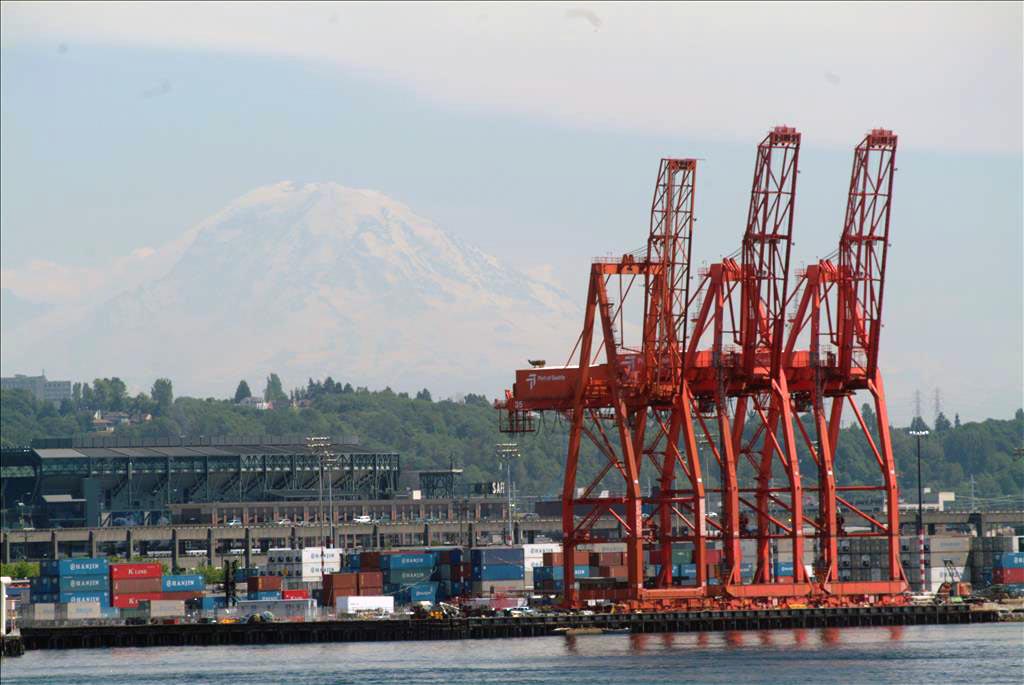
Every morning, long before most Seattle residents pour their first coffee, massive container ships glide into Elliott Bay, their hulls riding low under the weight of goods that will soon stock shelves across America. Above, cargo planes descend through the Pacific Northwest’s famous clouds, their bellies packed with electronics, pharmaceuticals, and time-sensitive freight connecting Asian manufacturers to North American markets. This is the Port of Seattle at work—a sprawling, complex operation that makes the city one of North America’s most vital gateways for international trade.
The numbers tell part of the story. The Northwest Seaport Alliance, the joint cargo operation between Seattle and Tacoma ports, handled nearly $76 billion in waterborne trade with 176 trading partners globally in 2024. Marine cargo operations support more than 52,000 jobs and drive $14 billion in business output for Washington state. Seattle-Tacoma International Airport processes more than 456,000 metric tons of air cargo annually, ranking 19th in air cargo volume across North America.
But statistics can’t capture the fundamental role the Port plays in shaping Seattle’s identity and economy. This is infrastructure that touches everything—the coffee shipped from Latin America to Starbucks’ headquarters, the automobiles arriving from Asian factories, the agricultural products from Eastern Washington farms destined for dining tables in Tokyo, the tech components flowing to and from Microsoft and Amazon. Understanding the Port of Seattle means understanding how a city on the edge of the continent became central to global commerce.
The Northwest Seaport Alliance: Partnership by Necessity
The creation of the Northwest Seaport Alliance in 2015 represented unprecedented cooperation between Seattle and Tacoma—two cities that had competed for maritime cargo for more than a century. The partnership merged the cargo operations of both ports under unified management while maintaining separate governance structures, creating the first marine cargo operating partnership of its kind in North America.
The arrangement has proven both economically and operationally successful, establishing the combined north-south harbors as the seventh-largest container gateway in the United States. The alliance handles approximately 3.3 million twenty-foot equivalent units annually—TEUs in industry parlance, the standardized containers that stack like giant Lego blocks on ship decks. Each TEU can carry anything from Korean electronics to Colorado grain, Chilean wine to Chinese manufacturing equipment.
Seventeen international container carriers provide regular weekly service to key markets in Asia, Europe, Central and South America, and Oceania. Eighteen regularly scheduled liner services connect cargo to 63 direct international ports of call. This network creates remarkable efficiency—a manufacturer in Shenzhen can ship products that arrive in Seattle within two weeks, then travel by rail to distribution centers in Chicago or Memphis within days.
The 2024 performance demonstrated the alliance’s resilience. Container volumes finished strong at 3,340,733 TEUs, up 12.3% over 2023. Full imports increased 19.6%, while full exports grew 8.1%. These figures reflect broader trends in American consumption and production—the country imports more than it exports by value, though the tonnage equation often reverses since exports tend toward bulk agricultural products and raw materials while imports concentrate on manufactured goods.
Terminal 5’s Phase 2 modernization project, completed in March 2024, expanded capacity to 185 acres and added six state-of-the-art super-post Panamax cranes capable of handling ultra-large vessels. These cranes, towering over Elliott Bay like mechanical giraffes, can reach across ships carrying 18,000 TEUs—vessels longer than the Space Needle is tall, wider than a football field, and capable of carrying more cargo than most ports handled annually just decades ago.
The Geography of Trade: What Moves Where
The Port’s trade statistics read like an inventory of global interdependence. China dominates both import and export volumes—unsurprising given the country’s manufacturing dominance and massive population. But the breakdown reveals nuance beyond simple U.S.-China trade dynamics.
Imports arriving through the alliance come heavily weighted toward consumer goods: electronics, apparel, furniture, toys, and household items manufactured in Asian factories. These products reflect American consumption patterns and the offshoring of manufacturing that accelerated over the past four decades. Walking through a Target or Costco, the majority of products probably arrived through container ports like Seattle-Tacoma.
Exports tell different stories. Agricultural products dominate—soybeans, wheat, hay, and specialty crops grown in Eastern Washington, Idaho, and beyond. The Terminal 86 grain facility in Seattle exports approximately 5 million metric tons of grain annually, feeding livestock and people across Asia. Oil seeds like rapeseed, used for canola oil, flow to processing plants in China and Japan. These bulk agricultural exports move in specialized ships different from container vessels, loaded through massive grain elevators that can fill holds with thousands of tons in hours.
Breakbulk cargo—items too large or oddly shaped for containers—includes aerospace components (Boeing remains a major factor), heavy machinery, steel products, and project cargo for major construction. The Port handles automobiles arriving from Asian manufacturers, helicopters bound for oil industry operations, and wind turbine components destined for renewable energy projects.
Domestic cargo represents about 25% of total volume, primarily serving Alaska and Hawaii. The alliance handles more than 80% of containerized ocean shipments between Alaska and the Lower 48 states. This domestic trade carries everything from building materials to food supplies, connecting isolated communities to continental supply chains.
The Air Cargo Advantage: Speed Versus Cost
While maritime cargo moves in massive volume at relatively low cost, air cargo prioritizes speed and handles time-sensitive, high-value goods. Seattle-Tacoma International Airport’s 456,289 metric tons of air cargo (2022 figures) may seem modest compared to maritime volumes, but air cargo’s economic value per ton far exceeds ocean shipping.
SEA Airport’s Pacific Northwest location makes it an ideal gateway between Asia and North America. The geographic positioning—roughly equidistant from Tokyo and London—provides competitive flight times to both continents. Airlines can route cargo through Seattle efficiently whether it’s destined for East Coast markets or continuing to European destinations.
Multiple nonstop freighter services supplement belly cargo capacity on passenger flights. Airlines like Lufthansa, Air France, British Airways, and multiple Asian carriers operate wide-body aircraft on routes to Seattle, providing substantial cargo space beneath passenger cabins. As passenger travel to Asia has expanded over the past decade, belly cargo capacity has increased correspondingly, creating opportunities for freight forwarders and logistics companies.
The air cargo market serves distinct niches: electronics and semiconductors requiring rapid delivery, pharmaceuticals with temperature sensitivity and shelf-life concerns, fresh seafood moving from Alaska processing facilities to global markets, e-commerce shipments feeding America’s addiction to next-day delivery, and automotive parts supporting just-in-time manufacturing processes.
The International Arrivals Facility, which opened in 2020 after years of construction, dramatically improved processing capacity for international passengers and indirectly benefited air cargo operations. The nearly $1 billion facility increased international gate capacity from 12 to 20, enabling more wide-body aircraft service that carries both passengers and freight.
Each new international route generates approximately $74 million in annual economic impacts to the region, according to consultant studies. Routes to cities like Singapore, Tokyo, Seoul, Shanghai, Paris, London, and Dubai create networks that benefit both passenger travel and cargo logistics. When Delta launches service to Osaka or Cathay Pacific adds Hong Kong flights, cargo opportunities follow passenger demand.
The Infrastructure Challenge: Building for Tomorrow’s Trade
The Port faces constant pressure to modernize infrastructure that must accommodate ever-larger vessels, increasing cargo volumes, and evolving environmental standards. Terminal modernization requires hundreds of millions in investment. Cranes capable of servicing 18,000-TEU ships cost tens of millions each. Rail infrastructure connecting terminals to transcontinental railways requires continual upgrades as train lengths and volumes increase.
Elliott Bay’s natural depth—600 feet in places—provides advantage over many competing ports that require regular dredging to accommodate modern vessels. If the Space Needle sat on the bay floor, only its tip would break the surface. This geological gift saves millions in maintenance costs while enabling the Port to handle the deepest-draft ships without restriction.
But natural advantages only go so far. Terminals need constant investment in paving, lighting, security systems, gate operations, and information technology that tracks containers from ship to truck or rail car. The alliance must balance infrastructure spending against competitive pressures from other West Coast ports—Los Angeles, Long Beach, Oakland—all competing for the same cargo flows.
Labor relations add complexity. Longshoremen represented by the International Longshore and Warehouse Union negotiate contracts that determine wages, working conditions, and operational procedures. Contract negotiations can create uncertainty that drives cargo to competing ports, as shippers avoid potential disruption from labor disputes. The Port must maintain productive relationships with labor while meeting shipper expectations for reliability and efficiency.
Environmental regulations increasingly shape Port operations. Washington’s commitment to carbon reduction affects everything from shore power for docked ships to equipment electrification to restrictions on diesel emissions. The Port has invested in becoming one of the greenest maritime operations in North America, but environmental leadership costs money and requires operational changes that can slow cargo velocity in the short term even while providing long-term benefits.
Truck traffic around terminals creates congestion that neighborhoods tolerate poorly. Rail movements require coordination with freight operators who prioritize their own schedules and customers. Every operational decision affects communities beyond the Port’s boundaries, requiring balancing economic benefits against quality-of-life impacts.
The Economics of Dependency: Trade’s Regional Impact
Washington state’s economy depends on trade to a degree that few residents fully appreciate. Forty percent of jobs in Washington connect to trade—an astonishing figure that reveals vulnerability alongside opportunity. When trade volumes decline, employment follows. When tariffs or trade disputes disrupt flows, regional economic impacts ripple far beyond Port facilities.
The 2024-2025 tariff situation demonstrates this fragility. As the Trump administration imposed tariffs ranging up to 145% on Chinese imports, speculation about “ghost town” ports circulated on social media. While those specific claims proved false—multiple cargo ships remained operational—the concerns reflected real anxiety about trade policy’s regional economic effects.
Port officials acknowledged that while volumes remained strong in early 2025, forecasts predicted 25% monthly declines over subsequent months as tariff impacts materialized. Container ships arriving with 30% less cargo than anticipated signaled shifting trade patterns. Canceled export orders left businesses scrambling to find alternative markets for products designed for Chinese consumers.
These disruptions affect far more than Port employees. Truck drivers hauling containers, warehouse workers processing goods, rail operators moving freight inland, customs brokers facilitating imports, freight forwarders coordinating logistics, packaging manufacturers, equipment maintenance providers—an entire ecosystem depends on steady cargo flows.
Agricultural communities in Eastern Washington feel trade disruptions acutely. When China retaliates against U.S. tariffs by restricting agricultural imports, wheat and soybean farmers lose markets they’ve cultivated for decades. These aren’t abstract economic concepts but family farms facing revenue loss that can force generational businesses into bankruptcy.
Technology companies shipping components and finished products through the Port face supply chain disruptions that affect production schedules and customer commitments. The just-in-time manufacturing model that dominates modern industry assumes reliable, predictable cargo flows. When tariffs, trade disputes, or other disruptions interrupt those flows, companies must either absorb costs or pass them to customers as price increases.
The Future Landscape: Challenges and Adaptations
Several trends will shape the Port’s evolution over coming decades. Climate change affects everything from sea level rise threatening coastal infrastructure to changing precipitation patterns affecting the agricultural products that comprise major export categories. The Port must plan for infrastructure that remains functional as water levels change and storm intensity increases.
Automation represents both opportunity and challenge. Automated terminals can operate 24/7 with greater efficiency and lower operating costs than labor-intensive operations. But automation eliminates well-paying union jobs, creating political and social challenges even when economic logic favors technological adoption. The Port must balance operational efficiency against community impacts and labor relations.
Competition from other ports never eases. Los Angeles-Long Beach’s massive scale creates economies that Seattle-Tacoma struggles to match. Oakland’s proximity to Silicon Valley provides advantage for technology cargo. Canadian ports in Vancouver and Prince Rupert offer alternatives for Asian cargo destined for North American markets, with Vancouver in particular positioning itself aggressively for trans-Pacific trade.
Changing trade patterns as manufacturing diversifies beyond China create both risk and opportunity. As companies pursue “China plus one” strategies, establishing production in Vietnam, Thailand, Indonesia, and India, Seattle’s traditional shipping patterns must adapt. New routes, different cargo mixes, and altered volumes require flexible infrastructure and operational models.
E-commerce growth drives demand for rapid cargo processing and distribution. Amazon’s presence in Seattle creates both demand for cargo services and pressure for faster, more efficient operations. The growth of direct-to-consumer shipping bypassing traditional retail channels affects cargo types, handling requirements, and distribution patterns.
Sustainability pressures will only intensify. Shippers increasingly demand carbon-neutral or carbon-negative logistics. The maritime industry faces regulations requiring cleaner fuels, emissions reductions, and operational changes that minimize environmental impact. Ports that lead in sustainability may gain competitive advantage as corporate commitments to carbon reduction shape logistics decisions.
The Alliance Model: Template or Exception?
The Northwest Seaport Alliance’s success raises questions about whether similar partnerships could benefit other port systems. The San Francisco Bay Area, with Oakland, San Francisco, and other ports potentially benefiting from coordination. Southern California, where Los Angeles and Long Beach could theoretically cooperate despite fierce competition. East Coast port systems where multiple smaller ports compete within regional markets.
But Seattle-Tacoma’s partnership emerged from specific circumstances: geographic proximity, complementary rather than identical facilities, political will to overcome historical rivalries, and recognition that competition from California ports threatened both unless they cooperated. Those conditions may not exist elsewhere.
The alliance’s governance structure—separate port commissions maintaining authority while joint management operates cargo facilities—requires sustained political commitment and operational discipline. Tensions inevitably arise when decisions benefit one harbor over another, or when community impacts from cargo operations affect one city more than the other.
Whether the alliance becomes a template for port cooperation elsewhere or remains an exception reflecting unique Pacific Northwest circumstances, it has demonstrated that historical competitors can collaborate when economic necessity demands it.
Historical Foundations: How Seattle Became a Pacific Gateway
The Port of Seattle’s emergence as a major trade gateway wasn’t inevitable. San Francisco had gold rush prosperity and established connections. Los Angeles boasted superior climate and proximity to Southern California’s growing population. Vancouver offered a deepwater harbor without international borders complicating Canadian trade.
But Seattle had advantages that proved decisive. The city’s location at the terminus of transcontinental railroads connected it to markets across North America. The completion of the Panama Canal in 1914 made Seattle accessible to East Coast ports without the lengthy voyage around South America. Most importantly, Seattle’s business and political leaders recognized that port infrastructure would determine the city’s economic future and invested accordingly.
The Port was founded in 1911 by a vote of the people as a special-purpose government—a structure that gave it authority to issue bonds, acquire land, and make long-term infrastructure investments without depending on annual city budget appropriations. This independence allowed strategic thinking beyond election cycles, enabling projects that might take decades to show returns.
Japan Airlines’ arrival in 1959, establishing the first international carrier service at Sea-Tac, signaled Seattle’s growing importance as a Pacific Rim gateway. The timing coincided with Japan’s postwar economic recovery and the beginning of trans-Pacific trade relationships that would reshape global commerce. Those early Tokyo flights carried business executives negotiating deals that would eventually move millions of tons of cargo through Seattle’s marine terminals.
The 1962 Seattle World’s Fair accelerated airport expansion and enhanced the city’s international profile. Infrastructure projects completed for the fair—runway extensions, terminal improvements, highway connections—created capacity that supported subsequent growth. The fair itself, visited by millions, established Seattle as a forward-looking city open to global engagement.
Boeing’s dominance in aerospace manufacturing created cargo flows and business connections that benefited the Port. When Boeing delivered 707s to airlines worldwide, executives visited Seattle, creating relationships that extended beyond aircraft sales to broader trade partnerships. The company’s supply chain—components arriving from global suppliers, finished aircraft departing for customers on every continent—ran through Port facilities.
The Technology Connection: How Digital Giants Use Analog Infrastructure
Microsoft and Amazon’s growth transformed Seattle into a global technology hub, but even digital-first companies depend on physical logistics. Microsoft ships Xbox consoles, Surface devices, and server equipment through the Port. Amazon’s e-commerce empire requires massive cargo flows—products manufactured in Asia, shipped through Seattle-Tacoma, then distributed to fulfillment centers serving the entire western United States.
Amazon’s presence has pushed cargo velocity expectations upward. The company’s commitment to rapid delivery creates pressure for faster terminal operations, quicker customs clearance, and seamless transfer from ships to trucks or trains. Other shippers benefit from improvements driven by Amazon’s scale and demands.
Technology companies also shape air cargo patterns. When Apple launches new iPhones manufactured in China, cargo planes deliver initial shipments to meet demand surges. Microsoft’s cloud computing expansion requires server components that arrive on dedicated flights. The region’s tech industry creates demand for specialized cargo handling—climate-controlled warehouses, secure facilities, rapid processing that minimizes inventory costs.
The symbiotic relationship between tech companies and the Port extends beyond logistics. Microsoft and Amazon employees traveling to Asia for business use Sea-Tac’s international routes. Their purchasing power supports the restaurants, hotels, and services that cluster around the airport. Tech wealth has funded civic improvements and cultural institutions that make Seattle attractive to international business visitors.
Technology has also transformed Port operations. Container tracking systems using GPS and RFID tags provide real-time visibility into cargo locations. Automated gate systems speed truck processing. Predictive analytics help optimize crane operations and yard management. The Port may move physical goods, but software increasingly determines how efficiently those goods move.
The Alaska Connection: Lifeline to the North
The alliance’s role as the primary maritime gateway to Alaska deserves specific attention. More than 80% of containerized ocean cargo between Alaska and the Lower 48 states moves through Seattle-Tacoma terminals—a percentage that reflects both geographic logic and decades of established relationships.
Alaska’s economy depends on reliable cargo service. Construction materials for building projects across the state arrive through the Port. Food supplies for communities not connected to road systems ship north, then transfer to smaller vessels or aircraft for final delivery. Mining equipment, fuel, vehicles, consumer goods—essentially everything Alaskans use but don’t produce locally travels through Seattle.
Return cargo includes seafood from Alaska’s fishing industry—salmon, halibut, crab, pollock destined for processors and markets worldwide. The seasonal nature of fishing creates cargo surges that terminals must accommodate through flexible operations and adequate capacity. Cruise passengers returning from Alaska voyages often carry seafood purchased during their trips, creating additional air cargo as they ship frozen fish home from Sea-Tac.
The Alaska trade represents stability. Unlike international cargo subject to trade disputes and shifting manufacturing patterns, Alaska needs the same essential supplies year after year. Population growth and economic development in the state increase cargo volumes predictably. This domestic trade provides steady base volume that supports terminal operations and employment even when international flows fluctuate.
Military logistics add another dimension. Joint Base Lewis-McChord, one of the largest military installations on the West Coast, uses the Port for equipment shipments supporting operations across the Pacific. When military units deploy or return, their vehicles and equipment often move through Seattle-Tacoma facilities. This government cargo provides additional volume while serving national security interests.
The Environmental Paradox: Green Port, Carbon-Intensive Trade
The Port of Seattle has positioned itself as one of North America’s greenest maritime operations. Shore power connections allow docked ships to shut down diesel generators and plug into the electrical grid. Equipment electrification replaces diesel-powered terminal vehicles with battery-electric alternatives. Sustainable building practices guide construction projects. Habitat restoration efforts address decades of environmental damage from industrial operations.
These initiatives demonstrate genuine commitment to environmental stewardship. But they also highlight an uncomfortable truth: international trade is inherently carbon-intensive. Ships burn bunker fuel—heavy, dirty petroleum that would be illegal for land-based operations. Cargo planes consume jet fuel at extraordinary rates. Trucks hauling containers produce emissions. Warehouses require climate control.
The environmental paradox creates tension between the Port’s role as economic engine and its sustainability commitments. Trade generates prosperity, but that prosperity comes with environmental costs that climate change makes increasingly unacceptable. The Port can optimize its own operations, but it can’t eliminate the fundamental carbon footprint of moving goods around the globe.
Emerging solutions offer hope without eliminating the paradox. Liquefied natural gas propulsion produces fewer emissions than traditional bunker fuel. Hydrogen fuel cells could eventually power zero-emission ships. Sustainable aviation fuels reduce air cargo’s carbon intensity. Shore power connections and equipment electrification cut emissions at terminals.
But these solutions require massive investment and industry coordination beyond any single port’s control. International shipping regulations move slowly. Airlines prioritize costs over emissions. Until carbon pricing or regulations force change, environmental improvements will be incremental rather than transformative.
The Port’s environmental leadership matters less for immediate emissions reductions than for demonstrating feasibility. When Seattle shows that shore power works, that equipment electrification is practical, that sustainable operations can be cost-effective, other ports gain confidence to make similar investments. Leadership accelerates industry transformation even when local impacts remain modest.
Connecting the Region to the World
Beyond cargo statistics and economic impacts, the Port represents Seattle’s connection to the broader world. When Japanese, Korean, Taiwanese, and Chinese ships dock in Elliott Bay, they carry more than manufactured goods. They represent commercial relationships, cultural exchanges, and interdependencies that transcend simple buyer-seller transactions.
The agricultural products flowing through the Port feed livestock and people across Asia, creating food security that benefits political stability. The consumer goods arriving in containers enable living standards that most Americans take for granted. The aerospace components, technology products, and specialized equipment moving in both directions support industries that define modern economies.
Trade creates vulnerability—dependency on foreign manufacturers, exposure to global economic disruptions, sensitivity to trade policy changes. But it also creates prosperity, efficiency through specialization, and connections that make war less likely between trading partners. The Port of Seattle facilitates both the benefits and the risks of participation in global commerce.
Cultural connections follow commercial relationships. Business executives traveling between Seattle and Asian cities build understanding that transcends trade. Students studying abroad, families visiting relatives, tourists experiencing different cultures—all benefit from transportation infrastructure that trade demands support. The routes exist because cargo volumes justify them, but passengers benefit from that same connectivity.
The Port’s workforce reflects global connections. Immigrants from Asia, Latin America, and beyond work in terminal operations, freight forwarding, customs brokerage, and logistics. These workers bring language skills, cultural knowledge, and personal connections that facilitate international commerce while enriching the region’s diversity. A longshoreman from the Philippines brings different perspectives than a fourth-generation Seattle native, and both contribute to operations that serve global supply chains.
Community organizations leveraging the Port’s international connections promote educational exchanges, cultural programs, and economic development initiatives. The Port partners with trade promotion organizations devoted to strengthening relationships with trading partners while fostering connections with emerging economies. These partnerships create opportunities that extend far beyond cargo volumes into realms of education, culture, and civic engagement.
As Seattle continues evolving from regional city to globally significant technology and trade hub, the Port’s role becomes more rather than less important. The city’s prosperity increasingly depends on connections the Port enables—whether moving physical goods or supporting business relationships that spawn from trade partnerships.
The cranes will keep swinging, the ships will keep calling, the planes will keep landing, and the containers will keep moving. Through economic cycles, trade disputes, technological disruptions, and political changes, the Port of Seattle will continue connecting the Pacific Northwest to the world. That connection, built over more than a century and renewed with each ship that calls, defines Seattle as surely as its mountains, forests, and waters.