

Richard Haag moved his office to the site. Not near it—to it. In 1970, when hired to design park for former gasification plant on Lake Union’s north shore, Haag opened on-site office to research and analyze the plant. He spent months walking among rusting towers, pipes dripping residue, contaminated soil releasing petroleum smells, abandoned machinery slowly succumbing to weather and neglect.
Most landscape architects would have surveyed briefly, marked structures for demolition, sketched clean green space. Haag stayed. He measured towers. Examined machinery. Studied how light hit metal at different times of day. Considered what these industrial relics meant—not just as objects to remove but as artifacts to preserve.
His conclusion shocked everyone: save the gas plant.
The public reaction ranged from bewilderment to outrage. Even preservationists who’d fought to save historic buildings called the gas plant “ugly intrusions on the landscape.” City officials who’d purchased the site in 1962 for $1.34 million envisioned erasing industrial past entirely—creating Olmstedian park comparable to Volunteer Park. Myrtle Edwards, city councilwoman who’d spearheaded drive to acquire site, wanted traditional green space. When Haag submitted master plan April 1971 calling for preservation and adaptive reuse of key structures, he met intense resistance.
Paul Goldberger eventually wrote in New York Times that “Seattle is about to have one of nation’s most advanced pieces of urban landscape design. Complex array of towers, tanks and pipes of gas works forms powerful industrial still life… serving both as visual focus for park and as monument to city’s industrial past.”
But in 1971, that sentiment was minority position. Haag had to campaign—speaking to public groups, finding allies in gas company, holding meetings explaining vision. He argued structures possessed “historic, esthetic and utilitarian value.” He described project as “thinning the forest”—editing conglomeration of industrial towers, stacks, pipes, sheds rather than clear-cutting entirely.
The Great Mound—also known as Kite Hill—opened to public August 31, 1973. Park fully opened July 1976. By then it represented perhaps first example of conversion of postindustrial landscape into public park. Haag won American Society of Landscape Architects President’s Award of Design Excellence for project.
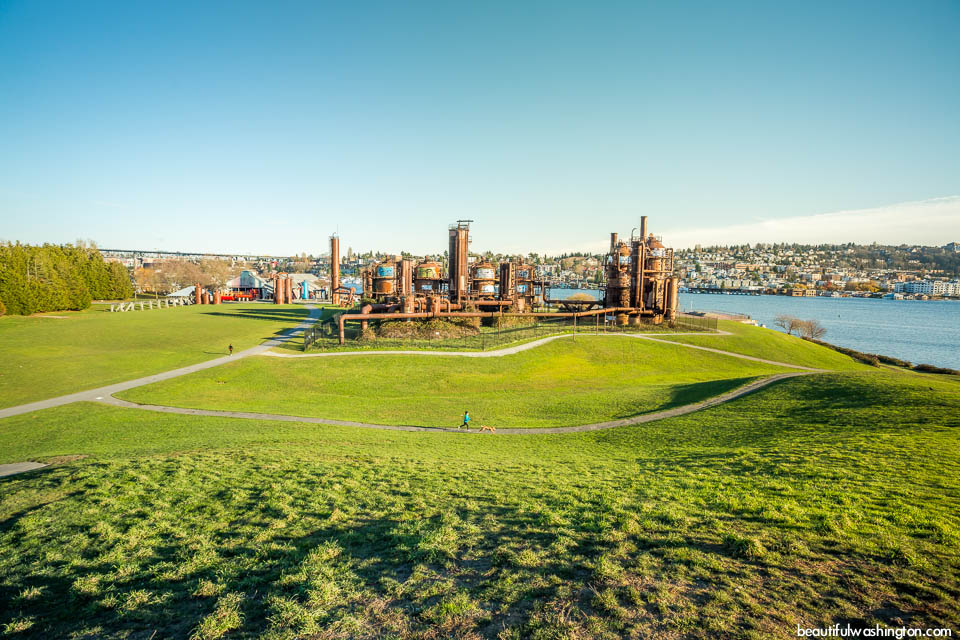
Gas Works Park today is Seattle icon. Nineteen acres on promontory extending into Lake Union. Views of downtown skyline, Space Needle, boats gliding across water. Popular spot for picnics, kite-flying, Seafair Fourth of July fireworks (drawing 20,000+ attendees). Burke-Gilman Trail running through providing bike and pedestrian access. Annual music festivals. Wedding photos. Children playing on brightly painted machinery in former exhauster-compressor building converted to open-air play barn. Families gathering at picnic tables in former boiler house.
But park’s success raises uncomfortable questions. Can you clean toxic site enough for public use without cleaning completely? Should industrial ruins be preserved when they represent environmental damage? Is contaminated soil acceptable under grass if people can’t touch it? When does celebration of industrial heritage become romanticization of pollution?
Gas Works Park’s story isn’t simple triumph of adaptive reuse. It’s ongoing negotiation between preservation and safety, between honoring industrial history and acknowledging environmental damage, between creating public amenity and managing public health risks. Washington State Department of Ecology announced plans 2022 to begin final efforts in soil and shoreline remediation—50-acre area surrounding park, cleanup scheduled to begin 2027, estimated cost $73 million. After 50+ years, park still requires environmental intervention.
The toxic mound where Seattle learned to love its ruins remains toxic.
The Industrial History: From Brown’s Point to Gas Works
Lake Union’s shores hosted sawmills by 1850s taking advantage of dense forests. 1872: Seattle Coal and Transportation Company ferried coal from Renton Hill mines across lake for portage to Puget Sound. 1880s brought Denny sawmill at south end, brick manufacturing, shipbuilding, tannery, ironworks. Canals with small locks cut 1885 from Lake Washington to Lake Union, from Lake Union to Salmon Bay—suitable for transporting logs but not shipping. 1887: Seattle, Lake Shore and Eastern Railway arrived, ensuring Lake Union would continue as industrial development focus.
The site was originally proposed for park in 1903 Olmsted Report. John Charles Olmsted noted: “If not too costly, point of land between northeast and northwest arms of Lake Union and railroad should be secured as local park.” Seattle was grappling with providing essential services to citizens after Klondike Gold Rush tripled population 1900-1910 while considering long-term benefits of designed park system.
But Seattle Gas Light Company—established 1873 by group including Arthur Denny, Seattle founder—had other ideas. Their first plant near Union Station burned down in Seattle fire of 1889. They needed new location. Thaddeus Lowe had discovered 1870s new cleaner and cheaper method for creating gas requiring large amounts of water. Brown’s Point on Lake Union’s north shore provided perfect site.
1900: Seattle Gas Light Company began purchasing lots. 1906: Coal gasification plant went into operation. Construction completed over year. 1907: Plant became Lake Station gas manufacturing plant—largest private utility then existing in Seattle. Small tar company manufacturing tar from coal byproducts began operations adjacent to gas plant same year.
The technology: carbonization of coal producing gas used to illuminate residences and businesses. Over years use expanded to stoves and heating. As Seattle population grew, gas plant expanded meeting increasing demand. By 1930s: 1,071 miles of gas main serving Seattle, Renton, Kent, Tukwila. Company dominated fuel industry.
Early 20th century, plant supplied gas to streetlights throughout city, gave Seattle Gas Light Company name literal meaning—gas lighting streets. Concrete train trestles brought coal cars up elevated tracks, releasing coal into hoppers. Coal fed into retorts where heated without oxygen, producing coal gas. Gas purified, stored in holders, distributed through mains.
1930s: Hydroelectric power introduced to market, beginning erosion of gas company’s dominance. Citizens increasingly complained about negative impacts to environment and health from plant operations. Black smoke. Pollutants released into air and water. But plant continued operations.
Another gas system emerged 1930s using oil rather than coal—cheaper and cleaner. Seattle’s new ship canal made bringing oil through Lake Union possible. Much original structure from 1906 taken down making way for newer structures. Most structures still standing at Gas Works today come from 1937 expansion.
1956: Trans Mountain Gas Pipeline brought natural gas from Canada to Seattle. Lake Station plant obsolete. Operations ceased after 50 years. The plant had done its damage—decades of black smoke, soil contamination, water pollution. Large plot of land left abandoned. Nobody knew what to do. Land around it pretty destroyed.
Richard Haag: The Landscape Architect Who Saw Potential
Richard Haag was born 1923 in Kentucky. Childhood experiences on grounds of father’s nursery and farm in Jeffersontown taught him horticultural and business skills. After serving World War II, studied at University of Illinois, earned bachelor’s degree landscape architecture at UC Berkeley, followed by Master of Landscape Architecture from Harvard Graduate School of Design.
1953: Won two-year Fulbright Fellowship to study in Japan. Resident at American Academy in Rome. Returned to Berkeley becoming associate faculty instructor while practicing landscape architecture.
University of Washington’s College of Architecture and Urban Planning picked Haag to begin landscape architecture program. He arrived Seattle 1958. By 1960, university approved Bachelor of Landscape Architecture program. Haag opened Richard Haag Associates, Inc., acting as lead designer of hundreds of projects until firm closed 2016. He died 2018.
Haag the activist participated in debates on future of Seattle as citizen and professional. Appointed to Seattle Arts Commission 1962. Argued design of public spaces was as important as works of art in public domain. His philosophy would profoundly influence Gas Works Park project.
October 1962: Haag submitted one of handful of proposals for Lake Union Park. His masterplan differed from others fundamentally—he planned to save and use relics onsite rather than haul them to landfill. Myrtle Edwards, who led effort to acquire land for park, opposed Haag’s ideas, advocated for removal of all toxic materials and creation of Olmstedian park comparable to Volunteer Park.
1970: City Council split between two landscape architecture firms—Richard Haag Associates of Seattle and Dan Kiley of Vermont. Unable to break tie, Council gave Kiley larger project (Discovery Park) and Richard Haag received gas works site. The “consolation prize” became his masterpiece.
As Haag studied site, realization emerged: old industrial structures could be incorporated into park design. He described process as “thinning the forest”—selective preservation rather than total demolition. The master plan submitted 1971 met great public resistance. Gas plant seen as eyesore and reminder of polluting past, didn’t fit public perception of what park should be.
Haag began campaign building support. Found ally in gas company. Spoke to interested public and private groups. Held countless meetings. Gradually convinced enough people that project could proceed. Richard Haag Associates opened on-site office—unprecedented move demonstrating commitment to understanding place deeply before redesigning it.
The design philosophy: preserve industrial archaeology, integrate structures into public space, remediate soil using innovative techniques, create multiple experiences (play areas, viewpoints, gathering spaces), honor site’s history while transforming function.
The Bioremediation Challenge: Cleaning Toxic Soil
The contamination was extensive. Decades of coal gasification had saturated soil with petroleum byproducts, heavy metals, carcinogens. Water contaminated. Air contaminated. Everything contaminated.
Traditional approach: remove all contaminated soil, dispose elsewhere, bring in clean fill. Extraordinarily expensive. Would destroy any possibility of preserving structures—foundations and surrounding areas all contaminated. Would turn project into conventional demolition and reconstruction.
Haag worked with soil scientists on bioremediation—using microbes to clean contaminated soil and groundwater. For early 1970s, approach was innovative. Released oil-degrading enzymes in area to stimulate breakdown of toxic contaminants. Through bio-phyto-remediation techniques, soil and water would be “cleaned and greened.”
Results: detoxified most of land. But “most” isn’t “all.” Most toxic materials put in pile covered by clay—that mound known today as Kite Hill or Great Mound. Constructed from on-site excavated material including contaminated soil, covered with clean fill and clay cap, then planted with grass. Earthwork provided practical solution to disposal problem while creating functional prominence with panoramic views of Lake Union and downtown Seattle.
The mound serves multiple purposes: practical recreational space (picnicking, kite-flying, winter sledding), visual prominence elevating landscape, solution to contaminated soil disposal, viewpoint offering unparalleled vistas. But underneath grass and clay: toxic waste. Visitors sunbathe, children roll down hill, dogs run freely—all atop sealed contamination.
Retained structures were capped preventing exposure. Safety ensured without aggressive removal that could disrupt subsurface stability. The approach challenged prevailing modernist landscape tenets favoring clean geometric forms. Instead embraced narrative of industrial excess through layered “thick sections” maintaining stratigraphic integrity.
But bioremediation only went so far. Hazardous sediments in Lake Union make swimming, fishing, wading unsafe. Signage throughout park reinforces restrictions. Visitors advised avoid water contact. The park opened 1975 with known contamination issues. Public health risk considered acceptable given remediation efforts and restricted access to most contaminated areas.
The Structures: Industrial Archaeology as Public Art
Haag’s editing process—”thinning the forest”—preserved specific structures with historic, aesthetic, and utilitarian value:
Coal Gasification Tower: 96-foot-tall icon dominating park. Original 1906 structure standing as monument to industrial process that powered Seattle. Visible from throughout Lake Union, became instantly recognizable landmark. Painted and capped but fundamentally unaltered—preserving authentic appearance while preventing dangerous access.
Boiler House: Converted to picnic shelter complete with tables and fire grills. Former industrial building now hosts family gatherings, birthday parties, summer barbecues. Original architecture preserved—steel beams, industrial brick, high ceilings—creating unique covered space unlike typical park shelters.
Exhauster-Compressor Building: Transformed into open-air play barn housing maze of brightly painted machinery for children. Industrial equipment painted vibrant colors—yellows, reds, blues—became climbing structures, imaginative play environment. Children scramble over pipes, turn wheels, explore machinery. What had been serious industrial production equipment became whimsical playground.
Concrete Train Trestles: Part of original 1906 gas plant running along north side of office and laboratories building. Nothing remains of that building but trestles show where train tracks ended and coal was delivered. Coal cars rode up trestles releasing coal into hoppers parked underneath. Structures preserved as industrial archaeology—educational artifacts explaining site’s history.
Various Towers, Tanks, Pipes: Selectively preserved creating “industrial still life” providing visual focus and monument to Seattle’s industrial past. Some painted, some left weathered, all capped and secured preventing dangerous access while maintaining authentic appearance.
The preservation was deep-cleaned—surfaces scrubbed so people could touch and even play on them. But fundamental character remained: industrial, massive, imposing. The structures don’t apologize for their past or pretend to be something else. They stand as what they are: remnants of coal gasification plant that polluted environment for 50 years.
The Public Response: From Resistance to Acceptance
Initial reaction when Haag’s plan revealed: widespread opposition. “Ugly intrusions on landscape.” “Reminder of pollution.” “Not what park should be.” Even Myrtle Edwards family requested her name removed from park 1972 because design called for retention of plant. In 1976, Elliott Bay Park north of Belltown was renamed Myrtle Edwards Park instead—separating her legacy from controversial Gas Works project.
The resistance made sense. By 1970s, environmental movement had gained momentum. Rachel Carson’s “Silent Spring” published 1962. First Earth Day celebrated 1970. Clean Air Act passed 1970. Clean Water Act 1972. Americans newly aware of industrial pollution’s costs, angry about environmental damage corporations had caused.
And Haag proposed… celebrating industrial ruins? Preserving structures that represented environmental destruction? Using contaminated site for public recreation? The proposal seemed perverse—honoring exactly what environmental movement opposed.
Haag’s counterargument: erasure doesn’t equal understanding. Demolishing plant and creating sanitized green space would be comfortable lie—pretending industrial era never happened, pollution never existed, city’s energy never came from dirty processes. Preserving structures forced confrontation with history. Educational opportunity. Honest acknowledgment of costs accompanying industrial development.
Gradually public opinion shifted. Goldberger’s New York Times piece provided national validation. Awards from landscape architecture professional organizations suggested experts recognized innovation. But most importantly: after Great Mound opened 1973 and full park opened 1976, people used it. Loved it. Brought families for picnics. Flew kites. Took photographs. Held concerts. Gathered for Fourth of July fireworks.
The structures weren’t ugly—they were dramatic. Photogenic. Interesting. Children found them fascinating. Adults appreciated unique character. What had seemed like celebration of pollution revealed itself as complex meditation on history, progress, environmental costs, industrial heritage.
Gas Works Park influenced subsequent brownfield conversions worldwide. Demonstrated viable alternative to total demolition. Showed postindustrial sites could become public amenities without complete erasure. Proved adaptive reuse could work at municipal budget levels. Inspired projects like London’s Tate Modern (power station converted to art museum), New York’s High Line (elevated railway converted to park), Germany’s Landschaftspark Duisburg-Nord (ironworks converted to park).
The Ongoing Contamination: Problem Never Fully Solved
Success story has asterisks. Contamination never completely addressed. The 1970s bioremediation was innovative but incomplete. Kite Hill remains toxic underneath clay cap. Lake Union shoreline remains hazardous. Swimming forbidden. Fishing forbidden. Wading forbidden. Water contact strongly discouraged.
September 2022: Washington State Department of Ecology announced plans beginning final efforts in soil and shoreline remediation. Estimated 50-acre area surrounding park. Cleanup scheduled begin 2027. Estimated cost: $73 million funded by City of Seattle and Puget Sound Energy. Work will help remove contaminants including arsenic, carbazole, dibenzofuran, nickel.
Successful decontamination may allow users official access to waters of Lake Union from park—something currently forbidden due to hazardous sediments. After 50+ years as public park, Gas Works still requires major environmental cleanup. The celebration of industrial heritage coexists with ongoing management of industrial pollution.
The ethical question persists: Should contaminated site be used for public recreation even with restrictions? Haag and supporters argued yes—benefits of unique park, educational value, historical preservation, public access to waterfront outweigh managed risks from capped contamination. Critics argue exposing public to any contamination risk for sake of preserving industrial ruins prioritizes aesthetics over health.
No perfect answer exists. Gas Works Park represents compromise—not full remediation to residential standards (prohibitively expensive) but functional remediation allowing public use with restrictions. The compromise worked for 50 years but requires ongoing investment, monitoring, eventual comprehensive cleanup.
The Safety Debate: Climbing the Ruins
Separate safety issue: climbing. The preserved towers, pipes, catwalks attract climbers—some casual, some serious, some reckless. At least three fatal falls since 2012. Eleven reported injuries alongside fatalities.
September 2025: Seattle Parks and Recreation proposed selective removal of ladders, catwalks, piping, support systems from towers. Framed as emergency measure eliminating access points preventing further unauthorized ascents. The proposal sparked preservation debate.
Proponents of modification argue retained industrial structures pose inherent climbing risks necessitating physical alterations prioritizing visitor safety. Existing barriers and signage proven inadequate—deaths and injuries continue despite warnings.
Opponents contend such interventions would undermine park’s core value as unaltered artifact of early 20th-century industrial engineering. Haag designed park specifically to educate visitors on gasification processes through preserved authentic structures. Removing elements changes historical integrity.
The tension between preservation and safety echoes original 1970s debate about whether to keep structures. Then: question was whether structures had value justifying preservation. Now: question is whether preservation justifies accepting safety risks. The tower modifications proposed 2025 remain under consideration.
The Legacy: What Gas Works Park Means
Fifty years after opening, Gas Works Park stands as one of America’s most influential landscape architecture projects. Not because it’s most beautiful—it isn’t. Not because it’s most popular—many parks receive more visitors. Not because it’s completely successful—ongoing contamination issues prove it isn’t.
Gas Works Park matters because it fundamentally changed how Americans think about postindustrial sites, adaptive reuse, environmental remediation, landscape architecture’s possibilities, historical preservation’s scope, public parks’ purposes.
The park demonstrated cities could acknowledge complicated industrial heritage honestly—neither celebrating pollution nor pretending it never happened. Structures preserved don’t glorify environmental damage—they document it, educate about it, force confrontation with it.
Children playing on painted machinery don’t think about coal gasification’s environmental costs. They’re just having fun. But adults seeing towers against skyline might pause considering: this powered Seattle for 50 years. This polluted Lake Union for 50 years. This represented cutting-edge technology 1906. This became obsolete 1956. This matters enough to preserve. This requires millions to remediate. All these things are true simultaneously.
Gas Works Park refuses simple narratives. It’s toxic and beloved. Contaminated and celebrated. Dangerous and popular. Historical resource and public health concern. Innovative and problematic. The contradictions aren’t flaws—they’re the point. Life in industrial society means living with such contradictions constantly.
The 19 acres on promontory extending into Lake Union contain Seattle’s complicated relationship with its own industrial past—neither condemned nor celebrated uncritically but acknowledged, preserved, managed, enjoyed with understanding that every benefit carries costs, every development leaves marks, every technology becomes obsolete, every solution creates new problems requiring ongoing attention.
Gas Works Park doesn’t solve contradictions between industrial heritage and environmental health. It holds them in tension—uncomfortable, unresolved, honest.