

Ella Bailey sold the land to Seattle for $2,350 in 1929. The sale came with stipulation: property must be used as children’s playfield. Bailey was Seattle school teacher for more than 30 years—someone who understood what children needed, believed outdoor play mattered, wanted her land serving young people after she no longer could.
The city honored Bailey’s condition—sort of. Leased property to Seattle School District for use by Magnolia Elementary School. Built 1927 in Floyd A. Naramore’s signature Georgian Colonial Revival style, school opened two years before Bailey sold her adjacent land. By 1929, 235 students enrolled. Additional space needed. School underwent series of buildouts 1931, 1939, 1941, 1969. Bailey’s playfield served generations of Magnolia children running, playing, learning outdoors as she’d intended.
1984: School closed. Part of district-wide closures addressing earthquake safety issues and demographic shifts—fewer children attending Seattle Public Schools citywide. Magnolia Elementary and Briarcliff Elementary selected for closure. Among factors: Magnolia School having its playground on city land rather than district property. Bailey’s stipulation—meant to protect children’s access—became liability in bureaucratic calculations.
Building used as interim site for several schools during renovations: Adams Elementary 1987-1989, John Muir Elementary 1989-1990, African-American Academy 1993-2000, Franz H. Coe Elementary 2000-2002 after devastating fire. 2002: Magnolia School boarded up. Remained empty. Bailey’s playfield abandoned—asphalt cracking, equipment rusting, weeds claiming ground. For 23 years former school sat deteriorating. For same period playground languished unused—technically fulfilling Bailey’s condition (land still designated for children) while violating its spirit (no children actually using it).
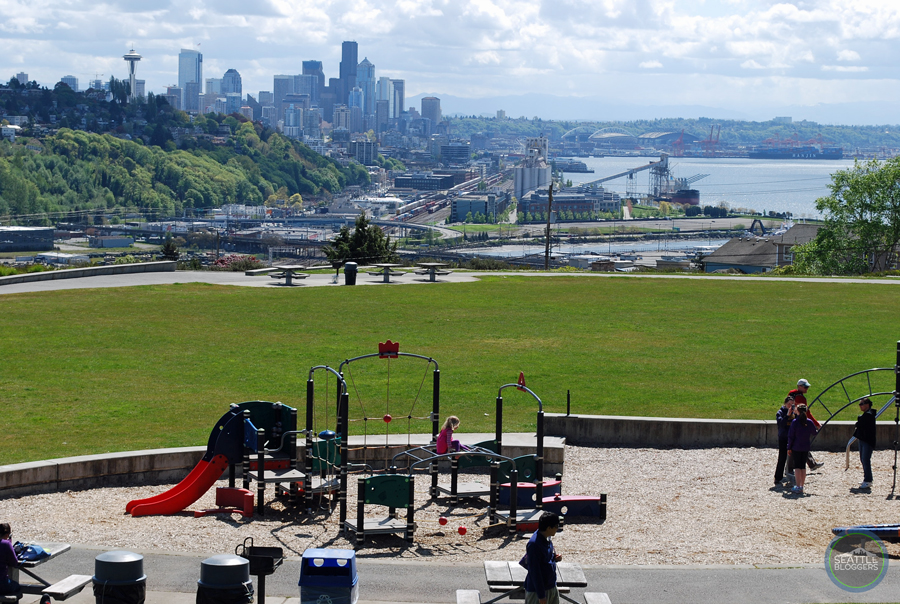
Then transformation: $1.4 million from Pro Parks Levy. Seattle Parks and Recreation partnering with neighborhood. 2007: Ella Bailey Park opened. Derelict asphalt school playground renovated into 2.4-acre public park. Beautiful in its simplicity. Making excellent use of limited space and scenic location. Playground, central lawn, picnic tables, basketball hoops, walking paths, barbecue grills, gently rolling slopes.
But most striking feature: views. Panoramic vistas of downtown Seattle skyline, Space Needle (partial—about half visible past Queen Anne Hill), Great Wheel, stadiums, Elliott Bay, Puget Sound, Alki Beach across water, Cascade Mountains to east, Mount Rainier looming southeast on clear days. One of Seattle’s best viewpoints combined with functional neighborhood park. What sets it apart from Kerry Park and other famous viewpoints: stuff for kids to do. Playground equipment for various ages. Space to run. Basketball. Lawns large enough for picnic blankets and informal games.
2015: Magnolia School granted historic landmark status. Community advocates had spent years asking if city could fund rehabilitation and reopen school. Enrollment projections showed increase of 7,000+ students over next seven years—making it necessary for district to upgrade and open more schools. 2016: Funding secured. Fall 2019: School officially reopened as Magnolia Elementary—restored, renovated, magnificent. Right next to Ella Bailey Park. Creating synergy Bailey likely envisioned 90 years earlier: school and playfield together serving neighborhood children.
Ella Bailey’s condition—property must be used as children’s playfield—required patience. Took 78 years from sale (1929) to park opening (2007). Took 90 years from sale to school reopening (2019). But promise kept, eventually. Her $2,350 land sale created public asset serving Magnolia families, tourists seeking views, photographers capturing Seattle skyline, picnickers enjoying Elliott Bay breezes, children playing exactly as she specified.
The question: Would Bailey recognize her playfield today? Would she approve of porta-potty being only toilet facility? Would she celebrate panoramic views or insist children’s play remains primary purpose? Would she understand why property sat abandoned 23 years? Would she forgive the wait?
Nobody knows. Ella Bailey is gone, record of her life largely absent from available sources beyond basic facts: teacher for 30+ years, landowner on Magnolia Hill, woman who cared enough about children’s outdoor play to attach permanent condition to land sale. But her park endures. Her name graces place families gather, children play, visitors marvel at Seattle’s beauty. The teacher who sold land for $2,350 bought immortality—small, local, unpretentious immortality perhaps, but immortality nonetheless.
The Magnolia Context: Upscale Peninsula with Small-Town Feel
Magnolia is Seattle’s second-largest neighborhood by area—hilly peninsula on western end of city. Named for mistake: Lt. George Davidson conducting survey 1857 misidentified madrone trees as magnolias. Name stuck despite botanical error. The neighborhood’s defining feature: geographic isolation. Connected to rest of Seattle by just three bridges crossing railroad tracks. Isolation created distinct character—small-town feel within major city, close sense of community, residents who choose Magnolia for its separateness.
Fort Lawton established 1897 on Magnolia’s western portion. During World War II: second-largest port of embarkation of soldiers and material to Pacific Theater. Influx of soldiers and workers contributed to number of homes built during that era—many mid-century houses constructed accommodating families electing to stay after war. Fort Lawton housed Army officers into early 2000s. 2011: Officially closed. Most of fort dedicated as Discovery Park 1973—Seattle’s largest park at 534 acres.
Residential Magnolia: beautiful homes, great mix of architectural styles—traditional Craftsman, mid-century modern, new construction. Lawns beautifully landscaped. Property values high. Neighborhood nicknamed “upscale” or “expensive” by real estate descriptions. Downtown retail area (Magnolia Village): cute shops, restaurants, small grocery stores. Beautiful parks beyond Ella Bailey: Discovery Park’s wilderness, Magnolia Playfield’s sports facilities, Magnolia Park’s shoreline access, Ursula Judkins Viewpoint’s vistas.
Great schools: Catherine Blaine School, Lawton Elementary (rebuilt after 1984 closures), now Magnolia Elementary reopened. Middle school children bused to McClure—one of few negatives residents mention about otherwise desirable neighborhood.
Within this context, Ella Bailey Park serves specific function: neighborhood gathering place with unexpected bonus of spectacular views. Not destination park like Discovery Park drawing visitors citywide. Not famous viewpoint like Kerry Park appearing in every Seattle tourism guide. Instead: hidden gem, local favorite, place Magnolia residents take visiting family to impress them, spot parents bring kids knowing playground keeps them occupied while adults enjoy scenery.
The “hidden” quality persists despite online reviews, blog posts, inclusion in Seattle park databases. Geography explains part of it—Magnolia’s isolation means fewer people stumble upon park accidentally. Cultural factors contribute: neighborhood identity built partly on separateness, on being somewhat apart from Seattle’s tourist infrastructure, on maintaining quieter character even as city densifies elsewhere.
Ella Bailey Park embodies this Magnolia identity: high quality but low profile, excellent amenities without crowds, family-oriented without being commercial, scenic without being overrun by Instagram photographers, community-focused while welcoming outsiders who make effort to visit.
The View: What Makes It Special (and Different from Kerry Park)
Kerry Park gets the fame. 1.26 acres on Queen Anne’s south slope. Space Needle perfectly centered, downtown skyline dramatic, Elliott Bay glittering, Mount Rainier hovering. Photographed millions of times. Tour buses stop there. Wedding photographers book sessions there. Instagram filled with identical shots from there. Everyone knows Kerry Park.
Ella Bailey Park offers different experience. View isn’t close-up like Kerry Park’s. Space Needle partially obscured by Queen Anne Hill—can see about half. Downtown skyline more distant. But trade-offs create advantages:
Broader panorama: Ella Bailey’s view encompasses more—full sweep from Cascade Mountains east to Olympic Mountains west, Puget Sound’s expanse, Alki Beach across water, multiple islands, broader sense of Seattle’s geographic setting. Kerry Park focused tightly on downtown and Space Needle. Ella Bailey shows relationship between city and natural surroundings.
Different angle: From Magnolia looking southeast rather than Queen Anne looking south-southwest. Different perspective reveals different aspects—Elliott Bay’s full curve, waterfront’s length, how downtown relates to surrounding neighborhoods.
Mount Rainier prominence: On clear days, Rainier dominates view. 14,411-foot volcanic cone rising dramatically. Distance (about 60 miles) and angle create sense of mountain hovering over city. Photographers waiting weeks for perfect conditions when atmosphere clear enough for sharp Rainier shots.
Fewer crowds: Even on beautiful summer days, Ella Bailey rarely crowded. Handful of families, few photographers, local residents. No tour buses. No jostling for position at railing. Space to spread picnic blanket, let kids run, sit quietly enjoying view without constant movement of strangers.
Functional amenities: Unlike Kerry Park (benches, railing, Changing Form sculpture, limited space), Ella Bailey has playground, basketball hoops, walking paths, barbecue grills, picnic tables, large lawn. Can spend hours there. Kids entertained while adults relax. Option to cook dinner. Space for informal games.
Neighborhood character: Feels like neighborhood park that happens to have spectacular view rather than viewpoint park with some amenities added. Different psychology—place feels welcoming rather than transactional, encourages lingering rather than quick photo-and-leave.
Comparing the two experiences: Kerry Park for dramatic close-up of iconic Seattle imagery—perfect for proving “I was there,” capturing quintessential skyline shot, seeing Space Needle prominently. Ella Bailey Park for broader perspective, quieter enjoyment, combining view with other activities, experiencing Seattle beauty without crowds, understanding city in geographic context rather than as isolated urban skyline.
Both have value. But Ella Bailey rewards visitors differently—requiring more effort to find, offering less immediately recognizable imagery, but providing more contemplative, flexible, family-friendly experience.
The School’s Closure, Limbo, and Resurrection
Floyd A. Naramore designed over thirty Seattle schools in 1920s-1930s. Signature Georgian Colonial Revival style. Magnolia Elementary opened 1927. Elegant brick building. Classic proportions. Built for Grades 1-6, later expanded including Grades 7-8. By 1947: overcrowded, prompting construction of Catherine Blaine Junior High School 1952.
1984 closures hit hard. Citywide demographic shifts—fewer children in Seattle Public Schools. Earthquake safety concerns. Budget constraints. District-wide citizen advisory board process selected schools for closure. Magnolia Elementary chosen partly because playground on city land (Ella Bailey’s parcel) rather than district property—administrative complication in era of consolidation.
Monica Wooton, who served on Magnolia School’s closure committee, explained redistricting aftermath: “Blaine, traditionally Magnolia middle school, became elementary and Lawton Elementary was re-built. Middle school children from Magnolia were (and still are) bused to McClure. New elementary school assignment boundaries were re-drawn, from traditional and long-standing north and south division to east and west one, to help balance schools with comparable student populations.”
The changes fractured Magnolia’s educational identity. Two elementary schools reduced to effectively one (Blaine). Lawton rebuilt accommodating some enrollment but middle school students sent off neighborhood. Magnolia School building—elegant, well-located, architecturally significant—sitting empty while families struggled with reduced capacity.
Interim uses 1987-2002 demonstrated building’s functionality. Various schools used it during their renovations. But 2002: boarded up. Empty. Deteriorating. For 13 years, Georgian Colonial Revival building sat abandoned on 28th Avenue West. Residents passed it daily—reminder of lost neighborhood asset, symbol of district’s failure to maintain capacity, frustration manifested in boarded windows and cracking paint.
Community advocates never stopped pushing. Letters to school board. Advocacy through Magnolia Community Council. Citing enrollment projections showing growth. Arguing neighborhood needed school. Stressing historic preservation value.
July 15, 2015: Landmarks Preservation Board unanimously approved historic landmark status for Magnolia School. Carol Burton, Magnolia Community Council President, wrote letter stressing preservation need. Landmark designation provided protection and potentially funding mechanisms for restoration.
2016: Funding secured. Buildings, Technology and Academics/Athletics IV (BTA) levy approved by voters. State of Washington providing additional funds. Seattle Public Schools committed to reopening as elementary school.
Renovation began. Seismic upgrades. Modern systems. Preservation of historic character—Naramore’s Georgian Colonial Revival detailing maintained. Classrooms updated for contemporary educational standards. Accessibility improvements. Building transformed while respecting 1927 design.
Fall 2019: Magnolia Elementary officially reopened. Magnificent doors opened to students and teachers. Historic landmark restored, functioning, serving purpose. Right next to Ella Bailey Park—creating intended relationship between school and playfield, honoring Ella Bailey’s vision, reuniting pieces separated by decades of closure.
The resurrection mattered symbolically and practically. Symbolically: demonstrated community’s ability to reclaim lost assets, validated preservation advocacy, proved historic buildings could be modernized for contemporary use. Practically: provided needed elementary capacity in growing neighborhood, reduced overcrowding at other Magnolia schools, allowed families to attend school in neighborhood rather than being reassigned elsewhere.
The 2007 Renovation: From Derelict to Gem
2007 transformation of Bailey’s playfield from derelict asphalt schoolyard into Ella Bailey Park represented typical Pro Parks Levy success story. Voters approved levy 2000 providing dedicated funding for park improvements, acquisitions, maintenance. Program invested $1.4 million in Ella Bailey renovation—substantial sum for 2.4-acre neighborhood park, reflecting commitment to creating quality public spaces throughout Seattle neighborhoods.
Seattle Parks and Recreation partnered with neighbors throughout design process. Community meetings. Input on amenities. Balancing desires: some wanted playground emphasized (families with young children), others wanted open space maximized (dog owners, picnickers, kite flyers), others wanted viewpoint enhanced (photographers, residents wanting to showcase Magnolia). Final design balanced competing interests.
The physical transformation: removed cracked asphalt. Addressed drainage issues. Created gently rolling terrain rather than flat expanse—more visually interesting, better for various activities. Installed playground equipment suitable for various ages—structures for toddlers, play sets for elementary-age children, basketball hoops for older kids. Built walking paths—paved surfaces accommodating strollers, wheelchairs, joggers, casual walkers. Added picnic tables and barbecue grills—encouraging longer visits, family gatherings, neighborhood events. Planted grass—large lawn areas for blankets, informal games, sunbathing. Installed drinking fountains. Provided bike racks. Added single handicap parking space at turnaround end of West Smith Street—ensuring accessibility for those with mobility limitations.
Design philosophy: beautiful simplicity. Not ornate or elaborate. Not themed or gimmicky. Just well-executed basic park amenities maximizing site’s natural advantages (topography, views, location) while serving neighborhood needs (children’s play, gathering space, recreational opportunities).
One notable absence: permanent restroom facility. Single porta-potty provided—standard for many Seattle parks but limitation for extended visits, families with young children, anyone preferring indoor plumbing. Nearest alternatives: Bartell’s and Albertsons on 32nd Avenue not too far away (as park blog helpfully noted). Trade-off between infrastructure cost and park character—permanent restroom building requires significant investment, creates maintenance needs, can dominate small park’s appearance.
Opening 2007 represented completion of 78-year journey from Ella Bailey’s 1929 sale to functional public park fulfilling her stipulation. Neighborhood celebrated. Families discovered hidden gem. Word spread through local networks, gradually beyond Magnolia through blogs, reviews, casual mentions.
Park quickly became popular for specific uses:
Daily family visits: Parents bringing children to playground, staying for picnics, making routine of after-school or weekend trips.
Fourth of July fireworks viewing: Elevated position providing excellent vantage for watching Seattle’s fireworks displays over Elliott Bay and downtown. Drawing crowds July 4th—one of few times park experiences significant density.
New Year’s Eve celebrations: Similar to Fourth of July—views of fireworks plus general festive gathering.
Photography sessions: Engagement photos, wedding photos, family portraits—backdrop of Seattle skyline, Mount Rainier, water. Less crowded than Kerry Park making it easier to get clean shots, schedule sessions without competing with other photographers.
Casual hangouts: Residents bringing coffee, sitting at picnic tables, enjoying views without specific agenda—park as daily amenity rather than special destination.
The Hidden Gem Quality: Why It Stays Under-Reported
Ella Bailey Park appears in online databases, reviews, blog posts. Google search returns information. TripAdvisor has listing. Seattle Parks website includes details. Yet it remains “hidden gem”—phrase used repeatedly in descriptions. Why?
Geographic isolation: Magnolia’s three-bridge connection to rest of Seattle. Neighborhood not on way to anywhere else. Don’t pass through Magnolia going somewhere else—must deliberately go to Magnolia. Reduces accidental discovery.
No transit access: Ella Bailey Park not near bus lines. Requires car or significant walk/bike from transit stops. Limits accessibility for tourists and residents without vehicles. Kerry Park reachable by bus—difference matters for spontaneous visits.
Dead-end location: Park on West Smith Street dead-end off 27th Avenue in residential neighborhood. Not visible from main roads. No signage directing visitors from major streets. Must know specifically where to go. Even GPS/maps apps only helpful if you’ve already identified park as destination.
Lack of tourist infrastructure: No tour buses. Not in typical Seattle tourism itineraries. Guidebooks mention Kerry Park, Discovery Park, maybe Magnolia Boulevard viewpoints—Ella Bailey rarely makes cut. Tourism marketing focuses on accessible landmarks, not hidden neighborhood parks.
Modest online presence: Compared to Kerry Park’s millions of Instagram posts, Ella Bailey has fraction. Photos posted tend to come from locals rather than tourists—different sharing patterns. Less viral amplification.
Self-reinforcing cycle: Hidden gem reputation actually helps maintain hidden gem reality. People who visit tell friends “I found this amazing hidden park” rather than broadcasting widely. Maintains slightly secretive quality—place insiders know, outsiders discover through deliberate research or local guidance.
Neighborhood preference: Some Magnolia residents genuinely appreciate park not being overrun. Not actively concealing it but not promoting aggressively either. Small-town mentality within big city—valuing quieter community space over popular destination.
The hidden quality creates better experience for those who find it—precisely because it remains somewhat hidden. Paradox of destination marketing: promoting place can destroy qualities making it special. Ella Bailey benefits from benign neglect by tourism industry.
The Teacher We Don’t Know: Ella Bailey’s Lost Biography
Beyond basic facts—teacher for 30+ years, landowner, 1929 sale for $2,350 with children’s playfield stipulation—virtually nothing about Ella Bailey exists in readily available sources. No biographical articles. No photographs. No oral histories. No descendants interviewed by local historians. No archived letters or documents beyond transaction records.
This absence is typical for women of her era and profession. Teachers (especially women teachers) left smaller documentary footprints than politicians, business leaders, wealthy donors. Unless they achieved fame through exceptional accomplishment or scandal, their lives went largely unrecorded beyond official documents (birth certificates, property records, death certificates).
What can be inferred: Bailey likely born 1860s-1870s if teaching 30+ years by 1929. Probably educated at normal school (teacher training institution). Unmarried or widowed without children (married women often prohibited from teaching; single women comprising majority of teaching profession early 20th century). Property owner on Magnolia Hill suggesting financial stability—teaching salaries modest but saved diligently or inherited means. Living long enough to see Magnolia develop from relatively rural area to established neighborhood. Caring enough about children’s outdoor play to attach permanent condition to land sale rather than simply selling to highest bidder.
The $2,350 sale price (late 1920s) suggests property value was modest but meaningful—equivalent to perhaps year’s salary for professional worker. Not giving away land but selling substantially below market value given Magnolia’s development. The stipulation reduced property’s marketability—potential buyers limited to public entities willing to accept children’s playfield requirement. Bailey choosing principle over profit.
Documentary silence about Bailey’s life frustrates but also represents broader historical pattern: countless women contributing to communities through teaching, modest philanthropy, stipulated land sales, volunteer work, but leaving minimal records. Their legacies exist in places named after them, students they influenced, communities they shaped—but personal stories largely lost.
Ella Bailey Park perpetuates her name while her biography remains elusive. Visitors enjoying views, children playing on equipment, families picnicking—all benefiting from Bailey’s 1929 decision without knowing who she was, what motivated her, what she hoped for property’s future. The park fulfills her stipulation but doesn’t tell her story. She achieved limited immortality while remaining essentially unknown.
Future research might uncover more—perhaps relatives’ descendants hold letters, photographs, personal documents. Perhaps Seattle Public Schools archives contain employment records, correspondence, information about her teaching career. Perhaps newspaper archives hold mentions in education reporting, social columns, civic activities. But unless someone invests effort researching Ella Bailey specifically, she remains what she is now: name attached to park, teacher who sold land with condition, woman who cared about children’s outdoor play, historical figure whose personality and story remain mystery.
The Porta-Potty Question: Infrastructure Limits
Every review mentions it eventually: only toilet facility is porta-potty. Practical limitation affecting park use. Families with young children making bathroom calculations. Older adults avoiding long visits. Photographers planning visits around nearby restroom availability (Bartell’s, Albertsons on 32nd Avenue mentioned repeatedly in reviews/blogs).
Why no permanent restroom? Cost-benefit calculation. Building permanent facility at 2.4-acre neighborhood park requires:
Construction costs: $250,000-$500,000+ for small restroom building depending on design, materials, systems.
Utility connections: Sewer, water, electrical—requiring trenching, hookups, permits, ongoing utility bills.
Maintenance: Daily cleaning, supply restocking, minor repairs, vandalism response, winter freeze protection.
Security: Bathrooms attract misuse—graffiti, drug use, vandalism, illicit activities. Requiring locks, monitoring, frequent inspections.
Aesthetics: Building presence in small park. Even well-designed restroom structures dominate visual space. Trade-off between functionality and open character.
$1.4 million Pro Parks Levy investment had to cover complete park renovation—grading, drainage, paths, playground equipment, landscaping, lighting, furniture, signage. Permanent restroom would have consumed substantial portion, potentially requiring cuts elsewhere.
Porta-potty compromise: provides basic sanitation, relatively low cost ($200-300 monthly for service), movable/replaceable, minimal visual impact, adequate for most park uses. Not ideal but functional.
Alternative for visitors: plan accordingly. Use facilities before arriving. Know nearest alternatives. Accept limitation as trade-off for quieter, less commercialized park experience. Many neighborhood parks lack permanent restrooms—Ella Bailey not exceptional in this regard, just notable because otherwise offers amenities suggesting larger infrastructure.
The absence occasionally sparks complaints in reviews but rarely deters visits. Parents make it work. Photographers accommodate. Picnickers plan ahead. Indicates issue is inconvenience rather than dealbreaker. If Ella Bailey required restroom for people to visit, nobody would use it. But people use it extensively, work around limitation.
Future upgrades might add permanent facility—BTA levies continue funding park improvements, capital budgets allocate infrastructure investments, community advocacy could push for enhancement. But equally possible porta-potty remains indefinitely—adequate solution not requiring expensive alternatives.
The 96-Year Arc: From Sale to School Reopening
1929: Ella Bailey sold land $2,350, stipulation for children’s playfield. School used it 1929-1984—55 years of intended use. Children running, playing, learning outdoors.
1984-2002: School closed, building used for interim purposes, playfield technically available but increasingly derelict—18 years of functional abandonment. Condition violated in spirit if not letter—still designated for children, no longer actually serving children.
2002-2007: School boarded up, playfield completely abandoned—5 years of total neglect. Condition violated—children not using property despite designation.
2007: Park opened—restoration of children’s use. Condition fulfilled again. Different form (public park vs. school playground) but compatible with Bailey’s intent.
2007-2019: Park operating, school still empty—12 years of partial fulfillment. Children using playfield but adjacent school dormant.
2019: School reopened—full realization of original vision. School and playfield together serving Magnolia families. Bailey’s stipulation honored comprehensively.
1929-2025: 96 years from sale to present. Of those years:
- 55 years (1929-1984): School playground use—intended function
- 18 years (1984-2002): Technical compliance, practical abandonment—limbo period
- 5 years (2002-2007): Complete neglect—condition violated
- 18 years (2007-2025): Park use, mostly without adjacent school—modified compliance
Calculating percentages: roughly 58% of 96 years in intended use, 24% in limbo, 5% in violation, 19% in modified compliance (park without school), 6 years (since 2019) in full realization.
The statistics don’t capture narrative arc’s meaning. Bailey’s stipulation survived school closure, decades of abandonment, bureaucratic complications, funding challenges, changing neighborhood demographics, evolving park planning philosophies. The condition proved surprisingly durable—legally enforceable, morally compelling, practically achievable. Despite many opportunities for city to abandon requirement or reinterpret away obligations, Bailey’s stipulation remained. Her $2,350 sale bought children’s playfield that ultimately materialized after decades-long detour.
What would Bailey think seeing park today? Probably delighted children playing as intended. Probably pleased by panoramic views enhancing property’s value. Possibly concerned about porta-potty. Possibly surprised by photography popularity, Instagram posts, online reviews—cultural phenomena she couldn’t have imagined. Possibly frustrated by 23-year abandonment period. Definitely vindicated by school’s reopening—her adjacent property and designated playfield finally working together as envisioned.