

In the summer of 1965, while the Vietnam War intensified overseas and the American counterculture movement gained momentum at home, a University of Washington drama professor named Gregory A. Falls gathered a group of passionate artists in a modest community hall at the base of Queen Anne Hill. Their mission was deceptively simple: create a theatre that reflected the artistic ferment of the times. What emerged from that endeavor would reshape Seattle’s cultural landscape for generations to come.
ACT Theatre—originally known as A Contemporary Theatre—has weathered financial crises, navigated leadership transitions, survived a global pandemic, and recently entered a bold new chapter through a historic merger. Through it all, the organization has remained committed to its founding purpose: presenting provocative, relevant work that challenges audiences to think differently about the world around them.
The Visionary Behind the Curtain
Gregory A. Falls arrived in Seattle in 1961 with an impressive theatrical pedigree. He had founded Ohio’s Mad Anthony Players, directed the University of Vermont’s drama program, and led the Champlain Shakespeare Festival. When the University of Washington appointed him to head their School of Drama, Falls brought with him an unshakeable conviction that theatre should confront its audience, not merely entertain them.
Looking around Seattle’s nascent professional theatre scene, Falls noticed a gap. The Seattle Repertory Theatre, then just two years old, had staked out the classics as its territory. Works by Molière, Shakespeare, and Chekhov dominated their programming. Falls admired the Rep’s work, but he saw an opportunity for something different—a venue dedicated to playwrights who were reinventing American drama.
The 1960s had ushered in a new wave of theatrical voices. Edward Albee was dismantling comfortable domestic narratives. Harold Pinter was mastering the art of menacing silence. Arthur Kopit was crafting absurdist comedies that satirized the very notion of absurdism itself. Falls wanted Seattle audiences to experience this revolution firsthand.
Working alongside his wife, Jean Burch Falls—herself a talented lyricist and actress who would later become instrumental in saving Pike Place Market—Gregory transformed an unused space called Queen Anne Hall into a 420-seat thrust-stage theatre. The intimate configuration, with seating on three sides, eliminated the formal barrier between performer and spectator that traditional proscenium stages create.
Falls also introduced a radical notion for the era: informality. Patrons could wear jeans if they wanted. There was no dress code, no stuffiness, no pretension. Theatre, Falls believed, belonged to everyone.
Opening Night and Early Triumphs
For ACT’s inaugural production on June 29, 1965, Falls selected Arthur Kopit’s darkly comedic masterpiece with the delightfully unwieldy title Oh Dad, Poor Dad, Mama’s Hung You in the Closet and I’m Feeling So Sad. Kopit himself had subtitled the work “a pseudoclassical tragifarce in a bastard French tradition.” It was irreverent, unconventional, and exactly the kind of statement Falls wanted to make about ACT’s artistic identity.
The gamble paid off. Critics raved, audiences filled the house, and the cast received half a dozen curtain calls on opening night. The Seattle Times praised both the professionalism of the production and the clever staging effects Falls and his technical crew had achieved on a modest budget.
The remainder of that first season included Tennessee Williams’s searing family drama Cat on a Hot Tin Roof, further establishing ACT’s reputation for presenting challenging contemporary work with exceptional craft. Word spread quickly through Seattle’s artistic community that something exciting was happening in that small theatre on Queen Anne Hill.
What began as summer stock programming soon expanded to year-round operation. Falls hired talented actors and directors, many of them from the University of Washington’s drama program, which he was simultaneously elevating to national prominence. The Professional Actor Training Program he founded produced a remarkable roster of talent, including Patrick Duffy, Jean Smart, Pamela Reed, Kyle MacLachlan, and Richard Karn.
Over the following two decades, ACT introduced Seattle audiences to works by Tom Stoppard, David Mamet, Sam Shepard, and dozens of other playwrights pushing the boundaries of American theatre. The company premiered new works, mounted West Coast debuts, and sent several productions onward to successful runs in New York.
A Christmas Carol: Seattle’s Most Beloved Holiday Tradition
In 1976, Falls created what would become ACT’s most enduring legacy: his own adaptation of Charles Dickens’s A Christmas Carol. The production premiered that November and has returned every holiday season since, making it one of the longest-running theatrical traditions in Pacific Northwest history.
The adaptation captured everything that made ACT distinctive under Falls’s leadership. It honored Dickens’s original text while finding fresh emotional resonances for contemporary audiences. The staging proved imaginative without becoming gimmicky. And the production maintained an accessibility that welcomed families while never condescending to younger viewers.
Nearly five decades later, the show continues to draw audiences who first attended as children and now bring their own children and grandchildren. The 2025 season marked the production’s 50th anniversary—a remarkable achievement for any theatrical institution. Different actors have inhabited the role of Ebenezer Scrooge over the years, various directors have put their stamp on the staging, but the essential spirit of the piece has remained constant.
Director R. Hamilton Wright, who has been associated with ACT for more than four decades and has appeared in over 55 productions there, has described how the show’s endurance stems from Dickens’s timeless examination of love, loss, and redemption. The technical elements—sets rising from trap doors, ghosts descending from above, the intimate theater-in-the-round configuration allowing audiences to feel surrounded by Victorian London—enhance rather than overshadow the human story at the production’s core.
The Eagles Auditorium: A Historic Home with a Legendary Past
By the mid-1990s, ACT had outgrown Queen Anne Hall. The organization began searching for a larger venue that could accommodate expanded programming while maintaining the artistic intimacy Falls had established. The solution came in the form of one of Seattle’s most historically significant buildings.
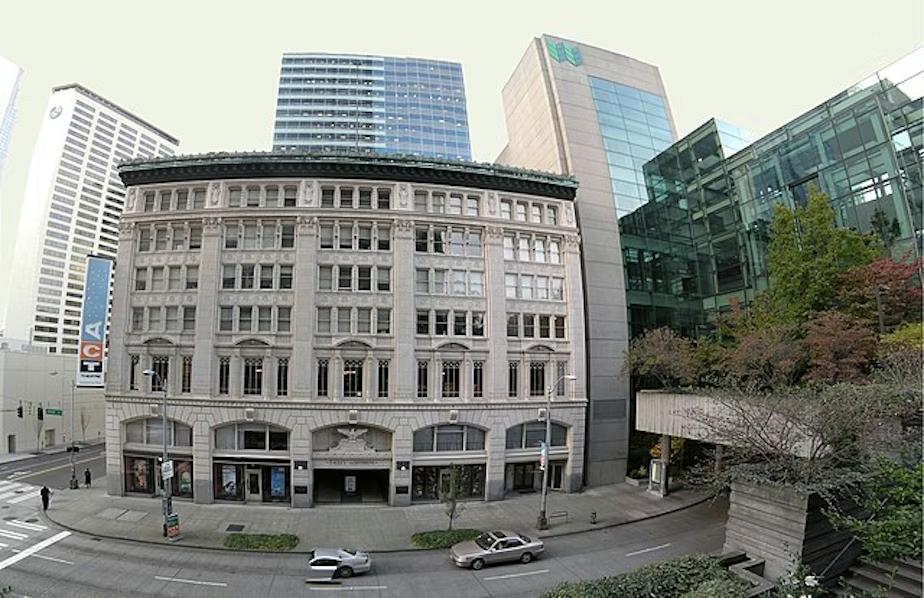
The Eagles Auditorium Building at 700 Union Street had stood since 1925, serving as the headquarters for Aerie No. 1 of the Fraternal Order of Eagles—the very lodge where the organization was originally founded. The seven-story structure, with its elaborate terracotta exterior designed by the Henry Bittman firm, had witnessed some of the most significant moments in Seattle’s cultural and political history.
On November 10, 1961—just a few years before ACT’s founding—Martin Luther King Jr. delivered a speech from the Eagles Auditorium stage during his only visit to Seattle. The building had also served as home to the Unity Church of Truth and, most colorfully, as a major rock concert venue during the late 1960s and early 1970s.
The list of artists who performed at Eagles Auditorium reads like a who’s who of the psychedelic era. The Grateful Dead played eight shows there between 1967 and 1968. The Doors performed in 1967. Pink Floyd, Janis Joplin, Cream, Led Zeppelin, Steppenwolf, Iron Butterfly, Jefferson Airplane, and Joe Cocker all graced its stage. For a generation of Seattle music fans, the Eagles was synonymous with transformative live performance.
ACT’s $30 million renovation of the building, completed in 1996, preserved the historic character while creating state-of-the-art theatrical facilities. The main performance space, renamed the Allen Theatre, retained the original auditorium’s gilded balcony, ornate ceiling, and crystal chandeliers—though some of these architectural details became partially obscured by modern theatrical infrastructure.
The most controversial aspect of the renovation involved converting the famous proscenium stage to theater-in-the-round. The very platform from which Dr. King had spoken and the Grateful Dead had performed became, as theatre critic Misha Berson noted at the time, “just a painted relic in the background.” Some Seattle preservationists mourned the loss, but the new configuration aligned perfectly with ACT’s artistic philosophy of audience intimacy.
The building, now known as Kreielsheimer Place in honor of a major donor, also includes the 4,539-square-foot Bullitt Cabaret, several smaller performance spaces, and 44 moderate-income apartments. The facility connects via internal tunnel to the Washington State Convention and Trade Center, integrating ACT into the physical fabric of downtown Seattle.
Navigating Financial Storms
The move to Kreielsheimer Place proved both triumphant and turbulent. Falls had retired in 1987 due to early indications of Alzheimer’s disease, and the organization struggled through leadership transitions during the critical years surrounding the relocation.
Artistic Director Peggy Shannon oversaw the move to the new facility in 1996, but her productions did not resonate with critics or audiences. Subscriptions fell from 11,400 to 9,000 in a single year. When Shannon resigned in 1997, ACT found itself in debt for the first time in its history. Gregory Falls passed away that same year, never seeing the organization he founded stabilize in its new home.
Shannon’s successor, Gordon Edelstein, worked to revive ACT’s critical and popular reputation. He brought notable performers including actresses Julie Harris and Jane Alexander, singer-songwriter Randy Newman, experimental director Joanne Akalaitis, and composer Philip Glass. Several productions under his leadership transferred successfully to New York. However, the ambitious programming came with ambitious costs, and ACT’s debts continued mounting.
By 2002, the situation had become dire. The organization carried $1.7 million in debt and faced serious danger of closing permanently—a fate that had befallen Seattle’s Empty Space Theatre, another prominent local company, during the same period. Subscriptions had dropped to 7,500.
Rescue came through a combination of emergency donations, strategic scaling back, and artistic recalibration. Boeing chairman Phil Condit contributed $500,000. The 2003 season, under artistic director Kurt Beattie, exceeded expectations both artistically and financially. By 2006, ACT had returned to venturesome programming, staging works like Martin McDonagh’s black comedy The Pillowman and local playwright Elizabeth Heffron’s Mitzi’s Abortion.
John Langs succeeded Beattie as artistic director in 2015, continuing ACT’s commitment to bold contemporary work while nurturing relationships with Pacific Northwest playwrights. Core Company playwright Yussef El Guindi joined in 2018, further cementing ACT’s role as an incubator for new voices.
World Premieres and National Recognition
Throughout its history, ACT has presented more than 300 productions, including 48 world premieres. The theatre’s relationship with new work has earned recognition at the highest levels, with productions garnering Tony Awards, Obie Awards, and Pulitzer Prizes.
The Mainstage series has consistently delivered what audiences have come to expect: exceptional design, directing, and acting from both local and national artists. Productions have traveled from Seattle to New York and beyond, establishing ACT as a significant voice in the American regional theatre movement.
ACT maintains membership in the League of Resident Theatres (LORT), the organization representing America’s premier nonprofit professional theatres. The designation places ACT alongside institutions like the Guthrie Theater, Arena Stage, and the Mark Taper Forum—companies that have collectively defined what American regional theatre can achieve.
The organization also belongs to Theatre Puget Sound, Theatre Communications Group, the Downtown Seattle Association, Seattle’s Convention and Visitors Bureau, and the Greater Seattle Chamber of Commerce. These affiliations reflect ACT’s dual identity as both an artistic institution and a vital component of Seattle’s economic and civic infrastructure.
A New Chapter: The Union Arts Center Merger
The COVID-19 pandemic devastated performing arts organizations worldwide, and Seattle’s theatre community proved no exception. Audiences that had stayed home for safety during lockdowns were slow to return even after venues reopened. The behavioral shift proved particularly pronounced in the Pacific Northwest, where public health measures had been taken especially seriously.
“Since COVID, specifically, the audiences just haven’t returned,” observed Elisabeth Farwell-Moreland, ACT’s Interim Producing Artistic Director. “It’s worse here in the Pacific Northwest, I think because we did COVID so well. We basically said, ‘You can’t gather.’ And then now we’re saying, ‘Come gather.’ And there’s some trauma out there.”
Facing these industry headwinds, ACT and Seattle Shakespeare Company—two of the region’s most respected theatrical institutions—announced in June 2024 that they would explore a merger. After extensive deliberation involving staff, donors, community members, and working committees, both Boards of Trustees approved the combination in January 2025, with an effective date of July 1, 2025.
The merged organization operates under the legal name Union Arts Center, presenting productions under both the ACT Theatre and Seattle Shakespeare artistic brands. The combination positions 700 Union Street as the preeminent home for Shakespeare, classical drama, contemporary plays, and theatre education in the Pacific Northwest.
The inaugural collaborative production—Shakespeare’s Twelfth Night—premiered in ACT’s Falls Theatre on June 12, 2025. The 2025/26 season features five productions representing this significant moment in the companies’ shared history, including Amy Herzog’s Tony Award-winning adaptation of Ibsen’s An Enemy of the People, a reimagined Shrew, A Midsummer Night’s Dream, the Seattle premiere of Jiehae Park’s the aves, and Frida…A Self-Portrait.
Managing Director John Bradshaw, who came from Seattle Shakespeare Company, articulated the philosophical foundation for the merger: “Shakespeare, which we can only ever really interpret through our contemporary experience, and contemporary works, which reflect our history as they open doors into the future, combine perfectly in the timeless arc of our need to gather around the fire and tell stories to make sense of our world.”
The Legacy Continues
Sixty years after Gregory Falls opened the doors of Queen Anne Hall with an absurdist comedy about death and motherhood, his artistic vision continues to animate Seattle theatre. The Gregory Awards—the Puget Sound region’s equivalent of the Tony Awards—bear his name, honoring individuals who embody the collaborative spirit and artistic excellence he championed.
ACT’s influence extends far beyond the productions that have graced its stages. The organization has trained generations of theatre artists, provided a launching pad for new playwrights, and demonstrated that regional theatre can be simultaneously accessible and challenging, entertaining and thought-provoking, rooted in community and reaching toward universal truths.
The historic Eagles Auditorium building—where rock legends once played and civil rights history was made—now pulses with new life each night the lights come up on another ACT production. The gilded balcony and crystal chandeliers witness audiences gathering much as their predecessors did decades ago, united in the ancient human ritual of collective storytelling.
As Union Arts Center embarks on its inaugural season, the organization carries forward Gregory Falls’s original conviction: that theatre should reflect the ferment of its times, challenge comfortable assumptions, and remind us what we share across all our differences. The names on the marquee may change, the artistic styles may evolve, and the industry may transform, but that founding purpose remains as vital as it was on opening night in 1965.
Whether you’re attending your first production or your fiftieth Christmas Carol, taking a chance on an experimental new work or revisiting a Shakespearean classic, ACT Theatre invites you into a conversation that has continued, uninterrupted, for six decades—and shows every sign of continuing for six decades more.