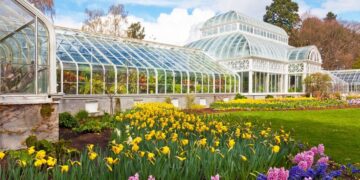


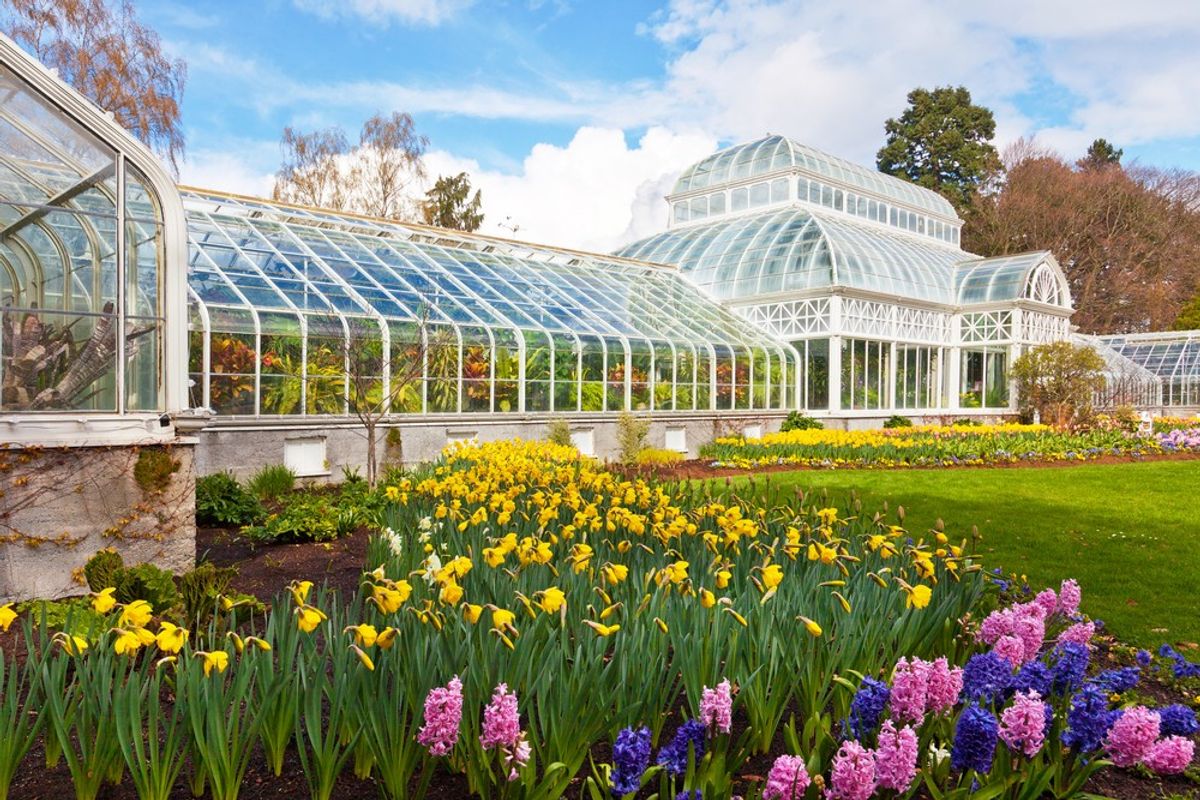
On a gray Seattle afternoon—and there are plenty of those—the warmth hits you the moment you step through the doors. Humid air wraps around you like a tropical embrace. The smell is earthy, green, alive. Overhead, 3,426 panes of glass curve gracefully in their wooden and iron framework, allowing whatever pale light the Pacific Northwest provides to filter down onto thousands of plant specimens from every corner of the globe.
The Volunteer Park Conservatory has been offering this sensory transformation since 1912, when Seattle was flush with Klondike gold rush prosperity and determined to prove itself a world-class city. More than a century later, it remains one of the only original Victorian-style glass houses still standing on the West Coast, a fragile survivor of earthquakes, windstorms, budget crises, and changing tastes. That it exists at all is testament to the stubbornness of Seattle citizens who refused to let it collapse.
But the conservatory is just one element of a larger landscape—a 48-acre urban oasis designed by the legendary Olmsted Brothers firm, the same family that created Central Park in New York. Within and around Volunteer Park, visitors can wander tree-lined promenades, climb a historic water tower for panoramic city views, contemplate a twelve-ton granite sculpture that frames the Space Needle, explore world-class Asian art in an Art Deco museum, and walk among the graves of Seattle’s founders and a martial arts legend. The conservatory sits at the heart of it all, anchoring the park’s northern end like the jewel in a crown.
From Cemetery to Crown Jewel
The land that became Volunteer Park began its municipal life with a rather macabre purpose. In 1876, Seattle paid $2,000 to a sawmill engineer named J.M. Colman for roughly 40 acres on Capitol Hill, then far from the city center. By 1885, the city was using the property as Washelli Cemetery. Two years later, officials reconsidered. Bodies were exhumed and relocated to the adjacent Lake View Cemetery, where they remain today alongside more recently arrived residents like Bruce Lee. The former graveyard was renamed Lake View Park, then City Park, generating considerable confusion.
The confusion ended in 1901 when J. Willis Sayre, a Seattle theater critic and Spanish-American War veteran, successfully lobbied to rename the space Volunteer Park in honor of the soldiers who had served in that conflict. By then, Seattle’s population was exploding in the wake of the Klondike Gold Rush. City leaders, influenced by the City Beautiful movement sweeping America, understood that a modern metropolis required proper parks.
They sought the best. In 1903, Seattle’s Board of Park Commissioners invited John Charles Olmsted of the Olmsted Brothers landscape architecture firm to design a comprehensive park and boulevard system. The Olmsteds were royalty in their field—Frederick Law Olmsted, John Charles’s stepfather, had designed Central Park and defined American landscape architecture. John Charles arrived in Seattle on April 30, 1903, and his hosts brought him to Volunteer Park on his very first day.
What Olmsted saw was potential. The site occupied a ridgetop with commanding views of Puget Sound, the Olympic Mountains, and the growing city below. His 1903 plan for Seattle incorporated Volunteer Park as the central park of the entire system. The following year, the city hired the Olmsted Brothers to develop detailed designs specifically for Volunteer Park.
The resulting plan emphasized what the Olmsteds called “passive recreation”—space for people to enjoy nature, contemplate scenery, and escape urban pressures. Paths meandered across large lawns and through tree groves. Multi-layer plantings organized the space while screening views of surrounding streets and homes. The central axis followed the ridgeline, creating a formal promenade lined with horse chestnut trees connecting the park’s major features.
The Glass House Takes Shape
The conservatory was among the earliest major additions to the Olmsted plan, though its origins predated the landscape architects’ involvement. The idea had been proposed as early as 1893, when civic boosters envisioned a Victorian-style greenhouse serving as the jewel box of Seattle’s emerging park system. The Olmsteds actually recommended waiting before installing such a structure, but the Parks Board pushed ahead anyway.
Seattle purchased a conservatory design and prefabricated framework from the Hitchings Company of New York. The entire structure—glass panes, wooden frames, steel skeleton manufactured by Carnegie Steel—was shipped across the country by rail. Parks Department staff assembled the kit on the north end of Volunteer Park, at the terminus of the grand horse chestnut promenade. A statue of William H. Seward, transferred from the Alaska-Yukon Pacific Exposition in 1909, greeted visitors approaching the entrance.
Construction was completed by late 1912, though the exact opening date has been lost to time. The Seattle Times reported in September that the building would be ready within a month; the Post-Intelligencer noted in January 1913 that the structure was complete but not yet stocked with plants. Whenever visitors first entered, they found a building modeled on London’s Crystal Palace—the revolutionary glass and iron exhibition hall that had dazzled the world at the 1851 Great Exhibition.
Above the main entry door, a decorative lunette window featured intricate woodwork carved from swamp cypress. That window survives today, as does the original Carnegie Steel framework still bearing its manufacturer’s marks. The building was designed to house five distinct display rooms, each maintaining different temperature and humidity levels for different plant families.
The collections grew through donations. In 1921, Mrs. Anna H. Clise donated her orchid collection, establishing what would become one of the conservatory’s signature attractions. Growing greenhouses were added in 1922 to propagate plants behind the scenes. A jade tree planted from a cutting in 1916 took root and thrived; more than a century later, it still lives in the Cactus House.
Five Houses, Five Worlds
Walking through the Volunteer Park Conservatory today feels like a journey across climatic zones. The path loops through five distinct environments, each with its own character.
The Palm House greets visitors with towering fronds and tropical abundance. Notable specimens include a Windmill Palm donated by Hiram Chittenden Locks circa 1953 and a Sago Palm that was approximately 80 years old in 2009. Bananas, Bird of Paradise, Anthurium, and ginger share space with the orchid collection Mrs. Clise began over a century ago. The conservatory now houses representatives of the largest orchid genera—Bulbophyllum, Epidendrum, Dendrobium—alongside commonly cultivated varieties like Cattleya and Phalaenopsis.
There is something else in the Palm House worth noting: confiscated plants. The Volunteer Park Conservatory holds official designation as a United States Fish and Wildlife Service repository for plants seized by federal agents. Transporting endangered orchids violates the Convention on International Trade in Endangered Species (CITES), and specimens intercepted at borders often end up here. The conservatory acquires, quarantines, and eventually displays these rescued plants, giving them a legal home after their intended illegal journeys.
The Fern House offers different textures—delicate fronds unfurling in perpetual dim humidity. The Bromeliad House blazes with color, its epiphytic specimens mounted on branches and rocks as they would grow in nature. Each room maintains precise conditions that visitors barely notice but that gardeners monitor constantly.
The Seasonal House changes completely six times per year. Poinsettias fill the space during the holidays. Chrysanthemums dominate autumn displays. Azaleas, hydrangeas, and fuchsias rotate through depending on the season. For years, a model train display transformed the room during December, though that tradition has recently been retired.
The Cactus House anchors the conservatory’s eastern end with specimens from the world’s arid regions. All cacti are succulents—plants adapted to store water in their tissues—but not all succulents are cacti. The collection includes both: Opuntia alongside Pachypodium, Haworthia, Agave, Aloe, and Euphorbia. The century-old jade tree remains a centerpiece, blooming in winter months.
And then there are the corpse flowers.
The conservatory has hosted the rare blooming of Amorphophallus titanum—the titan arum, commonly called the corpse flower—in 2005, 2008, and 2014. These events draw crowds and media attention because corpse flowers are botanical spectacles. They produce the largest unbranched flower structure of any plant on Earth, can reach heights of nearly ten feet, and emit an overwhelming stench of rotting flesh when they bloom. The smell attracts pollinating beetles and flies in their native Sumatra; in Seattle, it attracts curious humans willing to endure the odor for a glimpse of something truly rare.
Seattle Mayor Ed Murray proclaimed “Corpse Flower Week” during the 2014 blooming. In 2016, the University of Washington loaned a young corpse flower named Dougsley—a portmanteau honoring former UW greenhouse manager Doug Ewing and the Addams Family character Pugsley—to the conservatory while the university’s facilities underwent renovation. These plants bloom only two or three times in their 40-year lifespans, making each flowering event genuinely singular.
Saved by the Citizens
By the late 1970s, the conservatory was dying. Seattle had been hit hard by national recession, unemployment reached double digits, and public maintenance budgets were slashed. The glass panes and framework of wood and iron had deteriorated significantly over six decades. During high winds, the building was closed out of concern that glass might fall on staff or visitors.
The city seemed prepared to let the structure collapse. Citizens refused to accept that fate. A grassroots movement demanded that Seattle not allow the jewel of its park system to fall into permanent disrepair. By 1977, the economy was beginning to recover, and political will followed public pressure.
The campaign to save the conservatory led to the formation of the Friends of the Conservatory (FOC) in 1980. Incorporated as a 501(c)(3) nonprofit, the FOC partnered with Seattle Parks and Recreation to sponsor an architectural restoration between 1980 and 1985. The campaign succeeded, but the organization’s work did not end there.
In 2004, the FOC led a community drive against a proposed mandatory $5 admission fee, keeping the conservatory accessible to visitors of all economic backgrounds. Today, admission remains modest—approximately $6 for adults, with free admission on first Thursdays each month and always free for young children.
The Friends have raised more than $3 million for restorations and improvements over four decades. Recent capital campaigns funded restoration of the Seasonal and Cactus houses and construction of a new multipurpose wing. Over 100 volunteers contribute more than 3,500 hours of service annually. The organization coordinates educational programming, plant sales, cultural arts events, and guided tours that help visitors understand both botanical science and architectural history.
Beyond the Glass Walls
Stepping outside the conservatory places visitors at the northern anchor of Volunteer Park’s central axis—the grand promenade Olmsted designed along the ridgeline. Horse chestnut trees line the path southward toward the park’s other major landmarks.
Directly adjacent to the conservatory stands the Seattle Asian Art Museum, housed in the original 1933 Seattle Art Museum building. Designed by Carl F. Gould in the Art Deco style, the structure was donated to the city by Richard Fuller and his mother Margaret MacTavish Fuller. The building served as SAM’s main facility until 1991, when the collection moved downtown. Reopened as the Seattle Asian Art Museum in 1994 and extensively renovated between 2017 and 2020, it now houses approximately 6,000 Asian art objects in thematically organized galleries. Visitors can ride the replica Bactrian camel statues at the entrance—a popular photo opportunity—before exploring collections spanning China, Korea, Japan, India, and Southeast Asia.
Outside the museum, facing the park’s reservoir, sits Isamu Noguchi’s Black Sun. The 1969 sculpture is a ring-shaped form nine feet in diameter, carved in Japan from a single 30-ton block of Brazilian black granite. The finished work weighs twelve tons. Its polished central void creates a dramatic frame through which visitors can photograph the Space Needle perfectly centered against the sky.
Noguchi was commissioned by the Seattle Art Museum and the Municipal Art Commission in 1967, with support from the National Endowment for the Arts and the Seattle Foundation. He spent months in Japan supervising stonecutters who carved and polished the massive block, sometimes spending twelve-hour shifts alone with his face inches from the stone’s surface. The sculpture was unveiled in 1969 with Richard Fuller pulling the string to remove the covering cloth.
Many visitors assume Black Sun inspired Soundgarden’s 1994 hit “Black Hole Sun”—the band took their name from another Seattle public artwork, A Sound Garden near Magnuson Park, and the song title seems too close for coincidence. However, singer Chris Cornell attributed the title to a misheard news broadcast rather than Noguchi’s granite circle. Whether connected or not, the sculpture has become synonymous with Seattle’s cultural identity, appearing on a 2004 U.S. postage stamp honoring Noguchi on the centennial of his birth.
The 1906 water tower rises at the park’s southern end, another Olmsted recommendation brought to fruition. Visitors who climb the 107 steps to the observation deck are rewarded with 360-degree views of Seattle, Puget Sound, and the mountains beyond. An exhibit inside explains the Olmsted Brothers’ legacy and the history of their landscape design accomplishments. The tower still serves its original function, holding water for the adjacent reservoir that Olmsted incorporated as a prominent visual feature of the park.
Between these anchors, paths wind through groves and across lawns. Tennis courts, an amphitheater with a stage designed by landscape architect Rich Haag in 1971, two formal lily ponds, a playground with wading pool, and extensive dahlia gardens planted annually since 1984 by the Puget Sound Dahlia Association fill the spaces between. Heritage trees planted generations ago provide shade and seasonal color.
The Cemetery Next Door
A chain-link fence on the north side of the playground offers glimpses of Lake View Cemetery. The entrance lies off 15th Avenue East, a short walk from the conservatory. Within those 40 acres rest many of Seattle’s founding figures—Arthur A. Denny, Henry Yesler, Doc Maynard, John W. Nordstrom—alongside one of the most visited graves in the world.
Bruce Lee was 32 years old when he died in Hong Kong in 1973, a month before Enter the Dragon made him an international superstar. His widow Linda chose Seattle for his burial because the city had been where the family was happiest. Lee had attended Edison Technical College on Capitol Hill, opened his first martial arts school in the neighborhood, and met Linda while teaching at the University of Washington.
Twenty years later, his son Brandon joined him. Brandon Lee was killed at age 28 during a shooting accident on the set of The Crow in 1993—the second plot his parents had purchased was meant for Linda, not for another early death. The two graves now draw approximately 10,000 visitors annually, so many that shrubs were planted around the site to prevent trampling on neighboring plots. Time magazine named the location one of the top ten celebrity graves in the world. Lake View Cemetery declined to accept Kurt Cobain’s remains when he died in 1994, reportedly fearing the additional visitor traffic.
Beyond the Lee graves, the cemetery offers views of Lake Washington and the chance to walk among Seattle’s pioneers. Princess Angeline, daughter of Chief Seattle, rests here in a canoe-shaped coffin. Her ghost, some say, still drifts among the headstones on certain evenings.
A Living Museum
The Volunteer Park Conservatory calls itself a “living botany museum,” and the description fits. Unlike collections of paintings or sculptures, the conservatory’s holdings grow, bloom, decline, and regenerate. The orchids that Mrs. Clise donated in 1921 have propagated descendants that still flower in the Palm House. The jade tree planted from a cutting in 1916 continues adding rings. Corpse flowers that bloom once in a decade remind visitors that patience is part of botany.
The building itself demands constant attention. Glass panes crack in earthquakes and hailstorms. The wooden frames require maintenance against Seattle’s damp climate. Current restoration projects include preserving the 1912 lunette window above the entrance and the adjacent decorative etched-glass panels created by artist Richard Spaulding in 1981.
Six staff members—two senior gardeners, two gardeners, and two greeters—maintain the collections and facilities with help from those 100-plus volunteers. The Friends of the Conservatory coordinates educational workshops, guided tours, cultural arts events, and plant sales that sustain both the organization and community engagement.
For residents of Capitol Hill and surrounding neighborhoods, Volunteer Park serves as a backyard—a place for morning runs, afternoon picnics, evening strolls. For visitors from around the world, it offers a concentrated experience of Seattle: the Olmsted landscape legacy, the Asian art collection, the Noguchi sculpture, the martial arts pilgrimage site, the Victorian greenhouse filled with tropical wonder.
The conservatory remains at the center of it all, doing what it has done for over a century: providing warmth and green life when the Seattle sky turns gray, offering a humid jungle escape when the Pacific winds blow cold, reminding everyone who enters that beauty sometimes requires stubbornness to survive.
The Volunteer Park Conservatory is located at 1400 East Galer Street in Seattle. Hours are Tuesday through Sunday, 10 a.m. to 4 p.m. Admission is approximately $6 for adults, with free admission on first Thursdays and always free for children under five. Volunteer Park is open daily from 6 a.m. to 10 p.m. The water tower observation deck is open from 10 a.m. to dusk. Lake View Cemetery, adjacent to the park, is open daily from 9 a.m. until dusk.