Pioneer Square stands as Seattle’s original heart, a neighborhood layered with stories of ambition, catastrophe, and reinvention. The Seattle Underground Walking Tour, led by Bill Speidel’s organization, offers an unparalleled descent into this history, guiding visitors through the remnants of a city literally built atop its own past. This 75-minute journey blends surface-level exploration of Pioneer Square’s historic streets with a plunge into subterranean tunnels that once served as bustling roadways and storefronts. Far more than a novelty attraction, the tour illuminates how disaster catalyzed urban transformation, revealing the gritty realities behind Seattle’s rise from muddy tideflats to a Pacific Northwest powerhouse.
The Foundations of a Frontier Town
Seattle’s story begins in the early 1850s amid challenging terrain that tested the resolve of its founders. Arthur Denny and his party, seeking a deep-water harbor on Elliott Bay, claimed land in what became Pioneer Square after abandoning the windswept Alki Point. Dr. David Swinson “Doc” Maynard, a colorful entrepreneur known for his generosity and wit, complemented Denny’s practicality, acquiring key waterfront parcels and helping secure the settlement’s viability through savvy land deals and medical aid.
The landscape posed immediate obstacles: extensive tideflats subject to twice-daily inundations, dense forests yielding to muddy wagon ruts, and relentless rainfall turning streets into quagmires. Henry Yesler’s steam sawmill on the waterfront provided timber for export to San Francisco’s booming market, with ships returning ballast rocks and fill that gradually expanded usable land. Sawdust from the mill filled potholes, but early sanitation woes soon emerged. Indoor plumbing introduced in the 1860s and 1870s relied on sewers that emptied into the bay, only for high tides to force backups, creating geyser-like eruptions in toilets—a daily indignity for residents.
By the 1880s, Pioneer Square—then encompassing Maynardtown—housed most of the city’s businesses. Wooden structures dominated, vulnerable to fire yet cheap and abundant in the timber-rich region. The area buzzed with logging operations, where massive logs skidded down what became Yesler Way, birthing the term “Skid Road” that later evolved into the nationwide slang for destitution. These early decades forged a resilient community accustomed to mud, floods, and rudimentary infrastructure, setting the stage for the cataclysm that would reshape the city.
The Inferno That Forged a New Seattle
On June 6, 1889, a seemingly minor mishap ignited Seattle’s defining disaster. In a cabinet shop basement near the corner of Front Street (now First Avenue) and Madison Street, Swedish carpenter apprentice John Back allowed a glue pot to boil over onto wood shavings and turpentine-soaked floors. Flames spread rapidly through the wooden buildings, fueled by low water pressure from a private hydrant system and hindered by low tide that limited fireboat access. The blaze consumed approximately 25 blocks of the central business district over 18 hours, destroying wharves, warehouses, and homes valued at around $20 million, though remarkably claiming no lives.
The ruins presented a stark tableau of devastation: charred skeletons of brick chimneys piercing smoke-filled skies, twisted metal, and debris-strewn streets along Front Street. Yet the fire’s aftermath revealed opportunity. With the economy robust from timber and coal trades, reconstruction commenced immediately. City leaders seized the moment to impose reforms: an ordinance mandated fire-resistant brick and stone construction in the core, municipal control over the water supply to ensure adequate pressure, and—most dramatically—a comprehensive regrading initiative.
Engineering Ambition: The Great Regrade
The regrading project addressed longstanding topographic and hygienic flaws. Seattle’s hills sloped steeply to the bay, exacerbating flooding and poor drainage. Engineers constructed retaining walls up to eight or more feet high along existing streets, filled the voids with earth (often sourced from nearby regrades or ballast), and paved new surfaces atop the fill. In places, street levels rose 10 to 30 feet, effectively elevating the city one story above its original grade.
Buildings originally at street level found their first floors transformed into basements. Merchants accessed new sidewalks via stairs or bridges to second-story entrances. The abandoned original sidewalks and roadways formed interconnected underground passages—vaulted tunnels up to 35 feet high in spots—linking basements across blocks. To illuminate these lower levels during transition, glass prisms (vault lights) embedded in the new sidewalks allowed daylight to filter below, many of which remain visible today, worn smooth by decades of foot traffic.
This engineering feat was not without controversy or cost. Property owners bore expenses for raising structures, leading to disputes, but the unified effort prevented future tidal sewage issues and created a more level, modern downtown. The Underground emerged as an unintended architectural byproduct: a network of forgotten storefronts, warehouses, and passages preserved in a state of arrested development, dusty relics of 1889-era commerce.
A Boomtown’s Underbelly: Klondike Gold Rush and Skid Row
The 1897 Klondike Gold Rush amplified Pioneer Square’s fortunes and flaws. News of Yukon strikes transformed Seattle into the primary outfitting gateway, with over 100,000 stampeders funneling through its docks and streets. Outfitting stores along First Avenue hawked shovels, woolens, boots, and provisions; signs like “Yukon Supply Co.” and “Alaska Outfitters” proliferated as merchants capitalized on the frenzy.
Prospectors crowded saloons, gambling halls, and brothels in what became known as the “Lava Beds,” “White Chapel,” or simply Skid Row. Madams and con artists thrived alongside legitimate suppliers. When the rush waned by 1899, many opportunists lingered, solidifying the district’s reputation for vice. Reputable businesses migrated northward to newer commercial zones, leaving Pioneer Square to decline into a forgotten skid row of cheap lodging, taverns, and marginal enterprises. This era infused the Underground passages with tales of rowdy nightlife, shadowy dealings, and economic opportunism that guides recount with wry humor.
Bill Speidel’s Vision: Rescuing History from Oblivion
By the mid-20th century, Pioneer Square languished amid urban decay and redevelopment threats. In 1954, journalist and publicist Bill Speidel, encouraged by his wife Shirley, championed restoration. Speidel publicized rumors of intact underground passages via newspapers, sparking public curiosity. When a Seattle Times column directed inquiries to him, hundreds of letters and calls flooded in, prompting informal tours that evolved into organized outings by 1965.
Speidel leveraged tour revenue and visitor petitions to advocate for preservation. Facing proposals to raze historic structures like the Seattle Hotel (replaced by the controversial Sinking Ship Garage), he rallied support, contributing to the 1970 designation of the Pioneer Square Historic District—the city’s first on the National Register of Historic Places. His efforts countered 1950s-60s demolition trends, bolstered by federal preservation incentives and influxes of artists seeking affordable lofts. Speidel’s 1978 book, Doc Maynard: The Man Who Invented Seattle, further revived interest in the district’s quirky founders. The Underground Tour, now a staple, embodies his legacy of humorous yet insightful storytelling that humanizes the “scoundrels” who built the city.
Stepping into the Tour: A 75-Minute Descent into Time
Participants gather at 614 First Avenue in Pioneer Place Park, beneath Doc Maynard’s Public House—a nod to the founding doctor’s legacy. Guides, often history buffs with sharp wit, begin with an orientation on Seattle’s origins and the fire’s legacy before leading groups across historic sidewalks. The route spans surface Pioneer Square before descending stairs into the Underground proper, covering roughly three blocks and three distinct underground sections.
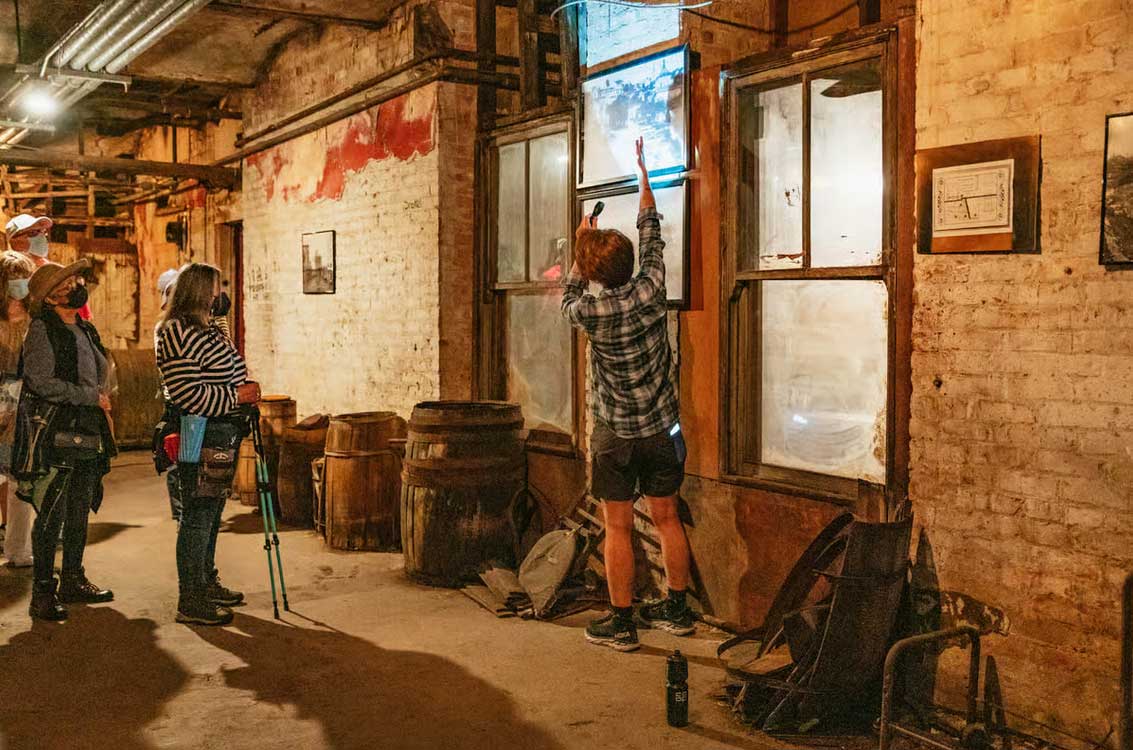
Above ground, the tour passes Romanesque Revival landmarks like the Pioneer Building (1892), with its ornate arches and turrets, evoking the post-fire rebuilding boom. Below, the atmosphere shifts dramatically: musty air, uneven brick and earthen floors, dim lighting, and exposed beams create an immersive time capsule. Visitors navigate interconnected tunnels revealing disused storefront facades, faded signage remnants, warehouse relics, and the original sidewalk levels now far beneath modern streets. Artifacts—old bottles, tools, or structural remnants—dot the passages, while guides spin anecdotes of flooded basements, opportunistic merchants, and Gold Rush excesses.
The terrain demands sturdy shoes—no high heels—as flights of stairs, uneven surfaces, and spotty illumination challenge mobility. Groups of varying sizes move leisurely, with stops for detailed explanations. The experience balances education on engineering feats with lighthearted tales of pioneers’ foibles, leaving participants with a tangible sense of layered urban evolution. Tours run daily on the hour (with seasonal extras), lasting about 75 minutes; children under 6 enter free but may struggle with the conditions.
Echoes of the Past in the Present: Pioneer Square Today
Pioneer Square has transformed since its skid row nadir. Designated a historic district in 1970, the neighborhood showcases one of the finest collections of late-19th-century brick and stone architecture in the U.S., protected by strict guidelines. The Pioneer Building anchors the square, now housing offices and retail. Nearby, the Klondike Gold Rush National Historical Park preserves outfitting exhibits and interprets Seattle’s role as the “Gateway to the Gold Fields.”
Art galleries, cafes, nightclubs, and sports bars animate the streets, reflecting a vibrant cultural scene. The 1980s-90s grunge era echoed in local venues, while the 2001 Nisqually earthquake tested—but did not break—the historic fabric. Today, tech firms coexist with preservationists, artists, and tourists. The Underground Tour contributes to this vitality, drawing visitors who then explore surface attractions, fostering economic revival without erasing the district’s raw edges.
Hidden Histories and Enduring Lessons
The Underground Tour transcends entertainment, offering profound insights into urban resilience. The 1889 fire and regrade exemplify how crisis drives innovation: from sewage woes to elevated infrastructure, Seattle engineered solutions that propelled growth. Yet the vice-laden Gold Rush era underscores the social costs of boomtown economics—exploitation, inequality, and marginalization that echo in modern discussions of urban gentrification and historic preservation.
Bill Speidel’s preservation crusade highlights citizen activism’s power against erasure. In an age of rapid development, the tour reminds us that cities are palimpsests, their hidden layers holding keys to identity and cautionary tales. Pioneer Square’s survival amid 20th-century decay models balanced progress with heritage stewardship, informing contemporary debates on sustainable urbanism.
Comparisons to other subterranean attractions—Paris catacombs or Portland’s Shanghai Tunnels—underscore Seattle’s unique narrative of self-reinvention rather than mere burial. The tour’s humor tempers darkness, humanizing history without sanitizing its rougher chapters.
Planning Your Visit: Practical Insights
Secure tickets online at undergroundtour.com, by phone (206-682-4646), or at the Pioneer Place Park counter; prices typically range around $22-$30 for adults (confirm current rates). Arrive 10-15 minutes early. Dress for variable weather, wear comfortable walking shoes, and note the moderately rugged conditions—stairs and dim paths make it unsuitable for those with mobility concerns or young children uncomfortable in enclosed spaces. Larger groups or private tours can be arranged. Combine with a visit to the Klondike Park or a meal in Pioneer Square for fuller context. Alternative tours like Beneath the Streets offer complementary perspectives but differ in focus and route.
Seattle’s Underground Walking Tour in Pioneer Square delivers far more than dusty corridors and old tales. It excavates the foundational grit, ingenuity, and contradictions that define the city, inviting reflection on how buried pasts inform present trajectories. In a metropolis synonymous with innovation, this subterranean stroll grounds visitors in the literal and figurative depths from which Seattle ascended—proving that even the most forward-looking places thrive by honoring what lies beneath.