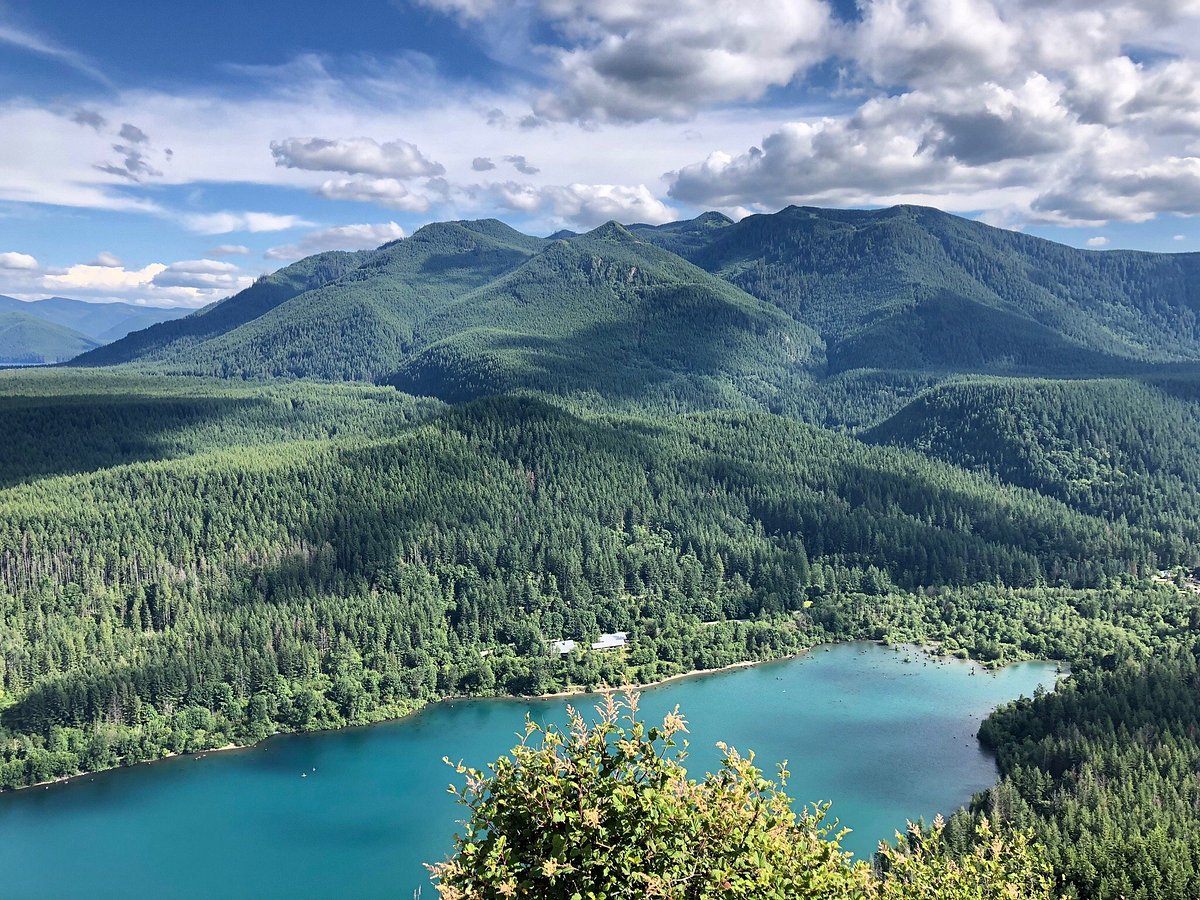
Thirty-five miles east of Seattle, past the suburban sprawl of Bellevue and the sleepy main street of North Bend, a jagged rock face rises above a shimmering alpine lake. That rock face is Rattlesnake Ledge, and it has become one of the most beloved hiking destinations in the Pacific Northwest — not because it is the tallest, the longest, or the most remote, but because it delivers an experience that feels far bigger than its modest stats suggest.
At just under two miles each way, with roughly 1,500 feet of elevation gain, Rattlesnake Ledge punches well above its weight class. The payoff at the summit — a sweeping 180-degree panorama over Rattlesnake Lake, Mount Si, Mount Washington, and the vast Cedar River Watershed — rivals viewpoints that demand twice the effort. It is, by nearly every measure, the best bang for your hiking buck within an hour of downtown Seattle.
But Rattlesnake Ledge is far more than a convenient viewpoint. It is a place layered with history, ecological significance, and the kind of raw natural beauty that makes the Pacific Northwest a global destination for outdoor enthusiasts. It is also a place with real danger, real crowds, and a story that stretches back more than a century to a drowned town lying at the bottom of the lake below.
A Ghost Town Beneath the Water
The story of Rattlesnake Ledge cannot be told without the story of Rattlesnake Lake, and the story of Rattlesnake Lake cannot be told without the story of Moncton — a town that no longer exists.
In 1907, the Chicago, Milwaukee, St. Paul and Pacific Railroad — better known as the Milwaukee Road — established a small company town along the northern shore of what was then a modest pond nestled in the foothills of the Cascade Range. The settlement was named Moncton, after a railroad town in the Canadian province of New Brunswick, and it quickly grew into a lively community of roughly 200 residents. Workers from the railroad, the nearby logging operations, and Seattle’s expanding water infrastructure moved in with their families. By 1912, Moncton boasted a hotel, a barbershop, a saloon, a restaurant, several stores, and even an indoor swimming pool. Children attended a school at the north end of town, and older students walked or rode horses seven miles to the nearest high school in North Bend.
Then Seattle built a dam.
In 1911, the city began constructing the Masonry Dam on the Cedar River to generate electricity and store drinking water. The dam created Chester Morse Lake, a large reservoir perched on the hillside roughly a mile and a half from Moncton. Nobody anticipated what would happen next. Water from the new reservoir began seeping through the porous glacial soils separating it from the little town below. Springs burst from the hillsides. The pond adjacent to Moncton began to grow.
Beginning in April 1915, the water rose at a rate of more than a foot per day. Streets muddied. Standing water filled the lower sections of town. Homes nearest the shoreline went under first. On May 14, 1915, The Seattle Times ran a front-page article describing a “little village” being “drowned out by mysterious floodwaters that came from the ground beneath the homes and lands of the people.” Motion picture operators arrived to film the slow-motion disaster.
Seattle Mayor Hiram Gill initially denied responsibility, blaming the flooding on natural causes. Months of political wrangling followed. Eventually, the city condemned the town and paid its residents a total of $47,658.03 for their land and property — a pittance even by 1916 standards. The following year, after water levels receded enough to access the remains, a crew tore down the waterlogged homes. Those that could be salvaged were hauled to higher ground. The rest were doused in kerosene and burned.
Today, Rattlesnake Lake sits where Moncton once stood. The lake’s water level fluctuates significantly with the seasons, rising with snowmelt and falling during dry summers. In drought years, the water drops enough to reveal the ghostly remnants of Moncton: old foundations, toppled river-stone chimneys, rotting fenceposts, and massive old-growth stumps from the forest that was clearcut before the town was even built. Scuba divers have probed the murky bottom and found additional artifacts. It is a haunting reminder that progress, particularly in the American West, has always come at a cost.
When hikers park at the Rattlesnake Lake Recreation Area and look up at the ledge they are about to climb, they are standing on the grave of a community that was sacrificed for Seattle’s drinking water. That water supply — drawn from the Cedar River Watershed — still serves roughly 800,000 people across the Seattle region today. The trade-off shaped the modern city.
The Trail Itself: What to Expect
The hike to Rattlesnake Ledge begins at the northwest corner of Rattlesnake Lake, about a third of a mile from the main parking area. Portable restrooms and an informative kiosk with maps and historical context mark the trailhead. From here, a well-maintained path climbs steadily through second-growth forest for 1.9 miles to the lower ledge.
The trail owes its current condition to years of volunteer labor, much of it organized by the Washington Trails Association. The original route to the summit was steep, eroded, and badly damaged by decades of heavy foot traffic and minimal maintenance. WTA work parties rebuilt the trail with carefully engineered switchbacks that added about half a mile to the original distance but significantly reduced the grade. The result is a hike that is challenging enough to get your heart rate up but manageable for most reasonably fit hikers, including families with older children.
The lower section of the trail winds through a corridor of towering Douglas fir and western red cedar, many of them draped in the thick, emerald-green moss that defines Pacific Northwest forests. Massive boulders — “mossy monsters,” as one trail description puts it — line the path in the early stretches, glacial erratics deposited thousands of years ago during the last ice age. The forest is alive with birdsong, and hikers frequently spot chipmunks, Douglas squirrels, and the enormous banana slugs that are practically a mascot of Washington’s west-side trails.
As the trail gains elevation, periodic gaps in the canopy offer glimpses of Rattlesnake Lake below, giving hikers a satisfying sense of their progress. The switchbacks keep the climbing steady without any genuinely grueling pitches, though the cumulative elevation gain is enough to make most people breathe hard, especially on the upper stretches.
At 1.9 miles, the trail reaches a signed junction. A short spur to the right leads about a hundred yards to the lower ledge — the main event. The ledge itself is a broad, exposed slab of rock with sheer cliffs dropping away on multiple sides. The views from this perch are extraordinary: Rattlesnake Lake spreads out directly below like a turquoise mirror, ringed by forest and backed by the imposing bulk of Mount Si and its neighboring peaks. On clear days, the panorama extends across the Cedar River Watershed and into the heart of the Cascade Range.
Three Ledges, Not One
Most hikers stop at the lower ledge, snap their photos, eat a snack, and head back down. But Rattlesnake Ledge actually consists of three distinct overlooks — lower, middle, and upper — and the two higher viewpoints are well worth the additional few minutes of climbing.
From the junction, the trail continues upward to the middle ledge and then the upper ledge, each offering slightly different angles on the valley below and progressively broader views to the north and west. Because the vast majority of visitors congregate at the lower ledge, the middle and upper viewpoints are typically much quieter — a significant advantage on weekends and holidays when the lower ledge can feel like a crowded stadium.
Including all three ledges, the round trip comes out to roughly 4.8 miles with about 1,500 feet of total elevation gain. For hikers wanting even more, the trail continues from the junction along the Rattlesnake Mountain Trail to East Peak, 2.4 miles away, or all the way across the ridge to Snoqualmie Point Park, a total traverse of roughly 11 miles. These extensions transform a quick morning outing into a serious full-day adventure, though the difficulty remains moderate by Cascade standards.
The Crowd Factor
There is no sugarcoating it: Rattlesnake Ledge is crowded. Its proximity to Seattle and Bellevue, its relatively forgiving difficulty, its stunning payoff, and its year-round accessibility combine to make it one of the most heavily trafficked trails in King County. On a sunny weekend morning between May and October, the parking area fills before 9 a.m., cars line Cedar Falls Road for hundreds of yards, and hikers encounter a near-continuous stream of traffic in both directions on the trail.
Trail counters and trip reports suggest that encounters with 50, 60, or even 70 other hikers on a single outing are not unusual. Dogs are everywhere — the trail is dog-friendly, though leashes are required — and the lower ledge can feel more like a festival than a wilderness experience. For hikers seeking solitude, this is not the trail.
The crowds, however, are also part of what makes Rattlesnake Ledge culturally significant. This is where many Seattle-area residents take their first real hike. It is the gateway drug to a lifetime of exploring the Cascades. Families bring toddlers in backpack carriers. College students show up in running shoes for a workout. Retirees take it slow and savor the forest. Tourists from around the world add it to their Pacific Northwest itineraries. It is a genuinely democratic trail — one that belongs to everyone, not just the ultralight backpacking crowd.
For the best experience, arrive early. Very early. A 7 a.m. start on a weekend will give you relatively quiet trails and available parking. Weekday mornings are even better. Late afternoon visits can also work, as the morning rush subsides by mid-afternoon on most days. Winter hiking is possible and rewarding, but ice and snow are common on the upper trail sections from November through April, and microspikes or traction devices are strongly recommended.
Safety and the Ledge’s Dark Side
The same exposed rock that makes Rattlesnake Ledge such a spectacular viewpoint also makes it dangerous. The cliffs drop vertically for a hundred feet or more, and there are no railings, guardrails, or fences of any kind. The ledge is slippery when wet, and the edges are unforgiving.
Multiple fatalities have occurred at Rattlesnake Ledge over the years. In 2009, a 28-year-old man fell a hundred feet to his death from the ledge. In 2013, another man in his twenties fell while his friend was photographing him near the edge — he slipped while attempting to jump to a rock and plummeted to the ground below. These are not isolated incidents. King County Search and Rescue has responded to numerous calls in the area.
The lesson is straightforward: respect the exposure. Stay well back from the edge, especially when the rock is wet or icy. Keep dogs on a short leash and maintain physical control of young children. The ledge is no place for horseplay, selfie stunts, or testing your balance near a precipice. The views are just as spectacular from ten feet back as they are from the very lip of the cliff, and that ten feet can be the difference between a great hike and a tragedy.
Another practical safety note: car break-ins are a persistent problem at Washington trailheads, and Rattlesnake Lake is no exception. Leave nothing of value visible in your vehicle, and ideally, leave nothing of value in your vehicle at all.
The Ecological Context
Rattlesnake Ledge sits within the 1,876-acre Rattlesnake Mountain Scenic Area, a Natural Resources Conservation Area co-managed by the Washington Department of Natural Resources and King County Parks. The scenic area protects a swath of the southern mountainous ridge of the Snoqualmie Valley, facing Mount Si across the valley floor.
The ecological significance of this land is substantial. The ridge harbors diverse wildlife habitat, numerous riparian systems, and cliff terrain that supports species not found in the surrounding lowlands. The protected forests help buffer the Cedar River Watershed — the source of more than half of Seattle’s drinking water — from development and contamination.
The forest through which the trail passes is second-growth, meaning it was logged at some point in the past and has since regenerated. The massive old-growth trees that once blanketed this slope were cut down during the logging boom of the late 19th and early 20th centuries. You can see evidence of that era in the enormous stumps that dot the forest floor, many with the distinctive springboard notches that loggers used to stand on while sawing through trunks too large to cut at ground level.
Despite being second-growth, the forest has matured beautifully. The canopy is thick and lush, the understory dense with ferns and salal, and the air carries the damp, earthy smell that is perhaps the defining sensory experience of hiking in western Washington. Herons feed at the edge of Rattlesnake Lake. Fresh elk tracks appear in the mud. Ravens circle overhead. The ecological recovery, while still a work in progress, is a quiet success story.
Practical Information for Planning Your Visit
Getting there is simple. From Seattle, take Interstate 90 east to Exit 32 for 436th Avenue SE. Turn right off the exit, heading south on 436th, which becomes Cedar Falls Road. Drive about three miles and follow signs for Rattlesnake Lake. Parking areas are on both sides of the road. Total drive time from downtown Seattle is roughly 45 minutes to an hour, depending on traffic.
Parking is free at the Rattlesnake Lake Recreation Area, though a Washington State Discover Pass may be required at the nearby Cedar Falls Trailhead if you plan to access the Palouse to Cascades State Park Trail. No camping or open fires are allowed in the recreation area. The park is open from dawn to dusk year-round.
There is no water available within the park, so pack your own. A small shop on Cedar Falls Road sells food and drinks for those who forgot to bring supplies. Restrooms are available near the lake and at the trailhead.
No specialized hiking gear is necessary for the trail in dry conditions, though sturdy shoes with good traction are strongly recommended. Flip-flops and sandals are a terrible idea, despite the people you will inevitably see wearing them. In winter, microspikes or similar traction devices are essential for the icy upper sections. Trekking poles can be helpful year-round, particularly on the descent.
Bug repellent is worth bringing during the warmer months, as the forest can harbor mosquitoes and other biting insects. Sunscreen is a good idea for the exposed ledge, even on partly cloudy days — the Pacific Northwest sun has a way of sneaking up on people who think they are safe beneath an overcast sky.
Why Rattlesnake Ledge Matters
There are longer hikes in Washington. There are harder hikes. There are more remote hikes with fewer people and wilder scenery. But few trails in the state deliver as complete an experience as Rattlesnake Ledge in so compact a package.
In under two hours of actual hiking, you walk through a forest that tells the story of logging, regrowth, and ecological resilience. You climb a ridge shaped by glaciers and maintained by volunteers. You stand on a rock face overlooking a lake that covers a drowned town, in a watershed that provides drinking water to nearly a million people. And you take in a view that stretches from the valley floor to the snow-capped peaks of the Cascade Range.
That combination of accessibility, beauty, history, and ecological significance is rare. It is also fragile. The trail’s popularity puts constant pressure on the landscape, and the Rattlesnake Mountain Scenic Area depends on responsible use to remain the gem that it is. Pack out what you pack in. Stay on the trail. Respect the wildlife and the exposure. And take a moment, before you start back down, to appreciate what you are looking at — not just the mountains and the lake, but the layers of human and natural history that have shaped this place over millennia.
Rattlesnake Ledge is not just a hike. It is a compressed lesson in what the Pacific Northwest is and how it got that way. Every foot of elevation gained carries a story. Every vista earned reveals something worth knowing. And every time you drive back down Cedar Falls Road toward the highway, you carry a little bit of that story with you.
That is why people keep coming back. That is why the parking lot fills before 9 a.m. on a Saturday. And that is why, despite the crowds and the danger and the cars lining the road, Rattlesnake Ledge remains one of the most essential outdoor experiences in Washington State.
Final Thoughts for First-Time Hikers
If Rattlesnake Ledge is your first hike — and for many people, it will be — a few parting words of encouragement. The trail is steeper than it looks from the parking lot, and you will almost certainly be breathing harder than you expected by the midway point. That is completely normal. Take breaks when you need them. Drink water. Let faster hikers pass. There is no rush and no scoreboard.
When you reach the ledge, take your time. Sit down. Eat something. Let the view settle into your memory before you reach for your phone. The lake below, the mountains beyond, the forest at your back — these things are not going anywhere, and neither should you, at least not for a few minutes.
And when you get back to the car, tired and satisfied, know that you have just done something that tens of thousands of people do every year — and that every single one of them understands exactly why you did it.
Welcome to hiking in Washington. It only gets better from here.