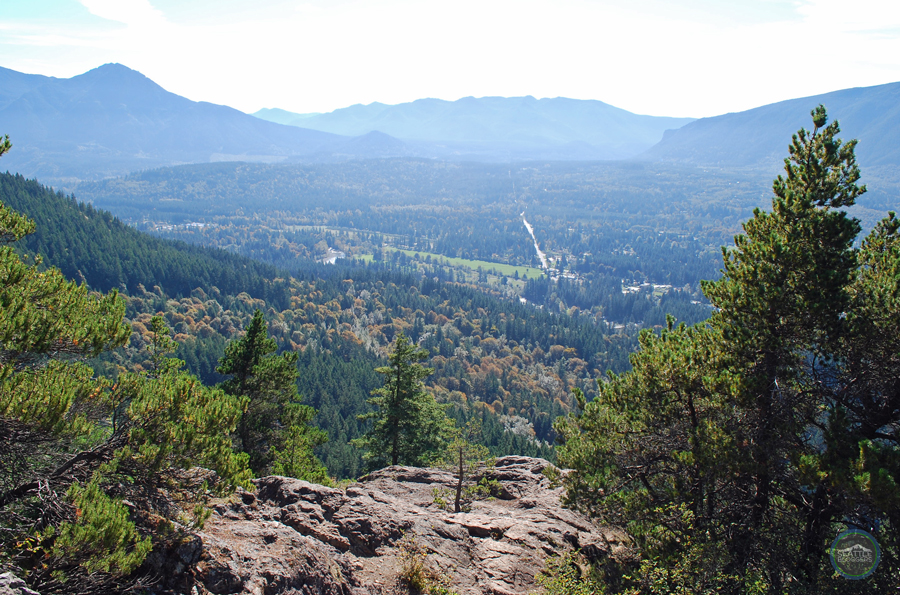
There’s a quiet irony embedded in the name Little Si. The word “little” suggests something modest, perhaps forgettable — a footnote next to the towering, more celebrated Mount Si that looms beside it. But anyone who has laced up their boots and walked those 4 miles round trip through ancient forest, past volcanic rock faces buzzing with climbers, and up to that windswept summit overlooking the Snoqualmie Valley knows better. Little Si is anything but small in terms of what it delivers.
Situated just outside the town of North Bend, Washington — roughly 45 minutes east of downtown Seattle on Interstate 90 — this rocky bluff has quietly become one of the most beloved hikes in the entire Puget Sound region. It draws beginners taking their first tentative steps into the world of hiking, seasoned trail runners looking for a quick weekday burn, families with young kids and energetic dogs, and rock climbers chasing some of the best sport routes in the state. That kind of range is rare for a single trail, and it’s the reason Little Si has racked up well over 15,000 reviews on AllTrails alone.
But what makes this trail so universally appealing? And what should you actually know before you go? Let’s break it all down.
A Mountain Named After a Gold Rush Drifter
Before we talk about the trail itself, the story behind the name deserves its moment. Mount Si and Little Si were both named after Josiah “Uncle Si” Merritt, a homesteader with a biography that reads like a rough draft of an American folk tale.
Uncle Si left Ohio during the Gold Rush, chasing fortune to California. When California didn’t pan out (literally), he headed north after hearing about gold discoveries in British Columbia. Along the way, he passed through the Snoqualmie Prairie, where he met another early settler named Jeremiah Borst. Something about the place — the sprawling valley, the towering peaks, the company of a generous neighbor — persuaded Uncle Si to abandon his gold ambitions entirely. He built a homestead cabin at the base of the mountain that would eventually bear his name. He raised pigs, grew vegetables, and lived out the rest of his days in the valley until his death in 1882.
There’s a deeper layer to this place, though, that predates Uncle Si by millennia. The Snoqualmie Tribe, the original stewards of this land, refer to Mount Si as q̓əlbc̓ in their Lushootseed language. The mountain holds profound cultural and spiritual significance to the Snoqualmie People — it is part of their origin story. Any visit to Little Si is, in a very real sense, a walk through sacred ground, and that context matters.
The Trail: What to Expect Mile by Mile
Little Si is classified as a moderate hike. It covers approximately 4 miles round trip with about 1,171 feet of elevation gain, and most hikers complete it in two and a half to three hours. Those numbers place it firmly in the sweet spot: challenging enough to feel like a workout, accessible enough that it won’t destroy you.
The Opening Salvo
The trail wastes no time testing your resolve. Right out of the parking lot, you’re greeted by a steep, rocky incline that threads through a series of switchbacks. This opening quarter-mile is, paradoxically, the hardest stretch of the entire hike. Your calves will protest. Your heart rate will spike. First-timers have been known to second-guess their footwear choices within the first five minutes.
Here’s the thing, though: it gets easier. The trail levels out considerably after that initial burst, and you’ll be rewarded with a stretch of relatively flat, forested walking that feels almost meditative. The Washington Trails Association even notes a small detour just 0.2 miles in — a short spur trail to the southwest that opens up to a low-elevation ridge with a quick peek into the valley below. It’s a lovely spot for a breather, and if for some reason you decide the hike isn’t for you, it functions as a surprisingly satisfying consolation prize.
The Boulder Garden Loop
At roughly the 0.3-mile and 0.5-mile marks, you’ll encounter two opportunities to hop onto the Boulder Garden Loop, an alternate trail that adds about 1.5 miles and 600 feet of elevation gain to your trip. The loop winds through a landscape of enormous moss-covered boulders — the kind of primeval scenery that makes you feel like you’ve wandered onto the set of a fantasy film. It also connects to the Mount Si Old Trail if you’re feeling ambitious and want to pivot to a much bigger adventure.
For the standard Little Si summit, though, you’ll want to stay left on the main trail at these junctions. Signs are clearly posted, and the route is well-marked.
The Forest Cathedral
Past the Boulder Garden junction, the trail enters what can only be described as a cathedral of trees. Towering second-growth Douglas fir, western hemlock, and western red cedar form a dense canopy overhead, filtering the light into soft green columns. The forest floor is a tapestry of sword ferns, salal, and thick carpets of moss draped over everything — rocks, fallen logs, the exposed root systems of ancient trees.
This middle stretch is where Little Si reveals its Pacific Northwest soul. The air is cool and damp, saturated with the earthy scent of decomposing wood and wet soil. Even on the hottest summer days, the shade here provides welcome relief. And if you’re hiking after rain — which, this being western Washington, is a strong possibility — the entire landscape seems to glow with an almost electric green luminescence.
You’ll also notice something else in this section: rock climbers. The cliffs adjacent to the trail are home to a thriving climbing community, and it’s common to see people scaling overhanging walls of volcanic metamorphic rock with an almost gravity-defying nonchalance. More on that later.
The Final Push
Around the 1.3-mile mark, the trail swoops around the slope and begins its final ascent. The last three-quarters of a mile is where Little Si demands your attention again. The terrain steepens, the path narrows, and exposed tree roots and loose rock require more careful footwork. The forest thins as you gain elevation, and patches of rocky outcrop start breaking through the canopy.
Just before the summit, a viewpoint opens up to the left with panoramic views of the North Bend valley. Many hikers consider this spot even more spectacular than the official summit, and it tends to be less crowded — a solid option for a quiet lunch if the top is packed.
And then you’re there. The summit of Little Si sits at 1,576 feet, and the payoff is outstanding. On a clear day, you can see Mount Si’s imposing form right next door, the distinctive haystack rock formation visible at its peak. Mount Washington stretches out to the east. The Snoqualmie Valley unfurls below like a green quilt stitched with river bends and farmland. Rattlesnake Mountain fills the southern horizon. It is, without exaggeration, one of the finest views available for the amount of effort required to earn it.
Little Si as a Rock Climbing Destination
Here’s something that surprises many first-time visitors: Little Si isn’t just a hiking trail. It’s one of the most significant sport climbing areas in Washington state.
The crags scattered around the northeast side of the peak — collectively known as the Exit 32 climbing area — feature over 700 fully bolted sport routes. The rock is metamorphosed volcanic andesite, a legacy of the region’s fiery geologic past, and it varies wildly in character. Some walls offer grippy, textured surfaces that feel almost engineered for climbing. Others are polished and slippery, demanding precision and technique.
The crown jewel is World Wall, a gently overhanging cliff with more than 60 sport routes ranging from 5.9 to 5.14d. Serious climbers regard it as potentially the best high-level sport crag in the state. The concentration of 5.13 and 5.14 routes is unmatched in the Snoqualmie Valley, and the wall draws dedicated climbers from across the Pacific Northwest.
The climbing season typically runs from April through mid-October, with June offering the best conditions. And because Little Si sits at relatively low elevation, many crags receive enough sun or shade to remain climbable in variable weather — some even stay dry during light rain.
For hikers who’ve never watched sport climbing up close, the cliffs along the Little Si trail offer a free front-row seat. It’s genuinely thrilling to watch someone work their way up a seemingly impossible overhang while you catch your breath on a flat stretch of trail.
The Geology Beneath Your Feet
The rocks you’re walking on — and past, and sometimes scrambling over — tell a story that stretches back hundreds of millions of years. The landscape around Little Si is composed of metamorphosed remnants of an oceanic plate volcano. In plain terms, what is now a peaceful hiking trail in the Cascade foothills was once the site of violent underwater volcanic activity along an ancient tectonic plate boundary.
The entire Mount Si Natural Resources Conservation Area, which encompasses Little Si, was established in 1987 to protect these outstanding geologic features, along with old-growth forest, wildflower communities, alpine lakes, and habitat for species like mountain goats, black bears, elk, and cougars. The conservation area spans an impressive 13,735 acres and includes four mountain peaks: Mount Si, Mount Teneriffe, Green Mountain, and Little Si.
The glacial history of the region adds another dimension. During the last ice age, the Puget Lobe of the Cordilleran Ice Sheet pushed down from Canada, filling the lowlands and dramatically reshaping the terrain. Valley glaciers from the Cascades had already retreated by then, creating massive glacial lakes along the margins of the ice sheet. The flat valley floor you gaze upon from Little Si’s summit is a direct result of thick lake sediments deposited during that period — a landscape sculpted by ice and water over tens of thousands of years.
Practical Matters: What You Need to Know Before You Go
Getting There
From Seattle, take I-90 East toward North Bend. Take Exit 32 for 436th Avenue SE and turn left. Head half a mile and take a left on SE North Bend Way. After 0.3 miles, turn right onto SE Mount Si Road. The main parking lot for Little Si is 0.4 miles ahead on the left. There’s also an overflow lot slightly to the west, connected to the main lot by a short trail.
Parking and Permits
A Washington State Discover Pass is required to park at the trailhead. This is non-negotiable — rangers do check, and tickets are not cheap. You can purchase an annual pass or a day-use permit online or at various retail locations.
Parking is the single biggest headache associated with Little Si. Both lots fill early on weekends and sunny days, often by 9 or 10 in the morning. If you want a guaranteed spot, aim to arrive before 8 AM. Weekday mornings are significantly less hectic.
Best Time to Visit
Little Si is hikeable year-round, but conditions vary dramatically by season. Summer (June through September) offers the driest trails and the best summit views, but also the biggest crowds. Spring and fall bring gorgeous foliage and fewer people, though the trail can be muddy and slippery. Winter hiking is possible, but the trail often accumulates snow and ice, particularly on the upper sections. Traction devices like microspikes or Yaktrax are advisable in winter months, and the avalanche advisory should be checked if conditions have been heavy with snowfall.
What to Bring
Sturdy footwear is essential. This is not a trail for flip-flops or fashion sneakers. The rocky terrain, exposed roots, and occasionally muddy conditions demand hiking boots or at minimum trail runners with good tread. Trekking poles are helpful on the descent, especially through the steeper sections. Bring at least a liter of water per person, sunscreen, layers (Pacific Northwest weather is famously fickle), and bug spray in summer — mosquitoes at the summit can be persistent.
Dogs and Kids
Little Si is both dog-friendly and family-friendly. Dogs are technically allowed off-leash in some areas, but given the heavy foot traffic, keeping your dog on a leash is the considerate move. The trail’s moderate difficulty makes it manageable for kids, though younger children may need encouragement (or a piggyback ride) on the steeper sections.
The Crowds: Little Si’s Blessing and Its Curse
There is no gentle way to put this: Little Si is crowded. Spectacularly, sometimes absurdly crowded. On a sunny Saturday in July, the trail can feel less like a wilderness experience and more like a well-organized parade through the woods.
This popularity is a double-edged sword. On one hand, the constant foot traffic means the trail is well-maintained, easy to follow, and generally safe. You’re never truly alone out here, which is reassuring for solo hikers and beginners. On the other hand, if you’re seeking solitude and the restorative silence of untouched nature, Little Si on a weekend is emphatically not your trail.
The solution is simple: go early, or go on a weekday. Hikers who arrive at 7:30 AM report passing only a handful of people on the way up. By mid-morning, the dynamic shifts completely. If your schedule allows flexibility, a Tuesday morning hike on Little Si is an entirely different experience from a Saturday afternoon one — quieter, more contemplative, and immeasurably more peaceful.
Beyond Little Si: Building Your North Bend Hiking Resume
One of the best things about Little Si is its role as a gateway. It sits at the center of a constellation of outstanding trails, each offering a different level of challenge, and it serves as the perfect warm-up for bigger adventures.
Once you’ve conquered Little Si, the natural next step is its big sibling, Mount Si. The Mount Si trail climbs roughly 3,500 feet over 4 miles — a significantly more demanding undertaking — and rewards hikers with expansive views from its summit ridge and the famous haystack rock scramble. From there, the options multiply. Rattlesnake Ridge offers a shorter but equally scenic alternative with views over Rattlesnake Lake. Mount Teneriffe, accessed from a trailhead just up the road, provides a more secluded and strenuous climb. And for the truly ambitious, Mailbox Peak — located within a five-mile drive of the Little Si trailhead — is widely considered one of the toughest day hikes in the region, with the old trail gaining over 4,000 feet in just 2.5 miles.
Little Si, in this context, functions as a training ground, a proving ground, and a gateway drug. It teaches you what a Pacific Northwest hike feels like — the rhythm of switchbacks, the texture of root-strewn trail, the particular satisfaction of earning a view — and it does so in a package that is forgiving enough to let you enjoy the process rather than just survive it.
The Cultural Footprint
Little Si has a cultural presence that extends beyond the trail itself. The town of North Bend, at the mountain’s base, gained national recognition in the early 1990s as the filming location for David Lynch’s surreal television series Twin Peaks. Mount Si featured prominently in the show’s iconic opening credits, its misty summit becoming synonymous with the eerie, beautiful atmosphere of the fictional town of Twin Peaks. While Little Si itself didn’t star in the show, its proximity to that cultural moment has contributed to the area’s enduring mystique.
North Bend itself is worth exploring after your hike. The town offers a range of dining options, from the beloved Twede’s Cafe (the real-life inspiration for the Double R Diner in Twin Peaks) to burger joints and local breweries. It retains the character of a small mountain town even as the sprawl of greater Seattle inches closer year by year.
Wildlife and the Ecosystem You’re Walking Through
Little Si is not just a trail through pretty scenery. It’s a functioning ecosystem, and paying attention to the life around you elevates the experience from a pleasant walk to something genuinely educational.
The Mount Si NRCA protects habitat for an impressive range of species. Black bears roam the higher elevations and occasionally wander closer to the trail corridor, particularly in berry season during late summer and early fall. Elk and black-tailed deer browse the forest edges. Cougars are present but rarely seen — they are masters of evasion. Coyotes are more commonly heard than spotted, their yipping sometimes audible from the summit at dusk.
The birdlife along the trail is surprisingly rich. Steller’s jays, with their striking blue plumage and raucous calls, are the most obvious avian presence. Pacific wrens sing complex, bubbling songs from the understory. Varied thrushes — sometimes called the voice of the Northwest woods — emit their haunting, single-note whistles from deep within the canopy. At the summit, chipmunks are the most visible wildlife, and they have grown bold from years of well-meaning (but ecologically harmful) feeding by hikers. The plea from trail stewards is simple: don’t feed the chipmunks, no matter how charming they are.
The plant communities tell their own stories. The lower and middle sections of the trail pass through classic lowland western Washington forest dominated by Douglas fir and western hemlock. Bigleaf maples draped in licorice fern add texture to the canopy edges. The understory is dense with Oregon grape, salal, and thimbleberry. On the rocky summit and the thin-soil areas just below it, the plant community shifts dramatically — here you’ll find wind-stunted trees, exposed rock gardens, and hardy species adapted to harsher conditions. It’s a compressed ecological gradient that you can observe within a single two-hour walk.
The Verdict
Little Si will not make anyone’s list of the most remote, most challenging, or most dramatic hikes in Washington state. It doesn’t need to. What it offers instead is something arguably more valuable: accessibility without compromise. It gives you old-growth forest, volcanic geology, world-class rock climbing, and a summit view that rivals trails twice its length — all within an hour of one of the largest metropolitan areas on the West Coast.
It is the hike you take when you have a free afternoon and a restless spirit. It is where you bring a friend who has never hiked before and wants to understand what all the fuss is about. It is where you go on a rainy Tuesday in November, when the moss glows green and the trail is yours alone, and you remember why you live in the Pacific Northwest in the first place.
Little Si asks for so little and gives back so much. That’s not a small thing at all.