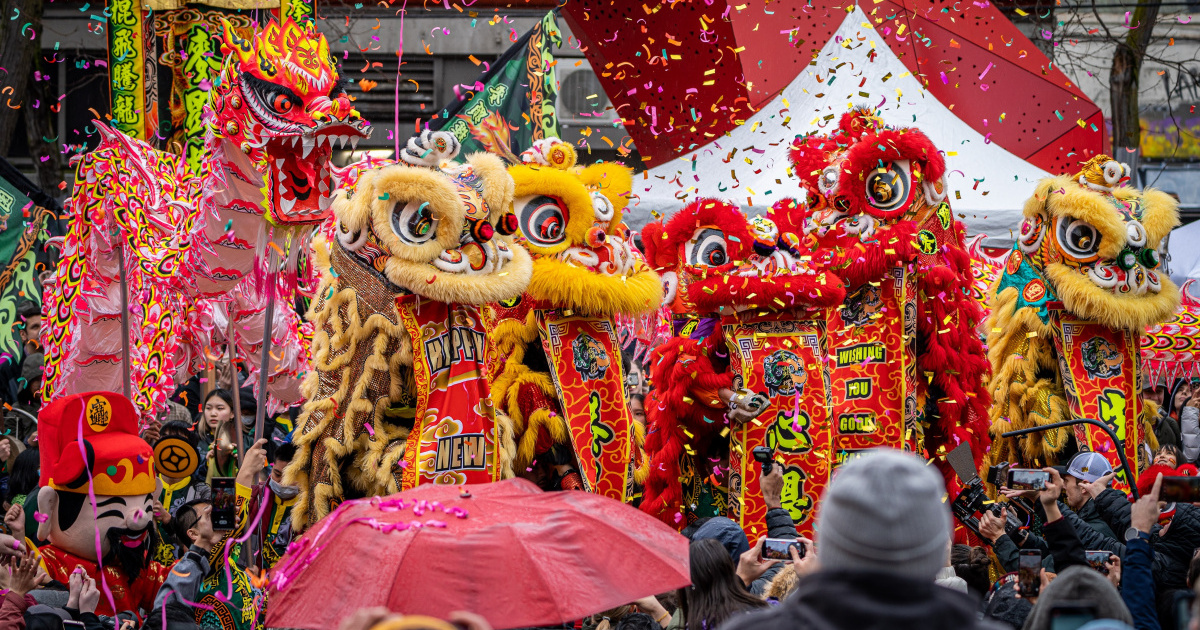
The lion dance begins precisely as it should: drums thundering, cymbals crashing, the massive gold-and-red creature leaping and prowling through Hing Hay Park while hundreds crowd S King Street watching. Han Eckelberg—instructor with Mak Fai Kung Fu Dragon & Lion Dance Association—knows exactly what the performance means. Not just cultural celebration or tourist spectacle. Real spiritual work.
“Whatever hatred, whatever evil that was down on that side,” Eckelberg gestures toward the Wing Luke Museum where nine windows were smashed in September’s racially motivated attack, “we’re chasing all that away. Not only testament to ongoing battles we go through as Asian Americans. But really testament to how strong our culture is and unifying altogether.”
Lunar New Year celebration in Seattle’s Chinatown-International District isn’t merely marking calendrical transition—Chinese zodiac rotating through twelve animals, lunar cycles dictating late-January or mid-February date. It’s survival ritual for neighborhood enduring decades of displacement, demolition threats, racist violence, economic disinvestment, and constant pressure from development erasing one of Seattle’s oldest treasures. The dragon and lion dances chase away literal evil—hate crimes, vandalism, displacement—while asserting that 150 years of Asian American presence in Seattle won’t disappear quietly.
The annual celebration hosted by Chinatown-International District Business Improvement Area has become region’s largest Lunar New Year event: hundreds of vendor booths lining S King Street, dragon and lion dances, martial arts demonstrations, Japanese Taiko drumming, food walks through 40+ participating businesses, families wearing traditional clothing, red lanterns everywhere, firecrackers (when permitted), and thousands gathering to claim public space in neighborhood where claiming space has always been political act.
Deputy Mayor Greg Wong’s 2025 welcoming speech captured the stakes: “Welcome home. Come home to the C.I.D. Come home to Seattle. A home filled with family and friends, celebrating new beginning. Take this Lunar New Year to celebrate your loved ones, your culture. Whatever you’re doing, do it together because we’re stronger as one community.”
The emphasis on home and community matters. The Chinatown-International District’s survival depends on people remembering it exists, visiting regularly, supporting businesses, defending it from destruction. Lunar New Year celebration makes neighborhood visible, attracts thousands who might never visit otherwise, demonstrates vitality defying narratives about declining ethnic enclaves, and generates economic activity sustaining vulnerable small businesses.
The District: 150 Years of Exclusion, Resilience, and Community
Seattle’s Chinatown-International District emerged from racist exclusion. Chinese immigrants arrived 1850s-1860s working railroads, lumber mills, canneries, coal mines. Discriminatory covenants prevented Asians living elsewhere in city—Chinatown wasn’t cultural choice but legal necessity. 1910 Seattle regraded hills, filled muddy waterfront flats. Buildings erected on reclaimed land south of Jackson along King Street created new International District.
Early Chinatown inhabitants were mostly men—single or supporting families back in China. They established import-export operations, restaurants, laundries, hotels, commercial enterprises. Japantown (“Nihonmachi”) originally sprang north of Jackson along Main Street until Executive Order 9066 forced Japanese residents into 1942 internment camps, erasing neighborhood overnight.
Filipinos—third Asian group arriving late 1800s—came in waves as Philippines transformed from American territory (1898) to full independence (1946). Today Filipino American community centers miles south along Martin Luther King Jr Way in southeast Seattle, but historical presence shaped International District’s pan-Asian character.
African Americans also settled International District along Jackson Street early 20th century, establishing Black-owned businesses and nightclubs. For years, Seattle’s Jackson Street jazz scene was place to be. Post-WWII housing discrimination and redlining forced Black population eastward into Central District between 12th Avenue and Empire Way (later Martin Luther King Jr Way).
The International District’s multicultural history—Chinese, Japanese, Filipino, African American communities overlapping spatially and temporally—created unique urban neighborhood. Not single-ethnicity enclave but intersection of communities excluded from elsewhere, building mutual support and shared cultural infrastructure despite different languages and traditions.
That multicultural character defines contemporary Lunar New Year celebration. Not just Chinese New Year but Lunar New Year—acknowledging Vietnamese Tết, Korean Seollal, other East Asian traditions marking lunisolar calendar transition. The terminology matters. Chinese immigrants may have established neighborhood first, but claiming shared cultural heritage respects all Asian Pacific American communities.
The CIDBIA: Community Defenders and Event Producers
Chinatown-International District Business Improvement Area operates behind scenes maintaining neighborhood. Gina Chaleunphonh—Seattle native running CIDBIA’s social media, newsletter, and event planning—explains: “We promote and improve Chinatown as welcoming, clean, and safe neighborhood through sanitation coordination, public safety coordination, and marketing and events, as well as advocating for quality of life issues.”
The organization works quietly until major events spotlight their work: CID Night Market return after hiatus, Lunar New Year celebration expanding annually, food walks throughout year. CIDBIA fundraises through events supporting critical programs benefiting businesses and residents. The nonprofit’s mission centers restoring “community aspect of what festivals and events mean to Chinatown-International District neighborhood in its many years of being catalyst for significant cultural moments in Seattle.”
The language reveals tension. “Restoring community aspect” acknowledges something was lost. The neighborhood that once bustled with residents living above shops, families shopping daily at Asian grocers, community gathering spaces thriving—that neighborhood declined as Asian Americans achieved economic mobility moving to suburbs, younger generations pursuing opportunities elsewhere, urban renewal demolishing buildings, and gentrification raising rents pricing out longtime businesses.
CIDBIA’s events attempt reversing decline by attracting visitors, showcasing neighborhood, generating foot traffic benefiting businesses. Chaleunphonh’s hope: “More visitors able to come into neighborhood. Not just local visitors, but also bringing people from out of town to showcase our neighborhood. Because it’s very special part of Seattle’s history, and definitely part some people don’t know about, or they haven’t really explored. Maybe because they’re not sure what to expect, or maybe they just don’t have people to go with and don’t want to go alone.”
The admission that people avoid Chinatown-International District from uncertainty or fear reflects neighborhood’s reputation challenges. Media coverage emphasizing crime, homelessness, drug activity creates perception problems. Visitors from whiter Seattle neighborhoods see district as dangerous despite violent crime rates not exceeding other downtown areas. The racialized fear—white people uncomfortable in predominantly Asian neighborhood, assuming danger where none exists—compounds economic challenges.
Lunar New Year celebration counters negative perceptions. Thousands attending festival see vibrant community, experience cultural richness, eat amazing food, witness traditions passed through generations. The positive exposure builds constituency defending neighborhood when development threatens, advocating for resources, and patronizing businesses year-round not just festival day.
Hing Hay Park: The Village Green That Almost Wasn’t
The festival centers Hing Hay Park—0.64-acre pocket park at Maynard Avenue S and S King Street. The park’s name means “park for pleasurable gatherings” in Cantonese, though some translate it as “favorable” or “good.” That naming choice reveals philosophy: not merely green space but community gathering place, village square transplanted to urban Seattle.
The site previously housed two wooden-frame single-room occupancy hotels—the Specie Bank of Seattle building from 1911 and adjacent structures typical of early Chinatown. Forward Thrust bond initiative approved by voters in 1968 provided funds purchasing buildings and land. The proposed park initially carried generic name “International District Mini Park” during planning phase.
Landscape architecture firm Sakuma, James, and Peterson led by S.K. Sakuma designed original 0.33-acre park completed 1973. But the space lacked distinguishing features—brick square with minimal amenities. Then-King County Council member Ruby Chow—Chinese American political pioneer who became first Asian American woman elected to King County Council—understood the park needed cultural significance, not just utilitarian function.
Mayor of Taipei visited Seattle early 1970s meeting with Ruby Chow. She explained city had purchased and demolished condemned buildings proposing park instead, but budget constrained possibilities. The mayor offered donating brickwork, pavilion, and bulletin board from his private funds. He sent crew of trained workers aiding construction. The ornate Grand Pavilion—bright red with elaborate painted details, traditional Chinese architectural style—was completed 1975, transforming generic urban park into cultural landmark.
The pavilion became Hing Hay Park’s defining feature: octagonal structure with sweeping curved roof, red painted columns, intricate designs in blue, green, gold. The traditional Chinese architectural symbolism—colors representing luck, prosperity, protection from evil—manifested in physical structure. Not decorative flourish but spiritual architecture embedding cultural meaning into urban landscape.
The park hosted summer tai chi classes, free music performances, community games (ping pong table, chess boards), and became social hub for neighborhood residents—particularly elderly Chinese and Japanese Americans who gathered daily. The space fulfilled Ruby Chow’s vision: cultural gathering place maintaining community bonds as younger generation moved away and neighborhood demographics shifted.
2007: Seattle Parks Department purchased former post office west side of existing park intending demolition to double Hing Hay Park’s size, adding 0.31 acres. Friends of Hing Hay Park formed 2012 meeting regularly with international design team: SvR Design Company from Seattle (now MIG) and Turenscape based in Beijing. Lead designer Kongjian Yu created masterplan integrating original 1970s design with contemporary expansion.
The 2018 expansion featured asymmetrical perforated red metal gateway at southeast corner—modern artistic interpretation of Asian paper cutting and folding traditions. Positioned obliquely, the gateway counters two nearby traditional structures: Historic Chinatown Gate one block west (traditional red-yellow-blue 45-foot paifang marking Chinatown’s entrance) and Grand Pavilion in park’s east section.
Curvilinear concrete terraces descend westward inspired by terraced rice paddies—agricultural heritage transplanted to urban context. Native Chinese plantings, integrated seating, performance space with custom seating, outdoor fitness equipment, decorative staircases with lighted Asian iconic figures, flowering trees, cafe tables. The expanded park became amphitheater hosting larger events while maintaining intimate community gathering functions.
The design’s agricultural references matter symbolically. Terraced rice paddies recall rural Chinese landscape—reminder that most Chinese immigrants’ ancestors were farmers before urbanization and emigration. The terraces also suggest cultivation: neighborhood carefully tended over generations, community requiring constant care preventing erosion.
The 2018 grand opening celebrated doubling park’s size and completing decade-long community planning process. The expansion enabled larger-scale events—Lunar New Year celebration, Dragon Fest, CID Night Market, DanO Festival (celebrating Korean indigenous culture), summer concerts, political demonstrations. Hing Hay Park transformed from community living room to neighborhood stage.
The Celebration: Lions, Dragons, Food, and Family
11 AM-4 PM typical festival hours pack enormous programming into five hours. Opening lion dance performed by groups like Mak Fai Kung Fu—dramatic spiritual blessing chasing evil, welcoming luck. Traditional lion dances originated Han Dynasty (206 BCE-220 CE), adapted through centuries. The performance requires immense physical skill: two performers inside costume coordinating movements while drums, cymbals, gongs provide percussive soundtrack. The lion “eats” offerings (vegetables, oranges hung high requiring acrobatic leaps), distributes blessings, and prowls through crowds.
Dragon dances involve longer serpentine costume manipulated by team of performers holding poles, creating undulating movement symbolizing power, strength, good fortune. Multiple dragons might perform simultaneously—children’s dragons, adult dragons, competitive demonstration dragons showcasing technical difficulty.
Martial arts demonstrations by various schools display kung fu, wushu, tai chi traditions. Japanese Taiko drumming groups provide thunderous rhythmic performances—massive drums requiring full-body technique, performers in traditional garb executing choreographed movements. The Taiko tradition, though Japanese, appears regularly at pan-Asian Lunar New Year celebrations acknowledging International District’s multicultural heritage.
The food walk represents festival’s most popular component. Printed maps distributed at Hing Hay Park tent direct visitors to 40+ participating businesses offering special menu items unavailable other times. Direct payment to businesses—not festival—ensures economic benefit flows to neighborhood. Chaleunphonh explains: “We usually have our food walks in summers, and they’re basically self-guided food tour of neighborhood. Visitors come in and grab printed map of participating businesses. Then they walk around, try new foods and also visit other retail businesses. Whatever businesses you go to, you pay business directly when you get there.”
The food walk transforms festival from concentrated Hing Hay Park event into neighborhood-wide experience. Visitors wander streets discovering businesses, making mental notes for return visits, experiencing district as living commercial ecosystem not museum. The economic impact matters enormously—small restaurants operating on thin margins depend on volume, festivals generating months of regular business through single day’s exposure.
Traditional foods carry symbolic meanings. Dumplings represent wealth (shaped like ancient currency). Long noodles symbolize longevity (never break them). Whole fish ensures surplus (Chinese word for fish, “yu,” sounds like word for surplus). Nian gao (sticky rice cake) represents rising prosperity (name sounds like “year higher”). Spring rolls suggest wealth (golden color resembling gold bars). Mandarin oranges offer good luck (Cantonese name “gam,” sounds like “gold”).
Vietnamese Tết foods include bánh tét (cylindrical sticky rice cakes), watermelon seeds, pickled onions, boiled chicken. Korean Seollal features tteokguk (rice cake soup eaten to gain year of age), jeon (savory pancakes). The food diversity within single celebration demonstrates International District’s multicultural character—not homogeneous Asian community but coalition of distinct traditions.
Vendor booths selling crafts, calligraphy, traditional clothing, imported goods, handmade jewelry, art create marketplace atmosphere. Local Asian Pacific American artists and small business owners gain platform showcasing work. The emphasis on community vendors—not corporate sponsors or national chains—maintains neighborhood’s character as independent business district.
Family-friendly activities for children include craft stations making zodiac animal artwork, calligraphy lessons teaching Chinese characters, storytime sessions explaining Lunar New Year traditions, meet-and-greet with animals (for Year of Snake, reptile exhibitions become popular). The multigenerational appeal ensures younger generation learns traditions while elders see culture valued publicly.
The Wing Luke Museum: Cultural Anchor and Target
Wing Luke Museum’s annual Lunar New Year Fair complements CIDBIA’s main celebration. Morning begins with lion dance—free and open to public—followed by timed-entry activities indoors. Local artists teach calligraphy, zodiac crafts engage children, galleries display cultural exhibitions. The museum’s KidPlace features “New Year’s All Year Round: Food, Family, and Fun” exhibition exploring different cultures’ new year celebrations.
The museum’s role extends beyond single day. Year-round programming educates about Asian Pacific American history, preserves cultural heritage, provides community gathering space. The September 2023 attack—nine windows smashed in racially motivated crime—targeted this cultural anchor. Windows were replaced with decorative murals donated by community, but attack’s psychological impact lingered.
Han Eckelberg’s statement about chasing evil away specifically referenced that attack. Lunar New Year performance became defiant response—we’re still here, culture remains strong, hatred won’t silence us. The spiritual work of lion dance—literally chasing away evil spirits—merged with political work of resisting racist violence through visible cultural celebration.
The attack exemplifies ongoing challenges. Anti-Asian hate crimes surged during COVID pandemic, persisting afterward. Seattle’s Chinatown-International District experienced multiple racist incidents: vandalism, assaults, harassment. The neighborhood’s visibility makes it target. Celebrating Asian culture publicly requires courage when white supremacist violence threatens Asian American communities.
The Development Threat: Revitalization or Displacement?
The neighborhood faces existential crisis from development pressure. Sound Transit’s light rail expansion required demolishing buildings and disrupting businesses during years-long construction. New luxury developments proposed for area threaten displacing affordable housing and longstanding businesses through rising rents.
The classic gentrification pattern: historic ethnic neighborhood becomes “interesting” to developers, real estate speculators buy properties, rents rise, longtime businesses can’t afford leases, luxury condos replace affordable housing, original community displaced. The neighborhood’s cultural character becomes marketing tool for developments ultimately destroying what made neighborhood valuable.
CIDBIA and community organizations fight this pattern through historic preservation advocacy, affordable housing requirements, small business support programs. But political power and economic resources favor developers. Light rail promised improved accessibility potentially benefiting neighborhood, but construction’s disruption harmed businesses and permanent changes remain uncertain.
Lunar New Year celebration asserts neighborhood’s continuing vitality. Thousands attending festival demonstrate public demand for Chinatown-International District’s preservation. The visible community support strengthens political arguments for protective policies, historic designations, affordable housing mandates. If neighborhood seems declining and moribund, developers’ replacement arguments gain credibility. If neighborhood appears vibrant and culturally significant, preservation arguments strengthen.
This instrumental logic—using cultural celebration as development resistance—feels uncomfortable but remains necessary. Communities shouldn’t need justifying existence through economic activity or cultural tourism. But political reality demands demonstrating value measurable to city planners and developers. Lunar New Year celebration provides that measurement: attendance numbers, economic impact studies, media coverage, visitor spending data.
The Traditions: Beyond Spectacle
Lunar New Year traditions carry philosophical depth beyond surface spectacle. The holiday marks lunisolar calendar transition—first new moon between January 21-February 20. Preparations begin days before: thorough house cleaning (sweeping away bad luck), decorating with red (lucky color), buying new clothes, preparing special foods, settling debts, reconciling grudges.
New Year’s Eve and Day traditionally reserved for family—multigenerational gatherings, religious ceremonies honoring ancestors, elders distributing red envelopes (hongbao) containing money to children and unmarried adults. The first days of new year determine fortune for coming months. Traditions prohibit sweeping (might sweep away luck), breaking dishes (bad omen), wearing black or white (mourning colors), arguments or crying (inauspicious start).
The fifteen-day celebration concludes with Lantern Festival—homes and streets decorated with red lanterns, riddle-guessing games, special foods like tangyuan (sweet rice balls). Seattle Chinese Garden hosts separate Lantern Festival featuring traditional music, tai chi demonstrations, cultural workshops, classical Chinese architecture providing meditative setting.
These private family traditions create context for public celebration. The CIDBIA festival represents community-scale enactment of household rituals—collective cleaning (neighborhood improvement), shared meals (food walk), cultural transmission to younger generation (demonstrations and education), welcoming luck and chasing evil (lion and dragon dances).
The public/private interplay matters. Lunar New Year isn’t performance for outsider consumption—it’s living tradition practiced by families privately, shared publicly to maintain community bonds and educate non-Asians. Festival attendees witness authentic cultural practice, not commercialized theme-park version. The authenticity builds understanding and respect rather than stereotypical caricatures.
The Politics: Who Celebrates, Who Benefits
Lunar New Year celebration navigates complex politics of cultural representation, economic development, and community survival. Who controls narrative? Who benefits economically? Who gets included or excluded?
The CIDBIA as organizing entity ensures community control—Asian American business owners and residents determining celebration’s character rather than outside event producers imposing vision. The grassroots governance prevents cultural appropriation or exploitation common when white institutions produce ethnic festivals.
But tensions exist. Gentrification brings white residents and businesses to Chinatown-International District. Do they belong at Lunar New Year celebration? How does neighborhood welcome newcomers while resisting displacement? The festival attracts diverse crowds—Asian American families connecting to heritage, white Seattleites seeking cultural experience, tourists wanting authentic Seattle. Managing these different audiences and agendas requires diplomatic programming.
The food walk exemplifies this balance. Participating businesses include longstanding Chinese restaurants, newer Vietnamese cafes, Japanese ramen shops, Korean bakeries, Thai eateries, and pan-Asian fusion spots. The diversity represents International District’s evolution while raising questions: Does fusion cuisine dilute authenticity? Do businesses catering to white palates betray cultural integrity? Or does adaptation ensure economic survival enabling cultural preservation?
No simple answers exist. Communities evolve, traditions adapt, cultures hybridize. Maintaining “purity” often means stagnation and irrelevance. But wholesale commercialization erases distinctive character. The tension persists between honoring roots and embracing change, between cultural preservation and economic survival.
The Future: Cautious Hope Amid Uncertainty
Gina Chaleunphonh signing off from interview said: “The main thing, one that anyone can do: hang out, and support.” The straightforward advice cuts through complexity. Chinatown-International District survives through patronage. Visit. Eat. Shop. Bring friends. Tell others. The economic support enables businesses staying open, landlords maintaining reasonable rents, neighborhood retaining character.
Lunar New Year celebration embodies this survival strategy. Attract thousands once annually. Hope they return monthly. Build loyal customer base supporting year-round business. Generate positive media coverage countering negative perceptions. Create memories associating neighborhood with joy, culture, community rather than fear and decline.
The strategy shows results. Attendance grows annually. 2025 celebration among largest yet according to Seattle Times coverage. Social media amplifies reach. Younger Asian Americans claim heritage through festival attendance. Non-Asian Seattleites develop appreciation for neighborhood. Political support for preservation strengthens.
But existential threats remain. Development pressure continues. Affordable housing disappears. Small businesses close. Longtime residents age without younger generation replacing them. The neighborhood’s future stays uncertain despite successful celebrations.
Han Eckelberg’s metaphor—chasing evil away through lion dance—captures both hope and precarity. The ritual works spiritually but requires constant repetition. Evil spirits return. Hatred persists. Displacement pressure never fully abates. So annually the community gathers, drums thunder, lions prowl, dragons soar, evil gets chased away for another year, and survival continues—defiant, joyful, communal, and absolutely necessary.
Seattle’s Chinatown-International District isn’t museum or theme park. It’s living neighborhood where 150 years of Asian American history meets present struggle for survival and future uncertainty about preservation. Lunar New Year celebration makes that complexity visible: cultural richness worth defending, community resilience inspiring action, neighborhood vitality demanding protection, and persistent reminder that chasing evil away requires showing up, celebrating loudly, supporting consistently, and refusing to let Seattle’s oldest treasure disappear quietly into gentrified homogeneity. The dragons keep dancing. The drums keep thundering. The neighborhood keeps fighting. And every year, thousands answer Greg Wong’s invitation: “Welcome home. Come home to the C.I.D.”