

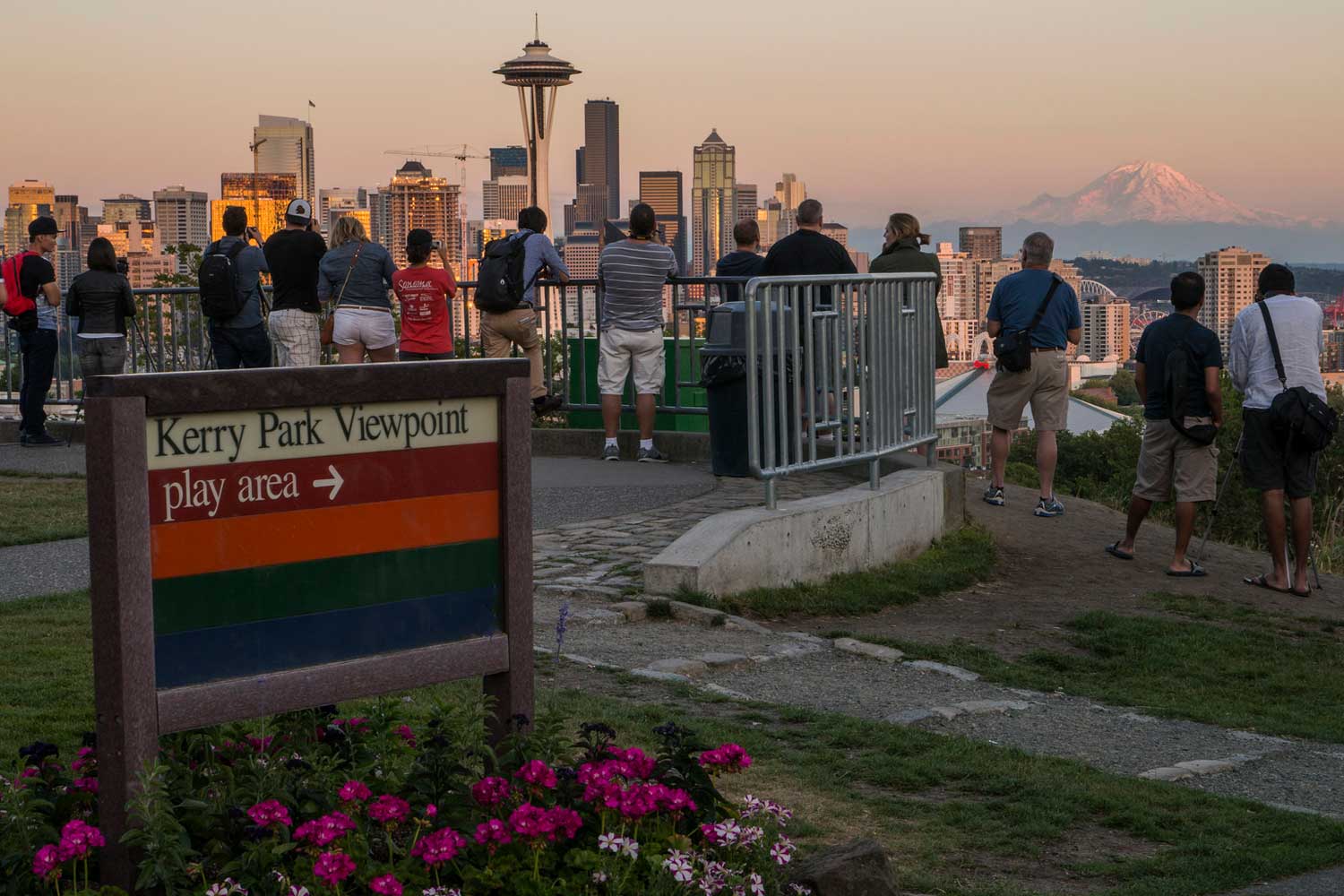
Every city has a view that defines it. In New York, it’s the skyline from Brooklyn. In San Francisco, the Golden Gate from the Marin Headlands. In Seattle, it’s the panorama from Kerry Park—a 1.26-acre sliver of grass and concrete on Queen Anne Hill that has produced more postcards, more television news backdrops, more Instagram posts, and more marriage proposals than any other spot in the Pacific Northwest.
The view is deceptively simple: the Space Needle rises in the foreground, the downtown skyline clusters behind it, Elliott Bay spreads to the west with ferries gliding across its surface, and on clear days—perhaps one hundred per year—Mount Rainier materializes in the background, a 14,411-foot volcanic sentinel that seems impossibly close and impossibly massive. This is Seattle compressed into a single frame, the city’s entire identity captured in one sweeping glance.
What most visitors don’t realize, standing at the railing with their cameras raised, is that this view almost didn’t survive. That the park exists at all is the result of one family’s generosity nearly a century ago. That it remains unobstructed is the result of citizens who formed an organization with a provocative Cold War acronym to fight developers in the 1970s. Kerry Park is not just a viewpoint. It’s a testament to what happens when people decide that some things are worth protecting.
The Lumber King Who Gave Away the View
Albert Sperry Kerry was born in Kingston, Ontario, on April 14, 1866, the son of a blacksmith and carriage maker, one of eleven children in a family that would eventually migrate to Michigan. At twenty years old, with no particular prospects and no particular plan, Kerry headed west. He arrived in Seattle in 1886 and later explained his choice with characteristic directness: the village was “as far west as I could go and still be in the United States.”
He went to work immediately as a tallyman in a lumber mill, recording the dimensions of cut timber. Within a year, the foreman quit and Kerry was promoted to his position. Within four years, he was managing an entire lumber company. Within six, he was leasing his own sawmill. The trajectory was relentless.
In 1896, Kerry and his brother James founded the Kerry Lumber Company. The mill burned down within a year. Around the same time, doctors diagnosed Kerry with tuberculosis and recommended he relocate to a cold, dry climate. The Klondike Gold Rush was underway, so Kerry headed north—not to pan for gold but to sell lumber to those who did. He established sawmills in the Yukon and British Columbia and operated a steamboat named the Olive May (after his daughter) on northern lakes. The boat would later achieve literary fame when Robert Service mentioned it in “The Cremation of Sam McGee.”
The tuberculosis diagnosis turned out to be wrong. Kerry returned to Seattle in late 1899 and rebuilt the Kerry Lumber Company. The new mill, located at the foot of Clay Street on the waterfront, was operational by January 1900. It burned down in February 1901, one day after Kerry’s wife Mary died. He rebuilt again.
In 1902, Kerry married Katherine Amelia Glen of Philadelphia and commissioned architects Bebb and Mendel to design a grand residence at 421 West Highland Drive on Queen Anne Hill. The house faced north, but its southern facade commanded the very view that would later draw millions of visitors. Kerry could look out from his home and see Elliott Bay, the downtown that was rapidly growing, and the mountains beyond.
His business interests expanded relentlessly. The Kerry Mill Company purchased 100 million board feet of standing timber along the Green River. A company town named Kerriston grew up around his operations east of Seattle. Another Kerry was established in Oregon. At his peak, Kerry controlled the largest private logging railroad in the Pacific Northwest.
But Kerry was never only a businessman. He served as vice-president of the Alaska-Yukon-Pacific Exposition in 1909, helping to organize Seattle’s first world’s fair. He became president of the Seattle Chamber of Commerce in 1923. He led the fundraising campaign that built the Olympic Hotel in 1924—a project of such significance that the hotel later commissioned a bronze statue in his honor. He served as president of the Seattle Park Board, president of the Pacific Northwest Golf Association, and president of the Rainier Club. When political allies urged him to run for the United States Senate, he declined, saying he wanted to benefit his local community directly.
In 1927, Albert and Katherine Kerry donated a portion of their estate to the City of Seattle, along with $20,000 toward its development as a public park. The deed included a stipulation that has since been inscribed on a plaque at the site: “Kerry Park given to the City in 1927 by Mr. and Mrs. Albert Sperry Kerry, Sr., so that all who stop here may enjoy this view.”
Kerry died on April 27, 1939, suffering a massive heart attack while returning to Seattle from California on a northbound train. He was transferred to a hospital in Portland but did not survive. He was seventy-three years old.
The View Before the Needle
When Kerry Park opened in 1927, the view was already spectacular—but it was not yet the view we know today. The Space Needle didn’t exist. The downtown skyline was lower, less dramatic, dominated by the Smith Tower, which had been the tallest building west of the Mississippi when it opened in 1914. Mount Rainier was visible on clear days, just as it is now, but the foreground lacked the focal point that would later define Seattle’s visual identity.
The view evolved with the city. The Seattle World’s Fair of 1962 transformed the landscape below Kerry Park, bringing the Space Needle and the Seattle Center campus into existence. Suddenly the viewpoint had a subject. The Space Needle, positioned perfectly in the sight line from Queen Anne Hill, became the anchor around which every photograph would be composed.
In the decades that followed, the downtown skyline grew taller and denser. The Columbia Center rose to 943 feet in 1985, becoming the tallest building in the Pacific Northwest. New towers filled in the gaps. The Great Wheel opened on the waterfront in 2012, adding a circle of light to evening views. Each addition changed the composition without diminishing it, the skyline growing into the frame that Kerry Park provided.
The Children’s Gift: Changing Form
For forty-four years, Kerry Park was defined entirely by what it looked out upon. Then, in 1971, the Kerry children—Albert Sperry Kerry Jr. and Lucy Glen Kerry—commissioned a sculpture to honor their parents’ gift.
The artist they chose was Doris Totten Chase, a Seattle native who had studied architecture at the University of Washington before dropping out to marry and raise a family. Chase had taught painting and design at Edison Technical School while her husband recovered from polio, supporting the family while squeezing her own artwork into nights and weekends. By the 1960s, she had turned to sculpture, creating abstract forms from wood and metal that featured interlocking circles and arches.
For Kerry Park, Chase designed “Changing Form,” a fifteen-foot steel sculpture consisting of geometric shapes—circles, cylinders, and curves—welded into an open framework. The piece was originally kinetic, designed so that visitors could rotate the upper section on bearings, changing the relationship between the sculpture and the view behind it. (Park officials later had it welded into a fixed position for safety reasons.)
The sculpture transformed how visitors experienced the park. Children climbed through its openings and posed within its frame. Photographers discovered they could compose shots with the Space Needle visible through the circular apertures, creating images that layered the sculpture’s abstraction against the city’s iconography. What had been purely a viewpoint became something more—a place where art and vista intersected.
Chase went on to international recognition. In 1972, at age forty-nine, she divorced her husband, moved to New York, and began making experimental video art from a studio in the Chelsea Hotel. She became known for films about the inner lives of aging women, earning honors that had eluded her during her years fighting for recognition in Seattle’s male-dominated art world. In 1999, Seattle declared “Doris Chase Day” when her second major public sculpture, “Moon Gates,” was installed at Seattle Center.
“Changing Form” remains one of the most photographed, climbed-upon, and posed-in-front-of artworks in Seattle. Chase died in December 2008, but her sculpture continues to frame the view her patrons’ parents had preserved eighty years earlier.
The Battle for the View: U.S.S.R. on Queen Anne
The generosity of the Kerry family protected one parcel of land. But a viewpoint is only as good as what lies in front of it, and by the 1970s, developers had noticed the valuable real estate on Queen Anne’s south slope.
In 1973, proposals emerged for high-rise apartment buildings on lots adjacent to Kerry Park. If constructed, they would have blocked significant portions of the iconic view—not just from the park but from the historic homes along West Highland Drive. The neighborhood had already suffered one blow: a tall building at 111 West Highland Drive had risen and blocked views from the Victoria Apartments, a grand 1921 structure designed by John Graham, Sr., one of Seattle’s most prominent architects.
Residents organized. Under the leadership of architect Art Skolnik—who would later become the first head of both Seattle’s and Washington State’s offices of historic preservation—neighbors formed an organization called United South Slope Residents. The acronym was deliberate. In the middle of the Cold War, these Queen Anne citizens claimed the letters U.S.S.R. for their fight against development.
The group gathered more than 4,800 signatures on a petition demanding low-rise zoning for the south slope. They hired respected Seattle land use attorneys—Thomas Goeltz, Susan Agid, and Jerry Hillis—to challenge developers who had rushed to file building permits under the old zoning code after the City Council began modifying regulations in response to the uproar.
The legal battle that followed had consequences far beyond Queen Anne. When U.S.S.R. prevailed in court, the ruling established that environmental reviews required by the State Environmental Policy Act must evaluate cumulative negative impacts of development, not just the effect of each individual project on its immediate surroundings. What began as a neighborhood fight to protect a view became precedent that shaped land use law across Washington State.
The south slope of Queen Anne Hill remains low-rise today. The view from Kerry Park remains unobstructed. Art Skolnik, the architect who led U.S.S.R., would later find himself on the opposite side of a preservation battle—arguing against landmark designation for the Harry Treat House on West Highland Drive. The ironies of urban development never cease.
The Photographer’s Pilgrimage
Kerry Park has become one of the most photographed locations in the Pacific Northwest, a place where amateur and professional photographers alike make pilgrimage to capture the definitive Seattle image.
The logistics are straightforward. The park sits at approximately 450 feet above sea level, looking south across the Queen Anne slope toward downtown. The Space Needle occupies the center of the composition, with the downtown skyline massed behind it and to the right. Elliott Bay spreads to the left, with ferries, sailboats, and container ships providing movement and scale. Mount Rainier, when visible, rises behind everything, its glaciated bulk dwarfing the human constructions in the foreground.
Serious photographers have developed detailed protocols for capturing the view. Sunset is the most popular time—the sun sets behind the camera, illuminating the Space Needle and skyline in warm golden light while the sky above the Olympics shifts through orange and pink. The period after sunset, when the sky turns deep blue and the city lights begin to glow, offers what photographers call “blue hour”—twenty to thirty minutes of magical transitional light.
Night photography reveals a different city entirely. The Space Needle glows against the dark sky. The windows of downtown towers create geometric patterns of light. Ferries crossing Elliott Bay appear as bright lines against the black water. The illumination changes seasonally, with holiday lights adding color in December and special events prompting the Space Needle to change its lighting scheme.
Clear days with Mount Rainier visible are precious and unpredictable. Locals have a phrase for it: “The mountain is out.” On such days, photographers drop whatever they’re doing and head for Kerry Park, knowing that the volcanic backdrop transforms a good image into an iconic one. Webcams monitoring Rainier’s visibility have become essential tools for planning photo expeditions.
The composition has been refined over decades. A normal zoom lens (24-70mm) or moderate telephoto (70-200mm) captures the classic postcard view. The “Changing Form” sculpture offers opportunities for creative framing, with the Space Needle visible through its circular openings. Tripods are essential for low-light shooting, though the small concrete ledge along the railing can support beanbags or other stabilizing devices in a pinch.
A Park for All Seasons
Kerry Park operates differently through Seattle’s seasons, each bringing distinct experiences and challenges.
Summer brings the longest days and the largest crowds. Sunset doesn’t arrive until after 9 PM in late June, and the park fills with tourists, photographers, families on evening walks, and couples seeking romantic backdrops. Parking becomes difficult by late afternoon. The competition for prime positions along the railing intensifies as the light improves. But summer also offers the best chance for clear skies and visible mountains.
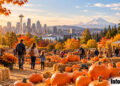
Autumn delivers shorter days and softer light. The crowds thin. The trees on Queen Anne Hill turn color, adding warm tones to the foreground of photographs. Mount Rainier takes on a different character as early snows dust its upper slopes. The air often clears after autumn rains, offering unexpected visibility.
Winter brings its own rewards. The mountain, when visible, gleams white against gray skies. The city lights appear earlier, extending the hours of night photography. Holiday illumination transforms the skyline. Visitors willing to brave cold and rain often find themselves alone at a viewpoint that would be crowded in July.
Spring offers unpredictable weather and alpenglow—the phenomenon where rising or setting sun paints the snow-covered mountain in shades of pink and orange. Cherry blossoms appear in the Queen Anne neighborhood, offering additional foreground interest for photographers willing to explore beyond the park’s formal boundaries.
The Small Park with the Large Purpose
Kerry Park measures 1.26 acres. By comparison, New York’s Central Park encompasses 843 acres. Seattle’s own Discovery Park covers 534. In purely physical terms, Kerry Park barely qualifies as a park at all—more a widened sidewalk with a railing and some benches.
But the park’s purpose was never recreational in the conventional sense. Albert and Katherine Kerry didn’t donate land for picnicking or sports or children’s play (though a playground does exist in the connected Bayview-Kinnear Park below). They donated land for seeing. They understood that the view itself was the attraction, and that preserving access to that view was a civic gift requiring no facilities beyond a place to stand.
The minimalism has proven essential to the park’s success. There are no concession stands to distract from the vista. No amphitheaters to generate noise. No facilities that would draw crowds uninterested in the view itself. Kerry Park exists to frame a panorama, and everything about its design serves that single purpose.
The railing along the southern edge provides a natural gathering point and safety barrier. Several benches face the view, offering rest for those who want to linger. A coin-operated telescope helps visitors identify distant landmarks. Stairs on the west end connect down to West Prospect Street and the small playground of Bayview-Kinnear Park. That’s it. The infrastructure is complete.
What the View Reveals
Standing at Kerry Park on a clear day, looking south across Seattle, certain truths about the city become apparent.
The Space Needle, built for a world’s fair more than sixty years ago, remains the city’s defining structure. Despite decades of development, despite the tech boom that transformed Seattle’s economy and skyline, the 605-foot tower still anchors the composition. This says something about the power of iconic architecture, and perhaps something about Seattle’s relationship to its own history.
The downtown skyline, dense with corporate towers, represents the city’s transformation from regional outpost to global hub. Amazon’s spheres, visible in recent years, signal the tech industry’s physical presence. The construction cranes that have become running jokes among locals—always present, always multiplying—testify to growth that shows no signs of stopping.
Elliott Bay, with its ferry traffic and industrial waterfront, connects Seattle to its maritime heritage. The ferries crossing to Bainbridge Island and beyond are working vessels, not tourist attractions, carrying commuters and freight just as ships have done since the city’s founding.
And Mount Rainier, when it appears, reminds everyone that this city exists in the shadow of an active volcano, that wilderness begins where the suburbs end, that nature in the Pacific Northwest is not background but presence.
The Gift That Keeps Giving
Albert Kerry could not have imagined what his gift would become. In 1927, when he and Katherine signed the deed transferring their land to the city, the Space Needle didn’t exist. Television didn’t exist. Social media was inconceivable. The idea that millions of people would someday travel from around the world to stand on his former property and photograph a skyline he never saw would have seemed absurd.
But Kerry understood something fundamental about his city and his view. He understood that some things are worth preserving for their own sake, that beauty has public value, that access to remarkable vistas shouldn’t be limited to those wealthy enough to own hilltop property. He gave away his view so that everyone could share it, asking nothing in return except that they enjoy what he had enjoyed.
Nearly a century later, they still do. Tourists line the railing at sunset. Photographers wait for the mountain to emerge from clouds. Children climb through Doris Chase’s sculpture. Couples stand together in silence, watching ferries cross the bay and lights come on in the city below.
The view has changed since 1927—the skyline grown, the Needle risen, the population multiplied—but the essential gift remains. Kerry Park still offers what Albert and Katherine Kerry promised: a place where all who stop may enjoy the view.