The ferries crossing Puget Sound don’t announce their revolution with fanfare. They board cars and passengers at terminals throughout the Seattle region just as they have for decades, their movements so routine that commuters check email or scroll phones during the crossing rather than watching the water. But beneath the familiar routine, something fundamental has changed. These vessels represent the vanguard of maritime decarbonization, hyb rid-electric propulsion systems replacing diesel engines, shore power connections eliminating idling emissions, operational modifications cutting fuel consumption by millions of gallons annually.
This transformation extends far beyond Washington State Ferries. Across Seattle’s maritime sector—from autonomous tugboats guiding container ships through Elliott Bay, to sensor-laden research vessels mapping ocean conditions, to startups developing modular battery systems that swap like power tools—innovation has replaced tradition as the defining characteristic. The city that built its economy on timber, fish, and Boeing’s airplanes has become the unlikely epicenter of the blue economy’s technological revolution.
Understanding this transformation requires looking past individual companies or projects toward the ecosystem that enables maritime innovation at scale. Seattle didn’t stumble into this position. It created conditions—through intentional policy, strategic investment, cross-sector collaboration, and institutional support—that allow traditional maritime industries to evolve while nurturing startups attacking old problems with new solutions.
The Washington Maritime Blue Strategy: Blueprint for Transformation
In January 2019, Governor Jay Inslee and a coalition of maritime stakeholders launched Washington Maritime Blue—a comprehensive strategic plan positioning the state as the global leader in clean maritime technology and sustainable ocean business practices. The initiative wasn’t merely aspirational rhetoric. It represented coordinated commitment from government agencies, port authorities, research institutions, established companies, and entrepreneurs to fundamentally reshape how Washington’s $37 billion maritime sector operates.
The strategy drew inspiration from Norway’s Green Coastal Shipping Program, which had successfully transformed Scandinavian maritime industries through similar cluster development approaches. Norwegian delegations visited Washington to share experiences with hybrid ferries, shore power systems, and regulatory frameworks supporting innovation. Washington representatives traveled to Norway studying successful models they could adapt to Pacific Northwest conditions.
DNV GL, the Norwegian classification society and maritime advisor, played pivotal roles in both initiatives, bringing global expertise to Washington’s strategic development. Their involvement connected Seattle to international best practices while ensuring local solutions met global standards. This knowledge transfer accelerated timeline dramatically—Washington didn’t need to reinvent approaches already proven elsewhere but could adapt and improve upon existing models.
The Maritime Blue framework identified specific focus areas: decarbonization and electrification of vessels and port operations, acceleration of startup companies through incubator programs, workforce development preparing workers for technology-intensive maritime careers, and collaborative structures ensuring industry, government, research institutions, and communities worked toward shared goals rather than competing priorities.
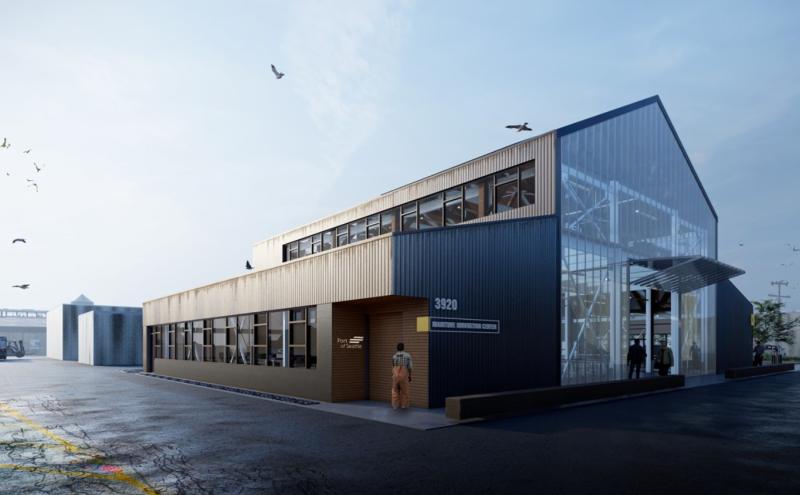
Within the first several years, tangible progress emerged across all priority areas. Washington State Ferries initiated the most ambitious electrification program in American ferry operations. The Port of Seattle committed funding for a Maritime Innovation Center providing infrastructure supporting startups and research. Educational institutions developed training programs addressing skills gaps. Regulatory agencies created pathways for innovation projects meeting sustainable development criteria.
Washington State Ferries: Proving Ground for Electric Propulsion
Washington State Ferries operates the largest ferry system in the United States, serving 20 terminals with 23 vessels transporting nearly 25 million passengers annually across Puget Sound. This massive operation consumes approximately 19 million gallons of diesel fuel yearly, generating substantial greenhouse gas emissions while exposing coastal communities to particulate matter and other pollutants. The system’s scale makes it both major environmental concern and exceptional opportunity—innovations proven on WSF vessels demonstrate feasibility at commercial scale rather than merely laboratory curiosity.
The centerpiece of WSF’s transformation involves converting three Jumbo Mark II Class vessels—the M/V Wenatchee, M/V Tacoma, and M/V Puyallup—from diesel to hybrid-electric propulsion. These conversions will create some of the largest car-carrying battery-hybrid ferries globally, demonstrating that large-scale maritime electrification is technologically and economically viable.
The conversion timeline reflects the complexity involved. Initial feasibility studies by Elliott Bay Design Group examined technical requirements, costs, and integration challenges. Complementary work by Glosten assessed shore power infrastructure needed at terminals in Seattle, Bainbridge Island, Edmonds, and Kingston where converted ferries operate. These studies revealed that terminal upgrades would cost approximately $6.91 million each—substantial investment but manageable within larger electrification budgets.
The converted vessels will operate initially as hybrids, combining battery power with diesel generators until shore charging infrastructure becomes fully operational. Each ferry will require 2,200 kWh average energy with cruising power reaching 7,200 kW—demands that push battery technology toward its current limits while creating market pull for continued advancement.
Beyond the three flagship conversions, WSF’s long-range plan envisions electrifying the entire fleet over coming decades. New vessel construction will default to all-electric or hybrid designs. The three Kwa-di Tabil class ferries—the fleet’s smallest vessels holding 64 cars—will convert to electric propulsion. This systematic transformation positions Washington as proving ground for maritime electrification technology applicable worldwide.
The environmental benefits extend beyond carbon emissions reductions. Electric propulsion dramatically reduces underwater noise pollution affecting Southern Resident orcas—endangered whale populations whose sonar communication systems suffer interference from conventional diesel engines. Eliminating this acoustic pollution while simultaneously cutting greenhouse gases demonstrates how environmental solutions can address multiple ecological concerns simultaneously.
Economic analysis suggests the conversions will pay for themselves through fuel savings. Matt von Ruden, Director of Vessel Engineering and Maintenance for Washington State Ferries, noted that even simple operational changes like reducing vessel speeds saved approximately 300,000 gallons of fuel from April to December 2018—a 5% reduction achieved without any technological modifications. The hybrid conversions promise far larger savings once fully implemented.
The Maritime Innovation Accelerator: Cultivating Startups
Washington Maritime Blue, in partnership with the Port of Seattle and Washington State Department of Commerce, launched the Maritime Innovation Accelerator to nurture startups developing technologies advancing sustainable maritime practices. The program provides coaching, training, networking opportunities, and connections to potential customers and investors—resources that dramatically improve startup survival rates in capital-intensive maritime sector.
The accelerator’s cohort model brings together diverse companies addressing different aspects of maritime innovation. Participants range from boat builders incorporating sustainable materials and autonomous systems, to software developers creating logistics platforms, to battery manufacturers producing modular energy storage solutions.
Sterling Plan B Energy Solutions (Sterling PBES) exemplifies the startup success stories emerging from this ecosystem. The Vancouver-based company developed CanPower Microgrid—containerized battery systems fitting standard 20-to-53-foot shipping containers that can hybridize or fully electrify commercial vessels. The technology addresses a critical challenge: charging large batteries requires substantial time and electrical infrastructure that many ports lack. Sterling PBES’s solution allows battery swapping in minutes rather than waiting hours for charging, similar to changing power tool batteries.
The system provides 25% or better fuel savings on any vessel while eliminating emissions, vibrations, and noise. Despite upfront costs, the battery systems typically pay for themselves within three years while providing savings for at least a decade. High-speed passenger ferries being built in Washington represent prime candidates for the technology, as do tugboats operators seeking zero-emission operations in environmentally sensitive harbors.
Silverback Marine, founded by Ian Gracey in 2020, brings innovation to custom workboat manufacturing with emphasis on personalized customer service and sustainable practices. The company has completed two autonomous, amphibious boats for the U.S. Navy, demonstrating how traditional boat building can incorporate cutting-edge autonomy technology. Gracey sees maritime innovation as essential for industry survival: “Three quarters of the earth is covered in water and boats have been around since the dawn of man, but people take it for granted compared to aerospace or computers. The maritime sector can never and will never go away. As long as there are humans on earth going to be boats. It’s a great time to see how we can be smarter and take more responsibility for the way we operate at sea, environmentally and economically, with the least impact on wildlife.”
OpenTug, developed by a 22-year-old entrepreneur, created a digital platform connecting shippers with available barge capacity—essentially an Uber for maritime freight. The platform optimizes asset utilization by matching cargo with vessels that would otherwise travel empty, reducing wasted fuel while creating revenue opportunities for operators. Initially focused on the Alaska market with approximately 15 operators signed up, OpenTug plans expansion along the West Coast as the network grows.
Pacific Mobility Group (PMG), founded by Greg Dronkert, works on integrating different transportation modes—marine, rail, trucking—while advancing zero-emission technology across sectors. The Washington State social purpose corporation focuses on vehicle electrification, shared mobility, and autonomous technology, recognizing that sustainable transportation requires systemic approaches rather than isolated improvements.
Autonomous Vessels: The Next Frontier
While electrification dominates current maritime innovation discussions, autonomous vessel technology represents the next major transformation. Companies globally are developing ships capable of operating with reduced or eliminated human crews, using artificial intelligence, sensor arrays, and communication systems to navigate, avoid obstacles, and optimize routes.
The advantages seem compelling. Human error causes most maritime accidents, so removing humans from direct control should improve safety. Autonomous systems don’t fatigue during long voyages or make poor decisions under stress. They can operate 24/7 without rest periods. They optimize fuel consumption through precise speed and route management. And they eliminate crew costs representing substantial portions of operational budgets.
Seattle’s maritime cluster includes companies working on autonomous technology applications. Foss Maritime, the region’s prominent tugboat operator headquartered in Seattle, partnered with Sea Machines Robotics on Department of Defense contracts developing autonomous supply stations globally. The $3 million project involves outfitting remotely commanded deck barges to land helicopters and host scaled fueling stations for aircraft, surface vessels, and shore replenishment.
The autonomous kits being prototyped include Sea Machines’ SM300 command and control systems meeting U.S. Navy criteria while complying with classifications and regulations from DOD aviation bodies. Foss Maritime provides naval architecture, support engineering, and operations management—leveraging its century of maritime expertise toward autonomous applications.
However, autonomous shipping faces substantial challenges beyond technological development. Existing maritime regulatory frameworks assume human-operated vessels. International Maritime Organization regulations, insurance requirements, liability standards, and safety protocols all require revision to accommodate ships without conventional crews. Questions about responsibility when autonomous vessels cause accidents, about cybersecurity protecting digital systems from unauthorized access, about technology reliability in harsh marine environments—all require resolution before autonomous shipping achieves widespread adoption.
The technology also raises workforce concerns. Maritime jobs provide family-wage employment for thousands of workers who lack college degrees but possess specialized skills and experience. Eliminating crew positions threatens these livelihoods while potentially eroding knowledge bases accumulated over generations of seafaring. Unions representing maritime workers understandably approach automation cautiously, seeking protections for members whose jobs face technological displacement.
Data-Driven Operations: The Ocean Internet of Things
Modern vessels generate enormous data streams from sensors monitoring everything from engine performance to weather conditions to cargo status. This information, properly analyzed, enables revolutionary improvements in efficiency, safety, and environmental performance.
ioCurrents, a Seattle startup founded by CEO Cosmo King, provides data-driven ship monitoring systems allowing onshore personnel to track all vessel systems in real-time. The technology uses AI and predictive analytics to spot faltering equipment before failures occur, enabling preventive maintenance that reduces costly breakdowns and dangerous malfunctions at sea.
Data applications extend far beyond equipment monitoring. Route optimization algorithms can steer ships through most efficient paths considering weather, currents, and traffic. Hull design improvements emerge from analyzing how different configurations perform under varying conditions. Port arrival timing coordinates to minimize waiting, reducing fuel waste from vessels idling offshore. Security systems leverage data to identify potential threats from pirates or terrorists during voyages.
The challenge involves maritime industry’s fragmentation. Different sectors, ports, and companies often operate within isolated silos using proprietary legacy systems. Ships more than 45 years old complicate digitization efforts. Creating interoperable standards allowing data sharing across fragmented industry requires coordination that historically hasn’t existed.
Washington Maritime Blue’s collaborative framework helps address this challenge by bringing stakeholders together around shared technological platforms. When ports, ferry operators, shipping companies, and technology providers work from common standards rather than competing proprietary systems, innovation accelerates while costs decrease through economies of scale.
The Workforce Challenge: Training for Technology Transition
Maritime innovation creates workforce disruptions requiring proactive responses. Traditional maritime careers emphasized mechanical skills, seamanship knowledge, and physical capability. Technology-intensive operations demand software proficiency, data analysis ability, and systems thinking alongside conventional maritime competencies.
The Youth Maritime Collaborative, part of Washington Maritime Blue’s workforce development initiatives, guides young people into maritime careers with focus on underrepresented communities. Programs include experiential events introducing students to maritime opportunities, high school internships providing hands-on experience, and connections between employers and the next generation of workers.
These efforts recognize that maritime industry faces demographic challenges. An aging workforce approaches retirement while younger generations often pursue tech careers without considering maritime applications. Making the industry attractive to digital natives requires demonstrating that maritime work increasingly involves sophisticated technology rather than merely physical labor.
Partnerships like the Goodwill collaboration with Seattle Schools create pathways for students who might not otherwise consider maritime careers. By engaging diverse communities and emphasizing technology alongside tradition, these programs work to ensure workforce diversity matching the region’s demographic reality.
Existing maritime workers also require training as their jobs transform. A mechanic who spent decades maintaining diesel engines needs education about battery systems, electrical propulsion, and digital diagnostics. A ship’s officer accustomed to manual navigation must learn autonomous system oversight. A port worker familiar with conventional cargo handling requires knowledge about sensor networks and automated equipment.
This transition creates anxiety among workers rightfully concerned about obsolescence. The maritime industry’s response—whether it invests in retraining or simply replaces experienced workers with younger, differently skilled employees—will determine whether technological change creates opportunity or hardship for existing workforce.
Environmental Monitoring: Sensors Mapping Our Oceans
Beyond vessel electrification and autonomous operations, Seattle’s maritime innovation ecosystem includes companies developing ocean monitoring technologies that generate data crucial for understanding environmental change, managing fisheries, and protecting marine ecosystems.
Autonomous sail drones, sensor-laden buoys, and satellite monitoring systems continuously collect information about water temperature, salinity, currents, chemical composition, and biological activity. This constant data stream enables researchers to track ocean acidification, monitor fish populations, identify pollution sources, and model climate impacts on marine environments.
The commercial applications extend beyond pure research. Fisheries management requires accurate population data to set sustainable catch limits. Shipping companies need current and weather information for route optimization. Coastal communities require tsunami warning systems and storm surge predictions. Oil spill response teams depend on current models guiding containment efforts.
Seattle’s position as home to major oceanographic research institutions—University of Washington’s School of Oceanography, NOAA’s Pacific Marine Environmental Laboratory, Washington Sea Grant—creates knowledge infrastructure supporting sensor technology development. Researchers collaborating with commercial partners can rapidly translate scientific insights into practical applications.
The challenge involves making sense of enormous data volumes these systems generate. Raw sensor data requires processing, analysis, and interpretation before becoming actionable information. Machine learning algorithms can identify patterns humans might miss, but they require training and validation. Creating accessible platforms allowing diverse users—from scientists to fishermen to policymakers—to extract value from ocean data represents ongoing work.
The Larger Context: Why Seattle?
Seattle’s emergence as maritime innovation hub didn’t happen accidentally. Several factors converged creating conditions for transformation:
Geographic positioning: Puget Sound’s complex waterways, island communities, and connection to Pacific trade routes created maritime dependence that persisted even as other industries diversified. The region’s reliance on ferries, shipping, fishing, and recreational boating maintained maritime expertise through economic transitions that might have eliminated it elsewhere.
Technology ecosystem: Seattle’s tech sector—anchored by Microsoft, Amazon, and hundreds of smaller companies—created deep talent pools, investment capital, and entrepreneurial culture that spilled into maritime applications. Tech workers looking for new challenges discovered maritime problems offering substantial opportunities for innovation.
Environmental consciousness: Pacific Northwest environmental values created political and social pressure for sustainable maritime practices. Orca protection, carbon reduction commitments, air quality concerns—all generated demand for cleaner maritime operations that technology could address.
Research institutions: University of Washington’s maritime programs, community colleges offering marine technical training, and research facilities studying ocean systems provided knowledge infrastructure supporting innovation.
Policy support: State government’s willingness to fund Maritime Blue initiatives, Port of Seattle’s investment in innovation infrastructure, and regulatory flexibility for demonstration projects created enabling environment.
Established industry: A century of maritime operations created companies, facilities, and supply chains that startups could leverage. Innovation didn’t require building industry from scratch but rather transforming existing capabilities.
The combination positioned Seattle uniquely. Norway might have more experience with electric ferries, but lacked Seattle’s tech ecosystem. Silicon Valley had superior tech talent but minimal maritime presence. Los Angeles had larger ports but less environmental pressure driving innovation. Seattle combined all necessary elements in proportions enabling transformation.
The Future: Challenges and Opportunities
Maritime innovation faces headwinds alongside opportunities. Climate change demands rapid decarbonization, but battery technology, hydrogen fuel systems, and other zero-emission solutions require massive infrastructure investments. Autonomous systems promise efficiency gains but raise unemployment concerns and regulatory challenges. Digitization could revolutionize operations but creates cybersecurity vulnerabilities.
The fragmented nature of global shipping complicates coordinated action. Unlike aviation, where relatively few manufacturers dominate and regulatory frameworks are internationally consistent, maritime shipping involves thousands of shipyards, diverse regulatory regimes, and economic pressures favoring lowest-cost operations over innovation investment.
Yet the transformation seems inevitable. Environmental regulations will only tighten as climate impacts worsen. Fuel costs will trend upward. Labor shortages in developed nations will drive automation. Competition will favor companies embracing efficiency improvements while eliminating laggards.
Seattle’s position at this transformation’s forefront creates economic opportunities. Companies developing successful maritime technologies can export them globally. Workers gaining expertise in emerging fields will command premium wages. The region’s reputation for maritime innovation will attract talent and investment.
But maintaining leadership requires continued commitment. Other regions are making similar investments. Norway, Singapore, Denmark—all compete for maritime innovation leadership. Complacency would squander advantages Seattle has built.
The stakes extend beyond regional economics. Global shipping’s environmental impact demands solutions that work at scale. Climate goals cannot be met while maritime transport continues business as usual. Technologies proven in Seattle’s ferries, developed by Seattle’s startups, and deployed through Seattle’s collaborative frameworks could influence how the world moves goods across oceans.
Standing on a Seattle ferry terminal watching hybrid-electric vessels load cars and passengers, the revolution remains almost invisible. The boats look similar to their predecessors. The operations follow familiar patterns. But beneath the routine lies transformation as significant as the shift from sail to steam, from steam to diesel. This time, the change points toward sustainability rather than merely increased power. And Seattle sits at the helm, navigating toward a maritime future that must reconcile humanity’s dependence on ocean transport with the planet’s need for radically reduced emissions.
The blue economy’s future is being written on Puget Sound’s waters, in Seattle’s shipyards, and through partnerships connecting century-old maritime traditions with bleeding-edge technology. The story is far from complete, but the opening chapters demonstrate what’s possible when innovation meets necessity, when tradition embraces change, and when a city decides its maritime future will look fundamentally different from its past.