Seattle didn’t become Seattle overnight. It was assembled, neighborhood by neighborhood, by loggers and fishermen, immigrants and artists, radicals and dreamers who couldn’t quite find what they were looking for anywhere else. The city’s identity — that strange and magnetic blend of grit, intellect, rebellion, and rain-soaked melancholy — wasn’t invented in a boardroom or handed down by a founding father with a grand vision. It was built from the ground up, block by block, in neighborhoods that each carried their own gravity, their own mythology, their own version of what the Pacific Northwest was supposed to be.
To understand Seattle, you don’t start with the Space Needle or the Pike Place fish throwers. You start in the neighborhoods. And while every corner of the city has a story worth telling, four neighborhoods in particular form what might be called the spiritual architecture of the place: Pioneer Square, the International District, Capitol Hill, and Ballard. Together, they represent the city’s origin, its multicultural conscience, its countercultural heartbeat, and its blue-collar backbone. They are the four corners of Seattle’s soul.
Pioneer Square: Where the Mud Was, and the Money Followed
Every city has a beginning, and Seattle’s is covered in mud. Pioneer Square, tucked into the southwestern edge of downtown, is where the whole experiment started — and where it nearly ended before it truly began.
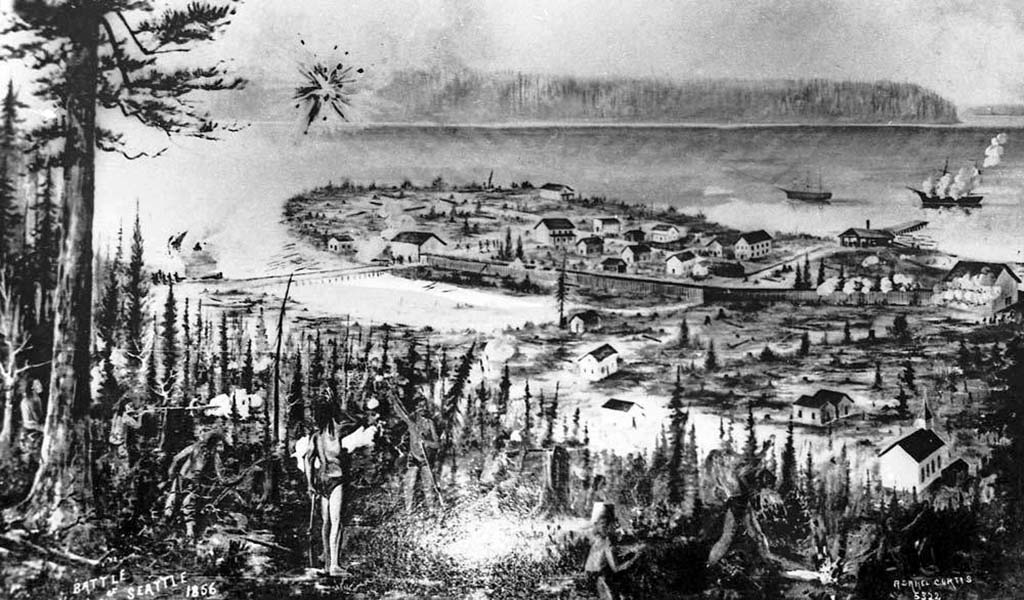
The area’s story begins in the 1850s, when Arthur Denny and a small group of settlers landed at Alki Point, took one look at the exposed beach, and decided to move inland to the sheltered harbor of Elliott Bay. They set up camp on the tidal flats that would become Pioneer Square, naming their settlement after Chief Si’ahl of the Duwamish and Suquamish peoples, the man whose name the city still carries, however imperfectly pronounced.
The early decades were brutal and muddy — literally. The neighborhood sat at or below the high-tide line, and the streets regularly flooded. Sewage was a civic crisis. The solution, or at least the ambition, was to build upward, raising the street grade by as much as two stories in some places. The remnants of this audacious engineering project still exist beneath the sidewalks, accessible today through the famous Seattle Underground Tour — a subterranean walk through the buried first floors of the old city, complete with skylights that once illuminated the world below.
Then came the fire. On June 6, 1889, a glue pot boiled over in a cabinet shop, and the flames tore through 25 blocks of the wooden city in a matter of hours. It was devastating, but in a way that only a young and stubborn city could manage, it was also liberating. The rebuilding effort transformed Pioneer Square from a ramshackle lumber town into a neighborhood of handsome brick and stone Romanesque Revival buildings. Architects like Elmer Fisher, who designed more than 50 buildings in the year after the fire, gave the district a sense of permanence and ambition it had never possessed before.
For a time, Pioneer Square was the commercial heart of the city. The Klondike Gold Rush of 1897 brought tens of thousands of prospectors through the neighborhood on their way to Alaska, and the money — much of it spent before anyone ever reached the goldfields — flooded into hotels, outfitters, saloons, and banks. The district roared with the chaotic energy of a city on the make.
But prosperity is fickle. As Seattle’s commercial center migrated northward in the early twentieth century, Pioneer Square began its long, slow slide into neglect. By the mid-twentieth century, it had become Skid Road — the original Skid Road, in fact, from which the American English term “skid row” derives. The phrase traces back to the area’s logging days, when Yesler Way served as the skid road down which logs were dragged to Henry Yesler’s sawmill on the waterfront. By the 1960s, the neighborhood was populated largely by the displaced, the forgotten, and the down-on-their-luck.
What saved Pioneer Square was a preservation movement that, at the time, was far from guaranteed. In 1970, the neighborhood was designated Seattle’s first historic district, protecting its beautiful old buildings from the wrecking ball. Artists, galleries, and small businesses slowly moved in, drawn by cheap rents and gorgeous architecture. Today, Pioneer Square is a neighborhood in perpetual tension — caught between its identity as a living museum of Seattle’s origins and the pressures of homelessness, gentrification, and a city that sometimes seems unsure whether to celebrate or commodify its oldest corner.
Walking through Pioneer Square on a weekday afternoon, past the iron pergola in the small triangular park, past the totem pole that has stood there since 1899, past the galleries and the missions and the craft cocktail bars that now sit beside them, you feel the full weight of that tension. This is where Seattle began, and the neighborhood still carries all the contradictions the city has never fully resolved.
The International District: A Crossroads Forged in Resistance
Just east of Pioneer Square, separated by a few blocks and a highway overpass that probably should never have been built, lies the International District — known to many longtime residents as the ID, and historically divided into distinct but overlapping communities: Chinatown, Japantown, and Little Saigon.
The ID is, in many ways, Seattle’s conscience. It’s the neighborhood that most directly confronts the city with the full complexity of its racial history — the exploitation, the exclusion, and the extraordinary resilience that followed.
Chinese laborers began arriving in Seattle in the 1860s and 1870s, drawn by railroad work and mining. They settled in the low-lying area south of Pioneer Square, building a community in the margins of a city that tolerated their labor but not their presence. Anti-Chinese sentiment boiled over in 1886, when a white mob attempted to forcibly expel the entire Chinese population of Seattle. Federal troops were called in. Some residents were driven out; others stayed, rebuilding in the same blocks where they’d been attacked.
Japanese immigrants followed in the late nineteenth and early twentieth centuries, establishing businesses, hotels, and community institutions along South Main Street and South Jackson Street. By the 1930s, Nihonmachi — Japantown — was a thriving enclave, home to hundreds of family-run businesses and a tight-knit social fabric built around Buddhist temples, language schools, and mutual aid societies.
Then came 1942, and Executive Order 9066. The forced internment of Japanese Americans during World War II gutted Japantown almost overnight. Families were given days to sell or store everything they owned before being shipped to camps in desolate corners of the American interior. Many never returned. The businesses that had taken decades to build were lost, and the social networks that had sustained the community were shattered. It remains one of the most painful chapters in Seattle’s history, and the ID bears that scar with a quiet, persistent dignity.
In the decades that followed, Filipino Americans, Vietnamese refugees, and other Southeast Asian communities added new layers to the district’s identity. The arrival of Vietnamese immigrants after the fall of Saigon in 1975 gave rise to Little Saigon, centered along South Jackson Street and 12th Avenue South, a neighborhood within a neighborhood defined by phở restaurants, herbal medicine shops, and a fierce sense of cultural preservation.
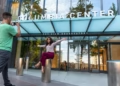
What holds the International District together — across its many languages, cuisines, and histories — is a tradition of community organizing that runs deeper here than in almost any other part of Seattle. The construction of the Kingdome in the 1970s, and later the stadiums that replaced it, threatened to swallow the neighborhood whole. Activists fought back, successfully preserving the district and securing investments in affordable housing and community spaces. The Wing Luke Museum, named after the first Asian American elected official in the Pacific Northwest, stands today as both a repository of the district’s history and a living argument for why that history matters.
The ID faces enormous pressures in the 2020s — rising rents, the lingering effects of anti-Asian violence amplified during the pandemic, the displacement of longtime businesses, and the constant anxiety that the neighborhood’s cultural identity will be diluted beyond recognition. But the community has survived worse. It has survived mobs, internment, and neglect. It has survived being treated as an afterthought by a city that owes it far more than it has ever repaid. And it endures, stubbornly and beautifully, as a reminder that Seattle’s story has never belonged to just one people.
Capitol Hill: The Rebel Republic
If Pioneer Square is Seattle’s memory and the ID is its conscience, then Capitol Hill is its restless, loudmouthed, endlessly complicated heart.
Perched on a ridge east of downtown, Capitol Hill has been the city’s cultural engine for the better part of a century. It’s the neighborhood where movements are born, where subcultures flourish before they’re absorbed into the mainstream, and where the tension between authenticity and commerce plays out in real time, every single day.
The neighborhood’s early history is more genteel than its reputation might suggest. In the late nineteenth and early twentieth centuries, Capitol Hill was home to some of Seattle’s wealthiest families. Millionaire’s Row, along 14th Avenue East, featured grand mansions with views of the Cascades and the lake. Volunteer Park, designed by the Olmsted Brothers, gave the neighborhood an elegant green heart, and the Seattle Asian Art Museum, housed in a stunning Art Deco building within the park, added a layer of cultural refinement.
But Capitol Hill’s true character began to emerge in the mid-twentieth century, as the neighborhood became the center of Seattle’s LGBTQ+ community. Gay and lesbian bars, bookstores, and community organizations took root along Broadway and Pike and Pine Streets, creating a visible, defiant queer presence at a time when such visibility carried real risk. The neighborhood became a sanctuary — not a perfect one, and not one free of conflict, but a place where people who had been told they didn’t belong could build something of their own.
The AIDS crisis of the 1980s and 1990s devastated Capitol Hill’s queer community, as it did queer communities across the country. The neighborhood lost a generation of artists, activists, and organizers. But it also mobilized with fierce energy, founding organizations, staging protests, and refusing to let the crisis be ignored. That spirit of defiance — the insistence that the marginalized have a right not just to exist but to be seen — became part of Capitol Hill’s DNA.
By the 1990s, the neighborhood had also become the epicenter of Seattle’s music scene. The grunge explosion that launched Nirvana, Pearl Jam, Soundgarden, and Alice in Chains into the global consciousness was rooted in the clubs, record shops, and cramped apartments of Capitol Hill. Venues like the Comet Tavern and the Cha Cha Lounge became gathering places for a generation of musicians, writers, and misfits who were drawn to the neighborhood’s cheap rents and permissive attitude. The culture that emerged — flannel-clad, self-deprecating, allergic to pretension — was unmistakably a product of this particular place.
The 2010s brought a new wave of transformation. The tech boom flooded Capitol Hill with money, new residents, and new buildings. Rents skyrocketed. Beloved dives and independent shops closed, replaced by luxury apartments and upscale restaurants. The neighborhood that had always prided itself on being a refuge for outsiders began to feel, to many longtime residents, like it was being hollowed out from the inside.
Then came the summer of 2020, when Capitol Hill became the site of the Capitol Hill Organized Protest, or CHOP — a protest zone established in the wake of George Floyd’s murder and the nationwide reckoning with police violence. For several weeks, a stretch of blocks around Cal Anderson Park became one of the most scrutinized pieces of urban geography in America. The zone was chaotic, idealistic, controversial, and ultimately unsustainable, but it was also deeply characteristic of the neighborhood — a place that has always been willing to take risks, make noise, and force uncomfortable conversations.
Capitol Hill today is a neighborhood wrestling with a fundamental question: can a place retain its soul when the economic forces reshaping it are this powerful? The queer community is still here, though its institutions are fewer and its visibility is increasingly threatened by the sheer cost of living. The music venues are thinner on the ground. The artists are being pushed further out. But the energy persists — defiant, queer, creative, and unwilling to go quietly.
Ballard: Salt, Timber, and Stubbornness
Northwest of downtown, occupying a peninsula between Salmon Bay and Puget Sound, Ballard is the neighborhood that reminds Seattle where its hands have been.
While much of Seattle’s identity has been shaped by culture, politics, and technology, Ballard’s identity was forged in physical labor — in the lumber mills, the fishing fleets, and the shipyards that made the neighborhood one of the most productive working-class communities on the West Coast for the better part of a century.
Ballard was originally an independent city, incorporated in 1890 by Scandinavian immigrants — primarily Norwegians and Swedes — who were drawn to the Pacific Northwest by its landscape, its timber, and its proximity to rich fishing grounds. The resemblance to the fjords and forests of home was not coincidental; these were people who knew how to work cold water and dense woods, and they built a community that reflected those skills.
By the early twentieth century, Ballard was home to the largest number of shingle mills in the world. The timber industry defined the local economy, and the neighborhood’s main street, Ballard Avenue, was lined with the businesses that served the men and women who worked the mills — hardware stores, taverns, boarding houses, and the occasional church where Lutheran hymns were sung in Norwegian.
When the timber supply began to thin, Ballard pivoted to fishing. The neighborhood’s location on Salmon Bay, connected to Puget Sound through the Hiram M. Chittenden Locks — an engineering marvel completed in 1917 that allows boats to pass between the saltwater of the Sound and the freshwater of the Ship Canal — made it a natural hub for the commercial fishing fleet. Generations of Ballard families made their living pulling salmon, halibut, and cod from the cold northern waters, and the fishing industry gave the neighborhood a rhythmic, seasonal identity tied to the movements of the sea.
Ballard was annexed by Seattle in 1907, a decision driven largely by the smaller city’s need for Seattle’s water supply. Many Ballard residents resented the annexation, and a streak of civic independence persists to this day. The bumper stickers reading “Free Ballard” are meant as jokes, mostly, but they gesture toward something real — a neighborhood that has always thought of itself as its own place, with its own rules and its own way of doing things.
The Scandinavian heritage remained visible for decades in the neighborhood’s cultural institutions. The Nordic Heritage Museum, founded in 1980, preserved the stories, artifacts, and traditions of the immigrant families who built Ballard. Syttende Mai — Norwegian Constitution Day, celebrated on May 17th — became the neighborhood’s signature annual event, a parade of flags, folk costumes, and marching bands that drew thousands and served as a yearly reaffirmation of Ballard’s roots.
Like every other Seattle neighborhood, Ballard has been dramatically reshaped by the city’s recent growth. The old industrial waterfront is now lined with breweries, restaurants, and condominiums. Ballard Avenue, once a working street for a working neighborhood, has become one of Seattle’s most desirable commercial corridors, home to boutiques, wine bars, and farm-to-table restaurants that would have bewildered the shingle mill workers who once walked its sidewalks.
The transformation has been jarring for longtime residents. The Scandinavian character of the neighborhood has faded, though it hasn’t disappeared entirely. The Nordic Museum moved into a striking new building in 2018, and the community still turns out for Syttende Mai. But the fishing boats are fewer, the mills are gone, and the old Ballard — rough-handed, unpretentious, smelling of salt and sawdust — exists now more in memory than in daily life.
What Ballard has managed to retain, even as its surface changes, is a certain stubbornness. It’s a neighborhood that doesn’t apologize for what it is. It doesn’t perform its identity for tourists or curate its history for Instagram. It simply persists, shaped by the same utilitarian pragmatism that built it in the first place. The locks still work. The boats still pass through. And on a quiet morning, standing on the pedestrian bridge above the fish ladder, watching the salmon fight their way upstream, you can still feel the old Ballard underneath — a place that was built to last, even if the world around it refuses to stand still.
The Sum of Its Corners
Seattle is a city that has always been better at reinvention than preservation. It tears down and rebuilds. It booms and busts. It absorbs new arrivals by the tens of thousands and then wonders, sometimes resentfully, what happened to the place it used to be.
But the soul of a city isn’t found in its skyline or its GDP. It’s found in the neighborhoods where people actually live, argue, worship, drink, mourn, organize, and fall in love. Pioneer Square holds Seattle’s memory — the fire, the gold, the mud beneath the streets. The International District holds its conscience — the injustices endured, the cultures preserved, the refusal to be erased. Capitol Hill holds its restless heart — the music, the protest, the insistence on being seen. And Ballard holds its calloused hands — the labor, the pragmatism, the quiet pride of people who built something real.
Together, these four neighborhoods don’t just tell the story of Seattle. They are the story — complicated, contradictory, and still very much being written.