The Pacific Northwest has a way of feeding you if you know where to look. From the moss-draped rainforests of Washington’s Olympic Peninsula to the volcanic slopes of Oregon’s Cascade Range, this corner of North America holds one of the most abundant and diverse foraging landscapes on the planet. It’s a region where rainfall is generous, old-growth forests still stand in meaningful tracts, and the intersection of marine, alpine, and temperate ecosystems creates a staggering variety of edible wild plants, fungi, and coastal treasures.
Foraging here isn’t a trendy weekend hobby tacked onto a farmers’ market lifestyle. It’s woven into the cultural fabric of the region — practiced for thousands of years by Indigenous peoples including the Coast Salish, Chinook, and Yakama nations, and carried forward today by a growing community of wild food enthusiasts, professional chefs, herbalists, and everyday people who simply want a closer relationship with the land that sustains them.
This is a guide to that world: what grows here, when to find it, how to harvest responsibly, and why it matters more than ever.
The Lay of the Land: Why the PNW Is a Forager’s Paradise
Geography and climate conspire to make the Pacific Northwest extraordinarily productive. West of the Cascades, mild temperatures and heavy rainfall — sometimes exceeding 100 inches annually in coastal areas — create temperate rainforest conditions that are globally rare. The soil is rich, acidic, and loaded with organic matter from centuries of decomposing conifers. East of the Cascades, drier pine forests and high desert offer an entirely different palette of wild foods, from bitterroot to huckleberries at elevation.
The marine influence cannot be overstated. The cold, nutrient-rich waters of the Pacific Ocean and the Salish Sea produce vast beds of edible seaweed, shellfish, and other coastal foods. Tidal zones become open-air pantries twice a day for those willing to get their boots wet.
What ties it all together is moisture. The PNW’s signature drizzle and fog feed the fungal networks that run beneath the forest floor like a second internet, producing some of the most sought-after edible mushrooms in the world. This is mushroom country, full stop — but it’s also berry country, green country, and root country. There’s something edible in nearly every season.
Spring Foraging: The Forest Wakes Up
Nettles, Fiddleheads, and the First Greens
Spring in the Pacific Northwest doesn’t arrive with a bang. It seeps in. By late February or early March, the first stinging nettles (Urtica dioica) push through the damp earth along riverbanks and forest edges. Nettles are a forager’s rite of spring — nutrient-dense, rich in iron and vitamins A and C, and surprisingly delicious once their sting is neutralized by cooking or drying. They make a vibrant pesto, a deep green soup, or a tea that herbalists have used for centuries to support joint health and reduce inflammation.
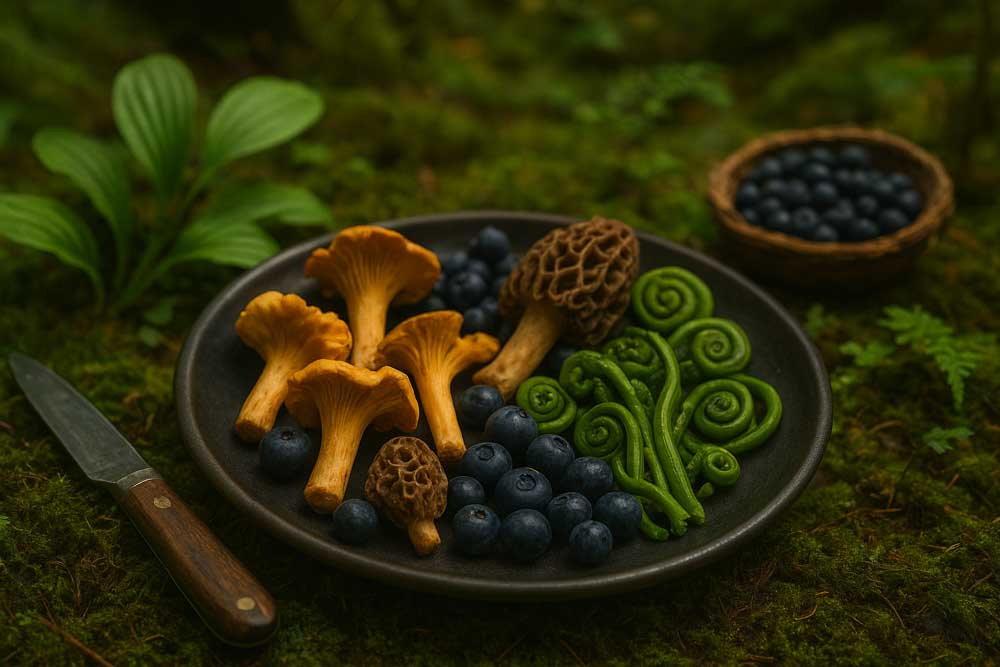
Around the same time, fiddlehead ferns — the tightly coiled young fronds of sword ferns and lady ferns — begin to unfurl in shaded, moist areas. Harvesting fiddleheads requires care and identification skill. Not all fern species are safe to eat, and even those that are should be cooked thoroughly. But sautéed in butter with a squeeze of lemon, they taste like a wild cross between asparagus and green beans.
Miner’s lettuce (Claytonia perfoliata) is another early spring treasure. This mild, slightly succulent green was famously eaten by Gold Rush miners to prevent scurvy, and it carpets shaded forest floors and trail edges from March through May. It requires no cooking and adds a fresh, clean flavor to salads.
Ramps and Wild Alliums
Wild ramps and other alliums appear in damp, shaded woodlands in spring. While the classic Appalachian ramp (Allium tricoccum) is less common in the PNW, its cousin — the Pacific wild onion (Allium cernuum) and nodding onion varieties — fill a similar culinary role. Their pungent, garlicky leaves and small bulbs add depth to spring dishes. Three-cornered leek (Allium triquetrum), an introduced species now naturalized in parts of western Oregon and Washington, has become a popular foraged ingredient in urban and suburban settings.
Morel Mushrooms: The Spring Crown Jewel
No discussion of PNW spring foraging is complete without morels. These honeycomb-capped fungi are among the most prized wild mushrooms in the world, and the Pacific Northwest is one of the best places on Earth to find them. Morels fruit in the wake of disturbance — forest fires, logging, flooding — and in the PNW, burn morels can appear in extraordinary quantities the spring following a wildfire.
Finding morels requires patience, a good eye, and a willingness to hike. They favor south-facing slopes, disturbed soil near cottonwoods and conifers, and old orchards. Their season typically runs from April through June, depending on elevation and snowmelt. They command high prices at market — often $30 to $50 per pound — but for foragers, the real currency is the thrill of spotting that first golden cap among the leaf litter.
A critical safety note: morels have a toxic look-alike in the false morel (Gyromitra esculenta), which contains a compound that can cause serious illness. Learning to distinguish the two is a non-negotiable prerequisite before any morel hunt.
Summer Foraging: Berries, Beaches, and Bounty
The Berry Season
Summer turns the Pacific Northwest into a berry factory. The variety and abundance are almost absurd. Wild strawberries ripen first, tiny and intensely sweet, hiding beneath low foliage along trails and meadow edges in June. Then come the salmonberries — those soft, golden-to-ruby drupes that grow in thickets along streams and clearings. Their flavor is delicate, sometimes bland, but at peak ripeness they carry a tropical sweetness that catches you off guard.
Thimbleberries follow, their large, flat-topped fruits disintegrating at the slightest touch. They don’t travel or store well, which is exactly why they’ll never appear in a grocery store and why eating them trailside feels like a small act of rebellion against the industrial food system.
By mid-July, the blackberries take over. The Himalayan blackberry (Rubus armeniacus), an invasive species introduced in the late 1800s, now dominates roadsides, vacant lots, and disturbed land throughout western Oregon and Washington. Foragers have a complicated relationship with it. Ecologically, it’s a menace — crowding out native plants and forming impenetrable walls of thorns. But its fruit is generous, sweet, and free for the taking. Many PNW residents fill freezers with pounds of Himalayan blackberries each August, turning them into jams, cobblers, wines, and syrups.
The native trailing blackberry (Rubus ursinus), by contrast, produces much smaller berries with a more complex, intense flavor. Finding a patch of trailing blackberries is like finding the difference between a grocery store tomato and one from your grandmother’s garden.
Huckleberries: The Sacred Berry
Then there are huckleberries, and they deserve their own discussion. The Pacific Northwest is huckleberry heartland. Multiple species grow here — the red huckleberry (Vaccinium parvifolium), the evergreen huckleberry (Vaccinium ovatum), and the mountain huckleberry (Vaccinium membranaceum) among them. Mountain huckleberries, which grow at higher elevations in the Cascades and the Blue Mountains of eastern Oregon, are widely considered the finest wild berry in North America.
Huckleberries cannot be commercially cultivated. Every huckleberry you’ve ever eaten was picked by hand in the wild. This fact alone gives them an almost mythic status in PNW food culture. Indigenous communities have harvested huckleberries for millennia, and many tribes consider certain huckleberry fields sacred. For non-Indigenous foragers, respecting these traditions — and following harvest regulations on public and tribal lands — is essential.
The season for mountain huckleberries runs roughly from late July through September, depending on elevation and weather. A good huckleberry spot is guarded like a family secret.
Coastal Foraging: Seaweed and Shellfish
Summer also opens up the coast. Low tides expose vast intertidal zones rich with edible seaweeds — bull kelp, sea lettuce, Turkish towel, nori, and bladderwrack among them. Bull kelp, with its long rubbery stalks and bulbous floats, can be pickled, dried into chips, or fermented into a savory condiment. Sea lettuce adds a briny crunch to salads.
Shellfish foraging — for clams, mussels, and oysters — is popular on Washington and Oregon beaches, but it comes with serious responsibilities. Paralytic shellfish poisoning (PSP), caused by toxic algal blooms, can be fatal. Foragers must check the state Department of Health’s biotoxin hotline before harvesting any bivalves. Seasons and limits are regulated, and a shellfish license is required. This is one area of foraging where cutting corners can kill you.
Fall Foraging: The Mushroom Kingdom
The Main Event
Fall is when the Pacific Northwest’s reputation as a foraging destination truly earns its weight. The rains return in September and October, and the forest floor erupts with fungi. This is the season that draws mushroom hunters from around the world.
Chanterelles are the flagship. The Pacific golden chanterelle (Cantharellus formosus) is Oregon’s state mushroom, and for good reason. These golden, funnel-shaped beauties grow in symbiotic relationships with Douglas fir, hemlock, and spruce trees. They fruit prolifically from September through November, sometimes into December in warmer years. Their apricot-like aroma and meaty texture make them one of the most versatile wild mushrooms in the kitchen — exceptional sautéed simply with butter and thyme, or folded into risottos, pastas, and cream sauces.
Porcini (Boletus edulis and related species) appear in fall as well, their fat brown caps and thick white stems hiding under spruce and fir. They dry beautifully and are a staple of Italian cuisine, but PNW foragers know them as local treasures found at mid-to-high elevations.
Matsutake mushrooms hold enormous cultural and economic significance. The American matsutake (Tricholoma murrillianum) grows in sandy soils under conifers, particularly in the southern Oregon Cascades. Prized in Japanese cuisine for their spicy, cinnamon-like aroma, matsutake have fueled a commercial harvest industry in the PNW for decades, with much of the harvest exported to Japan. Picking matsutake is hard, competitive work — and the social dynamics of matsutake camps have been the subject of anthropological study, most notably in Anna Lowenhaupt Tsing’s book The Mushroom at the End of the World.
Lobster mushrooms (Hypomyces lactifluorum) are not technically a mushroom species at all, but rather a parasitic fungus that colonizes other mushrooms — usually Russula or Lactarius species — transforming them into dense, bright-red organisms with a seafood-like flavor and firm texture. They’re unmistakable in appearance and forgiving for beginners.
Hedgehog mushrooms, black trumpets, yellowfoot chanterelles, and cauliflower mushrooms round out the fall bounty. Each has its own habitat preferences, flavor profile, and culinary strengths. Taken together, they represent a wild harvest season that puts the Pacific Northwest in a class of its own.
A Word on Identification
Mushroom foraging demands rigorous identification skills. There are no shortcuts. Field guides like David Arora’s Mushrooms Demystified and Daniel Winkler’s regional guides are essential references, but nothing replaces hands-on learning with experienced foragers or through a local mycological society. The Pacific Northwest has several excellent ones — the Oregon Mycological Society, the Puget Sound Mycological Society, and the Southwest Washington Mycological Society among them. They host forays, identification workshops, and annual mushroom festivals that are both educational and genuinely fun.
The old adage holds: every mushroom is edible at least once. Take identification seriously.
Winter Foraging: The Quiet Season
Winter slows things down but doesn’t shut them off entirely. The mild maritime climate of western Oregon and Washington means that some foraging continues even through the darkest months.
Yellowfoot chanterelles (Craterellus tubaeformis) persist well into December and sometimes January, hiding among mossy logs and conifer duff. They’re smaller and thinner than golden chanterelles, but their nutty, almost smoky flavor makes them a winter kitchen staple.
Wood ear mushrooms (Auricularia auricula-judae) and velvet foot (Flammulina velutipes, the wild ancestor of enoki mushrooms) fruit on dead hardwood throughout winter. Both are excellent in soups and stir-fries.
On the plant side, chickweed (Stellaria media) and wintercress remain available in mild coastal areas. Rosehips — the fruit of wild roses — can be harvested after the first frost, when their vitamin C content is at its peak. They make a tart, floral tea or a thick jelly that tastes like autumn condensed into a jar.
Evergreen huckleberry leaves and branches are harvested commercially in winter for the floral industry, but their berries — which ripen in late fall and persist on the bush — remain available to patient foragers through the wet months.
Ethics, Law, and the Responsibility of the Harvest
Foraging in the Pacific Northwest operates within a web of regulations, ecological considerations, and cultural sensitivities that every forager should understand before heading into the woods.
Permits and Regulations
On national forest land, a free-use permit allows the harvest of small quantities of mushrooms and plant materials for personal use. Commercial harvest requires a paid permit. State parks generally prohibit foraging. City and county parks vary — Portland, for example, allows limited foraging in some parks. Private land requires landowner permission, always.
Shellfish, as noted, require a license and close attention to seasonal closures and biotoxin advisories. Harvesting certain plants — particularly those listed as threatened or sensitive — is restricted or prohibited under state and federal law.
Ecological Responsibility
Sustainable foraging means taking only what you need and leaving enough for the ecosystem to regenerate. For mushrooms, this means cutting fruiting bodies at the base rather than pulling them out of the ground, which can damage the underlying mycelium. For plants, it means never harvesting more than a small percentage of a given population, and avoiding areas that show signs of over-harvesting.
Invasive species foraging — blackberries, garlic mustard, Japanese knotweed — is one area where enthusiastic harvest is actually encouraged. Eating invasives is a small but meaningful act of ecological restoration.
Indigenous Sovereignty and Respect
Many of the foods foraged in the PNW have deep roots in Indigenous food systems. Camas, wapato, huckleberries, salmon, and dozens of other species have been cultivated, managed, and harvested by Native peoples since time immemorial. Non-Indigenous foragers should educate themselves about these histories, respect tribal harvesting rights and treaty-protected gathering areas, and avoid treating Indigenous food knowledge as a resource to be extracted without credit or reciprocity.
Getting Started: Practical Advice for New Foragers
Breaking into foraging can feel overwhelming, but the Pacific Northwest makes it easier than most places. Here’s how to begin.
Start with a handful of easy, unmistakable species: stinging nettles, Himalayan blackberries, chanterelle mushrooms, and dandelions. These are abundant, well-documented, and hard to confuse with anything dangerous. Build confidence with them before branching out.
Invest in at least two good regional field guides. Cross-reference everything. When foraging mushrooms, use the “rule of three” — confirm your identification with three separate sources before eating anything.
Join a local foraging or mycological group. The PNW has an unusually strong community of foragers who share knowledge generously. Guided walks and forays are the fastest way to learn.
Bring a basket or mesh bag rather than plastic bags. This allows spores to drop as you walk, seeding future harvests. Carry a knife for clean cuts. Wear layers and waterproof boots — you’re in the Pacific Northwest, after all.
Above all, approach foraging with humility. The forest doesn’t owe you anything. Every chanterelle found, every berry picked, every nettle stung is a gift from a living system that existed long before you arrived and will continue long after. Treat it accordingly.
The Deeper Pull
There’s a reason foraging has experienced a surge of interest in the Pacific Northwest over the past decade. Part of it is the local food movement. Part of it is a growing distrust of industrial agriculture. Part of it is the simple, grounding pleasure of walking through a forest with all your senses engaged, looking for something beautiful and edible.
But underneath all of that is something harder to articulate — a longing for connection. Connection to place, to season, to the organisms that share this landscape with us. Foraging rewires your relationship with the land. You start noticing things you never noticed before: the way chanterelles cluster near certain trees, the patch of nettles that returns every March in the same bend of the same creek, the first flush of oyster mushrooms after the October rains. The forest becomes legible in a way it wasn’t before. It becomes personal.
The Pacific Northwest, with its rain and its moss and its stubborn, extravagant fecundity, invites that kind of attention. All you have to do is show up, pay attention, and be willing to get a little muddy.