

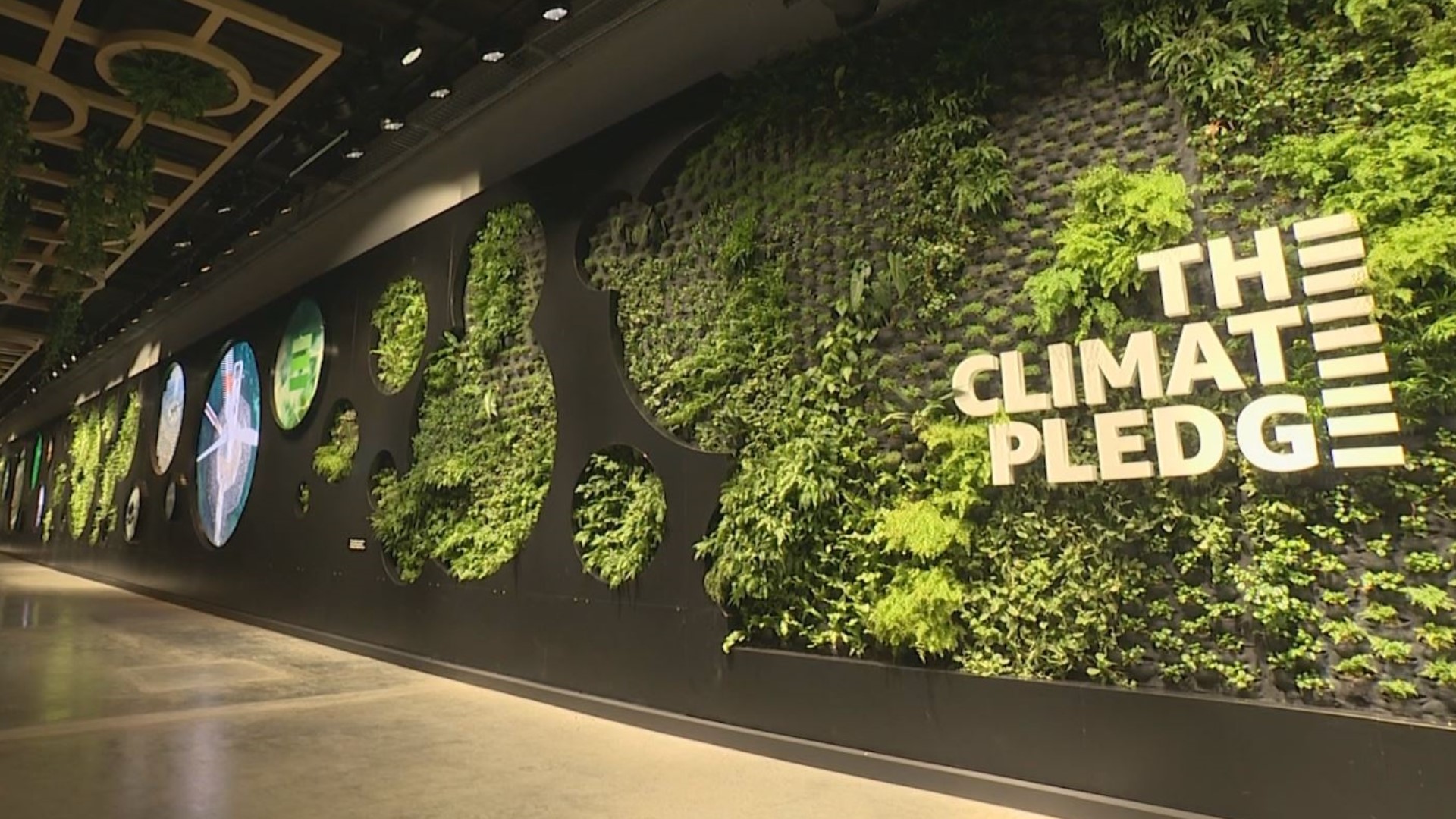
Climate Pledge Arena opened 2021 as world’s first arena achieving International Living Future Institute Zero Carbon Certification. All-electric. No fossil fuels for daily operations. Mechanical systems, heating, Zambonis, forklifts, dehumidification, cooking equipment—everything running on electric power sourced from renewable energy. Solar panels on Alaska Airlines Atrium roof. 15,000-gallon cistern capturing rainwater for NHL ice. LEED-certified. Free public transportation for guests. Target: 25% choosing transit.
The arena calculated embodied carbon from construction: 34,400 metric tons. Then offset it through renewable energy certificates purchased from Puget Sound Energy’s Snake River wind farm. RECs retired so they can’t be reused or resold. Starting 2025: committed to being first commercial client of Seattle City Light’s Renewable Plus Program building brand new wind and solar farms.
Here’s the thing: Despite being greenest arena in world, Climate Pledge Arena still generated 34,400 metric tons of carbon through construction. The steel, concrete, glass, equipment—all required energy-intensive manufacturing and transportation. The certification doesn’t mean building produced zero carbon. It means building offset the carbon it produced by funding renewable energy elsewhere.
This is Seattle’s sustainable business paradox in microcosm. City leads nation on climate policy, green building standards, renewable energy commitments. Businesses here pursue sustainability certifications aggressively—EnviroStars recognition, B Corp certification, LEED credentials, TRUE zero waste designation. Yet greenhouse gas emissions reduction falling short of targets. 2022 emissions inventory shows Seattle not on track meeting 58% reduction below 2008 levels by 2030. ACEEE projects city won’t achieve near-term community-wide GHG emissions reduction goal based on past data.
Seattle does sustainability better than most American cities. Also: doing sustainability isn’t same as being sustainable. The gap between certification and reality, between policy and outcome, between aspiration and achievement—that gap defines Seattle’s green business landscape.
The Policy Framework: Seattle’s Green New Deal
2019: Seattle passed Green New Deal resolution setting ambitious goal—carbon neutral by 2030. Eleven years to eliminate net greenhouse gas emissions from city with 750,000+ residents, major port, international airport, tech giants consuming enormous energy, construction boom adding thousands of housing units annually, cars still dominating transportation despite transit investments.
The goal emerged from grassroots pressure, City Council advocacy, climate justice organizing. Green New Deal Oversight Board established advising city on climate justice, ensuring equity considerations centered in climate policy. Fall 2024: Board partnered with MLK Labor and Urban League of Metropolitan Seattle hosting five community assemblies where dozens of union workers and residents collaborated on climate solutions informing Board’s recommendations and city’s climate planning.
Mayor Bruce Harrell’s administration embraced ambitious targets while navigating practical constraints. 2024: City invested $2.2 million in Clean Energy Training and Career Pathways program training and placing workers who experienced economic and environmental injustices into clean energy jobs—construction, engineering, more. Program had nearly 150 trainees in 2024. Directly connecting climate action to economic opportunity, particularly for communities historically excluded from clean energy economy.
Building Emissions Performance Standard (BEPS) signed into law represents boldest policy move. Reducing greenhouse gas emissions from existing large buildings by approximately 325,000 metric tons by 2050—27% decrease in building-related emissions from 2008 baseline, equivalent to taking 72,322 gasoline-powered cars off road for year.
August 2024: Seattle secured $17.2 million from U.S. Department of Energy helping buildings in overburdened communities reduce emissions while developing local clean energy jobs. Federal funding enabling implementation at scale BEPS would otherwise struggle achieving.
The framework is comprehensive: Climate Action Plan (adopted 2013, updated 2018), Green New Deal (2019), JumpStart bill (2020) levying payroll tax on big business funding supportive housing and $20 million annually for Green New Deal, Commercial Energy Code improvements requiring all-electric space heating in commercial buildings and electric water heating in hotels/multifamily buildings.
Yet progress lags ambition. Seattle’s Climate Action Plan established goal reducing greenhouse gas emissions 58% below 2008 levels by 2030, zero net core emissions by 2050. Plan sets sector-specific targets: 82% reduction from passenger vehicles, 39% from building energy by 2030. Based on ACEEE analysis of past emissions data, ACEEE projects city will not achieve near-term community-wide goal. Seattle conducting greenhouse gas emissions inventories at three- to four-year intervals—most recent 2022 inventory released showing continuing shortfall.
The policy framework exists. Implementation struggles. Enforcement uneven. Voluntary programs succeed only when businesses voluntarily participate. Mandatory programs face resistance, litigation, delayed timelines. Climate doesn’t wait for politics to catch up.
EnviroStars: The Free Certification Nobody Talks About
EnviroStars offers something remarkable: free sustainability certification for businesses. Free technical assistance. Free climate calculator accounting for industry, business volume, geography. Free tools and information protecting employee/customer health and planet. Connection to rebates and resources. Clear path to sustainability recognition.
Recognized businesses listed in Green Business Directory communicating environmental commitment to customers, employees, local community. Toolkit provided for sharing recognition. Networking opportunities with other certified businesses and member agencies. Events and learning opportunities through partnerships with local programs.
From cafes and restaurants to hotels and auto repair—every industry eligible. “Start small but be ambitious” is advice given to businesses. C and M Auto Complete Care LLC testimonial: “Running our business sustainably is healthier for our employees and the planet.”
The program makes environmental sense: protects earth’s natural resources while reducing greenhouse gas emissions, reduces landfill and unnecessary waste promoting circular economy, improves energy efficiency and conservation, products with non-toxic ingredients improving overall wellbeing.
Here’s curious part: relatively few Seattle businesses pursue EnviroStars certification despite being free, despite providing marketing value, despite offering cost savings through efficiency improvements. Why?
Time investment: Certification requires documentation, assessment, implementation of practices, ongoing compliance. Small businesses operating on razor-thin margins struggle finding staff time for anything beyond core operations.
Knowledge gap: Many business owners unaware program exists. EnviroStars does outreach but competes for attention with hundreds of other business support programs, industry associations, regulatory requirements.
Perceived complexity: Sustainability seems daunting. Business owners imagine needing expertise they don’t possess, resources they don’t have, changes they can’t afford. Reality: EnviroStars designed for exactly this situation, providing support addressing barriers. But perception prevents initial contact.
Lack of customer demand: If customers don’t ask about environmental practices, businesses don’t prioritize demonstrating them. Seattle customers generally environmentally conscious but rarely make purchasing decisions based on EnviroStars certification specifically. General reputation and word-of-mouth matter more.
Competitive dynamics: When most businesses in sector don’t pursue certification, those that do gain minimal competitive advantage. Creates prisoner’s dilemma—everyone benefits if everyone certifies, but individual business sees little return on investment being first/only certified in category.
The paradox: Seattle created accessible, free certification program for sustainable business practices. Program works. Businesses that participate benefit. Yet participation remains limited fraction of potential. The gap between what’s available and what’s utilized reveals that barriers to sustainability aren’t always financial—they’re cultural, informational, psychological.
B Corp Certification: Measuring What Actually Matters
B Corp certification takes different approach than EnviroStars. Not free. Not easy. Not government-sponsored. Instead: rigorous private certification measuring company’s entire social and environmental performance across supply chain, input materials, charitable giving, employee benefits.
The B Impact Assessment evaluates how company’s operations and business model impact workers, community, environment, customers. Companies must meet highest standards of verified performance. Recertification required every three years maintaining standards. Public transparency required—scores published, improvement areas identified.
Seattle has significant B Corp presence. Tech companies, consumer goods manufacturers, professional services firms, food businesses—diverse sectors pursuing certification. Why undergo expensive, demanding process?
Recruitment advantage: Talent increasingly choosing employers based on values alignment. B Corp certification signals commitment to stakeholder capitalism beyond shareholder returns. Particularly valuable for companies competing with Amazon/Microsoft for talent where financial compensation alone insufficient differentiator.
Customer trust: B Corp logo communicates verified commitment rather than self-proclaimed greenness. Reduces greenwashing concerns. Builds credibility with environmentally/socially conscious consumers willing to pay premium for authentic values.
Supply chain pressure: Large corporations increasingly requiring suppliers meet sustainability standards. B Corp certification satisfies requirements across multiple customers rather than navigating different assessment frameworks for each.
Operational improvements: Assessment process identifies inefficiencies, risks, opportunities. Many companies discover cost savings through waste reduction, energy efficiency, improved employee retention resulting from better benefits.
Investment access: Growing number of impact investors, ESG-focused funds, purpose-driven venture capital requiring certain certifications or performance metrics. B Corp status opens doors to capital sources prioritizing more than financial returns.
But certification has limits. B Corp measures and verifies performance against standards. Doesn’t guarantee carbon neutrality. Doesn’t prevent contributing to broader systemic problems. Company can be certified B Corp while still generating significant emissions, using virgin materials, participating in extractive industries. Certification means doing better than most in category, not doing perfectly or even adequately by absolute environmental standards.
Some certified B Corps in Seattle face criticism: technology companies manufacturing hardware using conflict minerals and exploitative labor in supply chains while certified. Food companies shipping products globally generating transportation emissions while certified. The certification assesses and compares but doesn’t prohibit activities ultimately incompatible with genuine sustainability.
The Building Challenge: LEED, BEPS, and the 40% Gap
Buildings account for roughly 36% of Seattle’s greenhouse gas emissions. Addressing building energy use essential for meeting climate goals. Two main strategies: building new green buildings (LEED certification), making existing buildings more efficient (BEPS requirements).
LEED Certification: Leadership in Energy and Environmental Design certification—green building rating system assessing energy savings, water efficiency, reduced carbon emissions, improved indoor air quality. Seattle’s Sustainable Buildings and Sites Policy requires new construction and major renovations 5,000+ square feet meet LEED Gold certification plus key performance requirements.
Multiple Seattle buildings achieved LEED Platinum—highest rating. Climate Pledge Arena. Amazon Spheres. Bullitt Center (often called world’s greenest commercial building). Numerous office towers, residential buildings, schools, municipal facilities. The certification works—LEED buildings consume 25-30% less energy than comparable non-LEED buildings, use 40% less water, generate less waste, provide healthier indoor environments.
Problem: new construction represents small fraction of Seattle building stock. Vast majority of buildings predate LEED standards. Retrofitting existing buildings to LEED standards often economically impractical—would require gutting and rebuilding at costs exceeding new construction.
Enter Building Emissions Performance Standard (BEPS). Instead of prescriptive standards (must have X efficiency rating, Y insulation, Z heating system), BEPS sets performance targets—buildings must meet emissions intensity limits based on size and use. How they meet targets: owner’s choice. Allows flexibility while ensuring outcomes.
BEPS applies to large buildings (20,000+ square feet for most uses). Phased implementation starting buildings over 50,000 square feet, eventually covering all commercial buildings and large multifamily residential. Compliance deadline varies by building size—largest buildings first, smaller buildings later.
Equity-aligned Clean Buildings Accelerator supports building owners through free coaching cohorts with one-on-one tailored sessions. Program had 30+ participants in 2023, expanding in 2024. Recognizes that many building owners lack expertise/resources for efficiency improvements, provides technical assistance reducing barriers.
The challenge: meeting 27% reduction target by 2050 requires retrofitting thousands of buildings across diverse ownership, uses, ages, conditions. Some improvements straightforward—LED lighting, upgraded HVAC, building envelope sealing. Others expensive and complex—replacing heating systems, adding renewable energy, reconfiguring ventilation.
Many older buildings face economic decisions: invest millions in retrofits to meet standards, or sell to developers who will demolish and rebuild? For historic properties, demolition conflicts with preservation goals. For affordable housing, retrofit costs threaten affordability if passed to tenants. For Class B/C office buildings already struggling with 35%+ vacancies, additional capital requirements potentially trigger foreclosure.
BEPS includes compliance flexibility, alternative compliance pathways, financial assistance programs, longer timelines for certain building types. Even with accommodations, achieving 27% reduction represents enormous undertaking requiring sustained investment, technical expertise, coordination across thousands of property owners making independent decisions.
Clean Heat: The Oil-to-Electric Transition
380 households received $2,000 instant rebate in 2024. 94 households received no-cost heat pump through services provided by Office of Housing. Roughly 162,500 gallons of oil avoided in 2024. 250+ rebates distributed.
Clean Heat Program targeting Seattle’s remaining oil heat systems—legacy infrastructure from era before natural gas pipelines reached all neighborhoods. Oil heat expensive, carbon-intensive, polluting. Electric heat pumps offer air conditioning plus heating, filter air improving indoor quality, eliminate oil deliveries and storage tank risks.
El Centro de la Raza in Beacon Hill hosted first-ever Home Electrification Fair featuring induction stove giveaway and local chefs cooking delicious food using electric appliances. Demonstrating that electric cooking performs well, eliminating gas safety risks and indoor air pollution.
The program addresses equity explicitly. Low-income households disproportionately stuck with oil heat systems—couldn’t afford earlier conversions to natural gas, can’t afford unsubsidized heat pump installation now. Without assistance, these households bear highest heating costs while contributing disproportionate emissions.
But 380 rebates in city with thousands of oil heat systems represents slow progress. At current pace: decades to eliminate oil heat completely. Funding constraints limit rebate availability. Contractor capacity constraints slow installations. Some properties face electrical service upgrade requirements adding costs. Rental properties require landlord participation—tenants can’t install heat pumps without owner approval, owners lack direct incentive since tenants pay heating bills.
The broader electrification challenge extends beyond oil heat. Natural gas used for heating, cooking, water heating in majority of Seattle buildings. Eliminating fossil fuels requires converting all uses to electricity. Commercial Energy Code now requires all-electric space heating in commercial buildings, electric water heating in hotels/multifamily—applying to new construction and major renovations. Existing buildings with functioning gas systems face no immediate requirement to convert.
Seattle City Light provides carbon-neutral electricity—over 90% hydropower. Converting buildings to electric heat essentially transfers emissions from on-site gas combustion to centralized power generation—which in Seattle’s case is already largely emission-free. This makes electrification particularly effective in Seattle compared to cities where electric grid relies on coal or natural gas generation.
Yet political resistance exists. Restaurant industry lobbying against gas stove bans. Homeowners concerned about cooking performance, costs, unfamiliarity with induction technology. Climate Pledge Arena demonstrates high-end restaurants can cook entirely on electric—but perception lags reality.
Transportation Electrification: The EV Charging Desert
Transportation Electrification Blueprint update released April 2024 tracking Seattle’s 2023 progress. Installing electric vehicle chargers, reducing emissions from truck deliveries, making transit cleaner and safer.
August 2023: Mayor Harrell announced Electric Trucks Pilot initiative supporting local truck drivers’ transition to electric freight vehicles, improving air quality in port-adjacent Duwamish Valley communities. Program aims bringing first electric drayage trucks to city by 2024. $1.2 million RAISE grant secured supporting development of “Low Pollution Neighborhoods” reducing transportation emissions and improving livability.
Seattle has roughly 1,500 public EV charging ports across city. Sounds impressive until considering: 450,000+ vehicles registered in Seattle. Even accounting for most EVs charging at home, public charging infrastructure inadequate supporting rapid EV adoption. Charging deserts exist—neighborhoods with minimal public chargers where residents without home charging (apartment dwellers, street parkers) face significant barriers to EV ownership.
Apartment buildings pose particular challenge. Installing chargers in parking garages requires electrical infrastructure upgrades, ongoing maintenance costs, allocation systems for shared spaces. New construction can include charging infrastructure during initial build at relatively low cost. Existing buildings face expensive retrofits—running high-capacity electrical service to parking areas, installing charging equipment, managing ongoing operations.
Climate Action Plan requires 82% reduction in transportation emissions by 2030 from 2008 levels. This means near-total elimination of gasoline vehicles within six years. Current EV adoption rates nowhere close to trajectory needed. 2024: EVs represent roughly 10% of new vehicle sales in Seattle—higher than national average but insufficient pace for 82% reduction by 2030.
The math doesn’t work. Even if 100% of new vehicles sold 2025-2030 were electric (not happening), used gasoline vehicles would remain on roads for years. Average vehicle lifespan 12-15 years. Vehicles purchased 2020-2024 will be driven until 2032-2039. Reaching 82% reduction requires either: accelerating retirement of functioning gasoline vehicles (expensive, wasteful), dramatically reducing total vehicle miles traveled (requires transit/density/land use changes taking decades), or revising targets acknowledging political/economic realities.
Seattle’s 2035 Comprehensive Plan updated 2022 includes sustainable transportation strategies, strategies benefiting disadvantaged communities. But ACEEE analysis found no information indicating Seattle made changes to zoning code facilitating more residential density, mixed-use development, transit-oriented development in past 10 years. Without density enabling car-free lifestyles, electrifying personal vehicles is only path—and current charging infrastructure and adoption rates fall short.
The Waste Problem: TRUE Zero Waste Certification
TRUE zero waste certification promotes sustainable resource management and reduction practices improving environmental, health, and economic outcomes. Certifies facilities diverting 90%+ of waste from landfills through reduction, reuse, recycling, composting.
Climate Pledge Arena pursuing TRUE certification. Examining waste streams from events—food waste, beverage containers, packaging, merchandise, equipment. Implementing comprehensive sorting, educating vendors/staff/guests, finding recycling/composting pathways for materials typically landfilled.
Few Seattle businesses achieve TRUE certification. Why? Waste diversion is hard. Requires:
- Complete waste stream analysis: Documenting everything disposed, understanding composition, identifying alternatives.
- System redesign: Changing procurement (eliminating non-recyclable materials), operations (implementing sorting), contracts (ensuring waste haulers provide appropriate recycling/composting).
- Staff training: Everyone must understand what goes where. Single contaminated recycling bin can render entire load landfill-bound.
- Ongoing monitoring: Waste streams change. Continuous attention required maintaining diversion rates.
- Cost implications: Recycling/composting often costs more than landfilling. Volume discounts favor single waste stream. Sorting requires labor.
Many businesses implement partial solutions—recycling some materials, composting food waste—without pursuing certification. Achieve 50-70% diversion without needing documentation, verification, ongoing compliance required for TRUE certification.
The deeper waste challenge: most business waste generated upstream. Product packaging decided by manufacturers. Shipping materials by suppliers. Even zero-waste retail operation receives goods in cardboard boxes, plastic wrap, styrofoam. True waste reduction requires supply chain transformation—manufacturers designing for disassembly, eliminating unnecessary packaging, using renewable/recyclable materials.
Individual businesses have limited leverage over suppliers. Unless large purchasers (Amazon, Whole Foods, REI) demand packaging changes, manufacturers have minimal incentive to innovate. Small businesses requesting sustainable packaging often told “not available” or quoted prices making products uncompetitive.
The Tree Canopy Gap: Environmental Justice in Green Space
Seattle pledged planting 8,000+ trees over next five years on public and private properties. Tree Equity Collaborative launched statewide. Mayor Harrell “digging in” to grow more equitable tree canopy.
Here’s what “equitable tree canopy” means: historically, wealthy neighborhoods have significantly more tree coverage than low-income neighborhoods and communities of color. North Seattle, Queen Anne, Magnolia—60-70% tree canopy. Rainier Valley, Georgetown, parts of Beacon Hill—20-30% canopy. Difference creates measurable health impacts—heat island effects, air quality, stormwater management, mental health benefits of nature access.
The disparity resulted from decades of inequitable investment, zoning favoring single-family homes with yards in some areas while concentrating apartments and industry in others, redlining that prevented Black families from purchasing homes in tree-rich neighborhoods.
Addressing this requires deliberately planting more trees in underserved neighborhoods. Sounds simple. Implementation challenges abound:
Property ownership: City can plant trees on public land (parks, sidewalk strips, public buildings). Most underserved neighborhoods have less public land, more private parcels. Planting on private property requires owner consent—complex in multifamily buildings with remote landlords or corporate owners.
Maintenance: Trees need watering, pruning, protection from damage. In wealthier neighborhoods, homeowners provide maintenance. In rental-heavy neighborhoods, responsibility unclear. Trees planted then neglected die within years.
Conflicts with infrastructure: Sidewalk trees conflict with utilities (underground pipes, overhead wires), business visibility, parking access. Dense urban areas have less space accommodating trees than low-density residential.
Species selection: Climate change means trees planted today must tolerate warmer, drier conditions than trees planted decades ago thrived in. Not all native species suited to projected climate. Non-native species risk invasiveness or pest vulnerability.
Despite challenges, tree planting is one of few climate interventions with broad public support, immediate visibility, multiple co-benefits beyond carbon sequestration. The trees also beautify neighborhoods, increase property values, create habitats. For businesses, trees near buildings provide shade reducing cooling costs, improve employee wellbeing, enhance customer experience.
Some businesses participate directly—sponsoring tree plantings, dedicating property for trees, organizing employee volunteer days. Others participate indirectly through taxes funding public plantings. The cumulative impact matters: every tree planted sequesters carbon, provides shade, filters pollutants, reduces stormwater runoff.
The Food System: From Local Salmon to Urban Agriculture
All 109 Seattle Public Schools served freshly prepared salmon alfredo pasta dish with 3,000 pounds of sustainable, local salmon purchased from Muckleshoot Seafood Products. Healthy Food in Schools program connecting students to traditional indigenous foods, supporting local tribal economy, reducing food miles.
Fresh Bucks program achieved 91% utilization rate, added two new local retailers: Local Yokels and Lee’s Produce Market. Program provides SNAP benefits match at farmers markets, encouraging fresh produce purchases, supporting local farmers.
Food Action Plan updated 2024—first update in more than decade. Addressing food security, access, sustainability, waste reduction, local food systems. Recognizing that food system contributes significantly to greenhouse gas emissions—agriculture, processing, transportation, refrigeration, waste—while also offering opportunity for climate solutions through regenerative agriculture, reduced food miles, waste prevention.
Seattle businesses engaging with sustainable food systems face tradeoffs:
Local sourcing: Reduces transportation emissions, supports regional economy, provides fresher products. But: Pacific Northwest doesn’t produce coffee, chocolate, spices, tropical fruits, many staples. “Local” means “local where possible” while importing necessities. Also: local doesn’t guarantee sustainable if local farms use conventional practices with heavy chemical inputs, monoculture, soil degradation.
Organic certification: Eliminates synthetic pesticides/fertilizers, prevents soil/water contamination, reduces farm worker exposure to toxics. But: organic yields sometimes lower requiring more land under cultivation. Organic doesn’t address food miles (organic produce flown from across country has higher carbon footprint than conventional produce from nearby).
Seasonal eating: Aligns consumption with what grows locally at each time of year. Reduces storage needs, improves freshness, supports local farms. But: consumers expect year-round availability of all products. Restaurants advertising seasonal menus then serving tomatoes in January signal disconnect between marketing and practice.
Food waste reduction: One-third of food produced globally is wasted. Preventing waste reduces emissions from production, transportation, disposal. Businesses can implement waste tracking, portion control, creative use of scraps, donations to food banks, composting as last resort. But: health codes restrict donations, composting requires infrastructure, overproduction provides buffer against running out.
Restaurants face particular challenges. Sustainability-focused establishments source local/organic/seasonal ingredients, minimize waste, compost, avoid single-use plastics. Premium ingredients cost more. Passing costs to customers limits clientele to those willing/able to pay. Keeping prices accessible requires operating on thin margins, limiting sustainability investments.
The deeper question: Is individual business sustainability meaningful when food system as whole is unsustainable? Factory farms producing most meat. Chemical-intensive agriculture dominating grain production. Industrial fishing depleting oceans. Global supply chains optimized for cost over sustainability. Individual restaurants making ethical choices within broken system—noble but insufficient transforming system.
The Duwamish Valley: Environmental Justice as Business Practice
Duwamish Valley Action Plan celebrated 5th anniversary. Fall 2022 to Summer 2023: Duwamish Valley Program engaged community understanding priorities, invested $500,000 in community spaces in Georgetown. Office of Sustainability and Environment supported small businesses through Vision 7 Advertising contract where $500 mini-grants awarded to South Park and Georgetown businesses with technical support.
The Duwamish Valley is Seattle’s industrial heart—manufacturing, port operations, warehousing, freight. Also home to low-income communities, immigrants, people of color living with air pollution, noise, truck traffic, contaminated soil/water. The river itself is Superfund site from decades of industrial discharge.
Environmental justice means: communities bearing disproportionate environmental burdens should receive priority in cleanup, mitigation, investment. Businesses in Duwamish Valley face question: Are we part of problem or part of solution?
Some businesses actively contributing to pollution—unpermitted discharges, inadequate pollution controls, truck traffic generating diesel particulates, noise disrupting residents. Others simply present in industrial zone doing business as usual—not causing new harms but benefiting from location where environmental standards historically lax.
Growing number of businesses see environmental justice as core value. This means:
- Exceeding compliance: Meeting minimum environmental regulations insufficient. Installing state-of-art pollution controls, electrifying truck fleets, implementing zero-discharge policies, investing in air filtration beyond requirements.
- Community engagement: Regular meetings with neighborhood organizations, responsive to complaints, transparent about operations, employing local residents, contributing to community projects.
- Site remediation: Cleaning up legacy contamination even when not legally responsible, participating in Superfund cleanup, preventing additional contamination, sharing information about environmental conditions with neighbors.
- Advocacy: Supporting stricter environmental regulations even when increasing own costs, lobbying for freight infrastructure improvements reducing impacts on neighborhoods, contributing to policy discussions affecting community.
The business case for environmental justice isn’t obvious. Investments in pollution control, community engagement, remediation increase costs without directly increasing revenue. But longer-term considerations shift calculation: avoiding regulatory penalties/lawsuits, maintaining operating permits, attracting employees who value social responsibility, building community support for operations rather than facing organized opposition.
Climate Pledge Arena, B Corp certified businesses, LEED Platinum buildings—these represent aspirational sustainability. Duwamish Valley businesses practicing environmental justice represent ground-level reality: acknowledging harm, reducing impacts, supporting communities, working toward justice while maintaining viable operations.
The Gap: Policy, Practice, and Actual Outcomes
Seattle Office of Sustainability and Environment released 2022 greenhouse gas emissions inventory. Continuing to track emissions reduction targets. Report and data visualizations available on OSE website.
The data shows gap. Ambitious targets set. Comprehensive policies adopted. Certification programs created. Billions invested. Emissions declining but not fast enough. 58% reduction below 2008 levels by 2030 requires steeper trajectory than current trend. Zero net emissions by 2050 requires complete transformation of energy, transportation, building systems—transformation not yet underway at necessary pace.
Why the gap? Multiple factors:
- Implementation lag: Policies take years from adoption to full effect. BEPS applies to large buildings first, smaller buildings later. Even buildings required to comply get years to achieve targets. Cumulative emissions continue during transition.
- Voluntary program limitations: EnviroStars, B Corp, LEED, TRUE—all voluntary. Businesses choosing not to participate face no consequences beyond missing benefits. Sustainable businesses compete against conventional businesses without level playing field.
- Enforcement challenges: Mandatory programs face enforcement challenges—understaffed agencies, complex compliance verification, legal challenges, political pressure to grant extensions/exemptions.
- Technological constraints: Some emissions sources lack viable alternatives. Heavy freight transport, aviation, industrial processes, chemical manufacturing—technologies exist but not yet cost-competitive or scalable.
- Economic tradeoffs: Aggressive emissions reductions increase costs for businesses. Higher costs mean higher prices, reduced competitiveness, potential job losses, business relocations. Political pressure moderates ambition protecting jobs and businesses.
- Behavioral persistence: People continue driving, flying, consuming, heating/cooling buildings similarly regardless of policies. Unless policies directly constrain behavior (gas bans, parking restrictions, building codes), voluntary behavior change insufficient.
- Growth effects: Seattle adding population, jobs, buildings. New growth generates emissions even if per-capita emissions decline. Carbon-neutral growth—where every new resident/job/building adds zero net emissions—remains aspiration not reality.
The gap between aspiration and achievement doesn’t mean Seattle failing. Seattle doing more than most American cities. But “more than most” insufficient for climate stabilization. Physics doesn’t grade on curve. Atmosphere accumulates greenhouse gases regardless of good intentions, certification programs, policy frameworks.
What Sustainable Business Actually Means
Climate Pledge Arena achieved Zero Carbon Certification through offsets. Built 34,400 metric tons of embodied carbon into structure, then purchased renewable energy credits eliminating equivalent emissions elsewhere. This counts as zero carbon certification but didn’t reduce atmospheric carbon—it prevented additional carbon from being added.
Most sustainable business practices follow similar logic. Reduce energy use (but still use energy from grid with some fossil fuel generation). Use recycled materials (but still consume virgin resources). Support local suppliers (but still transport goods, use packaging, generate waste). Pay living wages (but employees still drive cars, heat homes, consume products).
Genuinely sustainable business would: operate entirely on renewable energy generated on-site, use only renewable/regenerative materials in closed loops, produce zero waste, generate no emissions, restore ecosystems, enhance community wellbeing, distribute wealth equitably. Essentially impossible in current economic system.
So businesses practice harm reduction. Do less damage than conventional alternatives. Make progress incrementally. Set targets knowing they’re insufficient but achievable. Celebrate improvements while acknowledging inadequacy.
Seattle’s sustainable business landscape reflects this reality. Climate Pledge Arena represents state-of-art—and still generated tens of thousands of tons of carbon. EnviroStars, B Corp, LEED, TRUE—all measure and verify relative performance without guaranteeing absolute sustainability. Policies set ambitious targets while accepting implementation timelines accommodating economic/political realities.
The honest assessment: Seattle’s businesses are becoming less unsustainable. Moving in right direction. Not fast enough to prevent climate catastrophe but faster than most other places. This is simultaneously true, important, and insufficient. The question isn’t whether Seattle leading on sustainable business—clearly is. Question is whether leading is enough when destination keeps receding faster than progress advances.
The Climate Pledge Arena paradox persists: world’s greenest building still burned massive carbon being built. Seattle’s greenest businesses still generate emissions, consume resources, contribute to extraction and exploitation upstream. The certification, policies, programs, investments—all necessary, all valuable, all inadequate. This is sustainable business in Seattle: doing better while remaining complicit, reducing harm while perpetuating systems causing harm, working toward sustainability while operating within fundamentally unsustainable structures.
Success looks like: closing the gap. Making targets met not missed. Transforming voluntary programs into universal practices. Enforcing requirements instead of granting extensions. Investing public dollars at scale matching climate urgency. Reimagining business models around regeneration not extraction. Supporting workers/communities through transition not despite it. Actually achieving carbon neutrality not just purchasing offsets.
Whether Seattle closes gap or gap continues widening: remains open question. The frameworks exist. The knowledge exists. The resources exist. Political will fluctuates. Economic constraints bind. Inertia resists. Five years from 2030 target, twenty-five from 2050 target—time compressing, action accelerating too slowly, outcomes uncertain. Seattle’s sustainable business landscape represents what’s possible within constraints. Question is whether possible is sufficient.