Seattle is a city that prides itself on its relationship with the natural world. Residents here will remind you, often unprompted, that they live surrounded by water, mountains, and evergreen forests. But there is a difference between living near nature and having nature embedded in the very bones of a city. Seward Park is that kind of place — not a curated garden or a manicured lawn with a jogging trail tacked on, but a genuine remnant of the primeval Pacific Northwest, sitting stubbornly in the southeast corner of Seattle as though the last ten thousand years of human activity were merely a passing footnote.
Spanning 300 acres on Bailey Peninsula, a wooded finger of land jutting into Lake Washington, Seward Park holds one of the last surviving tracts of old-growth forest within Seattle’s city limits. It is home to nesting bald eagles, a mysterious colony of feral parrots, a Japanese stone lantern weighing eight tons, and a human history stretching back to the end of the last Ice Age. And yet, it remains one of the most underappreciated parks in the Pacific Northwest — overshadowed by the tourist-magnet grandeur of Discovery Park and the cultivated charm of the Washington Park Arboretum.
That is, frankly, part of its appeal.
The Land Before the Park: 10,000 Years of Life on the Peninsula
Long before any European set foot in the region, the peninsula that now forms Seward Park was a vital resource for the Indigenous peoples of the area. The xačuʔabš, or “lake people,” a subgroup of the Duwamish, lived on the shores of Lake Washington — which they called xachu — and used the peninsula and surrounding waters for hunting, fishing, and gathering. The Lushootseed name for the peninsula is sqəbəqsəd, a word referring to the rocky points, or “noses,” at its northern and southern tips. The narrow isthmus connecting the peninsula to the mainland was called cqaʔlapsəb, meaning “neck,” and it was so slender that seasonal flooding would transform the peninsula into a full island.
The bay, the shoreline, the dense forest — all of it sustained a people who had called the region home for at least four thousand years, and likely far longer. They hunted ducks from canoes on what is now Andrews Bay, gathered wapato roots (sometimes called “Indian potatoes”) from the marshes, and wove cattails into mats for their summer houses.
The Duwamish people still live in Seattle and King County today. They have fought for decades for federal recognition as a sovereign tribe — a struggle marked by a brief period of recognition during the last days of the Clinton administration, which was subsequently revoked under the Bush administration. Their connection to the land that became Seward Park is ancient and ongoing, a reminder that the park’s history did not begin when white settlers arrived.
From Graham Peninsula to Bailey Peninsula: The Settler Era
The first Euro-American to lay eyes on the peninsula was likely Colonel Isaac Ebey, who explored Lake Washington by canoe in 1850 with Lushootseed guides. Within two years, settlers John Harvey and Edward A. Clark staked adjoining claims on the peninsula, sharing a cabin that straddled the boundary of their properties. That cabin was burned during the “Battle of Seattle” in January 1856, when Indigenous warriors attacked the settlement in protest of treaties negotiated by Territorial Governor Isaac Stevens.
Clark, who was one of Seattle’s first photographers and schoolteachers, sold his claim to David Graham in 1858, and the peninsula became known as Graham Peninsula. The land passed through a succession of owners over the following decades, a chain of transactions driven by the speculative fever that gripped the young city. One curious detail: accounts suggest the peninsula’s thick blankets of poison oak may have actually saved the old-growth trees from being logged. In a region where timber was king and nearly every accessible hillside was stripped bare, a patch of forest too unpleasant to walk through turned out to be its own best defense.
In 1890, William E. Bailey, a Yale-educated investor from Pennsylvania, purchased the bulk of the peninsula for $26,000. Bailey had arrived in Seattle just before the Great Fire of 1889, and he poured money into real estate in the rebuilding boom that followed. The peninsula was renamed Bailey Peninsula in his honor.
The Olmsted Vision: How a Famous Landscape Firm Saved the Forest
Seattle’s park system owes an enormous debt to the Olmsted Brothers, the legendary landscape architecture firm founded by the sons of Frederick Law Olmsted, the designer of Central Park. In 1903, John Charles Olmsted visited Seattle and developed a sweeping plan for the city’s parks and boulevards. Bailey Peninsula was central to that vision.
Olmsted recognized what Park Superintendent E.O. Schwagerl had argued as early as 1892: the peninsula was a treasure. Schwagerl had proposed the city buy it as part of its first Comprehensive Plan, but many officials balked. The peninsula was too far from the city center, they said. Too remote. Too wild.
Olmsted disagreed. He saw Bailey Peninsula as the natural anchor for a scenic boulevard system that would stretch north along Lake Washington for several miles. More importantly, he urged the city to acquire the land before its forest was “injured by logging or clearing for development.” His 1912 preliminary plan for the park was a masterwork of ecological design, preserving the old-growth canopy while threading it with meandering woodland trails, an amphitheater, and a shoreline path.
In 1911, the city of Seattle purchased Bailey Peninsula for $322,000 — a steep price at the time — and renamed it Seward Park, in honor of William H. Seward, the U.S. Secretary of State who had brokered the purchase of Alaska from Russia in 1867. The naming was a nod to Seward’s foresight in acquiring what many of his contemporaries dismissed as a frozen wasteland. There is a pleasing symmetry in that: the man who saw the value in land others wanted to ignore became the namesake of a park that was itself nearly discarded as too inconvenient.
The Forest: 120 Acres of Living History
The crown jewel of Seward Park is its forest. Of the park’s 300 acres, roughly 120 are covered in surviving old-growth trees — Douglas fir, western red cedar, bigleaf maple, and the Garry oak, Washington’s only native oak species. Some of these trees are more than 250 years old, though the forest is considered relatively young by Pacific Northwest standards. Before Seattle was settled, the region’s forests were typically 1,000 to 2,000 years old, towering cathedral-like ecosystems that took millennia to reach maturity.
What remains at Seward Park is a fragment, but it is a profoundly important one. Walking the interior trails, you pass through a canopy so thick that sunlight filters down in pale, shifting columns. The air is cool and damp, thick with the smell of decomposing cedar and damp earth. Sword ferns blanket the forest floor — though in recent years, a mysterious die-off of sword ferns has alarmed ecologists and volunteers alike, prompting the Friends of Seward Park to fund microbiome research to investigate the cause.
The forest is not a museum piece. It is a living, breathing ecosystem, and it is under constant pressure from invasive species, climate change, and the simple reality of being surrounded by a city of over 700,000 people. The Friends of Seward Park have discussed the creation of a 500-year vegetation management plan — not to dictate what the forest should look like five centuries from now, but to establish ongoing processes for keeping it healthy. That kind of long-range thinking is rare in a culture obsessed with quarterly earnings and election cycles, and it speaks to the deep commitment the park inspires in those who know it best.
Eagles, Parrots, and Rabbits: The Wildlife of Seward Park
For a park in the middle of a major city, Seward Park supports a startling diversity of animal life. The most majestic residents are the bald eagles — two nesting pairs that can frequently be spotted soaring over Lake Washington, diving to the water’s surface to snatch fish and, occasionally, unlucky ducks. Watching an eagle hunt from the park’s perimeter trail is one of those experiences that recalibrates your sense of what urban life can be.
Then there are the parrots. Since at least 2004, a colony of feral Peruvian conures — likely Chapman’s mitred or scarlet-fronted parakeets — has made Seward Park their home. The birds were apparently released by their owners, or escaped, and found the park’s mild microclimate and abundant food sources hospitable enough to establish a breeding population. They commute, astonishingly, between Seward Park in the south and the Maple Leaf neighborhood in northeast Seattle, a journey of roughly ten miles each way. Their raucous, tropical calls echo through the old-growth canopy, an improbable soundtrack for a temperate rainforest.
Wild rabbits, too, have colonized the park in significant numbers, often seen nibbling grass near the parking lots and picnic areas at dusk. They are a reminder that urban parks, even well-managed ones, are magnets for species that thrive at the edges of human settlement.
The Human Landscape: Beaches, Trails, and a Storied Inn
Seward Park is not just a forest. It offers at least five distinct areas for recreation and contemplation, and its variety is part of what makes it so beloved by the surrounding community.
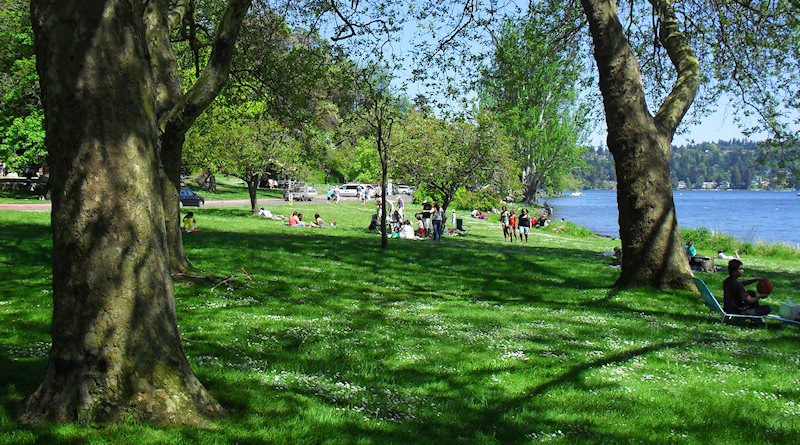
The beach on Andrews Bay is the park’s most social space — a wide stretch of sand flanked by a broad lawn, a bathhouse constructed in 1927, and views across the water. On warm summer days, it fills with families, swimmers, and kayakers. The lowering of Lake Washington in 1917, caused by the construction of the Ship Canal, exposed the meadow that now leads down to the water — an unintended gift of infrastructure that became one of the park’s most cherished features.
The 2.4-mile perimeter trail is the park’s most popular attraction, a flat, paved loop that circles the entire peninsula. Closed to automotive traffic since 1971 — after residents complained about people using the loop for car races and, remarkably, laundry — the trail is now a haven for walkers, runners, cyclists, and rollerbladers. On clear days, the trail offers sweeping views of Mount Rainier, Mercer Island, and the Cascade Range. It is one of the finest urban walks in the Pacific Northwest, and it costs nothing.
The upper area of the park includes a large picnic area and an outdoor amphitheater that has hosted civic events, concerts, and community gatherings for decades. In 1971, a benefit rock concert was held here to support the preservation of Pike Place Market — a quintessentially Seattle event at a quintessentially Seattle location.
At the park’s entrance stands a Tudor-style building that was originally the Seward Park Inn, a concession stand and gathering place that opened in the 1920s. Its history is a microcosm of Seattle’s scrappy, independent spirit. During the Depression, the leaseholder Catherine Redfield applied for a liquor permit to sell beer and requested permission to install a gasoline pump — attempts to keep the business afloat in desperate times. The beer license was granted but quickly revoked after community opposition, and the gas pumps were never installed. The building, now a Seattle city landmark, was renovated and reopened in 2008.
A Gift from Yokohama: The Stone Lantern and the Torii Gate
One of the most meaningful objects in Seward Park sits quietly at the main entrance, easy to miss if you are not looking for it. An eight-ton taiko-gata stone lantern, a gift from the city of Yokohama, Japan, was installed in 1930 as a gesture of gratitude for Seattle’s assistance after the devastating Great Kanto Earthquake of 1923, which leveled both Yokohama and Tokyo. In return, Seattle sent 1,000 rose bushes to Yokohama. Descendants of those roses still grow in the Yokohama Municipal Children’s Botanical Garden.
Near the entrance, a Japanese-style wooden torii gate stood from 1936 to the mid-1980s, when it was removed after decades of decay. The original was designed by Kichio Allen Arai, the first Asian American architect in Seattle to be credited for his professional work. A replacement torii, built with stone columns and timber crossbeams, was completed in early 2021 and formally dedicated in 2022 — a restoration of a symbol that connects Seattle to its deep and sometimes troubled relationship with its Japanese and Japanese-American communities.
The ornamental cherry trees that line portions of the park’s perimeter were donated at various times as further gestures of friendship between Seattle and Japan. In spring, they bloom in cascades of pink and white, a counterpoint to the dark, ancient green of the old-growth forest beyond.
The Neighborhood: Diversity, Faith, and Community
The neighborhood that surrounds Seward Park and takes its name is one of the most quietly distinctive in Seattle. Unlike many Seattle neighborhoods that were branded and bounded by real estate speculators, the Seward Park neighborhood grew organically, absorbing parts of Brighton Beach, Hillman City, and Lakewood along both sides of South Orcas Street.
It is a remarkably diverse area — racially, economically, and culturally. For decades, it has been a center of Jewish life in Seattle, home to three synagogues: Bikur Cholim-Machzikay Hadath, the Sephardic Bikur Holim Congregation, and Congregation Ezra Bessaroth. An estimated ninety percent of Seattle’s Orthodox Jewish community lives within a mile of these congregations. As one resident told the Seattle Post-Intelligencer, the neighborhood on the Sabbath carries a certain “Fiddler on the Roof” quality — families walking to services, the pace of life slowing, the modern city briefly yielding to something older and more deliberate.
The ridge overlooking Lake Washington attracted builders who erected impressive homes with sweeping views of the water, Mount Rainier, and the Cascades. Inland, the houses became more modest. This blend of the grand and the humble, the diverse and the traditional, gives the neighborhood a stability and cohesion that many parts of Seattle have lost to rapid gentrification. Home ownership in the area has historically been around eighty percent, and turnover is low. People who move to Seward Park tend to stay.
The Poet and the Park
For the last eight years of her life, the celebrated poet Denise Levertov lived just a block from Seward Park. An anti-war activist, feminist, and environmentalist, Levertov found in the park a landscape that matched her inner life — wild, layered, resistant to easy categorization. A plaque installed in 2016 marks her home nearby, and her poems about the natural world carry echoes of the old-growth canopy, the lake light, and the quiet persistence of a forest that refuses to be anything other than itself.
She was, as one writer noted, “a fiery pilgrim who never wanted to be known as any of those things.” The same might be said of Seward Park itself — a place that does not announce its significance, does not market itself as a destination, and yet endures as one of the most extraordinary green spaces in any American city.
Why Seward Park Matters Now More Than Ever
In an era of accelerating climate change, rapid urbanization, and the slow erosion of public space, Seward Park stands as a testament to what happens when a city chooses, however imperfectly, to protect something irreplaceable. The officials who dismissed the peninsula as “too far from town” in the 1890s were wrong. The Olmsted Brothers, who saw its potential as the anchor of an entire park system, were right.
Today, the park faces real challenges. The sword fern die-off is a troubling sign that the forest’s health cannot be taken for granted. Andrews Bay has been plagued by noise complaints and conflicts over commercial use. And the broader pressures of a growing metropolitan area — pollution, invasive species, increased foot traffic — are constant.
But the community around Seward Park has shown, again and again, that it is willing to fight for this place. Volunteers have raised private funds to patrol the bay. Scientists are studying the microbiome of ailing ferns. The Friends of Seward Park are thinking in terms of centuries, not quarters.
Seward Park is not a relic. It is a living argument for the idea that wild places and urban life can coexist — not in some sanitized, Instagram-ready version of nature, but in the messy, complicated, deeply rewarding way that real coexistence demands. The old-growth trees do not care about property values or zoning disputes. The eagles hunt whether or not anyone is watching. The parrots, absurd and magnificent, shriek their way across the city as though they own it.
And in a way, they do. So does the forest. So does the park. After ten thousand years of human presence on this peninsula, Seward Park endures — not because it was inevitable, but because enough people, at enough critical moments, decided it was worth saving.
That is a story worth telling, and a place worth visiting. Bring good walking shoes. Leave the earbuds at home. The forest has its own soundtrack.