

There is something almost mythological about the setting. Husky Stadium sits on the edge of Lake Washington in Seattle, tucked between the water and the Cascade Mountains, a place where fog rolls in off the water on autumn mornings and the crowd noise bounces off the open ends like a canyon echo. The 70,138-capacity venue, home to Husky football since 1920, has witnessed more than a century of sport. It is not merely a football stadium. It is a monument to a program’s identity — loud, proud, deeply regional, and occasionally transcendent.
The Washington Huskies do not simply play football. They carry a tradition that stretches back to an era when the forward pass was still a novelty. The weight of that history is felt in the bronze statue outside the gates, and in the purple and gold that washes through the stands every fall Saturday. To understand this program, you have to go back to the beginning — to a coach who never lost, a national champion who built a dynasty with toughness, and a modern era that took Washington to the edge of college football’s ultimate prize before the program was forced to reinvent itself yet again.
The Unbeatable Beginning: Gil Dobie and the Foundation
Before the Rose Bowl, before Don James, before any of the modern-era glory, there was Gil Dobie — a man who coached the Huskies and simply did not lose. Dobie’s 1908–1916 tenure produced a perfect 58–0–3 mark, including five straight Pacific Coast Conference championships. Let that sink in for a moment. Nearly nine seasons, not a single loss. It is the kind of statistical absurdity that feels like a typo until you realize that the man was simply that good, that organized, and that relentlessly demanding.
Dobie was famously pessimistic by nature — opposing coaches thought it was gamesmanship, but it was apparently just his personality. He would tell anyone who would listen that his team was hopelessly outmatched before each game. Then his team would go out and win. His tenure at Washington is the stuff of genuine legend, and he holds the highest winning percentage of any Huskies coach at .950.
That foundation was built on something specific: discipline, preparation, and a fierce sense of regional pride. Washington was not recruiting nationally. They were building something local, something fierce, something that belonged to the Pacific Northwest. That philosophy would resurface again and again across the program’s history, each time under a different name with a different playbook, but always recognizable at its core.
Don James and the Golden Era
If Dobie built the foundation, Don James built the house that the modern program lives in. James is the leader in seasons coached and games won, with 153 victories during his 18 years with the program. He arrived in 1975 and spent nearly two decades methodically turning Washington into a consistent national power, winning six Pac-10 titles along the way and producing the kind of football that made the Huskies must-watch television before there was really such a concept.
James profoundly shaped the Washington Huskies football program’s culture during his tenure from 1975 to 1992, instilling a fierce “Dawg” identity that emphasized toughness, discipline, and regional pride. He prioritized recruiting talent from the Pacific Northwest, fostering a sense of local ownership and loyalty that transformed the Huskies from a middling program into a national contender.
The 1991 season remains the crowning achievement. Washington went 12–0, a perfect season. They won the co-national championship, and James was named Coach of the Year by the Sporting News. It was the peak moment for a program that had been building toward it for nearly two decades. Among the program’s highlights are two claimed national championships — in 1960 under Jim Owens and a co-championship in 1991 under James — as well as 43 bowl appearances, highlighted by 15 Rose Bowl games where the Huskies hold an 8–6–1 record, the most appearances outside of Southern California schools.
The Don James era ended in 1992 under circumstances that were, to put it charitably, unfortunate — he resigned in protest of NCAA sanctions. The controversy stung, but it could not erase what he built. His statue stands outside Husky Stadium today, not as nostalgia but as a permanent statement about who the Huskies are and where they came from.
The Long Middle: Searching for the Next Don James
What followed James were years that ranged from decent to difficult. Jim Lambright, Rick Neuheisel, Keith Gilbertson, Steve Sarkisian, and eventually the ill-fated tenure of Jimmy Lake — each coach tried and largely fell short of recapturing the dominance James had established. There were high points: Neuheisel’s 2000 Rose Bowl team went 11–1 and reminded the Pacific Northwest what Washington football could look like. Sarkisian had some notable wins and produced NFL talent. But sustained greatness remained elusive.
Lake’s tenure is perhaps the most dramatic cautionary tale of the modern era. He inherited the program from Chris Petersen in 2020 and got off to a reasonable start in a COVID-shortened season. By 2021, things had collapsed entirely — he was suspended after a sideline incident in which he shoved a player during a loss to Oregon, and was eventually fired. Lake finished his tenure with a 7–6 record. The program that had reached national championship contention under Petersen was suddenly searching for direction again.
Chris Petersen: The Man Who Moved the Bar
Before the Jimmy Lake era derailed everything, Chris Petersen arrived in 2014 and immediately made his presence felt. He came with a reputation from Boise State, where he had gone 92–12 and routinely embarrassed programs that outspent him by a factor of ten. Chris Petersen, from 2014 to 2019, revolutionized player development by integrating character-building with skill enhancement through his “Talent + Character = Our Kind of Guy” philosophy, producing well-rounded athletes who excelled both on and off the field.
In his third year, Petersen did something no Husky coach had done in the modern era: he took Washington to the College Football Playoff. In his third year, Petersen led Washington to a Pac-12 title and the program’s first College Football Playoff appearance, the 2016 Peach Bowl. The 2018 season brought another Pac-12 title and another Rose Bowl. Petersen was coaching at the very highest level of the sport, producing NFL talent and winning games that nobody thought Washington could win.
Then, almost without warning, he stepped away. On December 2, 2019, Petersen announced he would step down as head coach and move into an advisory role. He cited his health and his family, and he meant it. He has not coached since. It was a jarring exit for a program that had gotten very comfortable winning ten games a year. After Petersen’s departure came a Peach Bowl quote that stuck in the air: “The bar has been moved.” He had moved it himself. Then he left, and Washington spent the next few years figuring out how to stay at that height without him.
Kalen DeBoer: The Meteoric Rise and the Sudden Goodbye
Few coaches in recent college football history have made a more dramatic entrance into a Power Five program than Kalen DeBoer. He arrived in late 2021 to take over a program that had just fired its head coach mid-season and finished 4–8. Within months, he had Washington playing some of the most exciting football the Pacific Northwest had seen in a generation.
DeBoer became the first Husky coach to win 11 games in his first year at the helm. Not only did he resuscitate a team that was on the brink of irrelevance following the disaster that was the 2021 season under Jimmy Lake, but he brought it to new heights both on the field and on the recruiting trail.
The 2022 season was remarkable enough. The 2023 season was something else entirely. DeBoer led Washington to a 14–1 record, winning the final Pac-12 conference championship against Oregon and advancing all the way to the College Football Playoff National Championship Game. It was the most successful season in Washington football history since the Don James era, and DeBoer was named AP Coach of the Year. For a brief, golden moment, it seemed like the program had found its architect for the next decade.
Then Alabama called. And Kalen DeBoer answered.
Kalen DeBoer elevated the Huskies’ national profile by leading them to the College Football Playoff national championship game, showcasing innovative offensive strategies that garnered widespread attention and positioned Washington as an emerging powerhouse before his departure.
His exit in January 2024 to replace Nick Saban at Alabama was stunning in its timing and its magnitude. He left behind a program that had just had the season of its life, a roster with enormous NFL talent about to walk out the door, and a fan base that was suddenly staring into a void. The whiplash was real. Washington had gone from the brink of irrelevance in 2021 to within a touchdown of a national title in 2023. Now, they had to start over. Again.
Jedd Fisch and the New Frontier
The man who arrived to pick up the pieces was Jedd Fisch, the former head coach at Arizona who had built a reputation as a program fixer with an energetic recruiting style and a forward-thinking offensive mind. On January 14, 2024, Fisch accepted the position, becoming the 31st head coach at Washington. His seven-year contract is valued at $7.75 million annually, reflecting the university’s investment in his leadership.
The timing could not have been more complex. Not only was Fisch taking over from a coach who had just gone to the national championship game, but he was doing so in the middle of the most significant conference realignment in college football history. Washington was leaving the Pac-12 — a league it had helped found — and entering the Big Ten. The 2024 season was Washington’s first in the Big Ten, after over a century in the Pac-12 Conference and its predecessors.
The 2024 season went about as well as anyone could have realistically expected — and probably worse than the fanbase had hoped. After finishing with a College Football Playoff National Championship game appearance the previous year, the Huskies regressed under Fisch, finishing with their first losing season since 2021. They went 6–7 overall, the growing pains of a new coach inheriting a depleted roster, transitioning to a brutal new conference, and doing it all simultaneously.
But here is the thing about Fisch that context demands you acknowledge: he was never starting from the same place as DeBoer. He inherited an empty roster. He basically started over from scratch, and still led Washington to bowl eligibility. Laying down the foundation, establishing a culture and implementing a new system is challenging.
And then came 2025.
The Bounce-Back: Year Two Under Fisch
The 2025 season told a more encouraging story. Washington finished 9–4 under Fisch in his second year, beating Boise State in the Bucked Up LA Bowl. Nine wins. A bowl victory. A program that looked, at moments, like it was genuinely finding its footing in the Big Ten.
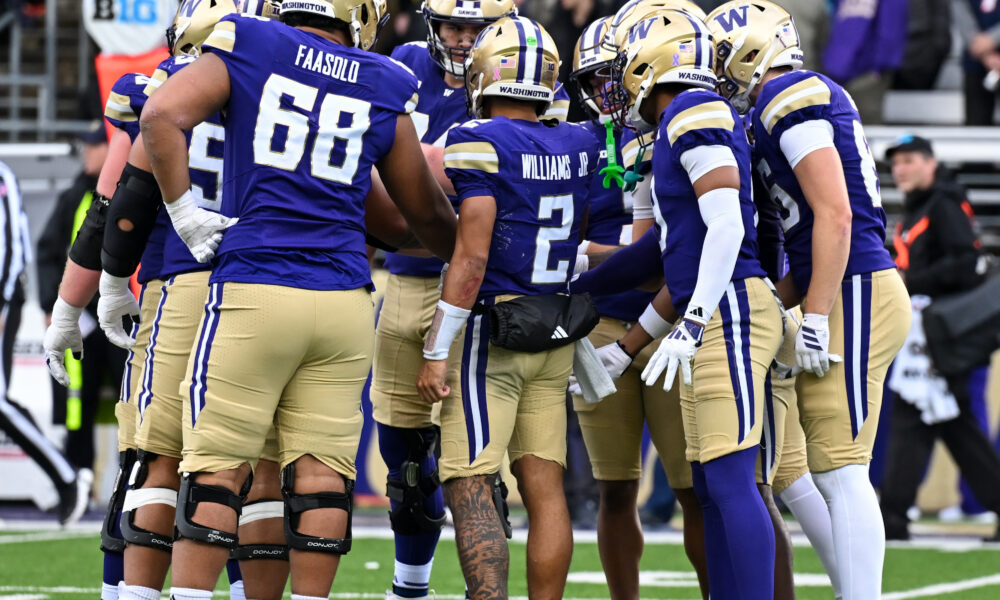
The Huskies looked bigger, deeper and more prepared for the rigors of the Big Ten than the previous year’s squad. Quarterback Demond Williams Jr. emerged as a legitimate playmaker, flanked by running back Jonah Coleman, who was expected to be one of the nation’s best, and wide receiver Denzel Boston, who proved to be one of the best pass-catchers in the Big Ten in 2024 with 63 receptions, 934 yards, and nine touchdowns.
The defensive side of the ball also showed real signs of life under new coordinator Ryan Walters. Walters snagged the services of arguably the best defensive player in the transfer portal in cornerback Tacario Davis, who rejoined Fisch after spending two seasons with him at Arizona. The 6-foot-4 cornerback was a smothering presence in man coverage.
Perhaps most importantly, Husky Stadium continued to be the fortress it has been for years. The Huskies have won 20 straight games at home, a streak that dates back to the 2022 season. Washington has seven home games in 2025, including Big Ten battles against Ohio State, Illinois, and Oregon — all entering the season as top-20 teams. The home-field advantage at Husky Stadium remains one of the most legitimate edges in the entire college football landscape.
The Big Ten Reality Check
Make no mistake: the move from the Pac-12 to the Big Ten represents the most significant institutional shift in Washington football’s modern history. The Pacific Northwest program, built on regional identity and West Coast football sensibilities, now competes in a conference that traditionally prizes the run game, physical defense, and brutal November road trips to places like East Lansing, Madison, and Columbus.
Washington gets an extra home game in 2025 compared to their first Big Ten season as it’s UW’s turn to have a five/four home advantage on the conference schedule. The scheduling gives the Huskies some room to breathe, but the challenges remain enormous. In a conference that has produced back-to-back national champions, simply getting to 9–4 represents genuine achievement.
The recruiting implications are equally significant. Fisch’s 2026 class currently ranks No. 19 nationally, four spots higher than in 2025. That upward trend is crucial as the Huskies adjust to competing in the Big Ten against recruiting powerhouses like Michigan, Penn State, Ohio State, and Oregon.
The program’s Pacific Northwest identity has always been its greatest recruiting strength and, in the broader national landscape, occasionally its greatest limitation. Now, in the Big Ten, that regional brand must evolve. Washington cannot simply recruit the best players from Oregon, Washington, and Northern California and expect to keep pace with programs that pull five-star talent from Texas, Georgia, and Florida year in and year out. Fisch seems to understand this, bringing in players from Alabama, adding depth through a busy transfer portal, and building a staff that can recruit nationally while still honoring the program’s roots.
Husky Stadium: The 12th Man on the Water
Any serious accounting of Washington Huskies football must include a chapter on the stadium itself, because the venue is not merely a backdrop — it is a participant. Officially known as Alaska Airlines Field at Husky Stadium, the open-air bowl sits literally on the edge of Lake Washington, with fans arriving by boat, by car, and on foot. The sight of the mountains in the distance on a clear autumn day is genuinely stunning. The noise, on a good Saturday, is genuinely punishing.
The stadium’s unusual design — open at both ends, with steep upper decks that trap sound — creates a decibel environment that visiting quarterbacks have complained about for decades. Chris Petersen used it deliberately and effectively, scheduling big home games and counting on the crowd to give his team a meaningful advantage. Fisch has done the same, and the 20-game home winning streak that Washington brought into 2025 is not a coincidence.
The boats in the marina below the stadium — “the Husky Navy” — are a genuine tradition, a sight that distinguishes game day in Seattle from virtually every other college football experience in America. On a bright October afternoon, with the lake shimmering and the mountains visible and 70,000 people dressed in purple, Husky Stadium is one of the great settings in all of American sport.
The Rivalry Files
No discussion of Washington football is complete without acknowledging the rivalries that give the season its dramatic architecture.
The Apple Cup — the annual matchup with Washington State — is among the more contentious in-state rivalries in college football. It has ended seasons, saved seasons, and in 2022 provided one of the defining moments of the DeBoer era when Washington handled the Cougars in Pullman. The game carries the particular intensity of a family dispute — the kind where both parties know exactly which buttons to push.
The Oregon rivalry carries different weight. In the historic Pacific Northwest rivalry, the Washington Huskies own the all-time record at 64–49–5 over the Oregon Ducks. But recent history has not been kind to Washington, and the Ducks have become a powerhouse under Dan Lanning, making the matchup increasingly one-sided in Oregon’s favor. Washington beating Oregon in any recent season is no longer an expectation — it is an event. That could change as Fisch builds his program, but the gap in resources and recruiting momentum between the two programs is real.
What the Future Holds
Where does Washington football go from here? The honest answer is that the program sits at a genuine crossroads — not a crisis, but a meaningful inflection point. The 2023 season under DeBoer represented a peak that may not be revisited immediately. The 2024 season under Fisch represented a painful transition. The 2025 season represented something more encouraging: a 9–4 record, a bowl win, a young quarterback with real potential, and a fan base beginning to believe again.
Jedd Fisch is clearly building something. He has been here before — he built Arizona from a 1–5 COVID season into a competitive program, winning Coach of the Year honors in the Pac-12. He is energetic, analytically driven, and genuinely good at the transfer portal in an era when transfer portal management is essentially a separate coaching discipline. After inheriting a depleted roster after Kalen DeBoer’s departure, fans should have plenty of reasons to be excited about Fisch and the current state of Husky football.
The longer arc of Washington football suggests that the program’s ceiling remains very high. Washington has won 18 conference championships, seven Rose Bowls, and claims two national championships recognized by NCAA-designated major selectors. The infrastructure is there. The stadium is world-class. The Seattle market, while not a traditional football town in the way that Columbus or Tuscaloosa are, provides a major media market, a tech-industry donor base, and a genuinely beautiful setting for the sport.
The challenge is sustaining excellence in a conference that does not allow for comfortable mediocrity. Every week in the Big Ten is a test. The margins are smaller. The opponents are faster and deeper. Washington proved in 2023 that it can compete at the highest level. The question Fisch is now answering — with real evidence, not hypotheticals — is whether he can get the program back to that elevation and keep it there.
Purple Forever
There is a specific kind of loyalty that Pacific Northwest football fans carry. It is not the unthinking devotion of a blue-blood program accustomed to winning. It is the loyalty of people who have lived through the lean years, who remember when Washington was irrelevant in the early 2000s, who watched the program scrape along under coaches who could not quite figure it out, and who still showed up at Husky Stadium and filled those purple seats.
That loyalty is not taken for granted by the coaches who have honored it best. Don James understood it. Chris Petersen understood it. Kalen DeBoer, briefly but brilliantly, understood it. Jedd Fisch is learning it now.
The Washington Huskies are not a program that has always won. They are a program that has always cared. There is a difference, and the difference matters. In a college football landscape increasingly driven by money, NIL deals, and conference mega-mergers, that sense of genuine identity — Dawg football, purple pride, the noise on the water — remains the most durable thing the program has.
The next chapter is being written in Seattle right now. Fisch is recruiting, developing players, and slowly assembling the kind of roster that can compete in the Big Ten for the long term. The mountain is steep. The history is rich. The stadium is loud.
The Huskies are back at work.