On a September evening in 1926, seven blocks of downtown Seattle went dark to automobile traffic. Streetcars were diverted. Klieg lights illuminated the night sky while flares shot from nearby rooftops. Thousands of revelers packed Fifth Avenue between Seneca Street and Pike Street, lured by the promise of free transportation and the spectacle of something Seattle had never seen before. The Seattle Times reported it was doubtful any Friday night in the city’s history had drawn more people to the downtown streets.
The occasion was the grand opening of the 5th Avenue Theatre—a $1.5 million architectural marvel that would become, over the following century, one of America’s most influential incubators of musical theatre. The building that opened its brass-knobbed doors that night has since launched dozens of productions to Broadway, survived economic collapse and near-demolition, and earned its place as the largest theatre employer in the Pacific Northwest.
What distinguishes the 5th Avenue from countless other grand movie palaces of its era—most of which have long since fallen to the wrecking ball—is not merely its survival but its transformation. From vaudeville house to movie palace to world-class musical theatre company, this remarkable venue has reinvented itself with each passing generation while maintaining the breathtaking interior that prompted legendary actress Helen Hayes to call it “a national treasure.”
An Imperial Vision in the American West
The story of the 5th Avenue Theatre begins with ambition—specifically, the ambition of Harry C. Arthur, president of Pacific Theatres, Inc., who saw Seattle as fertile ground for expansion. The largest theatre operator on the West Coast wanted a flagship venue that would announce his presence in the Pacific Northwest in unmistakable terms.
Arthur found a willing partner in C.D. Stimson, a major stockholder in the theatre company who envisioned a grand entertainment district for Seattle. The planned Skinner Building, a mixed-use development on Fifth Avenue, would provide the perfect home for Arthur’s theatrical ambitions. To design this centerpiece, they turned to Robert C. Reamer, an architect already famous for creating Yellowstone National Park’s Old Faithful Inn.
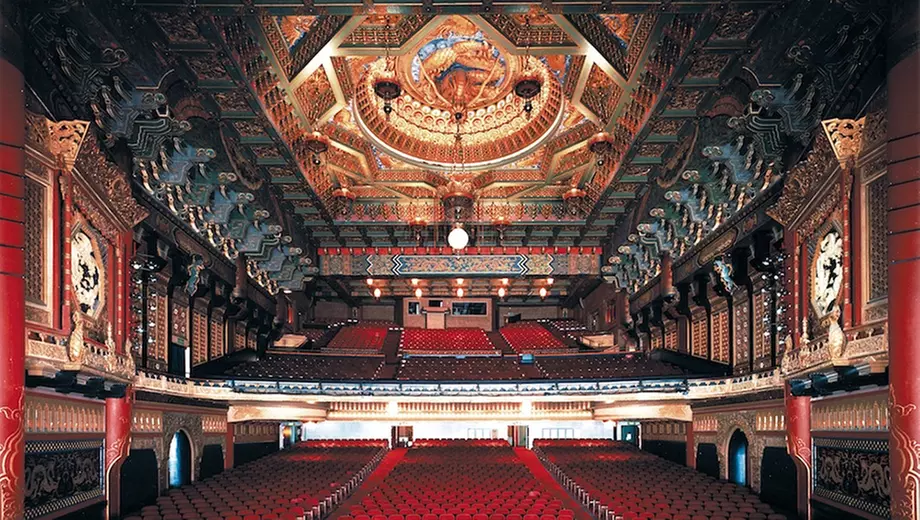
What Reamer conceived defied all expectations. At a time when most American theatres drew their decorative inspiration from Italian Renaissance or Spanish colonial styles, Reamer chose something unprecedented: Imperial China. Working with Norwegian interior designer Gustav Liljestrom of San Francisco’s S. & G. Gump Company, Reamer created what movie palace historian David Naylor would later describe as the most exacting replication of Chinese imperial architecture ever attempted in an American theatre.
The design drew inspiration from three of Beijing’s most celebrated landmarks: the Forbidden City, the Temple of Heavenly Peace, and the Summer Palace. Liljestrom had traveled to China and studied Ernst Boerschmann’s illustrated accounts of Chinese architecture, published in 1925. The result was an interior so lavish, so meticulously detailed, that one Seattle journalist declared the entire house “a masterpiece of Oriental art.”
The auditorium’s crown jewel is its octagonal coffered ceiling—a replica, at twice the original scale, of the ceiling in the Hall of Supreme Harmony within Beijing’s Forbidden City. From this ceiling springs a sculpted five-toed Imperial Chinese dragon, its whiskers spanning eighteen feet from tip to tip. Suspended from the dragon’s mouth hangs the “Pearl of Perfection” chandelier, a massive glass fixture referencing the Chinese legend of dragons disgorging flaming pearls.
Throughout the 2,130-seat house, traditional colors—red, orange, jade, black, and silver—adorn every surface. Guardian lions flank the stairway to the balcony. Velvet panels embroidered with scenes from Chinese legends measure approximately twenty feet by eight feet. Even the exit signs incorporate both English and Chinese characters. No detail was overlooked.
It is worth noting the historical irony embedded in this design: the theatre’s Chinese-inspired grandeur was conceived and executed by white European architects at a time when Chinese immigrants faced severe legal discrimination in the United States, including laws prohibiting property ownership and entry into the country. The building represents both a celebration of Chinese aesthetics and a troubling example of cultural appropriation during an era of explicit exclusion.
Nevertheless, the architectural achievement remains extraordinary. The 5th Avenue Theatre opened eight months before the now-famous Grauman’s Chinese Theatre in Hollywood, making it the pioneer of this distinctive style in American entertainment architecture.
The Vaudeville Years and the Rise of Cinema
Opening night on September 24, 1926, featured the kind of hybrid programming typical of the era: the silent film Young April, Fanchon and Marco’s stage presentation The Night Club, and Lipschultz and his Syncopated Soloists. Oliver Wallace, Seattle’s first movie house organist, returned from Portland to provide accompaniment on the theatre’s magnificent 4/18 Wurlitzer pipe organ.
Throughout the late 1920s, the 5th Avenue thrived as a vaudeville and film house, presenting top touring entertainers alongside the newest motion pictures. When sound technology revolutionized cinema, the theatre transitioned smoothly into its role as a movie palace—one of the most opulent on the entire West Coast.
For decades, Seattle residents flocked to the 5th Avenue to experience Hollywood’s latest offerings in surroundings that rivaled any palace. The thick carpets woven with lotus flower patterns, the overstuffed furniture with intricate Far Eastern sidepieces, the candelabra-style lighting fixtures—all transported moviegoers into a world of exotic fantasy before the projector even flickered to life.
But nothing lasts forever, and the 5th Avenue was not immune to the forces reshaping American entertainment. Television arrived in living rooms across the country. Suburban shopping centers sprouted multiplex cinemas that offered convenience over grandeur. The economic recession of the 1970s delivered a final blow to Seattle’s grand downtown theatres. In 1978, the 5th Avenue closed its doors, joining the nearby Orpheum in silence.
For a building that had welcomed millions of visitors over half a century, the proposals for its future were dispiriting: conversion to a Chinese restaurant, transformation into a triplex movie house, demolition to make way for office space or a shopping center. The city of Seattle found itself unable to protect the venue as a designated landmark because of its unique position on land owned by the state of Washington—specifically, the original territorial university grounds now held by the University of Washington.
Forty-Three Business Leaders and a National Treasure
What happened next became a template for historic preservation efforts across the country. In 1979, forty-three Seattle business leaders formed the nonprofit 5th Avenue Theatre Association and underwrote a $2.6 million loan to rescue the building. Their vision extended beyond mere preservation: they wanted to transform the movie palace into a legitimate theatre venue that could bring Broadway touring productions to a city that had been bypassed by national tours traveling from California directly to Vancouver, B.C.
The restoration took eighteen months, with workers carefully preserving the ornate Chinese detailing while adapting the space for live theatrical production. When the theatre reopened on June 16, 1980, with a gala ceremony narrated by Helen Hayes, the building looked much as it had in 1926—only now, it would serve a very different purpose.
Hayes’s declaration that evening—calling the 5th Avenue “a national treasure”—proved prescient. Less than three weeks later, on July 3, 1980, the theatre presented Annie, then a brand-new musical on its national tour. The show ran for 77 sold-out performances over ten weeks, stamping the 5th Avenue as Seattle’s premier venue for large-scale musical theatre.
The early years brought remarkable success—and then, reality intervened. Another national recession hit in the mid-1980s, and by 1985, the theatre had virtually shut down its musical presentations, surviving only through occasional rentals. The ambitious dream of making Seattle a Broadway destination seemed to be fading.
The Marilynn Sheldon Era and the Birth of a Theatre Company
The 5th Avenue’s resurrection came through the unlikely figure of Marilynn Sheldon, who had joined the theatre in 1980 as the box office treasurer. In 1987, she was appointed managing director and charged with leading the organization into a new era.
Sheldon’s approach was systematic and visionary. In 1989, the 5th formed a partnership with Theatre Under the Stars (TUTS) in Houston, Texas, with Artistic Director Frank Young curating co-productions that played in both cities alongside touring shows. This arrangement allowed the 5th to move beyond presenting tours to actually producing its own musicals—shows created in Seattle that could stand alongside anything coming out of New York.
The 5th Avenue Musical Theatre Company was born, and with it came a fundamental shift in identity. No longer merely a receiving house for touring productions, the 5th Avenue became a creative engine in its own right. By 1993, it had become a largely self-sustaining nonprofit with one of the largest subscription audiences in the country.
The organization didn’t stop at the stage. Establishing a $1 million charitable endowment through the Seattle Foundation, the 5th made grants to education programs throughout the city. It created the Adventure Musical Theatre Touring Company, bringing original educational musicals to schools across Puget Sound. The commitment to nurturing young talent would eventually grow into one of the most comprehensive theatrical education programs in the nation.
Broadway’s Testing Ground
In 1995, something happened that would define the 5th Avenue’s national reputation for the next three decades. The theatre premiered Jekyll & Hyde, a new musical that, after its Seattle run, went on to open on Broadway in April 1997. It was the first 5th Avenue production to make that journey—but it would be far from the last.
When David Armstrong joined as the first resident Producing Artistic Director in 2000, he brought a vision of the 5th Avenue as a crucial waystation on the road to Broadway. The traditional model of out-of-town tryouts had largely collapsed, with producers unable to afford the expense of mounting full productions outside New York. Armstrong saw an opportunity to fill that void.
In 2002, the 5th Avenue premiered an unknown musical called Hairspray. Seattle audiences embraced it immediately. When the show transferred to Broadway, it became an overnight sensation, winning multiple Tony Awards including Best Musical. The film adaptation premiered at the 5th Avenue on July 16, 2007—four days before its nationwide release—as acknowledgment of the theatre’s role in the musical’s success.
The Hairspray triumph launched what would become the 5th Avenue’s signature contribution to American musical theatre. Over the following years, a remarkable string of premieres followed: The Wedding Singer in 2006; Shrek the Musical in 2008 (Tony Award winner); Memphis in 2009 (four Tony Awards including Best Musical); Catch Me If You Can in 2009; A Christmas Story: The Musical in 2010; and Disney’s Aladdin in 2011, which went on to become a global phenomenon.
Since 2001, the 5th Avenue has premiered more than twenty new musicals, with ten subsequently opening on Broadway and earning a combined fifteen Tony Awards, including two for Best Musical. No other theatre company on the West Coast—and few anywhere in America—can claim such a track record for launching Broadway-bound productions.
Education and Community
While the main stage captured headlines, the 5th Avenue was simultaneously building an educational infrastructure that would become a model for the industry. The 5th Avenue Awards Honoring High School Musical Theatre, created in 2003 by Producing Artistic Director Bill Berry, began as a modest program evaluating 24 productions involving 3,100 students. By 2019, it had grown to encompass 128 productions at 106 schools with more than 11,000 participating students.
Modeled on the Tony Awards, this annual ceremony brings together student performers from across Washington State to celebrate excellence in high school musical theatre. Winners in categories like Outstanding Performance by an Actress in a Leading Role and Outstanding Overall Musical Production travel to the National High School Musical Theater Awards in New York City. Beyond the glamour of the ceremony, the program has helped schools secure funding, improve curriculum, and increase student participation in theatre arts.
The Adventure Musical Theatre Touring Company continues to bring original educational musicals to schools throughout the region. The Rising Star Project provides tuition-free mentorship for students ages 14-19. Collectively, these programs reach over 30,000 young people annually, fulfilling the organization’s commitment to developing the next generation of audiences and artists.
Surviving the Pandemic and Forging a New Alliance
Like every performing arts organization, the 5th Avenue was devastated by the COVID-19 pandemic. The 2020-2021 season was cancelled entirely. When audiences finally returned, their behavior had shifted—attendance patterns that might take years to normalize, if they ever do completely.
The financial model that had sustained the organization for decades no longer worked. Rising production costs, changing audience demographics, and the lingering effects of the pandemic created what leadership described as an existential challenge requiring bold strategic action.
That action came in March 2025, when the 5th Avenue Theatre Company announced a strategic alliance with Seattle Theatre Group (STG), the nonprofit organization that operates the Paramount, Moore, Neptune, and Kerry Hall venues. Under the agreement, STG assumed the lease of the 5th Avenue Theatre building from the University of Washington and took over management of the physical space.
The arrangement is neither a merger nor an acquisition but rather a partnership designed to maximize the building’s use while allowing each organization to focus on its strengths. The 5th Avenue Theatre Company remains an independent nonprofit, continuing to produce its own musicals for approximately 26 weeks each year. During the remaining weeks, STG programs concerts, comedy, and other performances, ensuring the historic venue stays active year-round.
The alliance debuted publicly with a co-presentation of Chicago in October 2025, demonstrating how the partnership could bring additional programming while preserving the 5th’s core mission. For Seattle’s downtown, the increased activity means more visitors supporting surrounding hotels, restaurants, and businesses—a crucial contribution to the urban core’s post-pandemic recovery.
Approaching the Centennial
As the 5th Avenue Theatre approaches its 100th anniversary in 2026, it stands at another inflection point in its remarkable history. The 2025-26 season—featuring the national tour of Suffs, Chicago, a locally produced Elf: The Musical, Monty Python’s Spamalot, and Jesus Christ Superstar—reflects the dual identity that has defined the theatre’s modern era: presenting touring Broadway productions while creating its own distinctive work.
The building itself remains essentially unchanged from opening night 1926. The five-toed dragon still guards the ceiling, the Pearl of Perfection chandelier still catches the light, and the guardian lions still watch over patrons ascending to the balcony. When the 2001 Nisqually earthquake shook the region, workers installed scaffolding to repair damage to the ceiling—the first time in 75 years anyone had reached those heights. The building proved resilient, as it has throughout its history.
The 5th Avenue Theatre has evolved through every phase of American entertainment: from vaudeville to silent film, from talkies to television, from touring house to world-class producer. It has faced closure, near-demolition, recession, and pandemic. Each time, it has emerged transformed but intact, its fundamental mission—to bring the magic of live performance to Pacific Northwest audiences—undiminished.
Few buildings can claim such a journey. Fewer still can point to concrete evidence of cultural impact: ten Broadway-bound productions, fifteen Tony Awards, generations of young performers nurtured through education programs, and millions of audience members who have stepped through those brass-knobbed doors into a world of dragons and pearls and stories told through song.
The Chinese characters on the exit signs have guided patrons back to reality for nearly a century now. But the magic they carry with them—the memory of orchestras swelling, of voices soaring up to that dragon’s whiskers, of transformations both onstage and in the hearts of those watching—that lingers long after the house lights come up.