

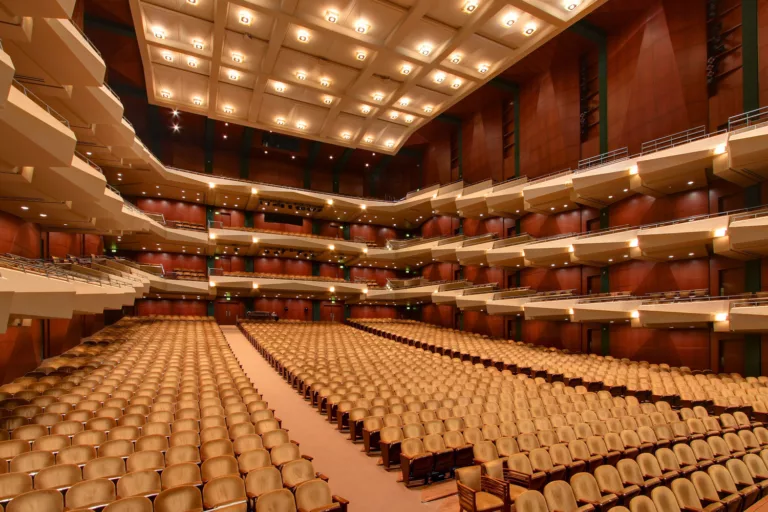
The Seattle Symphony performed its first concert in Benaroya Hall on September 12, 1998, with Gerard Schwarz conducting Mozart’s final three symphonies and soprano Jessye Norman lending star power to the gala opening. The acoustics designed by Cyril Harris—one of the world’s foremost concert hall acousticians—delivered sound so clear and balanced that principal cellist Efe Baltacigil would later rank the S. Mark Taper Foundation Auditorium alongside Carnegie Hall as one of the two best concert halls in America.
But the numbers tell the deeper story. In 1983, when Schwarz became music advisor, the Seattle Symphony had 5,000 subscribers. By 2008—a decade after Benaroya Hall opened—that figure had reached 35,000. The orchestra’s budget doubled. Performance frequency doubled. The transition from the Seattle Opera House at Seattle Center to the custom-built hall at 200 University Street (3rd Avenue and Union Street) didn’t just improve acoustics. It fundamentally altered the orchestra’s financial model, audience relationship, and artistic ambition.
Benaroya Hall cost $118.1 million (some sources cite $120 million), built on time and on budget in just two years. The project raised $159 million from the private sector—the largest arts fundraising campaign in Washington State history as of 1998. Jack and Becky Benaroya’s unsolicited $15.8 million donation in 1993 catalyzed the campaign, triggering enthusiasm among other donors when previous Seattle Center-based plans had languished. The state, city, and county added public support. The hall occupies an entire downtown city block, integrating seamlessly into Seattle’s urban core despite sitting directly above the Great Northern Tunnel and next to the Downtown Seattle Transit Tunnel.
Twenty-six years later, Benaroya Hall remains Seattle’s most-visited performing arts venue, hosting over 700 events annually and drawing approximately 500,000 people through over 450 performances. The hall’s acoustic excellence continues earning praise from performers and critics. Its downtown location—walkable from hotels, restaurants, theaters—makes it cultural anchor rather than destination requiring deliberate pilgrimage to Seattle Center.
Yet the institution’s recent history reveals challenges matching the triumphant opening. Thomas Dausgaard’s abrupt January 2022 resignation as music director—telling Danish National Radio “I have felt threatened and I haven’t felt safe with going to work” and The New York Times “I felt my life is too precious to be in such tension”—exposed tensions within the organization. The September 2024 appointment of Xian Zhang as music director (effective 2025-26 season) makes her the first woman to lead a major West Coast orchestra, signaling both historic achievement and organizational reset after turbulence.
The Seattle Symphony and Benaroya Hall story encompasses architectural triumph, acoustic science, funding innovation, artistic excellence, organizational conflict, and the complex economics of maintaining world-class orchestras in American cities.
The Acoustic Science: Building a Box Within a Box
Cyril Harris approached concert hall design with scientific rigor unusual in architecture. Before designing Benaroya Hall, he had analyzed acoustics in sixty concert halls worldwide, interviewed hundreds of conductors, performers, and music critics, and developed theoretical frameworks for optimizing sound reflection, reverberation, and clarity. His previous work included renovating Avery Fisher Hall at Lincoln Center and designing concert halls earning international acclaim.
Benaroya Hall’s S. Mark Taper Foundation Auditorium presented unique challenges. The site sat above active rail tunnels—the Great Northern Tunnel carrying freight trains and the Downtown Seattle Transit Tunnel (now part of Sound Transit’s light rail system). Third Avenue traffic created continuous ambient noise. Traditional concert hall construction would allow subway rumble, freight train vibration, and street noise to penetrate performance spaces, destroying the acoustic purity essential for unamplified orchestral music.
Harris’s solution: build the auditorium as box within a box, with the inner performance space structurally isolated from the outer building shell. The entire 2,500-seat auditorium sits on rubber isolation pads, decoupling it from ground vibration. The double-wall construction blocks external noise while the inner surfaces—carefully shaped wood and plaster—diffuse sound effectively throughout the space.
The coffered ceiling panels promote sound reflection and clarity without creating acoustic dead spots or excessive reverberation. Every surface angle was calculated to direct sound optimally. The traditional shoebox shape—long and relatively narrow compared to fan-shaped modern halls—follows acoustic principles dating to 19th-century European concert halls where orchestral music evolved. The wood paneling resonates at specific frequencies, adding warmth to string instruments while maintaining brass clarity.
The result: natural acoustics so exceptional that amplification rarely occurs except for pop collaborations and film score performances. Performers consistently praise the hall’s balance—every section of the orchestra hears itself and others clearly, while audiences throughout the 2,479-seat space (final count differs slightly from original 2,500 estimate) experience consistent sound quality regardless of seating location.
The 536-seat Illsley Ball Nordstrom Recital Hall (sometimes listed as 540 seats) applies similar acoustic principles at intimate scale, providing warm environment for chamber music, solo recitals, lectures, and film screenings. The smaller space allows different acoustic character—less reverberation than the main hall, more immediacy and detail appropriate for small ensembles.
The technology-infused approach Harris pioneered—using advanced measurement equipment, computer modeling, and empirical data from existing halls—represented mid-1990s state-of-the-art. Subsequent concert halls worldwide studied Benaroya’s acoustic solutions, particularly the vibration isolation system protecting performance spaces from urban infrastructure.
The Fundraising Campaign: Benaroya’s Catalytic Gift
The Seattle Symphony’s search for a permanent home spanned decades. The orchestra performed at various venues since its 1903 founding—the Moore Theatre, Meany Hall at University of Washington, finally the Seattle Opera House (now Marion Oliver McCaw Hall) at Seattle Center starting in 1962. Sharing the Opera House with Seattle Opera and Pacific Northwest Ballet created scheduling conflicts and compromised each organization’s needs. The Symphony needed performance space optimized for orchestral music. Opera required stage machinery for sets. Ballet needed different acoustic properties.
By the 1980s, plans emerged for Symphony-dedicated hall. The Kreielsheimer Foundation donated property near Seattle Center. Initial estimates projected $50 million cost. But planning lagged, fundraising proved difficult, and cost estimates climbed. The project seemed perpetually delayed, generating skepticism about whether Seattle could support dedicated concert hall.
In 1993, Jack and Becky Benaroya changed the equation. Jack Benaroya had built fortune in commercial real estate, developing industrial properties and becoming noted philanthropist. The couple’s unsolicited $15.8 million donation—largest single arts gift in Washington State history at that time—transformed the project from aspirational to achievable. Other major donors followed. The S. Mark Taper Foundation contributed naming rights funds for the main auditorium. Illsley Ball Nordstrom provided recital hall support. The Samuel and Althea Stroum family funded the grand lobby.
Public sector added critical support. Washington State, King County, and City of Seattle recognized that world-class concert hall would enhance Seattle’s cultural reputation and economic development. Tourism, convention business, and quality of life for attracting employers and workers all benefited from robust arts infrastructure. The public-private partnership model—private philanthropy building the facility, public support providing tax incentives and infrastructure—became template for subsequent Seattle cultural projects.
The campaign ultimately raised $159 million including construction costs, endowment, and financing—exceeding the $118-120 million construction budget. The surplus funded operations endowment, ensuring the Symphony wouldn’t simply inherit beautiful building without resources to maintain it.
The site selection proved as important as funding. Downtown location at 3rd Avenue and Union Street placed the hall in Seattle’s commercial and retail core, surrounded by hotels (including the Four Seasons directly adjacent), restaurants, retail, and other cultural venues. Theatergoers could dine before concerts, hotel guests could walk to performances, convention attendees could add Symphony concerts to business trips. The accessibility contrasted with Seattle Center’s relative isolation requiring transit or parking.
The Gerard Schwarz Era: Building Audience and Reputation
Gerard Schwarz’s tenure as music director (1985-2011) fundamentally shaped the Seattle Symphony’s identity. His leadership coincided with Benaroya Hall planning, construction, and opening, making him the figure most associated with the hall’s first decade.
Schwarz championed American composers—particularly neglected 20th-century figures like Howard Hanson, David Diamond, Walter Piston, William Schuman, Alan Hovhaness, and Morton Gould. The Symphony recorded more than 100 albums under Schwarz for Delos International and Naxos Records, documenting American orchestral music that major labels ignored. These recordings earned Grammy nominations starting in 1990 and established the orchestra’s recording reputation.
Subscriber growth from 5,000 (1983) to 35,000 (2008) reflected both Schwarz’s programming and Benaroya Hall’s impact. The beautiful venue attracted subscribers who might have avoided the Opera House. Improved acoustics let audiences appreciate musical details previously obscured. Increased seating capacity (2,500 vs. Opera House’s 2,890 for opera configuration but less for orchestra) with better sightlines made tickets more desirable.
Schwarz spearheaded Benaroya Hall advocacy, recognizing that world-class orchestra required world-class performance space. He conducted the September 12, 1998 inaugural concert—Mozart’s Symphonies No. 39, 40, and 41 with Jessye Norman—creating the hall’s first musical memories. The block around Benaroya Hall was named “Gerard Schwarz Place” in 2011, recognizing his contributions.
But Schwarz’s leadership style generated controversy. Some musicians found him autocratic, creating tension between conductor and orchestra members. Financial pressures emerged toward the end of his tenure—the 2005-2006 season posted $3.2 million deficit amid rising operational costs. Internal discord and musician dissatisfaction led to Schwarz’s September 2008 announcement that he would step down at the 2010-2011 season conclusion.
The Schwarz era demonstrated both possibilities and limitations of conductor-led institutional transformation. He built audience, championed repertoire, and advocated for Benaroya Hall construction. But sustainability required addressing financial models and organizational culture beyond one conductor’s vision.
The Morlot and Dausgaard Years: Innovation and Crisis
Ludovic Morlot succeeded Schwarz as music director (2011-2019), bringing different aesthetic and leadership approach. French-born and trained, Morlot emphasized contemporary music, innovative programming, and international collaborations. Under his direction, the orchestra earned Grammy nominations for recordings made at Benaroya Hall, including contemporary compositions that expanded the Symphony’s repertoire beyond Schwarz’s American focus.
Morlot capitalized on Benaroya Hall’s acoustic capabilities for demanding 20th and 21st-century scores. The hall’s clarity and balance suited complex modern orchestrations requiring precise sectional balance. His tenure saw increased critical acclaim, with NPR describing the Seattle Symphony as one of the “most vital American orchestras.”
Morlot concluded his tenure at the 2018-2019 season end, departing amicably after eight years. The transition to Thomas Dausgaard seemed promising. The Danish conductor had guest-conducted the orchestra in 2013, becoming principal guest conductor in 2014 with three-year contract later extended through 2019-2020. His October 2017 appointment as music director effective 2019-2020 came with four-year contract.
Dausgaard resigned abruptly via email on January 7, 2022—halfway through his contract. His public statements shocked the classical music world. He told Danish National Radio’s P2: “I have felt threatened and I haven’t felt safe with going to work.” He told The New York Times: “I felt my life is too precious to be in such tension.”
Orchestra officials denied impropriety. Board chair Jon Rosen (who assumed the position August 2021) acknowledged the crisis to the press: “We all wanted to have someone who was going to be very congenial, be able to relate to the musicians. I certainly wanted to learn from the experience with Thomas.” The specific nature of conflicts remained unclear publicly, but the departure exposed organizational dysfunction severe enough that a music director felt unsafe.
The crisis raised questions about institutional culture, labor relations, and governance. Orchestras require collaboration between conductor and musicians. When that relationship breaks down—whether from personality conflicts, artistic disagreements, management failures, or workplace culture problems—the entire organization suffers.
The Zhang Appointment: Historic Leadership and Organizational Reset
The September 2024 announcement of Xian Zhang as music director (effective 2025-26 season, serving as music director designate in 2024-25) marked multiple significances. Zhang becomes the first woman conductor to lead a major West Coast orchestra—a milestone in field where women have historically faced barriers to podium positions. Her five-year contract signals institutional commitment to stability after Dausgaard’s turbulent departure.
Zhang first conducted the Seattle Symphony in June 2008 at Benaroya Hall in Prokofiev’s “Alexander Nevsky,” returning for multiple engagements including Orff’s “Carmina Burana” (2023) and Copland’s “Appalachian Spring” (April 2024). Her comment about those experiences—”With each visit, I realized the depth and the understanding of the music from the musicians. It felt in a way musically speaking that we’re really on the same page and speaking the same language”—suggests musical compatibility and collegial relationship that eluded Dausgaard.
Board chair Jon Rosen’s acknowledgment that Dausgaard’s “messy departure” was “at least a subliminal consideration” in the search indicates organizational awareness that conductor-musician relationships matter as much as artistic vision. Zhang’s appointment emphasizes compatibility alongside credentials.
The 2024-25 season as music director designate allows transition period—Zhang conducting multiple programs, working with musicians in rehearsal, building relationships before assuming full responsibilities. This gradual approach contrasts with direct appointments, suggesting institutional learning from recent turbulence.
Zhang’s appointment also signals continued commitment to repertoire diversity and international perspective. Her conducting career spans opera and symphonic music, European and American orchestras, traditional and contemporary works. This versatility suits the Seattle Symphony’s current identity—rooted in canonical repertoire but exploring contemporary music, pop collaborations, and multimedia presentations.
The Pop Collaborations: Broadening Audience and Revenue
Since 2007, Benaroya Hall has hosted regular collaborations between Seattle Symphony and popular music artists as part of expanded programming. Performers have included Brandi Carlile, Macklemore, Sir Mix-A-Lot, Nancy Wilson, Thunderpussy, and SYML—local and national acts combining popular music with symphonic arrangements.
These concerts account for approximately 30% of the Symphony’s revenue—a substantial portion of operating budget. More significantly, they attract audiences who might never attend traditional classical concerts. Fans of Macklemore or Brandi Carlile encountering live orchestra for the first time may develop curiosity about orchestral music generally. The economic model—leveraging Benaroya Hall’s acoustic excellence and the Symphony’s musical expertise for pop audiences willing to pay premium ticket prices—addresses classical music’s aging demographic challenge.
Nonclassical performances including pop collaborations, live film scores (the Symphony performing while classic or contemporary films screen), and video game music broaden the hall’s utility beyond traditional repertoire. Video game music concerts—featuring scores from games like “The Legend of Zelda,” “Final Fantasy,” and others—draw younger audiences raised on gaming. Film score concerts combine visual and musical experiences, demonstrating orchestra’s role in cinematic storytelling.
These collaborations also showcase Benaroya Hall’s acoustic flexibility. The hall was designed for unamplified classical music, but amplification systems support pop performances while maintaining sound quality. The venue’s technical capabilities—advanced lighting, projection screens (16 feet 2 inches high by 28 feet 10 inches wide in the main auditorium), and sound reinforcement—enable multimedia presentations impossible in traditional concert halls.
Critics sometimes question whether pop programming dilutes classical mission or represents capitulation to commercial pressure. But the financial reality is clear: subscriptions and traditional concert ticket sales cannot fully fund major American orchestras. Diversified programming attracts broader audiences, generates revenue, and uses the hall more fully rather than leaving it dark between classical concerts.
The Dale Chihuly Lobby: Art as Architectural Element
Benaroya Hall features substantial glass art installations by Dale Chihuly, particularly the “Crystal Cascade” in the Samuel & Althea Stroum Grand Lobby. The massive glass sculpture—characteristic of Chihuly’s dramatic scale and color—creates visual focal point complementing the hall’s architectural grandeur.
Chihuly’s presence reflects Seattle’s glass art tradition and the artist’s international reputation. His work appearing in a major civic building reinforces Seattle’s identity as design-forward city valuing public art. The Grand Lobby’s expansive bow windows provide city skyline views, creating indoor-outdoor visual connection, while Chihuly’s glass adds interior drama.
The lobby serves multiple functions beyond concert intermissions. The space hosts receptions, corporate events, weddings, and banquets—revenue-generating uses that help fund Symphony operations. The LMN Architects design created flexible space elegant enough for formal events while accommodating large crowds during intermissions.
The American modernist Robert Rauschenberg contributed additional artwork, establishing the hall as gallery-quality arts space beyond mere performance venue. This integration of visual and performing arts within single facility reflects comprehensive approach to cultural infrastructure.
The Garden of Remembrance: Civic Memorial Space
Benaroya Hall’s western plaza along 2nd Avenue features the Garden of Remembrance, primarily funded by Patsy Bullitt Collins (1920-2003) and Boeing Company. Designed by Murase Associates and dedicated July 4, 1998—two months before the hall opened—the memorial lists names of Washingtonians who died in military service during World War II and subsequent conflicts.
The Garden’s presence transforms Benaroya Hall from arts facility into civic space serving multiple community purposes. Veterans groups hold commemorations. Families visit names of fallen service members. The terraced garden provides public green space in dense downtown area, open year-round regardless of hall events.
This civic dimension—concert hall as community gathering space rather than exclusive cultural temple—reflects deliberate design philosophy. The hall occupies entire city block but remains permeable, with commercial life continuing along one side and public garden on another. The integration into urban fabric rather than isolation behind plazas or moats makes the building accessible and welcoming.
The Economic Model: Public Benefit, Private Funding
Benaroya Hall operates under hybrid model characteristic of American cultural infrastructure. BH Music Center, a nonprofit organization, owns the facility. The Seattle Symphony holds long-term residency but doesn’t own the building. This structure separates facility management from artistic programming.
The initial $159 million fundraising campaign included endowment funding recognizing that building maintenance, utilities, staffing, and operations require ongoing revenue beyond construction costs. The Symphony’s annual budget—doubled since Benaroya Hall opening—funds artistic programming, musician salaries, administrative staff, marketing, and education programs.
Revenue streams include subscription sales, single-ticket purchases, pop concert tickets, facility rentals (corporate events, weddings, conferences utilizing the Grand Lobby and recital hall), concessions, parking revenue from adjacent facilities, and annual fund contributions. Foundation grants, corporate sponsorships, and individual major gifts supplement earned income.
The economic model faces ongoing challenges. Orchestra musician salaries must remain competitive with other major American orchestras to attract and retain talent. Healthcare costs, pension obligations, and administrative expenses rise faster than revenue growth. Classical music audiences skew older—subscription bases age while younger audiences attend less frequently or prefer single-ticket flexibility over season subscriptions.
The pop programming strategy addresses these challenges but creates others. Symphony musicians trained in classical performance may resent pop concerts as artistically inferior. Programming balance between traditional repertoire, contemporary classical music, and commercial pop collaborations requires careful navigation. Too much pop alienates traditional subscribers; too little misses revenue opportunities and audience development.
The Current Moment: Stability After Turbulence
As of January 2026, the Seattle Symphony enters Xian Zhang’s music director designate season before her full tenure begins in 2025-26. The organization has weathered the Dausgaard crisis, appointed historic leadership, and continues operating at Benaroya Hall two blocks from the address where it all began September 12, 1998.
The hall itself requires ongoing maintenance. Acoustic systems need calibration. Seating, carpeting, and finishes deteriorate with use. HVAC systems, lighting equipment, and building infrastructure require updates. The isolation pads protecting the auditorium from vibration require monitoring. Twenty-six years is young for concert halls that often serve for centuries, but maintenance demands constant attention and investment.
The Symphony reaches over 750,000 people annually through live performances, radio broadcasts, and Seattle Symphony+ streaming service. Digital initiatives—accelerated during COVID-19 pandemic—extended the orchestra’s reach beyond Benaroya Hall’s 2,500-seat capacity. Streaming concerts make performances accessible to people unable to attend in person, whether due to mobility limitations, geographic distance, or ticket costs.
The education programs, particularly Octave 9: Raisbeck Music Center established 2019, foster music access for diverse communities. Youth programs, school partnerships, and community concerts extend the Symphony’s mission beyond entertaining established classical audiences.
The numbers that began this story—5,000 subscribers to 35,000, budget doubled, performances doubled—tell one narrative: Benaroya Hall’s transformative impact on Seattle Symphony’s institutional capacity. But another narrative emerges from Thomas Dausgaard’s departure and the search for organizational culture supporting artistic excellence: buildings alone don’t create great orchestras. Acoustics, funding, and downtown location matter profoundly, but so do leadership, workplace culture, and genuine collaboration between conductors and musicians.
The first notes of Mozart performed September 12, 1998 in Cyril Harris’s acoustic masterpiece built on Jack Benaroya’s philanthropic vision established Benaroya Hall as Seattle landmark. The next chapters—written by Xian Zhang and musicians of the Seattle Symphony in the decades ahead—will determine whether that landmark truly fulfills its founding promise: being permanent home where one of America’s finest orchestras creates transcendent musical experiences generation after generation.