Festival ’71 wasn’t supposed to work. A $25,000 budget, three days, minimal publicity beyond cardboard posters screened in yellow and magenta showing a closed fist—thumb pointing skyward. Mayor Wes Uhlman’s hastily organized arts festival attempting to revive spirits amid Seattle’s economic depression from Boeing’s near-collapse. Laser shows, inflatable soft sculptures, electronic jam sessions, dance, theater, folk music, crafts, car and body painting, a Miss Hot Pants Contest, indoor motorcycle races, and exactly one out-of-town performer: country singer Sheb Wooley, best known for novelty hit “The Purple People Eater.”
August 13-15, 1971, Seattle Center. Expected attendance: maybe 40,000. Actual attendance: 125,000—euphoric estimates possibly inflated but still Seattle’s largest gathering since 1962 World’s Fair. One Bellevue plus one Walla Walla descending on Seattle Center campus for “Fun for Everyone.”
The closed fist on the poster—thumb ascending—might have been folded umbrella. Cockney bumbershoot. That whimsical British slang term for umbrella wouldn’t attach to festival until 1973, but the metaphorical umbrella already existed: “overarching mission to be umbrella for all the arts.” Over next five decades, Bumbershoot would become Washington’s longest-running independent festival, Pacific Northwest’s cultural tastemaker, region’s largest showcase for local talent, and surviving testament that weird populist arts festivals could endure through economic downturns, management changes, corporate takeovers, grunge’s rise and fall, three-year pandemic closure, and constant tension between celebrating local art and attracting tourist dollars.
The Origins: Post-Fair Malaise and Mayoral Ambition
Mayor Wes Uhlman attended 1970 national mayors conference in New York, impressed by Mayor John Lindsay’s arts festival. Seattle possessed magnificent 74-acre Seattle Center campus—legacy of 1962 World’s Fair with galleries and performance venues: Coliseum, Arena, Horiuchi Mural Amphitheater, Opera House. The venues sat mostly dark except for occasional events. Uhlman returned determined creating Seattle’s arts festival.
Talk radio host Irving Clark Jr. chaired fair committee. Avant-garde impresario Anne Focke—co-founder of the and/or gallery—used one-fifth of budget for laser shows (incorporating lasers, still novelty), computer graphics, enormous inflatable soft sculptures by Land Truth Company, electronic jam session. The “Free Expression Art” component filled Flag Plaza Pavilion with multimedia extravaganza confounding definition.
Seattle Times’ Bruce Chapman articulated consensus in October 1970: “Seafair was wonderful expression of local boosterism in 1950s. But Century 21 changed our tastes. And, anyway, pre-eminence of our ties to sea has diminished, and in fact, so have events during Seafair that are water-oriented. I think we should now recover spirit of World’s Fair and plan something spectacular, unique and prestigious; something that will enhance our international fame, attract tourist and their dollars, create year-around momentum for art and entertainment; something bold, fun, and adventuresome that will send surge of optimism and excitement through area.”
The vision explicitly positioned festival as Seafair replacement—moving Seattle’s civic celebration from maritime/military boosterism toward arts/culture sophistication. The 1962 World’s Fair had exposed Seattle to world, created infrastructure, changed local cultural expectations. Festival ’71 attempted sustaining that cosmopolitan momentum.
The hastily produced event succeeded beyond imaginings. Rock groups sponsored by City Youth Division pulled 500-2,000 people to grass in front of Food Circus. “At times, it looked like ad hoc rock festival.” The populist grab-bag—some called it smorgasbord of experiences, multimedia extravaganza, big box of gift chocolates, metropolitan telephone book—released human spirit while defying categorization. The success wasn’t sophisticated programming or major acts. It was Seattle Center campus activated with free/cheap activities where families, hippies, straights, artists, tourists could wander discovering unexpected pleasures.
The Name and the Growth: 1972-1980
Festival ’72 expanded. Claus Oldenburg designed poster showing giant faucet on Capitol Hill pouring water into Lake Union. One Reel Vaudeville Show—formed from Empty Space Theatre crew at Pike Place Market—presented “mellerdrama” about Klondike Gold Rush. Seattle Opera staged La Boheme excerpts. Seattle Rep Theatre performed. The eclectic mix continued.
1973 brought official name: Bumbershoot. Public relations firm coined term referencing Pacific Northwest’s famous rain and festival’s umbrella concept. Five days (August 22-26), first film festival, jazz emphasis (Cal Tjader, Joe Venuti, Bill Smith), 200,000 attendance. The name stuck—quirky, memorable, distinctly Seattle.
1974 grew to ten days (August 16-25) with first “name” acts: Stan Getz, Ry Cooder, John Hartford, Willie Dixon. Children’s activities added. Film festival included Will Vinton’s “Closed Mondays” animated short winning Oscar following year. Attendance jumped to 325,000. Seattle Parks Department employee Jon Kertzer helped curate music, booking bluesman Willie Dixon, zydeco master Clifton Chenier, jazzer Stan Getz, guitar ace Ry Cooder. Mayor Uhlman and City Council members participated directly manning Lost Child Center, reading children’s stories, dressing as clowns.
1975 became longest-ever Bumbershoot: eleven days, August 22-September 11. Local attorney Peter LeSourd named chairperson. John Chambless—exiled UW philosophy/history professor who’d co-founded 1968 Sky River Rock Festival—resurfaced as director. Budget reached $35,000 with additional support from King County and Washington State arts commissions, Olympia Brewing, Rainier Brewing, Weyerhaeuser Foundation. The program guide grew big enough to deflect rain—which fell on opening Friday.
The populist festival held diversity and contradictions: Seattle Times clip reads “Members of Society of Military Widows who plan to attend Bumbershoot Festival Sunday at Seattle Center are asked to meet at main entrance to Food Circus Building at 2 p.m.” Simultaneously, Patchwork played “on jazzy side” at Mural Amphitheater. Half-hour later, blues-rocker Dan Bono and organ shared same stage.
But late-1970s brought fiscal and provincial withdrawal. According to John Chambless, about 25% of 1975 budget went to out-of-town talent. 1976 festival became nearly 100% local, cut to two weekends. 1977 further cut to just Labor Day weekend. Unfortunately, Labor Day weekend 1977 and 1978 both rained. Isaac Asimov—reached by Literary Arts coordinator Carol Orlock requesting reading—asked: “Is that Seattle, Washington?” T.R. Uthco brought 50-foot tall balloon version of Oldenburg’s faucet with monumental “OFF.” Squall prevented inflation. The metaphor landed hard.
Through late-1970s struggle, Bumbershoot survived. Still free admission (except few specific events), donation stations set up. The festival maintained commitment to local artists even as financial pressures mounted.
The One Reel Era: 1980-2015, Professionalization and Peak
1980 brought transformative change. City contracted management to Northwest nonprofit One Reel to produce event. One Reel originated 1972 as traveling show “The One Reel Vaudeville Show,” founded by Norman Langill who became One Reel president and CEO. The professionalization began.
First time in history, Bumbershoot charged admission: $2.50. One Reel booked renowned acts—Chuck Berry, Etta James—attempting drawing larger crowds. Mid-1980s, Seattle Center itself attempted wresting back control but City Council overruled. One Reel solidified position.
Early-1980s, One Reel worked with Red Sky Poetry Theatre running Literary Arts aspects, holding competitions determining local talent for performance stage—precursor to poetry slam. The collaboration maintained grassroots community involvement while professionalizing operations.
1981: First free public screening of Star Wars “Empire Strikes Back.” “Taste of Seattle” introduced as part of event though later became separate. 1985: Bumbershoot Festival Commission created to oversee festival. 1988: “Bumberdrum” introduced exhibiting international and local percussionists—proving instrumental gaining international exposure, attracting worldwide musicians.
The new formula featured world-class acts while grounding festival on bedrock of Pacific Northwest talent. Record numbers flocked to multiple indoor and outdoor stages, galleries, food/art/craft vendors. Eurythmics, James Brown, Spinal Tap, Tina Turner shared turf with art oddities like gigantic flying pencil, Bumbernationals soapbox derby, robotic art.
Bumbershoot initially resisted hip hop but mid-1990s introduced first large-scale hip hop shows ever held in Seattle—tradition continuing. The One Reel Film Festival within Bumbershoot celebrated American independent film shorts. Poetry slams, break dancing, circus, contortion, aerial, street theater—festival incorporated emerging and traditional arts.
The grunge paradox: Seattle’s alternative rock explosion happened largely despite Bumbershoot, not because of it. Soundgarden performed 1988, providing early platform amid burgeoning scene. But festival struggled fully embracing grunge movement, missing booking many emerging talents. From grunge’s ashes came new Seattle sound: Sleater Kinney, Modest Mouse, Death Cab for Cutie, Grand Archives played Bumbershoot. But festival’s caution about embracing local rock trends when they were happening—preferring booking established acts—meant missing cultural moment.
Late-1990s brought continued growth. 1998: Bonnie Raitt and Joan Baez together onstage for first time. Annoying firsts: wristbands required for shows, steel-fence enclosures herding crowds into Mainstage area. 1999: Emmylou Harris dueting with Linda Ronstadt. Macy Gray discovered. Festival required 25 stages to hold everything. Peak Bumbershoot: massive, eclectic, drawing 100,000+ attendees, region’s defining cultural event.
International artists included Baba Maal, Grand Kabuki Theatre of Japan, Ethiopian youth circus. As region’s largest single showcase for regional talent, Bumbershoot became cultural tastemaker paving way for other Seattle-area outdoor events. Northwest Folklife Festival premiered Seattle Center Memorial Day weekend nine months after first Bumbershoot, becoming established annual tradition.
1994 restructuring plan following three straight years financial losses consolidated management with production, abolished commission. The financial challenges persisted—balancing artistic ambition with fiscal sustainability, free/cheap access with operational costs, local focus with tourist appeal.
The AEG Partnership and Decline: 2008-2017
2008: One Reel signed three-year programming and promotional agreement with AEG Live—one of largest for-profit international rock concert promoters. Deal allowed AEG assisting One Reel with booking musical acts and sponsorship. Locals worried AEG would change festival’s deep cultural significance highlighting local creatives. New Orleans resident told Seattle Times that when AEG began producing JazzFest, city’s history and culture fell to background, local artists replaced by money-making headliners.
But local AEG staff believed in Bumbershoot and Seattle. Source told Crosscut: “local AEG staff thought festival should be saved, and not because it represented potential chance to make money.” One Reel founder Norm Langill met with Chad Queirolo and Rob Thomas of AEG’s Pacific Northwest chapter.
The AEG partnership proved unfruitful for both parties. 2015: AEG “took over after nearly million dollars of debt threatened festival’s future.” The debt crisis revealed underlying problems: escalating costs for major acts, declining attendance as festival became more corporate and less community-oriented, competition from other festivals, changing music consumption patterns (streaming replacing album sales, social media fragmenting attention).
The 2015-2017 AEG-produced festivals featured major headliners—Ellie Goulding, The Weeknd, Chance the Rapper, Macklemore—but lost community character. Ticket prices rose dramatically. Programming emphasized commercial appeal over artistic curation. The umbrella metaphor—festival covering all arts—narrowed to music-focused event resembling other corporate festivals nationwide.
The financial model collapsed. High-priced headliners required high ticket prices reducing accessibility. Reduced accessibility meant declining attendance. Declining attendance meant less revenue. Less revenue meant inability paying headliners. The death spiral culminated in cancellations and ultimate 2017 hiatus.
The Three-Year Darkness: 2020-2022, COVID and Uncertainty
Following 2019 return under new management attempting reviving community focus, COVID-19 pandemic shut down 2020 festival. Then 2021. Then 2022. Three-year absence. Seattle Center sat empty during traditional Labor Day weekend. The longest interruption since 1971.
Broader Seattle arts ecosystem endured severe impacts: nearly $100 million collective losses, widespread layoffs across organizations. Festival producers like One Reel faced existential crisis. Could Bumbershoot survive? Should it? Had cultural moment passed?
Preparation for revival gained momentum late 2021. September 2, 2021: Seattle Center launched formal request for proposals seeking new producing partner. RFP committee—advisory body with mayoral and city council appointees—evaluated submissions based on criteria: artistic innovation, financial viability, commitment to equity and community collaboration.
January 12, 2022: Unanimous selection of new partner. The decision set stage for equitable relaunch focused on sustainable community-centered programming. The choice: Third Stone Productions, formed specifically for Bumbershoot revival by team including former festival producers, local artists, community organizers.
The Revival: 2023-2024, Return to Roots
2023: 50th anniversary, Bumbershoot returned Labor Day weekend. The revival marked philosophical shift: rejecting corporate festival model, returning to community roots, emphasizing local artists, affordable pricing, diverse programming, equity and inclusion.
Third Stone’s mission: foster inclusive, energized, sustainable arts economy in Pacific Northwest through festival, artistic spectacle, community-driven programming. Primary purpose: produce festival over Labor Day weekend that is equitably programmed, affordably priced, accessible to all.
The workforce development program—supported by Washington State Department of Commerce, City of Seattle Office of Arts & Culture, Seattle Center, Schultz Family Foundation, community members—provides critical business skills to young people aged 17-25 using “festival as classroom” philosophy. Inspired by Concert Career Pathways Education Program from UC Theatre in Berkeley, program focuses serving young people from underserved communities.
2023 attendance: strong return though numbers didn’t match peak years. Programming: full-spectrum arts and music experience—punk to performance art, ballet to wrestling, pole dancing to roller skating, food to fashion, all manner of ingenuity. Celebrating creators and innovators, breaking stereotypes, championing inclusive art community, betting on dreamers, makers, performers calling Pacific Northwest home.
Media response positive: “This year they added even more pizzazz to mixture and many are saying it was one of best fests the center has ever seen” (Setlist FM). “Bumbershoot’s music lineup was as diverse and unique as crowds, offering sublime balance between old favorites and fresh faces” (Northern Transmissions). “It’s all-out celebration of creativity with every kind of artistic expression you can imagine. It’s weird, it’s wonderful, and it’s everything this city is” (Seattle Mag).
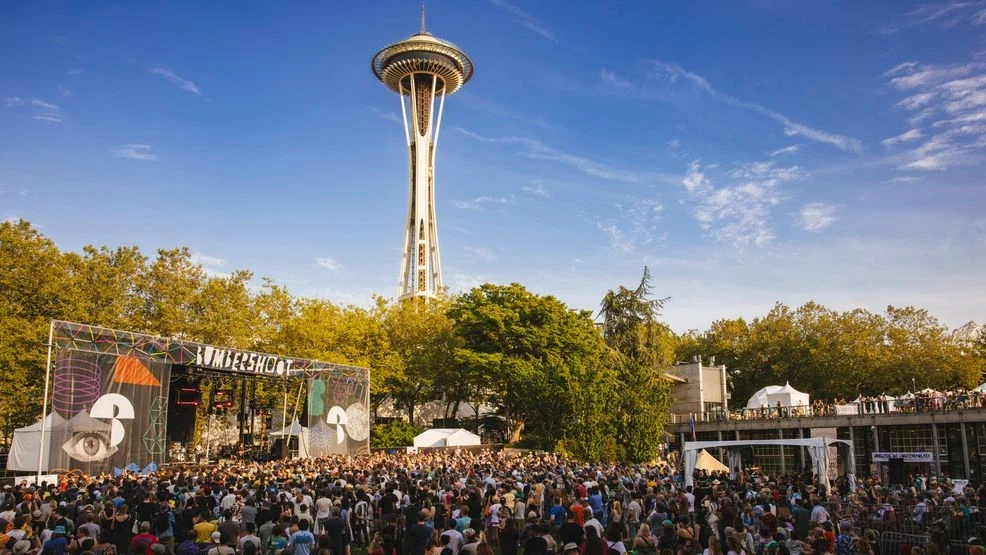
2024: 51st year, “smashing success,” 26,000 attendees. “These two years under New Rising Sun have been sterling return to form” (Post Alley). The revival succeeded not by competing with corporate festivals but by embracing what made Bumbershoot distinctive: Pacific Northwest’s unique culture, “moss-covered Mardi Gras daring everyone to join spectacle,” made for community by community.
Free admission first Thursdays. Sliding scale pricing. Emphasis on local artists. Diverse programming beyond music—visual arts, literary arts, performance art, comedy, dance, film. The umbrella concept restored: covering everything, welcoming everyone.
The Contradictions: Populist Festival in Tech Boom City
Bumbershoot’s survival required navigating impossible tensions. Seattle transformed from Boeing-dependent industrial city to Amazon/Microsoft tech hub. Cost of living skyrocketed. Working artists priced out. Neighborhoods gentrified. Cultural homogenization threatened city’s weird creative spirit.
Yet Bumbershoot persisted as affordable accessible arts festival in prohibitively expensive city. The contradiction revealed both festival’s importance and fragility. As Seattle became wealthier and whiter, Bumbershoot maintained commitment to diversity, inclusion, economic accessibility.
The workforce development program training young people from underserved communities in festival production created pathways into arts careers. The emphasis on local artists provided platform for Pacific Northwest talent. The affordable pricing (relative to other major festivals) maintained democratic access.
But survival required corporate sponsorships—Amazon prominent among them. The irony: Amazon’s arrival transformed Seattle, drove up costs, displaced artists, yet Amazon money helped sustain arts festival. Festival depended on sponsorships from companies whose economic impact threatened cultural ecosystem festival served.
The balance remained precarious. Third Stone’s model—nonprofit producing festival through community partnerships, emphasizing mission over profit—offered sustainable alternative to corporate festival model. But sustainability required resources. Resources required sponsors. Sponsors had agendas.
The Legacy: Cultural Tastemaker and Community Anchor
Bumbershoot’s 50+ year legacy extends beyond specific performances or attendance numbers. The festival shaped Seattle’s cultural identity, provided platform for generations of artists, created community gathering space, demonstrated that populist arts festivals could survive and thrive.
The ripple effects: Bumbershoot paved way for Northwest Folklife Festival, Bite of Seattle, Black Arts Fest, Chinese Culture & Arts Festival, Festa Italiana, Seattle PrideFest. The model—using Seattle Center campus for multi-day accessible arts festivals—became template for Seattle’s festival culture.
For artists, Bumbershoot represented crucial opportunity: professional platform, exposure to large audiences, legitimization of artistic practice. Local bands that played Bumbershoot could claim professional status. Visual artists exhibited at Bumbershoot gained recognition. Poets, dancers, comedians, filmmakers—all benefited from association with respected festival.
For audiences, Bumbershoot provided discovery mechanism: encountering unfamiliar art forms, musicians from other cultures, local artists they’d never heard. The serendipity of wandering Seattle Center campus finding unexpected performances, sitting on grass watching someone amazing—that experience shaped cultural tastes, built community, created memories.
The festival’s commitment to weird Pacific Northwest creativity—robotic art, soapbox derbies, performance art, genre-defying music—validated cultural values beyond mainstream commercial success. Bumbershoot asserted that art matters, community matters, creativity matters, access matters.
The populist ethos—from 1971’s “Fun for Everyone” through 2024’s “made for community by community”—remained constant through all transformations. Bumbershoot wasn’t exclusive event for cultural elite. It was Seattle’s Labor Day tradition where families, artists, tourists, teenagers, seniors, everyone mixed together experiencing art.
The Moments That Defined Generations
Bumbershoot’s history contains countless moments becoming Seattle cultural lore. 1981: Empire Strikes Back screening brought Star Wars fans flooding Seattle Center before home video made such events obsolete. The communal film experience—thousands watching together on massive screen—represented pre-streaming era cultural consumption.
1995: 25th anniversary guitar festival and Jimi Hendrix tribute concert acknowledged Seattle’s guitar-god legacy. Hendrix—Central District native achieving international fame—embodied Seattle’s capacity producing world-changing artists. The tribute honored hometown hero while asserting Seattle’s continuing musical relevance.
The wearable art exhibitions throughout 1970s-1980s showcased Pacific Northwest’s craft-art fusion—functional objects as artistic expression, everyday items elevated through creativity. This aesthetic—valuing craftsmanship, rejecting fine-art pretension—defined regional sensibility.
The robotic art displays, gigantic flying pencils, soapbox derbies demonstrated Bumbershoot’s willingness embracing absurdist creativity. The festival didn’t just present serious art requiring contemplation—it celebrated playfulness, humor, spectacle. The 50-foot Oldenburg faucet balloon (when it inflated) embodied this spirit: monumental sculpture that was also joke, art installation that was also public amusement.
The Miss Hot Pants Contest at 1971’s Festival—cringe-inducing by contemporary standards—revealed changing cultural values. What seemed fun in 1971 (objectifying women through beauty contest) became embarrassing retrospectively. Bumbershoot’s evolution tracked broader social progress: from Hot Pants Contest to LGBTQ+ artist prioritization, from exclusively white lineups to equity commitments.
The logging shows, indoor motorcycle races, horseback rides for kids at early festivals reflected Seattle’s working-class industrial character. These weren’t highbrow arts—they were popular entertainments for regular people. As Seattle gentrified and professionalized, these elements disappeared, replaced by craft cocktails, artisan food vendors, curated experiences. The loss represented Seattle’s broader transformation from blue-collar Boeing town to white-collar tech hub.
The poetry slams emerging from 1980s Red Sky Poetry Theatre competitions created new art form—competitive spoken word performance. What began as grassroots innovation became international phenomenon. Bumbershoot’s role incubating poetry slam culture demonstrated how festivals could shape artistic evolution rather than just presenting established forms.
The international acts—Grand Kabuki Theatre of Japan, Ethiopian youth circus, Baba Maal—exposed Seattle audiences to global cultures before internet made everything instantly accessible. Pre-YouTube, seeing Japanese traditional theater or West African music required physical presence at live performances. Bumbershoot provided that access, expanding provincial Seattle’s cultural horizons.
The grunge-era tensions—festival’s hesitation fully embracing Seattle’s exploding rock scene—revealed institutional conservatism. Major cultural movements often happen in underground venues, DIY spaces, unofficial channels. Institutional festivals recognize trends after they’ve proven commercially viable, missing crucial developmental moments. Bumbershoot’s caution about booking unproven local bands meant sacrificing cultural relevance for financial security.
Yet from grunge’s ashes, Bumbershoot successfully showcased next-generation Seattle artists: Death Cab for Cutie, Modest Mouse, Sleater-Kinney. The festival learned from mistakes, became more receptive to emerging sounds, maintained connection to local music scenes.
The Future: Sustainability and Community Trust
The 2023-2024 revival demonstrated demand still exists for Bumbershoot’s particular brand of arts festival. But financial sustainability remains challenge. Third Stone seeks endowments, sustained sponsorships, community support ensuring long-term viability.
The equity commitments—prioritizing BIPOC and LGBTQ+ artists, workforce development for underserved youth, affordable pricing, accessibility—reflect contemporary cultural values. Bumbershoot can’t return to 1970s model unchanged. Seattle’s demographics, economics, cultural landscape transformed completely.
The festival must balance honoring history while evolving. Celebrating local artists while attracting tourists. Maintaining affordability while covering costs. Programming experimentally while ensuring quality. Embracing Seattle’s tech economy while critiquing its impacts.
The question isn’t whether Bumbershoot will exist—2023-2024 proved revival possible. The question is what kind of festival it becomes. Will it sustain community-centered model or gradually corporatize? Will local artists remain central or become decorative additions to commercial lineups? Will affordability persist or erode?
The umbrella metaphor endures: Bumbershoot still attempts covering everything, sheltering all arts, welcoming everyone. In rainy Seattle, umbrellas aren’t luxury—they’re necessity. The festival named for humble rain protection became cultural institution protecting, preserving, and promoting Pacific Northwest’s creative spirit through five decades of economic downturns, cultural shifts, management changes, and pandemic disruption.
Festival ’71’s cardboard poster showed closed fist with thumb ascending—call to arms, gesture of defiance, folded umbrella waiting to open. Bumbershoot opened that umbrella, sheltered Seattle’s arts community through half-century of rain and shine, and continues holding space where creativity flourishes, community gathers, and everyone finds something unexpected and wonderful beneath the bumbershoot’s broad protective arc.