There’s a stretch of Seattle’s northwestern edge where the city doesn’t just fade into nature — it surrenders to it. Carkeek Park, a 223-acre expanse of old-growth remnants, salmon-bearing creeks, and wind-battered shoreline, sits in the Broadview neighborhood like a secret the locals have been keeping from the tourist maps for decades. While visitors flock to Pike Place Market for fish-throwing spectacle and crowd the overlooks at Kerry Park for that iconic skyline-and-Rainier shot, Carkeek quietly offers something far more rare in a growing metropolis: genuine wildness.
This isn’t a manicured urban park. It isn’t a place designed for Instagram backdrops or curated picnic aesthetics. Carkeek Park is the kind of place where you lose cell service on a forest trail, where bald eagles circle overhead with zero interest in your presence, and where the thunder of a passing freight train reminds you that this landscape has always been contested ground — between humans and nature, industry and ecology, development and preservation.
And that tension is exactly what makes it one of the most compelling green spaces on the entire West Coast.
A History Written in Timber, Rail, and Salmon
The First Stewards
Long before the park had a name or a boundary, the Duwamish people inhabited these coastal bluffs and stream corridors. The watersheds of Piper’s Creek and Venema Creek — the twin waterways that carve through Carkeek’s ravines — provided seasonal salmon runs that sustained communities for generations. The old-growth forests of western red cedar and Douglas fir were not wilderness in the European sense; they were managed landscapes, shaped by fire and harvest practices that maintained ecological balance over centuries.
The arrival of European settlers in the mid-1800s upended this relationship with brutal efficiency. Logging stripped the hillsides. The salmon runs, once so thick you could allegedly walk across the backs of returning fish, began their long decline.
A.W. Piper and the Park’s Origin
The land that became Carkeek Park passed through several hands before the City of Seattle acquired it in 1929. The park takes its name from Morgan and Emily Carkeek, prominent Seattle citizens in the early twentieth century. Morgan Carkeek, a contractor originally from Cornwall, England, was instrumental in building much of early Seattle’s infrastructure. But the park’s ecological story is more closely tied to A.W. Piper, a confectioner and naturalist who owned the land in the late 1800s and whose name survives in Piper’s Creek.
The city’s acquisition of the land was part of a broader parks movement inspired by the Olmsted Brothers’ 1903 plan for Seattle’s park system. That visionary plan recognized something that feels prophetic today: a rapidly growing city would need preserved natural corridors not just for recreation, but for the psychological and ecological health of its residents.
The Railroad Factor
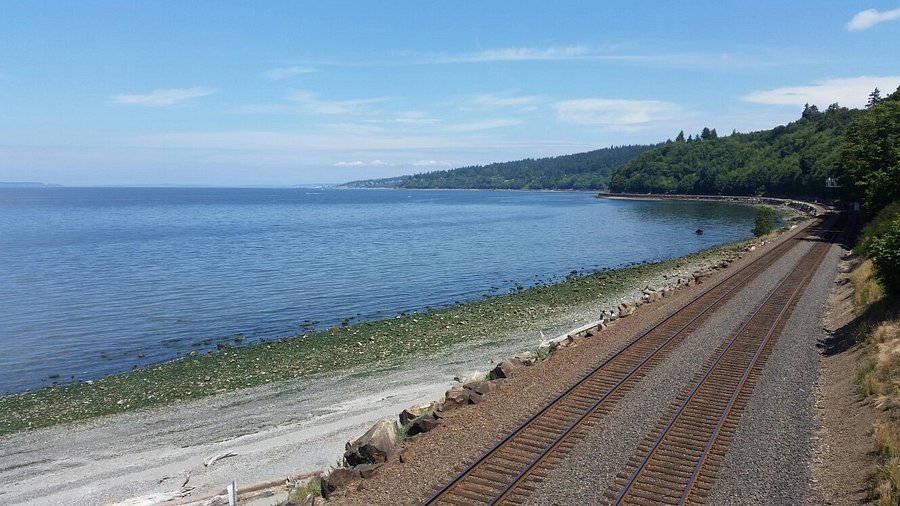
One of Carkeek Park’s most distinctive and unusual features is the active Burlington Northern Santa Fe (BNSF) railroad line that runs directly along its beach. The tracks separate the forested uplands from the Puget Sound shoreline, and getting to the water requires crossing a pedestrian overpass — a bridge that has become one of the park’s most recognizable landmarks.
The railroad has been a source of both character and controversy. Trains barrel through at regular intervals, their horns echoing off the bluffs. For some visitors, the juxtaposition of heavy industry and natural beauty is jarring. For others, it’s the defining feature of Carkeek’s identity: a park that doesn’t pretend the human footprint doesn’t exist, but instead forces you to reckon with it.
The railroad predates the park itself. The line was established in the late 1800s to connect Seattle’s economy to the broader Pacific Northwest. It carried timber, coal, and goods. Today, it carries freight and Amtrak passenger service. The trains are a living reminder that Carkeek Park exists not in opposition to Seattle’s industrial heritage, but alongside it.
The Landscape: Forest, Creek, and Shore
Into the Ravine
The experience of entering Carkeek Park from the main parking area on NW Carkeek Park Road is one of rapid descent — both in elevation and in the noise and tempo of urban life. The road drops steeply into a ravine carved by Piper’s Creek, and within minutes, the canopy closes overhead. Bigleaf maples draped in licorice fern create a green cathedral effect. Sword ferns carpet the forest floor. The air smells different down here: damp earth, decaying leaves, the mineral tang of running water.
The park’s trail system is extensive but not overwhelming. The main arteries follow the creek corridors, with connecting paths climbing the steep ravine walls to the residential neighborhoods above. The Piper’s Creek Trail is the backbone, a relatively flat path that follows the creek from the environmental education center down to the beach. Side trails branch off into quieter zones where it’s easy to go twenty minutes without seeing another person, even on a weekend.
What strikes most first-time visitors is the maturity of the forest. While true old-growth was largely eliminated by logging, the second-growth forest in Carkeek has had over a century to recover, and in many areas, it has done so magnificently. Western red cedars with trunks four feet in diameter rise alongside towering Douglas firs. Red alder colonizes the disturbed edges, and in autumn, their golden leaves create a contrast against the evergreen backdrop that rivals anything in New England — though Seattleites would never admit to the comparison.
Piper’s Creek: A Salmon Story
The ecological crown jewel of Carkeek Park is the return of salmon to Piper’s Creek. Chum salmon, primarily, along with smaller numbers of coho, make their spawning runs in the late fall and early winter, swimming up from Puget Sound, under the railroad tracks, and into the gravel beds of the creek.
This wasn’t inevitable. For decades, urbanization degraded Piper’s Creek to the point where salmon runs were nearly nonexistent. Stormwater runoff from surrounding neighborhoods carried pollutants and raised water temperatures. Culverts blocked fish passage. The creek’s riparian zones were encroached upon by development.
The recovery has been a multi-decade effort involving Seattle Public Utilities, the Department of Parks and Recreation, and a passionate community of volunteers. Riparian buffers were replanted. Fish passage barriers were removed. Stormwater management was improved. The results have been tangible: salmon have returned, and each November, visitors gather along the creek banks to watch the ancient ritual of fish fighting their way upstream to spawn and die.
The Carkeek Park salmon viewing experience is free, accessible, and profoundly moving. Volunteer naturalists from the Carkeek Watershed Community Action Project (CWCAP) are often on hand to explain the lifecycle and answer questions. Watching a battered, discoloring chum salmon push through shallow riffles with the last of its strength is the kind of encounter that recalibrates your sense of what matters. No admission fee. No gift shop. Just life, doing what it has done for millennia.
The Beach and the Bluff
Cross the pedestrian overpass and you arrive at Carkeek’s beach — a narrow strip of sand, gravel, and driftwood facing west across Puget Sound toward Bainbridge Island and the Olympic Mountains. On clear days, the view is staggering. The Olympics rise in jagged, snow-capped relief, and the sun sets directly into them, painting the water in shades of copper and rose.
The beach at Carkeek is not a swimming beach in any conventional sense. The water is cold year-round — we’re talking upper forties to low fifties Fahrenheit, even in summer. But it’s a magnificent place for beachcombing, tide pool exploration, and simply sitting with the sound of waves and train horns competing for your attention.
The bluffs above the beach are another story. Erosion is a constant concern, and the park’s management has had to balance public access with geological reality. The bluffs are composed of glacial till — unstable, sandy soils deposited during the last ice age — and they’re actively retreating. Landslides have closed trails periodically, and the long-term management of the bluff edge is one of the more complex challenges facing the park.
The Ecological Restoration Movement
Volunteers as Stewards
Carkeek Park is arguably the best example of community-driven ecological restoration in Seattle. Organizations like the Carkeek Watershed Community Action Project and EarthCorps have invested thousands of volunteer hours in removing invasive species, replanting native vegetation, and monitoring water quality.
The invasive species battle is relentless. English ivy, Himalayan blackberry, and herb Robert are the primary antagonists, and they are formidable. Left unchecked, ivy can smother the forest canopy, killing mature trees. Blackberry thickets displace native understory plants. The volunteer work parties that convene regularly in Carkeek are engaged in a form of ecological warfare that is unglamorous, physically demanding, and absolutely essential.
What makes Carkeek’s restoration movement remarkable is its longevity and depth. This isn’t a one-off corporate volunteer event. The people who show up to pull ivy in Carkeek do so month after month, year after year. They know individual trees. They track specific patches of native trillium. They celebrate when a section of creek bank, once choked with blackberry, produces its first crop of native salmonberry and red elderberry.
The Environmental Education Center
Tucked into the forest near the park’s entrance, the Carkeek Park Environmental Education Center serves as a hub for school programs, community workshops, and interpretive displays. The center focuses on watershed ecology, salmon biology, and the interconnection between urban land use and environmental health.
Programs for children are particularly strong. Seattle school groups visit regularly for hands-on lessons in stream ecology, and the annual Salmon Homecoming celebration in November draws families from across the city. These programs do something that no amount of environmental legislation can accomplish on its own: they build a constituency of people who care about wild places because they’ve experienced them firsthand.
Carkeek in All Seasons
Spring
The forest floor erupts. Trillium, bleeding heart, and skunk cabbage emerge in the wetland areas along Piper’s Creek. Birdsong intensifies as migratory species return. The understory fills in with new growth, and the trails that felt open and airy in winter become enclosed green tunnels. Spring is also prime time for the volunteer restoration crews, who take advantage of the wet soil to plant native species.
Summer
Seattle’s dry summers transform the park. The creek levels drop, exposing gravel bars and creating shallow pools where children wade and dogs splash. The beach becomes a gathering place for sunset watchers and picnickers. The forest canopy provides welcome shade when the rest of the city bakes under increasingly common ninety-degree days. Summer evenings at Carkeek, with long golden light filtering through the trees and the distant rumble of a northbound freight train, have a quality of stillness that feels almost medicinal.
Autumn
This is Carkeek’s peak season, though most of Seattle doesn’t know it. The bigleaf maples turn gold. The alders drop their leaves into the creek, creating the nutrient base that will sustain aquatic invertebrates through the winter. And then the salmon come. The first chum typically appear in Piper’s Creek in late October or early November, and the runs can continue into January. The forest takes on a dramatic, moody character — fog hangs in the ravines, rain drips steadily from the canopy, and the creek rises with the first autumn storms.
Winter
Carkeek in winter is for the committed. The trails can be muddy and slick. The beach is wind-scoured and cold. But the rewards are real. Winter storms produce dramatic wave action on the Puget Sound shoreline. Bald eagles are more visible, perching in the bare deciduous trees along the creek. The forest, stripped of its deciduous canopy, reveals its underlying architecture — the massive trunks, the nurse logs, the intricate root systems that hold the steep slopes together.
The Cultural Pulse of the Park
Carkeek Park is not just an ecological asset. It functions as a cultural commons for Seattle’s diverse northwestern neighborhoods. On any given weekend, you might encounter a Korean family grilling on the picnic shelters, a group of trail runners hammering out hill repeats on the ravine paths, a birding club scanning the shoreline with spotting scopes, or a solitary artist sketching the railroad bridge.
The park’s playground, renovated in recent years, is one of the better ones in the Seattle parks system, and it draws young families from Broadview, Bitter Lake, and Crown Hill. The picnic shelters can be reserved for events, and on summer weekends, birthday parties and family reunions fill the meadow areas with laughter and the smell of charcoal.
There’s also an active community of dog walkers, though Carkeek is not an off-leash park. The tension between dog owners and ecological stewards is a perennial Seattle parks issue, and Carkeek is no exception. Salmon-bearing streams and unleashed dogs are not a good combination, and the park’s signage reflects this ongoing negotiation.
Why Carkeek Matters Now More Than Ever
Seattle is growing. The population of the metro area has surged past four million, and the pressures on green space are intensifying. Development encroaches on urban forests. Stormwater volumes increase with every new impervious surface. Climate change is altering precipitation patterns, raising summer temperatures, and stressing cold-water species like salmon.
In this context, Carkeek Park is not a luxury. It is infrastructure — ecological infrastructure that filters water, sequesters carbon, moderates urban heat, and provides habitat connectivity. It is psychological infrastructure that gives hundreds of thousands of people a place to decompress, to move their bodies, to remember that they are biological organisms in a biological world. And it is cultural infrastructure that builds community across lines of age, ethnicity, and economic status.
The ongoing investments in Carkeek — the creek restoration, the invasive species removal, the educational programming — represent a bet on the future. They are a wager that a city can grow and still maintain its relationship with the natural systems that sustain it. That a salmon can still find its way home through a landscape of concrete, rail, and stormwater pipe.
Getting There and Making the Most of Your Visit
Carkeek Park is located at 950 NW Carkeek Park Road in Seattle’s Broadview neighborhood, roughly fifteen minutes north of downtown via Aurora Avenue (Highway 99). The park is open daily from 6:00 a.m. to 10:00 p.m., and parking is free but limited on busy weekends.
For first-time visitors, the best approach is to park in the main lot and walk down to the beach via the Piper’s Creek Trail. Cross the pedestrian overpass, spend time on the shore, then loop back through the forest on one of the ravine trails. Allow at least two hours. Bring layers — the beach can be significantly windier and cooler than the sheltered forest.
If you’re visiting in November, check with CWCAP for salmon viewing conditions. The fish don’t run on a schedule that respects human convenience, but the volunteers are excellent at providing updates.
And if you’re a Seattle resident who hasn’t yet visited Carkeek — or who hasn’t been in years — go. Not because it’s a hidden gem (that phrase has been drained of all meaning). Go because it’s the kind of place that reminds you why you live in this city in the first place. Before the cranes and the condos and the tech campuses, before the traffic and the cost of living and the arguments about density, there was this: a creek, a forest, a stretch of shoreline, and the salmon coming home.
That’s still here. For now.