

Every summer evening, the ritual repeats. Groups of friends stake out fire pits hours before sunset, hauling wood and coolers across the sand. Kayakers and stand-up paddleboarders glide across the cold waters of Puget Sound. Dogs race through the off-leash area on the bluff above. Volleyball players dive for impossible saves on the beach courts. And as the sun drops toward the Olympic Mountains, bathing everything in that particular golden light that gives the park its name, the flames rise and the conversations deepen.
Golden Gardens is Seattle’s most beloved beach park, an 87.8-acre stretch of sand, wetlands, and forested hillside that draws hundreds of thousands of visitors each year. Located in Ballard at the western edge of the city, it offers something increasingly rare in urban America: a genuine beach experience within minutes of a major metropolitan downtown. The water is too cold for casual swimming—Puget Sound rarely exceeds 54 degrees even in August—but that has never stopped Seattleites from claiming this shore as their own.
What most visitors don’t realize, as they arrange driftwood and toast marshmallows against a backdrop of snow-capped peaks, is that this park exists because of one of the oldest real estate schemes in Seattle’s history. Golden Gardens was never meant to be a public park. It was bait.
Harry Treat’s Calculated Paradise
In the early 1900s, Seattle was expanding rapidly in the wake of the Klondike Gold Rush. Developers eyed the undeveloped lands north of downtown, knowing that the key to selling remote properties was transportation. A man named Harry W. Treat saw opportunity in a mix of stump land and forest beyond Ballard. He purchased the acreage and named his new development Loyal Heights, after his younger daughter Loyal.
Treat was a graduate of Cornell University and Harvard Law School, an energetic capitalist with sophisticated instincts. He understood that people wouldn’t buy property in a remote area without a compelling reason to visit. In 1907, he deployed the classic developer’s playbook: build a trolley line through the land you want to sell, and put something attractive at the end.
That something attractive was Golden Gardens. Treat developed the shoreline as a privately-owned pleasure park, an “attraction” designed to lure city dwellers onto his new electric streetcar line. The Loyal Heights trolley left downtown Ballard and traveled less than two miles before reaching its terminus at Northwest 85th Street and 32nd Avenue Northwest—then the city’s northern boundary. The final four blocks broke through the conventional street grid via a surviving diagonal, Loyal Way Northwest, which still carries the daughter’s name. A loop at the terminus allowed the trolley to turn around while passengers disembarked and made their way down the steep bluff to the beach.
The strategy worked exactly as intended. Families packed onto the trolley for “Sunday outings out of town and through the woods to a picnic or swim at a beach,” as contemporary accounts described it. Along the way, they were made very aware of the real estate available for purchase. The beach at the end of the line was the hook; the properties lining the route were the product.
For those who owned one of the new automobiles—”tin lizzies” in the parlance of the era—an alternate route existed. A dusty county road (roughly the present-day drive entering the upper park from the north) wound down to a small parking area on the east side of the railroad tracks. Visitors then crossed the tracks on foot to reach the beach. The northern half of what’s now called Meadow Point was occupied by a shipyard until 1913. To the south, the beach curved along the railroad right-of-way all the way to Salmon Bay.
Treat’s connection to Golden Gardens would end with tragedy and irony. In 1922, while pursuing mining interests in Canada, he attempted to turn his automobile around on a narrow mountain road. The car plunged into a precipice, killing him. His wife subsequently sold Golden Gardens to the City of Seattle for parkland. The man who had built a pleasure park to sell real estate became, posthumously, the benefactor who gave Seattle one of its most treasured public spaces.
The Olmsted Connection
Even during its private ownership, Golden Gardens attracted the attention of the region’s premier landscape architects. In 1907, the same year Treat opened his pleasure park, developer E.B. Cox solicited advice from John Charles Olmsted, who was in Seattle recommending parkland acquisitions for the city’s newly annexed areas, including Ballard.
Olmsted’s response included suggestions for paths connecting down the steep bluffs to the shore and methods for safely crossing the railroad tracks to reach the beach. Cox provided Olmsted with a plan that boasted Golden Gardens Park “Will be the Finest Park on the Pacific Coast”—promotional hyperbole, perhaps, but not entirely unfounded ambition.
In his notes during his Seattle visits, Olmsted had written that “the whole stretch of bluff ought to be in park all the way to city boundary, if it were possible.” The city’s 1923 acquisition of Golden Gardens fulfilled at least part of that vision, though decades would pass before the park received the investment it deserved.
Depression-Era Transformation
The Great Depression brought devastating unemployment to Seattle, but it also brought federal work programs that would transform Golden Gardens from a private pleasure resort into a genuine public park. Between 1935 and 1940, the Works Progress Administration (WPA) funded a series of improvement projects that shaped much of what visitors experience today.
The work began with the park’s most pressing problem: the steep, unstable hillsides in the eastern section. Between 1935 and 1936, WPA workers excavated more than 7,500 cubic yards of earth from a landslide-prone area along Golden Gardens Drive. That soil was used to fill in a low area north of the park bathhouse, adding two acres of usable beachfront to the park. The redistribution served dual purposes—stabilizing the hillside while expanding the beach.
Workers cleared timber and removed tree stumps throughout the eastern section, opening space for construction of drainage ditches, stairways, and trails. The rock-lined drainage ditches were designed to control erosion along two streams running down the hillside. Two sets of concrete steps were constructed leading up from the beach area, along with several hundred feet of new trails.
In 1936, workers widened Golden Gardens Drive between the park entrance and the main parking area, smoothing out the sharp curve near its junction with Seaview Place—the same switchback road that would later be used as a demonstration stage for the 1987 Olympus Pro Rally, part of that event’s campaign to achieve FIA World Rally Championship status.
Additional projects between 1937 and 1940 brought a concrete walkway between the bathhouse and main parking area, extension of the hillside retaining wall along the entire length of the parking area, reconstruction of older trails, installation of curbs and concrete walks around the parking area, and a new path into the park from West 80th Street.
One final WPA project in 1940 revealed both the era’s civic spirit and its specific enthusiasms: workers constructed a model yacht sailing basin on Meadow Point at the northern end of the beach area, funded through contributions from the Lions Club and Model Yacht Club.
The Bathhouse: Seattle Landmark
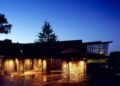
The most significant surviving structure from this era is the Golden Gardens Bathhouse, built in the 1930s and designated a Seattle historic landmark in 2005. Originally constructed to house a changing room, storage facility, and lifeguard station, the bathhouse served beach swimmers until limited funds forced its closure in 1974.
The building’s second life has proven more glamorous than its first. Renovated in 2004, the bathhouse now operates as an event venue, its cathedral ceiling and skylights flooding the main hall with natural light. The space accommodates up to 140 seated guests or 295 for standing events. Independent heating keeps it warm in winter; cross ventilation cools it in summer.
The venue has become particularly popular for weddings—couples drawn by the combination of historic architecture, sandy beach, sailboats on Puget Sound, and the sun setting over the Olympic Mountains. All of this sits just fourteen minutes from downtown Seattle, an accessibility that would have pleased Harry Treat, though for different reasons than he originally intended.
The Geography of Recreation
Golden Gardens today divides into distinct zones, each offering different experiences. The lower portion splits between wetland marsh and beach, situated north of the Shilshole Bay Marina. Dunes and large grassy areas separate the sand from the forest above.
The beach stretches long enough to absorb summer crowds while maintaining pockets of relative solitude. Six beach volleyball courts front the bathhouse—four reservable, two open for first-come drop-in play—and competitive games run continuously on warm days. The sand is real, imported and maintained, soft underfoot in a way that surprises visitors expecting the rocky shores common elsewhere on Puget Sound.
Fire pits dot the beach, the fuel for Golden Gardens’ most distinctive ritual. From Memorial Day weekend through Labor Day, beachgoers can build fires in designated rings, a privilege that draws hundreds on summer evenings. The pits operate first-come, first-served, which means serious sunset enthusiasts arrive hours early to claim spots. The park removes the fire pits after Labor Day, and fires are not permitted during the off-season.
The grassy foreshore offers space for frisbee, soccer, and picnicking. A pirate-themed playground—complete with a popular pirate ship climbing structure—keeps children occupied while parents watch the water. Beyond the playground, paths lead to the wetlands and lagoon at the park’s northern end, where a bridge crosses to the quieter section of beach at Meadow Point.
The upper section of the park occupies the forested hillside above. A one-acre off-leash dog area in the northern portion has become a popular destination, its wood-chip surface scattered with trees and furnished with tables, benches, and a small covered area offering protection on rainy days. Hiking trails wind through the forest, and 272 stairs connect the beach level to Loyal Heights above—a workout that rewards climbers with a different perspective on the park Harry Treat created more than a century ago.
Wildlife at the Water’s Edge
Golden Gardens hosts a remarkable diversity of wildlife for an urban park. The wetlands and ponds support mallards and Canada geese (which have become so habituated to humans that they occasionally attack visitors), red-eared slider turtles that sun themselves on floating logs, beavers actively cutting down alder trees, and muskrats swimming in the shallows. Anna’s hummingbirds frequent the trees near the ponds.
The beach and waters offer different species. California sea lions are often heard barking from the marina; harbor seals are commonly spotted. Great blue herons stalk prey along the shore. Bald eagles soar overhead on thermals, while various shorebirds probe the sand at low tide.
The most dramatic wildlife encounters, however, come from the deep. Orcas sometimes swim near the beach during their seasonal travels through Puget Sound. Both resident and transient pods have been spotted from Golden Gardens, and photographers with long lenses occasionally capture images of dorsal fins silhouetted against the Olympic range. Gray whales pass during migration seasons. For visitors lucky enough to witness such moments, the experience transforms an urban beach outing into something approaching wilderness encounter.
The waters themselves are cold but inviting to those equipped for immersion. Sailing, kayaking, and canoeing are popular, with the Shilshole Bay Marina just south providing boat launches and services. Kitesurfing and sailboarding draw wind-sport enthusiasts, particularly when breezes sweep across Puget Sound. The Sound’s geography—cut off from the open Pacific for more than a hundred miles—shelters the park from severe weather while still delivering enough wind for sport.
The View That Defines Seattle
What ultimately draws people to Golden Gardens, beyond the fire pits and volleyball courts and dog park, is the view. Few places in Seattle offer such an unobstructed panorama of Puget Sound and the Olympic Mountains beyond.
The Olympics rise directly across the water, their peaks snow-capped for much of the year, their foothills draped in the blue-green of Pacific Northwest forests. On clear days, the mountains seem impossibly close, as though you might kayak across the Sound and start climbing. On overcast days—more common in Seattle’s notorious climate—they appear and disappear through layers of cloud and mist, creating moments of revelation when the sky opens.
Sailboats trace lines across the water. Ferries steam to and from Bainbridge Island to the south. Freight trains still run along the historic rail line that once brought vacationers to Harry Treat’s pleasure park, their rumble and horn a reminder of the industrial history underlying this recreational present.
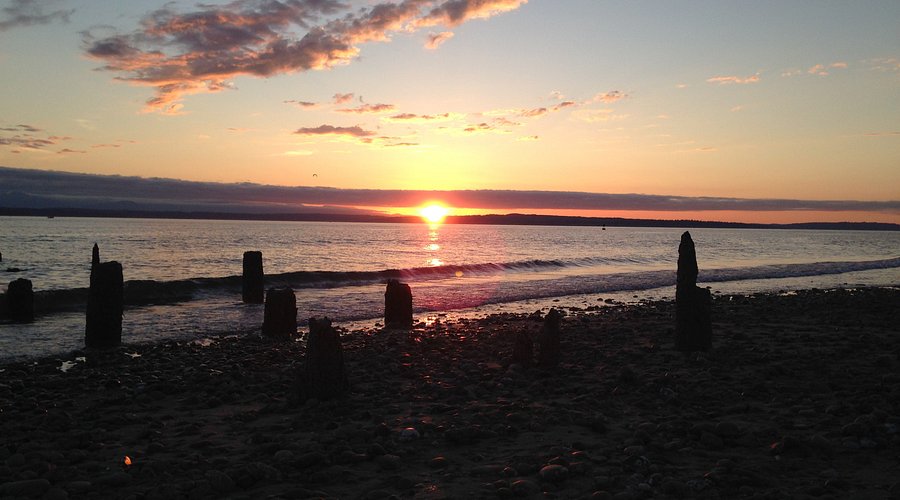
But the view reaches its apotheosis at sunset. As the sun descends toward the Olympic peaks, the water transforms into a mirror of light. The mountains shift through purples and pinks. The air takes on that golden quality that gives the park its name—a quality some say Treat deliberately invoked when he chose his marketing terminology, understanding that names shape perception.
This is when the fire pits come alive. This is when families linger past their intended departure times. This is when photographers compose shots they’ve taken a hundred times before, hoping this evening’s light will somehow exceed all the others. The sunset ritual at Golden Gardens has become as essential to Seattle’s summer culture as the ferries crossing the Sound or the coffee shops lining every commercial strip.
Four Seasons on the Sound
While summer defines Golden Gardens in the public imagination, the park offers distinct experiences through every season. Winter brings contemplative walks along storm-tossed beaches, with waves crashing against driftwood and the Olympic peaks dusted in fresh snow. The crowds vanish, leaving only serious walkers and photographers willing to brave the cold for dramatic light.
Spring brings migrating birds and lengthening days. The wetlands come alive with nesting activity. Early flowers bloom in the forested sections. Brave souls test the waters, confirming that Puget Sound remains far too cold for casual swimming.
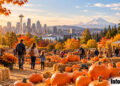
Autumn offers different light—softer, more golden in truth than the summer version that gave the park its name. The deciduous trees on the hillside turn, adding warm colors to the evergreen palette. Evening fires become more atmospheric as darkness arrives earlier.
Even on rainy days—and there are many in Seattle—Golden Gardens holds appeal. The beach takes on a moody beauty. Dog owners still need to exercise their pets. The trails through the forest become intimate tunnels of green. And sometimes, after the rain, the clouds part just as the sun approaches the horizon, creating displays of color that reward those patient enough to wait.
A Park That Almost Wasn’t
The transformation of Golden Gardens from private promotional scheme to beloved public park was never guaranteed. After Harry Treat’s death in 1922, his wife might have sold to another developer. The city might not have found the funds to purchase. The WPA might have invested its Depression-era resources elsewhere. The bathhouse might have been demolished after its 1974 closure rather than designated a historic landmark and renovated.
At each juncture, someone chose preservation. At each juncture, the public interest in maintaining beach access outweighed the private interest in development. The result is an 87.8-acre sanctuary where Seattle residents can experience genuine connection with water, mountains, wildlife, and community.
The streetcar that brought Sunday visitors to Treat’s pleasure park stopped running long ago. The properties he sold along the route now house generations of residents who may never have heard his name. But the beach at the end of the line endures, drawing crowds that would have astonished its creator—not for the real estate sales they might generate, but for the sunsets they illuminate, the fires they kindle, and the memories they create.
Harry Treat called it Golden Gardens because he wanted to sell property. Seattle kept calling it that because the name turned out to be true.