

On the morning of July 17, 1897, the steamship Portland nosed into Elliott Bay carrying sixty-eight grizzled prospectors and what newspapers would breathlessly report as “a ton of gold.” That figure was wrong. It was actually closer to two tons. And within forty-eight hours of the Portland‘s arrival, the city of Seattle — a waterlogged, second-tier lumber town still licking its wounds from the Panic of 1893 — had lost its collective mind and stumbled into the greatest economic windfall in its history.
This is the story of those forty-eight hours, and the months of frenzy that followed. It is a story about greed, genius, suffering, and the peculiar American talent for turning someone else’s treasure into your own profit. Because here’s the thing most people get wrong about the Klondike Gold Rush: the real winners never went anywhere near the Yukon.
The Telegram That Lit the Fuse
The madness didn’t start on the docks. It started with a telegram.
Beriah Brown Jr., a stringer for the Seattle Post-Intelligencer, had been tipped off that the Portland was steaming south from Alaska with a fortune in its hold. The paper’s editor, sensing the story of a lifetime, dispatched a tugboat — an actual tugboat — to intercept the ship before it reached port. Brown climbed aboard, interviewed the dazed and filthy miners, and raced back to file his copy.
The headline hit the streets before dawn: “GOLD! GOLD! GOLD! GOLD! Sixty-Eight Rich Men on the Steamer Portland. STACKS OF YELLOW METAL!”
It was the journalistic equivalent of throwing a lit match into a barrel of kerosene. By the time the Portland actually docked later that morning, thousands of people had already gathered along the waterfront. They watched, slack-jawed, as men who had left Seattle as nobodies staggered down the gangway carrying suitcases, sacks, and jars physically bulging with gold dust and nuggets. One man carried his fortune in a blanket slung over his shoulder. Another had stuffed gold into a fruit jar.
The crowd wasn’t just watching wealth. It was watching proof — tangible, gleaming, undeniable proof — that ordinary people could walk into the wilderness broke and walk out millionaires. That proof was more dangerous than any sermon or advertisement. It bypassed the rational mind entirely.
What made the scene so electrifying wasn’t just the quantity of gold. It was the quality of the men carrying it. These weren’t professional miners or corporate agents. They were former clerks, farmers, fishermen, and drifters — men whose hands had been soft before they went north and were now calloused and frostbitten. They looked half-dead and entirely rich. One miner, a man named William Stanley, had left Seattle seventeen months earlier with little more than hope and a grubstake. He walked off the Portland carrying more than a hundred thousand dollars in gold. The transformative power of that image — a nobody becoming a somebody in the span of a single northern winter — was intoxicating beyond measure.
The rival Seattle Times scrambled to catch up. Every paper on the West Coast picked up the story within hours. Within days, it was national news. Within a week, it had crossed the Atlantic. The Klondike was on every front page, every tongue, every barroom conversation from San Francisco to London.
The City Empties Itself
What happened next in Seattle can only be described as a kind of civic psychotic break.
Within hours, the mayor of Seattle, W.D. Wood, resigned his office. Just quit. He announced he was heading to the Klondike and formed a prospecting company on the spot. The police chief tried to follow. Doctors abandoned their patients. Teachers left mid-lesson plan. Streetcar drivers walked off their routes. A barber reportedly put down his razor mid-shave, left the customer in the chair with lather still on his face, and went to book passage north.
Newspapers from the era record that within two days of the Portland‘s arrival, an estimated several hundred men had already departed for Alaska, with several thousand more scrambling to arrange transport. Hardware stores were stripped bare. Every pack mule in the Pacific Northwest was spoken for. The price of sled dogs tripled overnight, and there weren’t enough to go round.
This wasn’t an organized migration. It was a stampede — raw, animal, and profoundly irrational. Men sold their homes for pennies on the dollar. Families cashed in life savings. One man reportedly traded his dental practice for a boat ticket and a sack of flour. These weren’t destitute drifters. Many were middle-class professionals, small business owners, and skilled workers who looked at those sacks of gold and made the calculation that their comfortable, predictable lives were worth gambling against a frozen wilderness thousands of miles away.
They were, almost universally, wrong. But that would take months to discover.
The Gold Was Real — The Odds Were Not
To understand the scale of the delusion, you have to understand the math.
The Klondike strike had actually occurred a year earlier, in August 1896, when a party led by Skookum Jim Mason, Dawson Charlie, and George Washington Carmack found gold on Bonanza Creek, a tributary of the Klondike River in Canada’s Yukon Territory. By the time word reached the outside world in the summer of 1897, every worthwhile claim in the region had already been staked.
Let that sink in. The gold those sixty-eight miners carried off the Portland had been pulled from claims that were already spoken for. The rush that their arrival triggered was, in a very real sense, a rush toward disappointment. Of the estimated 100,000 people who set out for the Klondike between 1897 and 1899, roughly 30,000 to 40,000 actually reached Dawson City. Of those, perhaps 4,000 found any gold at all. And of those, a few hundred struck it genuinely rich.
The odds were terrible. But odds have never stopped Americans from doing anything. And in the summer of 1897, nobody was doing math. They were reading headlines.
Seattle’s Great Swindle — Selling the Dream
Here is where the story pivots from human folly to something more calculated.
While thousands of starry-eyed prospectors were booking passage north, a handful of cooler heads in Seattle recognized that the real money wasn’t buried in frozen creek beds. It was walking through their front doors, wallet in hand, desperate to buy supplies.
The Canadian government, in a rare moment of bureaucratic foresight, required every prospector entering the Yukon to carry a year’s worth of supplies — roughly one ton of goods per person. This was known as the “Klondike outfit,” and it included everything from flour and bacon to wool blankets, rubber boots, picks, shovels, ropes, stoves, tents, and medicine. Nobody was getting past the Mounties at the border without it.
Seattle’s business community saw this requirement not as a burden but as a gift from heaven. Erastus Brainerd, a former museum curator turned publicist, was hired by the Seattle Chamber of Commerce to market the city as the one and only gateway to the Klondike. Brainerd was brilliant and utterly shameless. He planted stories in newspapers across the country and in Europe. He sent letters to governors, foreign heads of state, and shipping companies. He printed pamphlets in multiple languages. He bribed journalists. He did everything short of skywriting, and he probably would have done that too if the technology had existed.
His message was simple and devastatingly effective: If you’re going to the Klondike, you start in Seattle. We have the ships. We have the supplies. We have the expertise. Every other city is a second-rate pretender.
It was, in large part, a lie. Portland, San Francisco, Tacoma, and Victoria all had legitimate claims as departure points. But Brainerd didn’t care about legitimacy. He cared about market share. And he won. By the peak of the rush, Seattle controlled an estimated 70 percent of all Klondike-bound trade.
Profiteers, Outfitters, and the Economy of Desperation
The transformation of Seattle’s economy was staggering in both speed and scale.
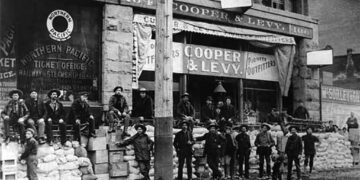
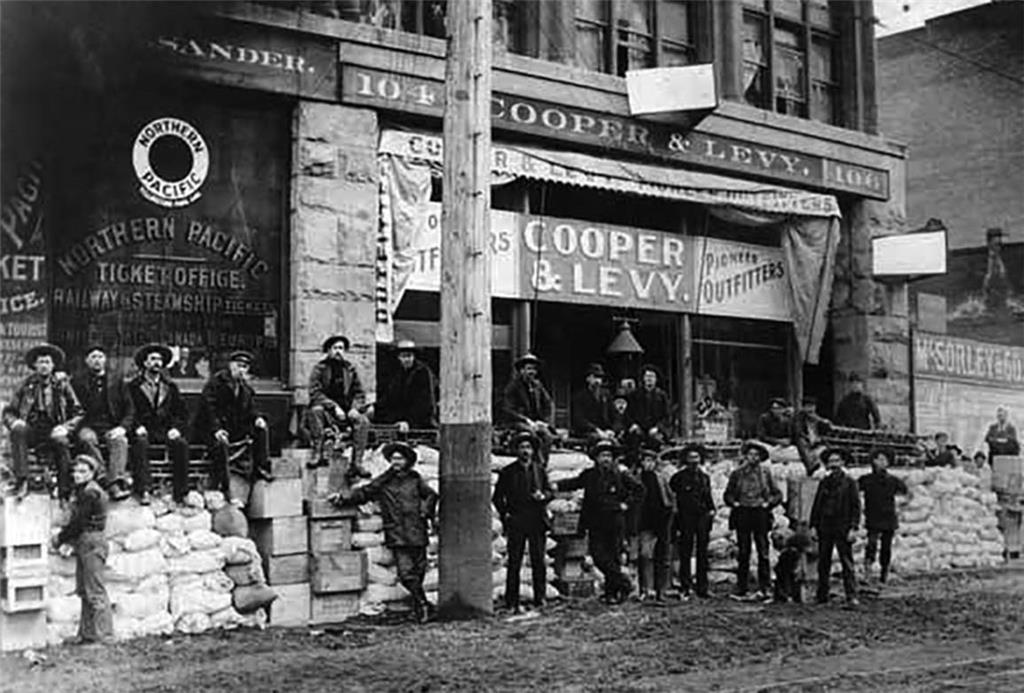
Overnight, the city became a machine for extracting money from prospectors. Outfitting stores multiplied like bacteria. Cooper & Levy, one of the city’s oldest mercantile firms, couldn’t restock its shelves fast enough. The Schwabacher Brothers hardware company saw revenue explode. New businesses appeared every week — not just outfitters, but shipping agents, guidebook publishers, mapmakers (many of whom had never been to Alaska and whose maps were dangerously wrong), assayers, hotels, boarding houses, saloons, and less reputable establishments catering to men about to spend months in the wilderness.
The prices were eye-watering. Items that cost a few cents in normal times were suddenly selling for dollars. Merchants with warehouse space and cold-weather inventory became wealthy almost as fast as the miners they were supplying. And unlike the miners, the merchants faced no risk of freezing to death, falling through ice, or starving on the Chilkoot Trail.
It wasn’t just goods. Seattle also sold services — and confidence. Steamer companies added routes and raised fares. Some ships that had no business carrying passengers — old cargo vessels, converted barges, barely seaworthy hulks — were pressed into service. Safety was an afterthought. Getting north was all that mattered, and people would pay almost anything to do it. “Klondike experts” appeared out of nowhere, offering lectures and guidebooks full of advice that ranged from useless to lethal. Con artists thrived. So did legitimate entrepreneurs who simply recognized an opportunity and seized it with both hands.
The newspapers, of course, were complicit. Editors understood that gold rush coverage sold papers the way nothing else could. Every success story was amplified. Every warning about the dangers of the trail was buried or minimized. The press and the merchants existed in a symbiotic relationship: the papers drove the frenzy, and the frenzy drove commerce, and commerce bought advertising, and advertising paid for more papers. It was a feedback loop of pure avarice, and everyone involved understood it perfectly.
The city’s population swelled as prospectors from across the country poured in to stage their expeditions. Hotels were overbooked. People slept in tents, in alleys, on the docks. Seattle wasn’t just a departure point — it was a boomtown in its own right, feeding on the dreams of people passing through.
The Human Cost: Chilkoot, White Pass, and the Trail of Dead Horses
For those who actually went north, the reality was a brutal education in the difference between fantasy and geography.
There were two main routes from the coast to the goldfields. The Chilkoot Trail climbed from Dyea, Alaska, over the Chilkoot Pass at 3,525 feet. The final ascent — the infamous “Golden Staircase” — was a near-vertical wall of ice and snow that prospectors had to climb in single file, each carrying as much of their one-ton outfit as their backs could bear. Most made the climb dozens of times, shuttling loads back and forth over weeks. The photographs that survive from this period show an unbroken line of black figures ascending into white nothingness, and they look less like documentary images and more like medieval paintings of purgatory.
The alternative was the White Pass Trail out of Skagway, which earned the nickname “Dead Horse Trail” for reasons that require no elaboration but deserve it. An estimated 3,000 horses died on the White Pass route during the rush, killed by exhaustion, starvation, falls, and the sheer impossibility of the terrain. Jack London, who made the journey himself, wrote that the trail was “a horror” and the suffering of the animals was beyond anything he had ever witnessed. The mud was waist-deep in places. Men and animals sank into it and sometimes didn’t come out.
Those who survived the trails then had to build boats and navigate hundreds of miles of lakes and rivers — including the deadly Miles Canyon and White Horse Rapids — before reaching Dawson City. Many drowned. Many more turned back. And many of those who finally reached the goldfields found exactly what the odds predicted: nothing.
Dawson City in the winter of 1897-98 was a frozen, overcrowded, disease-ridden nightmare. Typhoid, scurvy, and dysentery were rampant. Food was scarce and astronomically expensive — a single egg could cost the equivalent of fifty dollars in today’s money. Men who had sold everything to get there found themselves trapped, broke, and sick, thousands of miles from home with no way to get back until the spring thaw.
The Winners Who Stayed Home
Back in Seattle, things were going spectacularly well.
The money flowing through the city during the Klondike rush fundamentally reshaped its economy and its identity. Before 1897, Seattle was a regional outpost. After the rush, it was a city with national ambitions and the capital to back them up.
The numbers tell the story. In the first year of the rush alone, Seattle businesses reportedly handled tens of millions of dollars in Klondike-related trade. The city’s banks swelled with deposits — both from merchants and from returning miners who needed somewhere to store their gold. Real estate values climbed. Infrastructure projects that had stalled for years suddenly had funding. The population grew rapidly as people who had come to Seattle to outfit for the Klondike decided to stay instead, recognizing that the city itself offered better prospects than a frozen creek in the Yukon.
Some of the fortunes made during this period went on to shape Seattle for generations. John Nordstrom, a Swedish immigrant, returned from the Klondike with a modest stake and used it to open a shoe store. That store became Nordstrom. The roots of several other Seattle institutions — banks, shipping firms, real estate empires — can be traced to the Klondike windfall.
The city’s port infrastructure, massively expanded to handle the rush traffic, positioned Seattle as the dominant gateway to Alaska and the Pacific for the twentieth century. The expertise in northern logistics that Seattle businesses developed during the rush became a permanent competitive advantage. When the Alaska-Yukon-Pacific Exposition opened in 1909, it was both a celebration and a coronation: Seattle was no longer a backwater. It was a power.
Erastus Brainerd and the Birth of Civic Branding
Erastus Brainerd deserves a longer footnote in American history than he typically gets. What he did for Seattle during the Klondike rush was, in essence, the invention of modern civic marketing.
Before Brainerd, cities competed for investment and immigration through word of mouth, railroad promotion, and the occasional pamphlet. Brainerd turned Seattle’s Klondike campaign into a coordinated, multi-channel, international propaganda operation. He understood, decades before the concept had a name, that perception creates reality — that if you could convince enough people that Seattle was the gateway to the Klondike, then Seattle would be the gateway to the Klondike, regardless of geography or logic.
He was right. And his methods — strategic media placement, targeted messaging, relentless repetition, and a willingness to shade the truth when it served the narrative — became the template for every city branding campaign that followed. Every time a city markets itself as a tech hub, a food destination, or a cultural capital, it is walking in Brainerd’s footsteps. He didn’t invent boosterism. But he professionalized it, weaponized it, and proved that it worked.
The Hangover
The rush was over almost as quickly as it began. By 1899, the easily accessible gold was gone, and industrial mining operations — backed by serious capital, not shovels and gold pans — were moving in. The stampeders drifted home, or drifted to the next rush (Nome, Alaska, in 1899; Fairbanks in 1902), or simply disappeared into the vast indifference of the North.
Many returned to Seattle broken in health, finances, or spirit. The city that had cheerfully sold them their outfits, their steamship tickets, and their dreams was not especially interested in their stories of failure. There were no headlines for the men who came back empty-handed. The narrative demanded winners, and winners were what Seattle chose to remember.
The Klondike Gold Rush remains one of the most extraordinary episodes in American economic history — not because of the gold, which was significant but not world-changing, but because of what it revealed about the mechanics of boom and bust, the power of narrative, and the cold logic of who really profits when fever grips a nation.
Seattle didn’t find gold. Seattle sold shovels. And in the forty-eight hours after the Portland docked, a city figured out that selling shovels was the smarter play — and never looked back.
The Legacy Carved in Rain and Steel
Today, the Klondike Gold Rush National Historical Park sits in Seattle’s Pioneer Square, a few blocks from where those sixty-eight miners hauled their gold ashore. It’s a modest space, easy to walk past. Most tourists do. A few blocks away, the Underground Tour takes visitors beneath the city’s streets, through the old storefronts and sidewalks that were literally buried when Seattle rebuilt itself on higher ground. Some of those buried spaces once housed the very outfitters who made their fortunes off Klondike-bound prospectors. The ghosts of commerce are layered under the city like geological strata.
There’s an irony embedded in Seattle’s relationship with the Klondike that the city has never fully reckoned with. The rush was, for the vast majority of participants, a catastrophe — a mass delusion that destroyed savings, health, families, and lives. It was also an ecological disaster for the Yukon, and it dispossessed Indigenous peoples whose lands were overrun by tens of thousands of desperate strangers. Seattle’s prosperity was built, in no small part, on other people’s ruin. That’s not a comfortable truth, but it’s the truth nonetheless, and any honest accounting of the Klondike legacy has to include it alongside the skyscrapers and the shipping lanes.
But every skyscraper in the downtown skyline, every container ship sliding through Puget Sound, every tech campus in the suburbs — all of it traces a line back to that summer morning when a steamship arrived and a city went mad. Seattle’s wealth, its ambition, its particular blend of optimism and ruthlessness, its instinct for positioning itself at the center of whatever gold rush comes next — tech, coffee, aerospace, cloud computing — all of it was seeded in those wild, greedy, extraordinary forty-eight hours.
The pattern has repeated itself so many times now that it seems almost genetic. When Boeing transformed Seattle into an aerospace capital, the city’s boosters sold it the same way Brainerd sold the Klondike — as destiny, as inevitability, as the only logical place for the future to happen. When Microsoft and Amazon arrived, the pitch was updated but the structure was identical. Seattle has always understood, at some deep institutional level, that you don’t need to dig the gold yourself. You just need to be the last stop before the digging starts.
The gold ran out. The hustle never did.