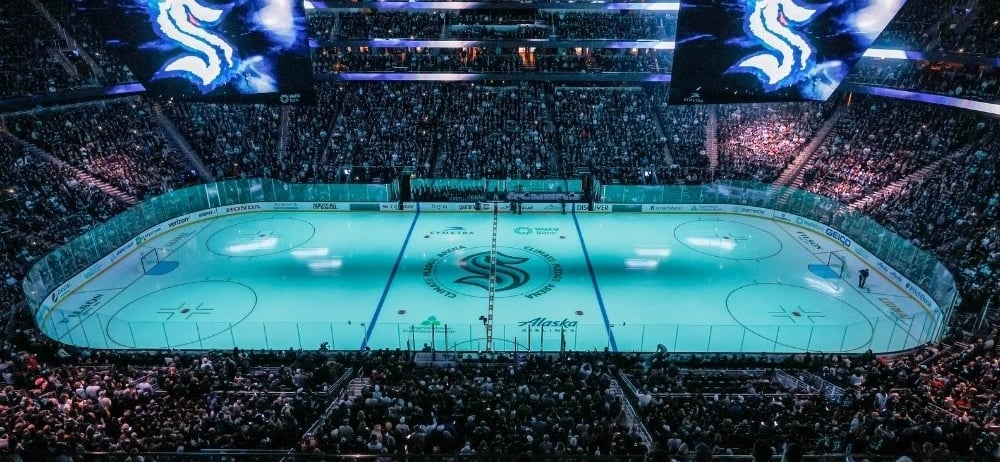
Seattle has always known how to make people feel things. The coffee hits harder here. The rain falls sideways. The mountains are so dramatically close that on clear days they feel almost accusatory, daring you to be more interesting. And for nearly a century, the city was home to exactly zero major professional hockey franchises — a conspicuous absence in a region that, by rights and by culture, absolutely should have had one.
That changed on October 12, 2021, when the puck dropped and the Seattle Kraken played their first NHL regular season game on the road against the Vegas Golden Knights. Ryan Donato scored the first goal in franchise history. They lost. But the city didn’t care. Seattle had a hockey team, and that was the whole point.
To understand the Kraken, you have to understand the hunger behind them. Seattle was home to the first hockey team from the U.S. to win the Stanley Cup — the short-lived Seattle Metropolitans in 1917 — but it had not had a top-flight professional ice hockey club for nearly a century before the NHL granted the city an expansion franchise in 2018. Nearly a century. Let that sit. Kids grew up, had kids, those kids grew up, and through all of it, Seattle waited. When the announcement finally came, the city did not react with the polite enthusiasm of someone who just got exactly what they wanted for Christmas. It reacted like something primal had been released.
How primal? On the first possible day in March 2018, fans put down deposits for season tickets in numbers that left the league stunned. The Kraken hadn’t played a single game, hadn’t hired a coach, hadn’t even settled on a color scheme — and Seattle was already sold.
The Name, the Myth, the Merchandise
The name “Kraken” is, objectively, one of the great franchise name choices in recent sports history. It is mythological, immediately visual, and carries the right energy for a Pacific Northwest city that has always had a slightly combative relationship with politeness. The Kraken is a sea monster. Seattle sits on Puget Sound. The maritime culture of the Pacific Northwest runs bone-deep in this city’s identity.
The franchise’s promotional materials state that the team’s “Kraken” name was adopted to honor the maritime culture of Seattle. The Pacific Northwest region also has a history of Scandinavian immigrants and ancestry, further connecting Seattle to the Nordic origin of the “Kraken” mythology. The colors chosen for the team’s logo were ice blue, boundless blue, shadow blue, and red alert. The team’s logo furthermore also contains a red eye and a tentacle.
Multiple shades of blue, a tentacle lurking behind a letter, and a red eye that stares back at you from the chest of every jersey. It is exactly as dramatic and weird as it sounds, and it works completely. The branding landed with the kind of cultural authority that most expansion franchises spend a decade trying to earn. The Kraken had it from day one.
The traditions came quickly too. Starting with their first win at home against the Montreal Canadiens on October 26, 2021, the Kraken feature a unique postgame tradition during the “Three Stars of the Game” ceremony. Instead of the honored players tossing conventional souvenir pucks or sticks to the fans, they throw a plush toy salmon into the crowd to mimic Seattle’s Pike Place Market fish toss and to honor the significance of wild-caught salmon to the state of Washington. Because of course they do. This is Seattle. If you’re not throwing fish, you’re not trying.
The team plays the Nirvana song “Lithium” after every Kraken goal at home; the song was chosen due to Nirvana’s importance to Seattle grunge culture. Every goal, “Lithium” floods the arena. It is an improbably perfect choice — simultaneously celebratory and a little unhinged, like the team itself.
Climate Pledge Arena: The Building That Shouldn’t Be Possible
Before a single Kraken player took the ice, the venue they would call home was already one of the most remarkable construction stories in sports history.
Climate Pledge Arena sits in the 74-acre entertainment complex known as the Seattle Center, the site of the 1962 World’s Fair, for which it was originally developed. That iconic roof — the sweeping, modernist structure that has defined the Seattle skyline since Kennedy was in the White House — was not going anywhere. So the engineers did something that borders on theatrical: they suspended the entire roof in the air, then demolished and rebuilt everything underneath it.
M.A. Mortenson Company was in charge of doubling the size of a 400,000-square-foot space while not disturbing the roof, so crews dug out 600,000 cubic yards of dirt to make room for more seating. Six hundred thousand cubic yards. The original floor was dropped 15 feet to accommodate an NHL rink. They essentially built a new arena underneath a roof that was floating in the air, and they did it to preserve a landmark. It’s the kind of engineering solution that makes you wonder how anyone thought it up and then actually did it.
The result is the first net-zero carbon certified arena in the world, and the environmental commitments go beyond the name on the door. Pipes on the roof of Climate Pledge funnel rainwater into 15,000-gallon underground cisterns. That water is filtered and used to produce game ice that is maintained by electric Zambonis. The ice the players skate on is made from Seattle’s rain. The Zambonis are electric. The whole building runs on renewable energy. It’s almost aggressively principled.
Climate Pledge Arena was opened to the public on October 19, 2021, by a Foo Fighters and Death Cab for Cutie concert for local charities. The Foo Fighters and Death Cab for Cutie. There is no more Seattle opening night in the history of Seattle opening nights.
The first sports event followed days later. Kraken defenseman Vince Dunn scored the first NHL goal in the arena and the game ended in a 4–2 Kraken loss to the Canucks. They lost the first one. They would win the next one. The arc of the franchise, in miniature.
The Calder Trophy Kid and the Building of a Core
In an expansion draft in 2021, the Kraken selected players from existing NHL rosters with the same analytical precision you’d expect from a franchise that had years to plan and zero games under pressure. They got Vince Dunn. They got Yanni Gourde, Jordan Eberle, Jared McCann. They got pieces.
The real foundation, though, was going to come through the draft. And in 2021, with the second overall pick, Seattle selected Matty Beniers — a center from Michigan who moved with the economical grace of someone who had been playing hockey since before he could read. Beniers would go on to win the Calder Memorial Trophy as the NHL’s best rookie in 2022-23, becoming one of the fastest players in recent memory to announce himself as a genuine franchise cornerstone.
Beniers was the franchise’s first ever draft pick, and he won the Calder Memorial Trophy as NHL rookie of the year with the team after the end of the 2022-23 season. He was so good so fast that the Kraken, recognizing what they had, moved quickly to lock him up. On August 20, the Kraken re-signed Beniers to a seven-year, $49.98 million contract. The kid they bet the franchise on is staying. That’s the headline beneath all the other headlines.
The 2022-23 season was, by every reasonable measure, the season that proved the Kraken were real. During the 2022-23 season, the team achieved a record of 46-28-8 and 100 points, securing fourth place in the Pacific Division and the first playoff wild card spot in the Western Conference. During the playoffs, the Kraken faced off against the Colorado Avalanche in the first round. They upset the Avalanche in seven games, becoming the first expansion team to win their first playoff series over the defending Stanley Cup champion.
Read that again. The Seattle Kraken — in just their second season — beat the defending Stanley Cup champions in the first round of the playoffs. In seven games. The Colorado Avalanche, winners of the Cup just one year prior, went home before Seattle did. It was the single best moment in franchise history to that point, and it set expectations at a height that would prove difficult to sustain.
Two Steps Forward, Several Steps Sideways
What followed the high of 2022-23 was the kind of organizational turbulence that turns a promising young franchise into a cautionary tale if it isn’t addressed honestly.
For the second consecutive season, the team did not qualify for the Stanley Cup Playoffs. The team ended their season with a 34-35-13 record and 81 points. After the playoff run that announced them to the hockey world, the Kraken missed the postseason in back-to-back years. Head coach Dave Hakstol was shown the door. Dan Bylsma came in, inheriting a roster that had been supplemented with significant free agent additions.
The 2024 offseason was aggressive. On the morning of July 1, 2024, 40 minutes after the start of free agency, the Kraken signed Florida Panthers defenseman Brandon Montour to a seven-year, $50 million contract. Montour had just won the Stanley Cup with Florida. He was exactly the kind of proven, battle-tested player the Kraken needed to add experience to a young core.
They also brought in Chandler Stephenson, the skilled center who had won a Cup with Vegas. Seattle’s 2024-25 opening-day roster features eight players who have hoisted Lord Stanley’s Cup. Eight Cup winners. On paper, this is the resume of a contender.
It didn’t matter. The 2024-25 season was a disappointment of the specific kind that is hardest to diagnose — not catastrophic, not historically bad, just steadily, relentlessly mediocre. Bylsma led the team to a 35-41-6 record, which fell short of expectations, particularly after the team’s two big free agent signings last summer. He was fired on April 21, 2025, after just one season. The Kraken had now cycled through two coaches in four years and missed the playoffs three times out of four. Something needed to change.
The Front Office Reset
The organizational shuffle that came in the spring of 2025 was honest in a way that front office moves often aren’t. Ron Francis, who had been the Kraken’s general manager since their inception, was moved into a new role as president of hockey operations. Jason Botterill was promoted to executive vice president, and Francis was promoted from general manager. Botterill confirmed April 22 that assistant coach Jessica Campbell will be retained for next season.
That last detail matters more than it might appear. Jessica Campbell had become a historic figure in 2024-25, entering her second season with the Kraken as an assistant coach after becoming the first full-time female assistant coach in NHL history to work behind the bench during the regular season. In a sport that can be glacially slow about these things, the Kraken made history — and then, in retaining Campbell regardless of the coaching change, reaffirmed that this wasn’t a publicity exercise. She’s there because she’s good at what she does.
Botterill’s first major decision was finding a new head coach, and the process was thorough. When Seattle general manager Jason Botterill was hired a month ago, he immediately embarked on a purposeful, in-depth search for the next Kraken head coach. Botterill didn’t rush the process. He started with a lengthy list of possible coaches that he whittled down to interview and re-interview the top candidates.
The man he landed on was Lane Lambert.
Lane Lambert and the Third Chapter
The Kraken announced that they have named Lane Lambert the third head coach in franchise history. Lambert, 60, comes with a resume that is deceptively strong. He spent 11 seasons as the top assistant to Barry Trotz — in Nashville, in Washington, on Long Island — and was part of eight playoff appearances and one Stanley Cup championship. Since 2015, Lambert’s teams have advanced to the second round or better eight times, highlighted by a Stanley Cup championship in 2018 with the Washington Capitals.
The fit with the Kraken goes deeper than biography. Lambert has existing relationships with several key players. Lambert’s ties to Kraken run deep: Botterill said one standout positive about Lambert’s candidacy was his connections to Kraken veterans, such as winning the Stanley Cup with Chandler Stephenson, Andre Burakovsky and Philipp Grubauer with Washington in 2018. Lambert grew close to Seattle captain Jordan Eberle as the New York Islanders advanced to two Eastern Conference finals in 2020 and 2022.
There’s even a neighborhood story that has become, in the short history of Lambert’s time in Seattle, something of a charming legend. Lambert was neighbors with the Stephenson family when Chandler Stephenson was a toddler in Saskatoon. “He would come over to my house when he was about four years old,” Lambert recalled. “In this little electric car. The neighborhood was brand-new. There weren’t any roads yet or anything. It was all muddy with winter and rain. Here he would come walking into my house, sit at the table and go, ‘got anything to eat?'” That same kid now plays center for the Kraken, and the guy who fed him snacks as a four-year-old is his head coach. The NHL is a smaller world than it appears.
Lambert is direct about what needs to change. Lambert promised improvement in the defensive zone, where the Kraken backslid under Bylsma, and in back-to-back games. That’s a fairly safe vow as there’s nowhere to go but up, as the Kraken went 0-12 in the latter game of back-to-backs the prior season. Zero and twelve. In twelve opportunities to win the second game of a back-to-back, they never did it once. Lambert wants accountability baked into the daily routine. “You set a standard and you don’t deflect from that standard, you don’t deviate from that standard. It’s an everyday thing. You do the same things every day, repetition, and if something isn’t right, you take care of it. You have to nip it. That is the key to the accountability. You can’t turn a blind eye and let something slide,” he said at his introductory press conference.
The Young Core That Could Save Everything
The hope in Seattle — and it is real, not the performative optimism of a team trying to sell tickets — lives in the prospect pool.
Berkly Catton, selected eighth overall in the 2024 NHL Draft, is the kind of player who makes scouts exhale. Catton had been placed eighth in the final NHL North American skater rankings for the draft, mainly due to his career-best 54 goals and 62 assists for 116 points during the 2023-24 season. Born in Saskatoon — yes, the same Saskatoon — Catton plays for the Spokane Chiefs, a Washington state WHL team. The local connection gives his potential arrival in Seattle an almost story-too-neat quality.
Shane Wright, who was once the consensus first-overall pick before one of the most debated draft slides in recent memory, is finally getting his chance to be a regular NHL player. At 20, he made Seattle’s opening day roster in 2024-25 for the first time. Jani Nyman, a 21-year-old Finnish forward who went 28 goals in 58 AHL games for the Kraken’s affiliate in Coachella Valley, is pushing for a regular role at the NHL level. Nyman (6-foot-4, 217 pounds) had six points in his first 12 NHL games after being recalled.
The GM’s vision for the team doesn’t rely on one dominant line carrying everyone else. “There’s other teams in the League, certainly in the Western Conference, that have better first lines than our first line and where we’re at right now,” Botterill said. “But we think we can have a team with four strong lines and three strong defense pairings, and hopefully that depth will allow us to win hockey games and have success over 82 games.”
Four lines that can all contribute. Three solid defense pairings. Joey Daccord in net, a goaltender who has flashed genuine star quality in his best games. This is the vision: not a superstar surrounded by role players, but a team that beats you with depth and defense and relentless work. It’s a sustainable model if it works. And with Lambert behind the bench, who built his entire coaching reputation on getting teams to play exactly that way, there’s at least a coherent plan for getting there.
What the Kraken Means to Seattle
Franchise records and coaching changes and draft picks only tell part of the story. The other part is what it means for a city to finally have this thing it spent a century wanting.
The One Roof Foundation, the Kraken’s philanthropic arm, has committed to ending youth homelessness, expanding youth access to hockey, and building genuine community infrastructure in a city that needs it. The foundation will connect across the tangible touchpoints of welcoming physical spaces at both the arena and training center, emotional togetherness created by sports and entertainment and purpose-driven financial resources.
The Kraken Community Iceplex at Northgate — three public rinks, open to anyone — has become exactly what the franchise said it wanted to be: a physical manifestation of the belief that hockey can belong to everyone in this city, not just the people who can afford a ticket to a game. Kids from neighborhoods that never had ice time are skating now. That matters separately from wins and losses, even if it gets less coverage.
Climate Pledge Arena continues to push what sports venues are supposed to be. Free public transit with every game ticket. Rainwater ice. Electric Zambonis. Local food sourcing. It is, genuinely, a new model — proof that you can build a state-of-the-art sports facility that takes its environmental commitments seriously without producing a substandard product.
And the games themselves? There is something particular about watching hockey in Seattle. The crowd at Climate Pledge is loud in the specific way of a city that doesn’t do things by halves. When the Kraken score and “Lithium” floods the building, when the salmon get thrown by the three stars, when the goal horn from an old ferry boat sounds across 17,000 people — it feels like a city expressing something it didn’t know how to express until it had a team to channel it through.
The Honest Reckoning
None of this is to pretend the Kraken are an unqualified success story. Three playoff misses in four years is a real number. The contracts on aging veterans are a real problem. The coaching instability — three head coaches in five seasons — is a real concern. The 0-12 record in back-to-backs in 2024-25 is, honestly, kind of staggering.
But the bones of this franchise are sound. The young players are genuinely talented. The arena is the best in the league. The fan base is real and committed and growing. The new general manager came in asking the right questions. The new head coach has a history of winning and a plan for how to implement it.
The Kraken are not yet what Seattle wants them to be. They might not be there next season, or the season after. But the city of Seattle has been waiting for this team for a hundred years. Another year or two of patience, in exchange for a franchise built the right way, with the right values, in the right building, in a city that deserves it — that’s a trade most fans would make without thinking twice.
Release the Kraken. They’re still figuring out how to swim. But they are, unquestionably, in the water.
The 2025-26 season is underway. Lane Lambert is behind the bench. Berkly Catton is knocking on the door. Matty Beniers is locked in for seven years. The Nirvana songs are already queued up. And somewhere in the deep, something is stirring.