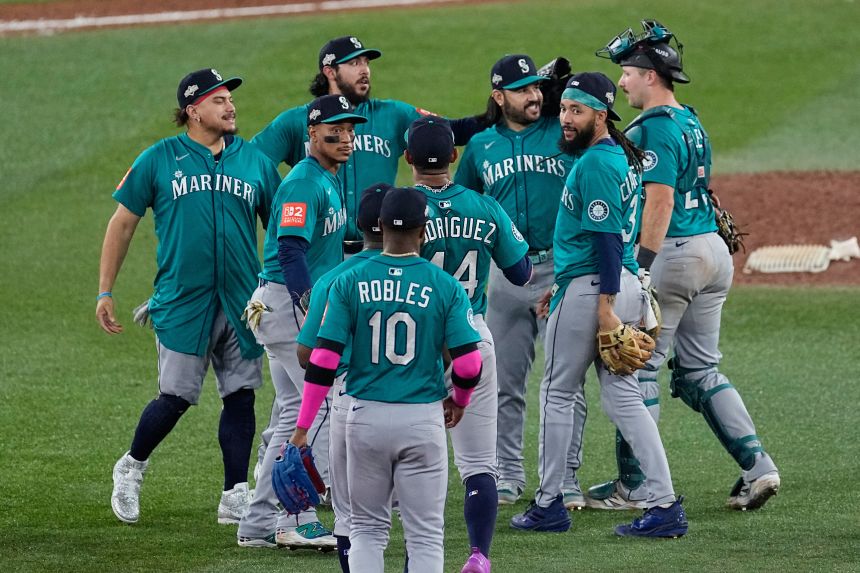
There is a particular kind of suffering that belongs exclusively to Seattle Mariners fans. It is not the loud, theatrical despair of a Cubs or Red Sox faithful, who at least wore their curses like badges of honor — those fan bases had World Series appearances to cry about. The Mariners’ pain is quieter, more existential. It is the ache of a franchise that, for more than two decades, existed outside the circle of relevance. They were not tragically close. They were simply… absent.
That changed in 2025. And now, as spring training dawns on a new season, what the Mariners have built feels less like a redemption arc and more like the opening chapter of a dynasty.
The Season That Rewrote the Record Books
The 2025 Seattle Mariners won their first American League West divisional title and Division Series since 2001. That alone would have been enough to fill T-Mobile Park with tears. But the season delivered something far larger — one of the most statistically remarkable individual performances in the history of professional baseball.
Cal Raleigh, the unassuming catcher from Harrisonburg, Virginia, known to his fans by the wonderfully absurd nickname “Big Dumper,” did something that nobody — not Barry Bonds, not Babe Ruth, not Mike Piazza, not Mickey Mantle — had ever done at his position. He became the seventh player in MLB history to hit 60 home runs in a season, setting the record for the most home runs by a catcher and a switch hitter.
The numbers deserve to be savored slowly. Raleigh finished with a .247 batting average, 60 home runs, 125 RBIs, 110 runs, 97 walks, an OPS of .949, and went without allowing a single passed ball during the regular season. He was, in the most literal sense, the best offensive catcher who has ever lived — while simultaneously running one of the best pitching staffs in the American League.
He joins a club that includes Barry Bonds, Mark McGwire, Sammy Sosa, Aaron Judge, Roger Maris, and Babe Ruth. Unlike most of those men, Raleigh crouches behind home plate for 150-plus games a season. The sheer physical improbability of what he did cannot be overstated.
The Making of Big Dumper
To understand what Raleigh’s season meant to Seattle, you have to understand how he got there — and how quietly it all happened. In his first 13 games of 2025, he hit .184 with two home runs and just three RBIs. The biggest news surrounding him was the Mariners’ announcement, the day before the regular season began, that they had signed him to a six-year, $105 million extension.
By the standards of what came next, that contract looks like one of the great bargains in sports history.
On May 30, Raleigh became the first MLB catcher to hit 20 home runs before the end of May. It was just the 29th time in MLB history and the fifth time a Mariners player had reached 20 home runs by the end of May, joining Ken Griffey Jr. (three times) and Alex Rodriguez. The pace was absurd. It was also undeniable.
By the time the baseball world descended on Atlanta for the All-Star Game, Raleigh had 38 home runs. He brought his power to Georgia, where he became the first catcher to win the Home Run Derby, edging Tampa Bay Rays third baseman Junior Caminero in the final. Raleigh is the second Mariner to win the event, joining Griffey, who won the Derby three times.
What made the chase genuinely gripping, beyond the numbers, was who Raleigh was chasing. With his 55th home run, Raleigh knocked Mickey Mantle — who hit 54 in 1961 — from the top spot for most home runs by a switch hitter. Then, on September 16, he tied and broke Mickey Mantle’s record with home runs 55 and 56. He also tied Ken Griffey Jr.’s Mariners franchise record of 56 in the same swing. In one at-bat, Raleigh stepped past the greatest Mariner who ever lived and one of the most hallowed names in American League history.
On September 24, Raleigh hit two home runs to reach his final total of 60, which led the majors. He was the first catcher to hit 60 home runs, one of only seven players in MLB history to hit 60 in a season, and the first in the American League who was not on the Yankees. That homer came on the same night the Mariners clinched the AL West, which was, characteristically, more important to Raleigh than the milestone itself.
The restraint with which Raleigh carried his historic season is part of what has made him so beloved. He most obviously resembles Roger Maris, the quiet, shy slugger from North Dakota who recoiled at all the attention he received when he chased down Ruth’s record in 1961. Maris, however, was at least the reigning AL MVP entering that season. Raleigh had never been an All-Star before 2025. He was simply a good player who became something transcendent, and he spent the entire summer seeming vaguely embarrassed by it.
The ALCS: This Close to History
The division title was not the end. The Mariners won their first American League Division Series since 2001, defeating the Detroit Tigers in a riveting series that went to extra innings. Then came the American League Championship Series against the Toronto Blue Jays — and Seattle came within eight outs of its first World Series appearance in franchise history.
Raleigh continued his assault on the record books in October. In Game 7 of the ALCS, he blasted a solo shot in the fifth inning for his 65th homer of the year counting both the regular season and postseason — a new AL record, surpassing the 64 total home runs Aaron Judge hit in 2022. Raleigh hit 60 homers in the regular season and added five more in Seattle’s 12 playoff games, including four in the ALCS.
But records are cold comfort when you lose. The Mariners fell to the Blue Jays in Game 7, their World Series dream dying eight outs too soon. The veteran backstop finished as the runner-up for the American League Most Valuable Player Award to the Yankees’ Aaron Judge — and now enters 2026 more determined than ever.
“It was pretty much in front of your face the whole time,” Raleigh reflected. “I’d be warming up in the clubhouse, MLB Network is on, and that was something they talked about a lot. But I think it just goes back to focusing on the right things… you don’t fall into that trap — don’t drink the Kool Aid.”
That quote tells you everything you need to know about who Cal Raleigh is and why Seattle adores him.
The Rotation: A Staff Built for October
Raleigh’s heroics rightfully dominated the headlines, but the Seattle Mariners are not a one-man team. They are, at their core, a pitching organization — and the rotation they’ve assembled is the kind that keeps general managers up at night in opposing cities.
With Luis Castillo, George Kirby, Logan Gilbert, Bryan Woo, and Bryce Miller, the Mariners send out quality arms every night. Their bullpen, already top seven in ERA last year, could be even tougher this season.
Consider that all of this production came in a season when the rotation was falling apart at the seams. Four of the Mariners’ five starters missed extended time with injury last year, with Castillo being the lone exception. Woo missed a full month heading into the playoffs. Gilbert, Kirby, and Miller all spent significant stretches on the injured list. And they still won the AL West and came within a game of the World Series.
What happens when they’re healthy?
Andrés Muñoz saved 38 games, nearly matching the 40 saves across his first five MLB seasons. Gabe Speier was second among AL relievers with 76 appearances and a staggering 29.2-to-1 strikeout-to-walk ratio. The bullpen depth behind those two is quietly one of the most underappreciated assets in the American League.
The ace question is genuinely interesting entering 2026. Bryan Woo had what many considered a breakthrough campaign, making his first All-Star team and establishing himself as a genuine top-of-rotation arm. Logan Gilbert, the Opening Day starter in 2025, brings consistency and durability at their ceiling. George Kirby remains one of the best command pitchers in baseball. And Luis Castillo, a veteran presence who has been through playoff runs before, anchors a staff that, at full health, could be the best in the AL.
Julio Rodríguez: The Franchise’s Next Chapter
If Cal Raleigh was the story of 2025, Julio Rodríguez is shaping up to be the story of 2026. The 25-year-old center fielder is what happens when a baseball organization identifies a generational talent early and builds an entire infrastructure around him.
Rodríguez hit .267 with a .798 OPS, tied his career-high with 32 home runs, and had a career-best 6.8 fWAR in 2025. He led the majors in at-bats, playing in all but two of Seattle’s games. The durability is there. The power is there. The speed is there. The question that has followed J-Rod throughout his young career is whether he can deliver his full-season best in the first half as consistently as he does in the second.
MLB.com selected Julio Rodríguez as the favorite to win the 2026 American League Most Valuable Player Award. That is not a small distinction. And analyst Jon Morosi, speaking about the Mariners’ young centerfielder, put it plainly: “I do think that he will figure it out and start to put it all together. He’s so talented, and he’s still only 25.”
Rodríguez is already the face of this franchise in a way that transcends statistics. He is electric, joyful, and genuinely seems to love playing baseball — which in an era of spreadsheet-driven, emotionally managed athletes, matters more than people realize. He will play for the Dominican Republic in the 2026 World Baseball Classic, further cementing his profile as one of the sport’s most globally recognized young stars.
The Supporting Cast and What Comes Next
The Mariners enter 2026 with a roster that looks, on paper, like it was built specifically to win a World Series — not just make the playoffs and survive.
Josh Naylor is at first base, Cole Young at second, Brendan Donovan at third, J.P. Crawford at short, Randy Arozarena in left, Rodríguez in center — and behind it all, Raleigh behind the plate. Donovan, acquired in a trade from the Cardinals, brings the kind of on-base skills and bat-to-ball contact that a lineup built around big power hitters desperately needs as its connective tissue.
The Mariners’ offseason was described as pragmatic and prudent. The main goal was accomplished early — signing first baseman Josh Naylor to a long-term contract. There was no flashy free-agent splash. No 10-year, $400 million blockbuster to announce. What Jerry Dipoto and the front office did instead was reinforce depth, add left-handed balance to the lineup, and trust the young foundation they’ve spent years building.
That foundation includes players fans haven’t fully met yet. Colt Emerson is described as the most polished 20-year-old the Mariners have had this century — arguably even a little more advanced than Julio was at this stage — while 22-year-old second baseman Cole Young remains someone the club is deeply bullish on. The farm system is not depleted. This is a team that can sustain itself.
In the bullpen, two high-end pitching prospects are waiting in the wings in lefty Kade Anderson and 20-year-old right-hander Ryan Sloan. The depth is real. The ceiling is legitimate.
The Weight of 2001
Any honest conversation about the Seattle Mariners has to reckon with the shadow of 2001. That team, the iconic 116-win squad anchored by Ichiro Suzuki’s otherworldly rookie season, remains the single greatest regular-season team in modern baseball history — and they never made the World Series. They lost the ALCS to the Yankees in five games and the franchise has been haunted by that particular ghost ever since.
For 21 years, the Mariners were baseball’s most famous non-participant. They existed in their own peculiar purgatory — occasionally competitive, never quite right, always finding a new and creative way to miss the postseason. The wait became so long, so grinding, that Seattle fans developed an almost preemptive resignation about it. Hoping hurt too much. Better to nod knowingly at the collapse before it happened.
The 2025 season shattered that psychology. Not because the Mariners won a World Series — they didn’t — but because they proved, in October, in a Game 7, with everything on the line, that they belonged. They were eight outs away. Eight outs from the Fall Classic. And that sting is not going to be motivation enough for Cal Raleigh — it is going to be the fuel that drives this entire organization in 2026.
Why 2026 Feels Different
The Mariners’ beat reporters at the Seattle Times put it plainly: this team is good enough to win the World Series, and when was the last time anyone could reasonably say that about a Mariners roster? In Cal Raleigh and Julio Rodríguez, the M’s have two of the top 15 players in the sport, both in the prime of their careers. In Andrés Muñoz, they have an elite closer. The players have something to prove.
That last sentence deserves to hang in the air for a moment. Randy Arozarena enters his platform year hungry to prove his 2025 numbers were a down season, not a new baseline. Cole Young and Luke Raley both dealt with injuries that short-circuited what could have been breakout campaigns. There’s a swagger about this team now. Coming off the sting of a Game 7 loss, they know how good they are, and how good they can be, and they’re embracing those expectations.
There is something meaningful in that word: swagger. The Mariners have not been a franchise that carried swagger — not since the days of Griffey, A-Rod, Edgar, Randy Johnson. For a generation of Seattle fans, the team’s identity was defined by its absence from October. That is no longer true, and you can feel it in how the players carry themselves, how the front office talks about the roster, how even the analytics community now speaks of Seattle not as a potential contender but as the presumptive favorite in the AL West.
No team in the American League can match Seattle’s pitching depth. Houston’s on the decline, and the rest of the division is still looking up.
The City and Its Team
T-Mobile Park, nestled in Seattle’s SoDo neighborhood with its retractable roof and its sight lines that frame the skyline on clear days, is one of baseball’s more genuinely beautiful ballparks. But for years it hosted games that felt more like academic exercises than sporting events. The city showed up, loosely, and watched a team that was fine — not great, not terrible, just somewhere in the middle distance of relevance.
That relationship has transformed. The 2025 season filled the park with a different kind of energy — louder, more desperate, more present. When Raleigh launched his 57th home run to pass Griffey, the crowd didn’t just cheer. They understood what they were witnessing. When the Mariners clinched the AL West for the first time in 24 years, the celebration in the stands was not just joy. It was the release of something held for a very long time.
Seattle is a city that has always been slightly suspicious of its own sports fortunes. The Seahawks won a Super Bowl and immediately gave it away the next year on a baffling goal-line call. The Sonics were stolen and never returned. The history is not warm. The 2025 Mariners could not undo any of that — but they could write a new line at the bottom of the page, and they did.
The Verdict
The Seattle Mariners are not a story about what might have been anymore. They are a story about what is being built and what is coming. They have the best catcher in baseball, one of the most exciting young outfielders on the planet, a rotation that is among the deepest in the American League, and a bullpen that would be the envy of most organizations.
They also have unfinished business. Game 7. Eight outs. The World Series they have never reached.
This team is good enough to win the World Series. The reporters who cover them every day believe it. The players believe it. And perhaps most importantly — finally, after all these years — the city of Seattle is beginning to believe it too.
The curse of 2001 is not gone. It will not be fully exorcised until the Mariners stand on a field in October holding the Commissioner’s Trophy. But the exorcism has begun. The ghost is fading. And in Peoria, Arizona, where pitchers and catchers have just reported to Cactus League camp, a team that once broke hearts for sport is quietly doing the work of building something that nobody in the Pacific Northwest has ever seen: a Seattle Mariners team with a legitimate, honest-to-God shot at a championship.
The long wait might finally be over.
Cal Raleigh’s 2025 season stats: .247 AVG / 60 HR / 125 RBI / .949 OPS. The Mariners finished 90–72, won the AL West, and reached the ALCS for the first time since 2001.