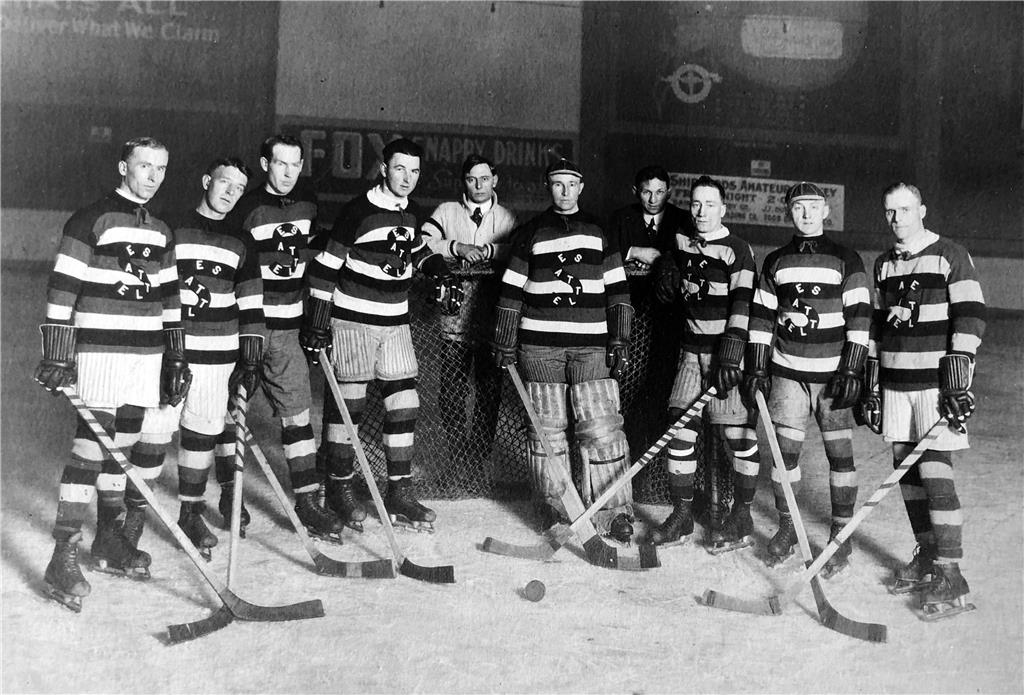
There is a story buried somewhere beneath the concrete and coffee shops of downtown Seattle — a story of men in barber-pole jerseys who skated onto the world stage a century ago and accomplished something no American team had ever done before. They won the Stanley Cup. They did it with a roster of poached players and castoffs, a coach barely old enough to rent a car by today’s standards, and a center who would later serve time at Alcatraz. And then, almost as suddenly as they appeared, they were gone — swallowed up by a pandemic, a parking garage, and the indifference of sports history.
The Seattle Metropolitans deserve better than a footnote. They were the city’s first professional hockey team and the first American team to win the Stanley Cup, hockey’s biggest prize — a feat accomplished in their second season when they defeated the Montreal Canadiens in the 1917 Stanley Cup Final. That achievement came eleven years before the New York Rangers — the team everyone remembers as hockey’s American pioneer — ever sniffed a championship. In the long, proud history of Lord Stanley’s trophy, Seattle got there first. It just took a century for most people to notice.
How the Metropolitans Were Born: A Hockey Heist in Broad Daylight
The story of the Metropolitans begins not with Seattle, but with a family feud between two competing leagues and a couple of shrewd brothers who weren’t afraid to play hardball.
The Metropolitans began play in the 1915-1916 season as one of four members of the Pacific Coast Hockey Association, and coach Pete Muldoon’s team was a hit, attracting capacity crowds at the Seattle Ice Arena in downtown Seattle. But before the first puck was ever dropped, general manager Pete Muldoon and PCHA President Frank Patrick had already made their most important moves — not on the ice, but in the recruiting office.
A long-simmering player war between the NHA and PCHA exploded in 1915 when the Patricks caught the Ottawa Senators trying to poach Vancouver’s best player, Cyclone Taylor. In response, the Patricks raided the Toronto Blueshirts, signing Eddie Carpenter, Frank Foyston, Hap Holmes, Jack Walker, and Cully Wilson for the Metropolitans. The Blueshirts had won the Stanley Cup in 1914, so Seattle wasn’t just acquiring players — they were importing an entire championship DNA.
To round out the roster, Muldoon made two more decisions that would prove transformational. He added two players released by Victoria: aging forward Bobby Rowe and unproven center Bernie Morris, who had both been reserves the previous season and cut by the team that summer. Muldoon immediately moved Rowe to defense, where he thrived, and Morris quickly made the team, scoring the game-winning goal in the Metropolitans’ first game and eventually becoming a five-time PCHA All-Star.
Bernie Morris. Remember that name. He will come up again and again in this story, always doing something extraordinary or suffering something deeply unjust.
First hired as a head coach with the new Portland Rosebuds for the 1914-1915 season, Muldoon jumped at the opportunity to return to Seattle with the expansion Metropolitans in 1915. He was twenty-seven years old. By the time he won the Stanley Cup two years later, he would be the youngest coach in history to claim it — a record that still stands today.
The team’s name was derived from the Metropolitan Building Company, the entity that built the Seattle Ice Arena on the University of Washington’s Metropolitan Tract property. The arena seated 2,500 fans — a modest structure by any standard — and yet on great nights, the building swelled with sound and significance. Seattle had fallen hard for this game.
The 1917 Championship: An Upset for the Ages
By 1916-17, the Metropolitans shocked the world. First, they won the league with a last-game road win against Portland, led by a 54-point season in 24 games by Bernie Morris. That scoring mark, astonishing even by modern standards for such a short season, was never broken in the history of the PCHA.
Their opponents in the Stanley Cup Final were the Montreal Canadiens — defending champions, confident and supremely talented, carrying the weight of history on their backs. The Canadiens, who won the Stanley Cup the previous season and were considered the best team in hockey, barnstormed their way across North America unconcerned about the PCHA team waiting for them.
The series opened disastrously for the Mets. The heavily favored Canadiens trounced the Metropolitans in Game 1, despite arriving in Seattle the same morning. Didier Pitre put on a clinic, scoring four goals as Montreal routed Seattle 8-4. The city’s confidence may have wavered. Muldoon’s did not.
The series operated under an unusual hybrid format that gave it a peculiar tactical texture. Games one and three were played under PCHA seven-man rules; games two and four were played under NHA six-man rules. This meant coaches essentially had to prepare two entirely different game plans. The PCHA style, with its forward passing and the extra position of “rover,” rewarded athleticism and flow. The NHA style was more physical, grinding, individualistic. Seattle, it turned out, was better at both.
Game 2 was a statement. Morris opened the scoring, Wilson made it 2-0 for Seattle after the first period. Morris and Foyston scored in the second to put Seattle up 4-0. Frank Foyston then scored twice in the third period to complete his hat trick and give Seattle a lead of 6-0. Montreal got one late to spoil the shutout, but the message was clear: the Mets had found their footing.
Game 3, played under PCHA rules, belonged to Seattle from start to finish. Game 4 — the clincher — was something else entirely.
The Mets went through the invaders’ defense like a tornado on wheels in huckleberry time, as one sportswriter put it. That was no exaggeration. Despite playing under NHA rules, Game 4 was a 9-1 blowout for Seattle, with Morris scoring six goals.
Six goals. In a single Stanley Cup Final game. Against a lineup that featured the legendary Georges Vézina in goal.
Morris’ 14 total goals for the series were three more than the Canadiens team scored and remain the most ever scored in a Stanley Cup Final. Even now, more than a century later, that record stands untouched. The series had featured nine future Hall of Famers on both sides, and yet one man — an orphan from Victoria who’d nearly been cut before training camp — had defined it entirely.
After the fourth and deciding game, the headline across the Post-Intelligencer Sports Section read: “Seattle Wins World’s Hockey Championship.” The Seattle Times described the end of the final game: “The lexicon of sport does not contain language adequate to describe the fervor of the fans who saw Seattle triumph last night.”
Seattle had done something no American city had ever done. Pete Muldoon was 29 years and nine months old and is still the youngest coach or manager to win the Stanley Cup. That record, too, remains intact.
War, Disruption, and the Shadow Years
Six days after the Metropolitans lifted the Cup, the United States formally entered World War I.
The timing was brutal. Just days after the Metropolitans’ victory, the U.S. entered WWI, severely impacting the 1917-1918 season. With its arena commandeered as a weapons depot by the Canadian military, the Victoria franchise disbanded for the season. Pete Muldoon was sent to coach Portland for the year while hockey legend Lester Patrick — the future New York Rangers head coach — managed the Metropolitans.
In addition to losing their head coach, the Mets roster was in flux, with Hap Holmes in Toronto, Frank Foyston and Jack Walker missing large portions of the season due to military service. That the team held together at all was a testament to the depth Muldoon had quietly assembled.
The 1917-18 season was a near-miss. The Mets repeated as PCHA regular-season champions but lost the league championship series to Vancouver. Then came 1918-19, and with it, one of the most extraordinary and heartbreaking postseason runs in the history of any sport.
1919: The Greatest Series Never Decided
The 1919 Stanley Cup Final is even crazier than the 1917 one, as author Kevin Ticen has put it — partially because it ended without a champion, but also because of the controversy and tragedy that surrounded it.
The trouble began before the first puck was dropped.
When the 1919 Stanley Cup Final began in Seattle on March 19, it had all the makings of one of the great series in professional sports. Then the bliss surrounding the Metropolitans was shattered. Morris had been a no-show for Game 1 of the PCHA league championship series. His lawyer hand-delivered a note to the Mets locker room saying that Morris, a Canadian citizen, had been mistakenly arrested by the U.S. military for draft evasion.
Bernie Morris, The Metropolitans’ leading scorer, was sitting in a jail cell at Fort Lewis awaiting trial for draft evasion from the U.S. military, despite being a Canadian citizen. The circumstances were Kafkaesque: Morris had registered for the U.S. military as required by a treaty between Canada and the U.S., but claimed exemption because of his Canadian citizenship. While he was away for the offseason in Canada, a notification was sent to his Seattle address to report for a military physical. When he failed to report, he was inducted into the military on November 5, 1918 — six days before the armistice was signed — and immediately charged with evasion.
The Mets played without their best player. And yet they very nearly won.
Game 1: The Seattle Metropolitans skated rings around the Flying Frenchmen, the Eastern champions. The final score was 7 goals to 0, with the Seattle men on the long end of the count.
Game 4 became the stuff of hockey mythology. Game four has been considered one of the greatest hockey games ever played, ending in a scoreless tie after 20 minutes of overtime, with Seattle’s Hap Holmes and Montreal’s Georges Vézina blocking every shot. Players literally collapsed on the ice after the buzzer. The crowd gave both teams a standing ovation — not for goals, not for wins, but for the sheer human effort it had taken to stay upright. The Metropolitans’ Cully Wilson netted the lone puck on the night only to have it waved off by referee Mickey Ion, who ruled that time had expired before the goal scored.
Game 5 was a war of attrition. Montreal trailed the game 3-0 after two periods, but Seattle tired, and Montreal scored three to force overtime. Lalonde had the Canadiens’ second and third goals. In the extra period, Montreal’s substitute Jack McDonald sprinted on the ice and tallied the game-winning goal in dramatic fashion after the Mets were down a player — Frank Foyston was injured, Jack Walker broke a skate, and Cully Wilson collapsed from exhaustion.
Then came the morning that changed everything.
The following morning, the Spanish Flu pandemic plaguing the world struck Seattle, hospitalizing five Canadiens and killing Montreal’s Joe Hall. Without enough skaters to field a team, the Canadiens offered to forfeit the final game and with it, the Stanley Cup. Pete Muldoon and Frank Patrick declined the offer, canceling the final game and declaring the series a tie — the only year a champion was not crowned.
The Mets, it turned out, were too honorable to accept a championship they hadn’t fully earned. That decision says everything about the character of the franchise and the men who ran it. Joe Hall, one of hockey’s roughest players and a future Hall of Famer, was buried in Brandon, Manitoba. Manager George Kennedy also was stricken; he never fully recovered from his symptoms and died two years later.
One week after the series ended, Morris’ sensational trial concluded with his conviction and a sentence of two years hard labor at the U.S. Military Prison — Alcatraz. He had won nothing, played in nothing, and was now being sent to a rock island in San Francisco Bay. The injustice of it is staggering even from the distance of a century.
1920: One Last Run
Morris didn’t stay at Alcatraz for long. By fall, Morris was transferred to an Army unit, and the following March — one year after his incarceration — he was granted an honorable discharge from the U.S. Army. Morris was sent back to Seattle in time to catch the team train to Ottawa for the 1920 Stanley Cup Final.
He played in all five games but didn’t score a goal as Seattle lost the series to the Senators, 3-2. Three Stanley Cup Finals in four years. One championship, one pandemic-canceled series that should have been theirs, and one loss. That record is extraordinary by any measure.
During the 1920 Stanley Cup Finals, the Ottawa Senators wore solid white uniforms to avoid confusion with Seattle’s barber-pole style of green, red, and white. The Senators changed their jerseys. The Mets didn’t. There’s a certain poetry in that.
The End of the Arena, the End of the Team
The Metropolitans folded in 1924 when a replacement for the Seattle Ice Arena could not be found. After the 1924 season, the owners of the newly built Olympic Hotel told the University of Washington that they needed the Seattle Ice Arena as a parking garage. The university bought out the final year on the team’s lease, sending the Metropolitans’ leadership scrambling to secure funding to build a new arena.
They couldn’t find it. The franchise that had beaten the Canadiens, weathered a world war, played through a pandemic, and sent its star player to Alcatraz — that franchise was ultimately killed by a real estate deal. The arena became a parking structure. The players scattered.
Frank Foyston and Bernie Morris had adjoining turkey farms in Port Orchard. Cully Wilson lived in North Seattle. Jack Walker lived in Beaux Arts over in Bellevue. Bobby Rowe lived in Portland. They had been world champions, and they retired to turkey farms and quiet suburbs, their names slowly fading from the public consciousness.
The tale of the Metropolitans, as compelling as it was, was being lost into the fog of history before the Kraken came along and shed new light on the Hollywood-like run of their predecessors as the toast of the town when hockey was a novelty here.
The Legacy They Left Behind
There are five members of the Hockey Hall of Fame who wore Metropolitans uniforms. Five, for a franchise that played only nine seasons in a city that had never seen professional hockey before they arrived.
Frank Foyston, the captain. Jack Walker, the rover who could do everything. Harry “Hap” Holmes in goal, steady as a stone wall. Coach Pete Muldoon, whose record of being the youngest Stanley Cup-winning coach may never fall. And then there’s Bernie Morris — not yet in the Hall of Fame, a fact that author Kevin Ticen has been fighting to correct for years. Morris scored 14 goals in a single Stanley Cup Final. He served time at Alcatraz for a crime he didn’t commit. He came back and played in the very next Finals. If there is a Hall of Fame argument that writes itself, it is his.
Another member of the ’17 Metropolitans, Jim Riley, holds the distinction of being the only person to play NHL hockey and major-league baseball. Even the supporting cast was remarkable.
How Seattle Remembers Them
The “S” logo of the NHL’s Seattle Kraken was designed as an homage to the Metropolitans. On October 26, 2021, the Kraken raised a 1917 Stanley Cup Championship banner at Climate Pledge Arena before the team’s game against the Canadiens. It was Montreal’s first non-exhibition game in Seattle since the 1919 Stanley Cup Finals, which were not completed due to the Spanish flu pandemic.
The Kraken’s uniforms for the 2024 NHL Winter Classic featured a “barber-pole” stripe pattern inspired by the Metropolitans’ uniforms. Descendants of the original championship players attended the banner-raising ceremony. The thread between 1917 and 2021 was pulled taut and held.
The Kraken are not appropriating the history of the Metropolitans — they are amplifying it. That distinction matters. There’s a difference between a franchise wearing the legacy of a predecessor like a costume and one genuinely trying to honor what came before.
“Walt Disney couldn’t have scripted it any better,” said Kevin Ticen, author of When It Mattered Most, a definitive history of the Seattle Metropolitans. “It was a wonderful, crazy story.”
Why the Metropolitans Still Matter
Sports history is littered with forgotten teams — franchises that won championships in dead leagues, players whose stats are buried in microfilm archives, eras that fell between the cracks of collective memory. The Seattle Metropolitans are the ultimate example of that phenomenon.
They played in a league that no longer exists. They competed for a trophy that was governed by rules that changed from game to game. Their arena was demolished to make room for cars. Their greatest player went to federal prison. Their best chance at a second championship was stolen by a virus.
And yet. The record in the books is real. The trophy existed. The goals were scored. Of the 28 starting players in the PCHA during the 1916-17 season, an astonishing 14 would later be inducted into the Hockey Hall of Fame. The Metropolitans were playing against and alongside the greatest players of their era. This was not some minor-league curiosity. This was elite professional hockey at the highest level of competition the sport had to offer, and Seattle stood at the very top of it.
There is something persistently moving about the 1919 squad in particular — a team that refused the Stanley Cup they were almost certainly going to win, because accepting it under those circumstances felt wrong. A team whose best player was wrongfully imprisoned. A team that had already overcome a world war, a coaching change, and roster upheaval just to get back to that final series. And when history was within their grasp, they let it go out of decency.
That’s the Seattle Metropolitans. Champions who put honor above hardware. Pioneers who opened the door for every American hockey team that came after them. Barnstormers in barber-pole jerseys who played with everything they had in a 2,500-seat arena on 5th and University, in a city that went absolutely mad for them.
The parking garage is long gone. Climate Pledge Arena now stands in Seattle with a banner in the rafters that says 1917. The Kraken wear their colors. The story, finally, is being told.
It just took a hundred years.