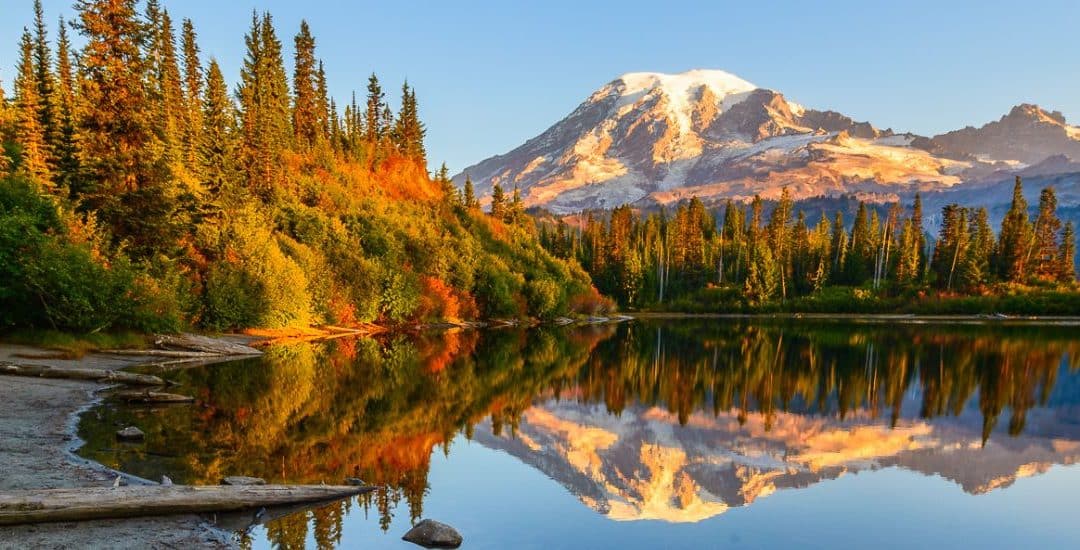
Standing at 14,410 feet, Mount Rainier dominates the Pacific Northwest skyline with an authority that few peaks can match. This active stratovolcano, wrapped in 25 major glaciers and crowned with perpetual snow, serves as the centerpiece of one of America’s oldest national parks. Established in 1899, Mount Rainier National Park encompasses 236,381 acres of pristine wilderness in Washington State, offering visitors a landscape where fire and ice have shaped the terrain for millennia.
The mountain itself commands respect. Native peoples including the Puyallup, Muckleshoot, Yakama, and Nisqually have revered this peak for generations, calling it Tahoma or Tacoma. To them, the mountain was—and remains—sacred, a place of power and spiritual significance. Early European explorers and settlers saw the peak from vast distances, with Captain George Vancouver naming it after his friend Rear Admiral Peter Rainier in 1792. But names aside, the mountain’s presence transcends human designation. It creates its own weather systems, generates rivers from its glacial melt, and reshapes itself through periodic eruptions and constant geological forces.
A Landscape Carved by Ancient Forces
The geography of Mount Rainier National Park tells a story millions of years in the making. The mountain began forming roughly 500,000 years ago through successive volcanic eruptions, building layer upon layer of lava and ash. Today’s peak represents just the latest chapter in this ongoing geological narrative. The summit crater, while dormant, releases heat and volcanic gases that create an intricate system of ice caves beneath the glaciers—a reminder that this sleeping giant could awaken.
What makes Rainier particularly striking is its glacial system. The mountain holds the largest collection of permanent ice and snow in the contiguous United States, with glaciers covering approximately 35 square miles. These rivers of ice—Emmons, Winthrop, Carbon, Nisqually, and more than two dozen others—have sculpted the mountain’s flanks into dramatic ridges and deep valleys. The Emmons Glacier alone stretches 4.3 miles and contains enough ice to fill Lake Washington.
But glaciers are not permanent fixtures. Climate data shows these ice masses are retreating, some dramatically so. Between 1913 and 1994, the park’s glaciers lost about 25 percent of their area. This retreat reveals fresh moraines and creates new meltwater streams, fundamentally altering the landscape. Scientists monitor these changes closely, recognizing that Mount Rainier’s glaciers serve as sensitive indicators of climate patterns affecting the entire Pacific Northwest.
Paradise Found: The Park’s Iconic Destination
Of all the locations within Mount Rainier National Park, Paradise earns its name honestly. Situated at 5,400 feet on the mountain’s southern flank, this area receives an average of 640 inches of snow annually—making it one of the snowiest places on Earth where measurements are regularly recorded. During the winter of 1971-72, Paradise recorded 1,122 inches of snowfall, a world record that still stands.
Yet Paradise is most famous for what happens when that snow melts. From mid-July through early August, the subalpine meadows explode into a riot of color. Avalanche lilies push through the retreating snow, followed by lupine, paintbrush, beargrass, and pasqueflower. The meadows transform into natural gardens that stretch across hillsides, creating vistas where wildflowers cascade toward glaciers and the massive volcanic dome beyond. The Skyline Trail, which loops through these meadows, offers what many consider the finest day hike in the park—six miles of continuous alpine scenery that shifts with every turn.
The Jackson Visitor Center at Paradise serves as the park’s architectural crown jewel. Rebuilt in 2008 after the original 1960s structure deteriorated, the new facility incorporates sustainable design while maintaining views that allow the building to disappear into the landscape. Floor-to-ceiling windows frame the mountain, while exhibits explain the complex ecosystems visitors are experiencing. Outside, the Henry M. Jackson Memorial Visitor Center sits amid the very meadows it interprets, making it both a destination and a starting point for deeper exploration.
The Sunrise Side: A Different Perspective
While Paradise draws the majority of visitors, Sunrise on the mountain’s northeast flank offers an entirely different experience. At 6,400 feet, Sunrise stands as the highest point accessible by vehicle in the park. The landscape here is drier, more austere, shaped by the mountain’s rain shadow. Where Paradise drowns in moisture from Pacific storms, Sunrise receives roughly half the precipitation, creating an ecosystem adapted to harsh conditions and thin soils.
The views from Sunrise reveal aspects of the mountain invisible from other vantage points. The Emmons Glacier spreads across the eastern face, its crevasses and ice falls clearly visible from nearby overlooks. Mount Adams and Glacier Peak appear on the horizon, fellow volcanoes in the Cascade chain. Early morning visitors—those who arrive at dawn to justify the location’s name—witness alpenglow painting the volcanic rock in shades of pink and orange, a daily light show that lasts mere minutes before the sun climbs higher.
Trails from Sunrise lead into truly wild country. The Wonderland Trail passes through, and day hikers can access stretches of this 93-mile circumnavigation of the mountain. The Burroughs Mountain Trail climbs into an alpine desert environment where only the hardiest plants survive, offering unobstructed views across volcanic badlands that look more like Mars than Washington. This landscape, formed by repeated lava flows and sculpted by glaciers, shows the mountain’s bones in ways the lusher southern slopes cannot.
Ancient Forests and River Valleys
While the alpine zones capture attention, the park’s lower elevations preserve equally remarkable ecosystems. Old-growth forests of Douglas fir, western hemlock, and western red cedar thrive in the Carbon River valley on the mountain’s northwest corner. These temperate rainforests, some of the finest remaining in the Cascades, contain trees exceeding 500 years in age and reaching heights of 200 feet or more. The Grove of the Patriarchs, accessible via a short suspension bridge trail, protects some of the oldest and largest trees in the park.
These forests operate on timescales that dwarf human experience. A single Douglas fir may have been a seedling when Christopher Columbus reached the Americas. These trees have weathered countless storms, survived periodic fires, and adapted to changing climate conditions while remaining rooted in the same spot. Walking among them provides perspective on the fleeting nature of human concerns and the enduring power of natural systems.
The rivers flowing from Mount Rainier’s glaciers carve their own stories into the landscape. The Carbon, White, Nisqually, Cowlitz, and Puyallup rivers all begin as meltwater streams, their milky gray color a testament to the glacial flour—rock ground to powder by moving ice—suspended in their waters. These rivers provide critical habitat for Pacific salmon, which return from the ocean to spawn in their natal streams. The sound of rushing water is constant in the park, a reminder that mountains are not static monuments but dynamic systems constantly in flux.
Wildlife in the Shadow of the Mountain
Mount Rainier National Park supports a diverse community of wildlife adapted to environments ranging from lowland forest to alpine tundra. Black-tailed deer browse meadow edges at dawn and dusk. Roosevelt elk, weighing up to 1,000 pounds, favor the Carbon River valley and the park’s western forests. Mountain goats, introduced in the 1920s and now numbering several hundred, navigate cliffs that would stop any other large mammal, their specialized hooves gripping surfaces that appear sheer to human eyes.
The park’s smaller residents are equally fascinating. Hoary marmots whistle warnings from boulder fields, their alarm calls echoing across meadows. Pikas—diminutive relatives of rabbits—gather vegetation during summer, creating hay piles they’ll consume through the winter months beneath the snowpack. These industrious creatures remain active year-round in their rocky homes, one of the few mammals in the park that neither hibernates nor migrates when winter arrives.
Birdlife varies dramatically with elevation and season. Gray jays—known as camp robbers for their bold behavior around hikers—patrol picnic areas and trail junctions. Clark’s nutcrackers cache thousands of whitebark pine seeds each fall, their remarkable spatial memory allowing them to relocate these buried treasures months later beneath feet of snow. Higher up, white-tailed ptarmigan change their plumage with the seasons, brown in summer and white in winter, remaining nearly invisible against their surroundings year-round.
The Challenge of the Summit
For mountaineers, Mount Rainier represents both a training ground and a significant objective in its own right. Each year, approximately 10,000 people attempt to reach the summit, though only about half succeed. The mountain’s accessibility—you can drive to Paradise and begin climbing within hours—belies the serious challenges it presents. Crevasses hidden beneath snow bridges, sudden weather changes, altitude sickness, and physical exhaustion eliminate many hopeful summiteers.
The standard Disappointment Cleaver route, while considered the mountain’s easiest path to the summit, still requires glacier travel, ice climbing skills, and the physical conditioning to ascend 9,000 vertical feet over two days while carrying overnight gear. Climbers typically depart high camp around midnight, navigating by headlamp across glaciers and up steep slopes to reach the summit at sunrise, when temperatures are coldest and snow bridges most stable.
Those who do summit experience something few others know. The crater rim offers views across hundreds of miles—the Olympic Mountains to the west, the Cascade volcanoes marching north and south, and on exceptionally clear days, mountains as far as southern Oregon. Volcanic vents release sulfurous steam, a reminder that climbers stand on an active volcano that has erupted as recently as 150 years ago. The descent requires equal care, as fatigued climbers navigate hazards they bypassed in darkness during the ascent.
Winter’s Transformation
When winter storms begin arriving in October, Mount Rainier National Park transforms completely. The Paradise area, so crowded with summer visitors, becomes a winter playground for those equipped to handle deep snow and avalanche danger. The meadows disappear beneath 15 or 20 feet of accumulation. Trees bend under snow loads. The landscape becomes monochromatic—white mountains against gray skies, punctuated by the dark spires of subalpine firs.
Cross-country skiers and snowshoers replace summer hikers. Popular destinations include Reflection Lakes, which freeze solid, and the slopes below Panorama Point, where backcountry skiers earn turns through gladed terrain and open bowls. The Paradise Inn closes, but the Jackson Visitor Center remains open on weekends and holidays, providing warmth and information for winter visitors who brave the drive up roads that see 100-foot snow walls by spring.
Winter also reveals the park’s avalanche terrain. Slopes that appear benign under summer flowers become deadly snowfields in winter. The park’s avalanche forecasting program works to keep visitors informed, but the responsibility for safety ultimately rests with each individual. This is wilderness in its purest form—beautiful, indifferent, and potentially fatal to those who approach it casually.
Conservation Challenges and Future Concerns
Managing Mount Rainier National Park requires balancing competing demands. The park receives over 1.5 million visitors annually, most arriving during the brief summer season. This concentration of use impacts fragile subalpine meadows, where a single footstep off-trail can destroy vegetation that took decades to establish. The park has implemented strict trail systems and educational programs, but the sheer number of visitors guarantees some level of environmental impact.
Climate change presents perhaps the most significant long-term challenge. Rising temperatures are shrinking the park’s glaciers at accelerating rates. Studies project that many smaller glaciers could disappear entirely within decades. This loss will fundamentally alter the park’s ecosystems. Streams that once flowed year-round may become seasonal. Plants adapted to cold, wet conditions may be replaced by species from lower elevations. The very character of the park—its identity as a glaciated peak—could change within our lifetimes.
The park also faces volcanic hazards that receive less attention than they deserve. Mount Rainier is considered one of the most dangerous volcanoes in the Cascades, not because eruption is imminent, but because of its proximity to population centers. Tacoma and Seattle lie in the path of potential lahars—volcanic mudflows that could be triggered by eruptions or simply by partial collapse of the heavily glaciated summit. The Electron Mudflow, which occurred roughly 500 years ago, traveled more than 40 miles down river valleys now occupied by towns and cities. Park geologists monitor the mountain constantly, but predicting volcanic activity remains an imperfect science.
A Living Laboratory
Beyond its role as a recreational destination, Mount Rainier National Park functions as an invaluable natural laboratory. Scientists study everything from glacial retreat rates to the impacts of nitrogen deposition from air pollution. Long-term ecological monitoring programs track changes in plant communities, animal populations, and stream chemistry. This research, conducted over decades, provides data crucial for understanding how mountain ecosystems respond to environmental change.
The park’s status as a protected area makes this research possible. Unlike areas subject to logging, mining, or development, Mount Rainier preserves relatively intact ecosystems that serve as baselines for comparison with modified landscapes. The knowledge gained here informs conservation efforts throughout the Pacific Northwest and provides insights applicable to mountain ranges worldwide.
The Enduring Appeal
What draws people to Mount Rainier defies simple explanation. Some seek physical challenge, whether summiting the peak or completing the Wonderland Trail. Others come for aesthetic experiences—wildflower meadows, sunrise over glaciers, the play of light on snow. Still others find spiritual renewal in wilderness, that sense of connection to something larger than themselves that wild places can provide.
The mountain has inspired artists, writers, and photographers for generations. Ansel Adams photographed here. John Muir explored these slopes in the 1880s, though he found the mountain less to his liking than the Sierra Nevada. Theodore Winthrop, whose writings helped promote the establishment of the national park, described Rainier as “the great white beacon of the northwest.” Each generation finds its own meanings in this landscape, its own reasons for preservation.
For residents of the Puget Sound region, Mount Rainier serves a unique role in daily life. The mountain is “out” or it isn’t—local shorthand for whether clouds obscure the peak. Its presence or absence affects moods, plans, and conversations. This intimate relationship between a population center and a wild landscape is increasingly rare in modern America, making the mountain’s role in regional identity all the more significant.
Planning Your Visit
Visiting Mount Rainier National Park requires preparation and realistic expectations. The brief summer season, roughly early July through September, sees the heaviest visitation. Paradise parking lots fill by mid-morning on summer weekends. Sunrise Road doesn’t open until late June or early July, depending on snowpack. Even in August, trails above 6,000 feet may cross snowfields requiring careful navigation.
The park maintains developed campgrounds and a backcountry permit system for those planning overnight trips. Day hikers should come prepared for rapidly changing weather. Morning sunshine can give way to afternoon thunderstorms. Temperatures drop dramatically with elevation gain. What begins as a pleasant hike at Paradise can become a challenging ordeal if fog rolls in and trails disappear under late-season snow.
Four entrance stations provide access from different directions, each offering distinct experiences. The Nisqually entrance leads to Longmire and Paradise. The White River entrance accesses Sunrise. The Stevens Canyon entrance connects the east and south sides of the park. The Carbon River entrance, on the northwest, remains the least developed and most rustic option. An entrance fee is required, though annual passes cover multiple visits.
A Mountain for the Ages
Mount Rainier National Park stands as one of America’s treasures, a landscape where natural forces operate on scales that humble human pretensions. The mountain was here long before the first people arrived in the Pacific Northwest, and it will remain long after our civilizations have passed into history. Yet it is not unchanging. Glaciers advance and retreat. Rivers carve new channels. Forests grow, burn, and regenerate. The mountain itself builds and erodes, subject to forces we are only beginning to understand.
The decision to preserve this landscape as a national park in 1899 reflected wisdom whose full value becomes clearer with each passing year. In protecting Mount Rainier, we preserved not just a mountain but the complex web of life it supports, the watersheds it creates, and the inspiration it provides. We maintained a place where wilderness persists within reach of millions, where the natural world operates according to its own rules rather than human convenience.
As climate change reshapes our planet and human populations continue growing, such places become increasingly precious. Mount Rainier offers more than scenic beauty or recreational opportunities. It provides a connection to the natural world that modern life tends to sever, a reminder that we are part of larger ecological and geological systems. The mountain teaches patience, humility, and respect for forces beyond our control. These lessons, more than any particular view or trail, may be the park’s most valuable gift to those willing to listen.