On June 6, 1889, an untended glue pot in a cabinet shop near the corner of First Avenue and Madison Street overheated and ignited. The flames spread rapidly through wooden buildings standing shoulder-to-shoulder along narrow streets. Within hours, twenty-nine downtown blocks had burned to ash. The fire consumed every structure in Seattle’s commercial core—stores, hotels, wharves, offices, the entire accumulated infrastructure of thirty-seven years since Arthur Denny, Carson Boren, and William Bell had relocated from storm-battered Alki Point to this protected harbor on Elliott Bay.
Henry Yesler watched his empire burn. His sawmill, the steam-powered operation that had guaranteed Seattle’s early success when he’d chosen the site in 1852, was gone. His first cookhouse, built of hewn logs in 1852 and rebuilt after an 1866 fire, was gone. The one-story buildings housing the post office and stores on his old mill site—gone. But Yesler’s house at 4th and James survived, and his architect Elmer Fisher’s drawings for the new Pioneer Building survived, locked in a safe that protected them through the flames.
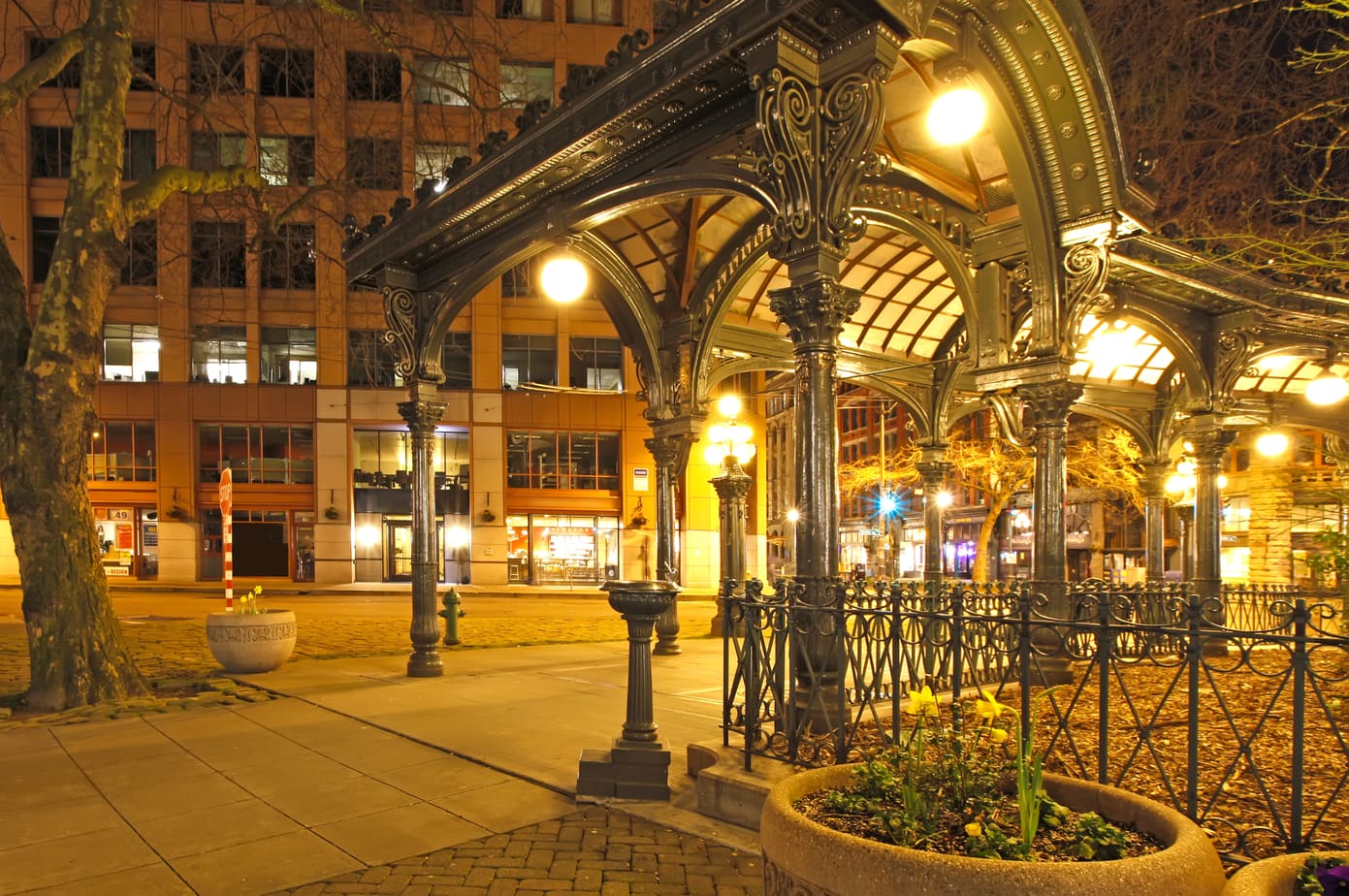
By the end of 1890, Pioneer Square had been entirely rebuilt. Dozens of brick and stone buildings replaced the wooden structures—fire-resistant, built to new ordinances, elevated a full story above the previous street level to solve chronic drainage problems. The architectural character established in that frenetic reconstruction still defines the neighborhood: Richardsonian Romanesque brick and stone, arched windows, decorative terra cotta, cast iron columns, buildings designed by Elmer Fisher and others who had a field day creating spectacular ensemble of office buildings reflecting both Victorian sensibilities and newer Romanesque Revival modes.
Today, Pioneer Square occupies roughly thirty acres bounded by Cherry Street north, Alaskan Way west, South King Street south, and Second Avenue east. It is Seattle’s oldest neighborhood, the city’s original downtown, birthplace of modern Seattle, and home to one of the nation’s best surviving collections of Romanesque Revival urban architecture. It is also historically contradictory space—simultaneously celebration of entrepreneurial achievement and reminder of displacement, preservation success story and ongoing struggle with homelessness and urban decay, cultural treasure and economic challenge, historic district and living neighborhood refusing to function as museum.
The Founding Geography: Why Here, Why Not Alki
The Denny Party—twenty-four adults and children led by Arthur Denny—arrived at Alki Point on November 13, 1851, establishing “New York Alki” (Chinook Jargon for “New York by and by”). The settlement faced harsh winter conditions, inadequate harbor, and limited timber access. Arthur Denny, Carson Boren, and William Bell recognized the problem. After sounding Elliott Bay in February 1852, they relocated east across the water to the mainland site offering deep-water harbor and proximity to dense forests.
The geographic advantages were immediate and determining. The protected harbor allowed ships to anchor safely while loading timber. The forests covering hillsides provided limitless raw material for lumber operations. The relatively flat area at the waterline—though small and marshy—offered buildable ground rare along Puget Sound’s steep shorelines. The tidal mud flats extending east from First Avenue could be filled, creating more land.
Doc Maynard claimed Piner’s Point and the mud flats south and east, establishing general store called “The Seattle Exchange” and convincing neighbors to rename their settlement from Duwamps to Seattle, honoring Chief Seattle (Sealth) of the Duwamish and Suquamish tribes. Louisa Boren started construction of the settlement’s first cabin at 2nd Avenue and Cherry Street in spring 1852. Maynard built second cabin at South Main Street and First Avenue South.
Henry Yesler’s arrival in 1852 sealed Seattle’s fate. He chose the site for Puget Sound’s first steam-powered lumber mill in exchange for generous chunks of the settlers’ land claims. His mill sat on a pier at the foot of today’s Yesler Way—originally called Mill Street, later nicknamed “Skid Road” because logs from wooded hillsides were skidded down to Yesler’s sawmill and wharf. The term later acquired darker connotations as the neighborhood declined, but originally it simply described practical logging infrastructure.
The mill’s output—shipped primarily to San Francisco during California Gold Rush—generated revenue and employment. Yesler built crude aqueduct system of elevated log troughs transporting water from ridge-top springs to the village below. The mill’s cookhouse and later Yesler’s Pavilion at First Avenue and Cherry Street served as Seattle’s first social center. Captain Felker’s home near First Avenue and Jackson Street operated as hotel, restaurant, and bordello managed by sharp-tongued Irishwoman Mary Conklin, better known as “Mother (later Madame) Damnable.”
By 1869, Seattle incorporated with more than 2,000 residents. By 1889, it ranked as Washington’s largest city with 40,000 people. Then the glue pot overheated.
The Fire and the Underground: Building Atop Ruins
The Great Seattle Fire of June 6, 1889 destroyed twenty-nine blocks in hours. But timing matters as much as devastation. The local economy was strong—timber industry booming, population growing, optimism high. Rebuilding began almost immediately with crucial differences from what burned.
Seattle City Council passed Ordinance No. 1147 in July 1889, requiring commercial buildings to be constructed of fire-resistant brick and stone rather than wood. The new regulation forced architectural shift toward masonry construction, incidentally creating employment for skilled masons, bricklayers, and stone carvers. Architects like Elmer Fisher—who designed the Pioneer Building, the Terry-Denny Building, and numerous other post-fire structures—found themselves overwhelmed with commissions.
Fisher’s work embodies the stylistic transition from Victorian to Romanesque Revival. The Pioneer Building, designed before the fire but built after new ordinances took effect, demonstrates how architects navigated changing requirements. Victorian ornamentation meets Romanesque massing and arched windows. Brick and stone replace wood. Terra cotta provides decorative flourishes. Cast iron columns support weight while creating open interior spaces.
City engineers simultaneously solved Pioneer Square’s chronic drainage problems by elevating street level a full story—in some places up to twenty-five feet. This regrade created unusual situation where many buildings were constructed with two entrances: one at old, low level and another higher up. As new construction proceeded at elevated grade, the original ground floors became subterranean.
These underground spaces initially functioned as basements and storage. Sidewalks featured purple glass panels (called “vault lights”) allowing natural light to penetrate below. But as street level stabilized and basements became impractical, most underground areas were sealed and forgotten. These catacombs remained largely unknown until the early 1960s when Bill Speidel began offering Underground Tours, revealing the literally buried history beneath modern sidewalks.
The Underground Tour became one of Seattle’s most popular tourist attractions—kitschy, entertaining, historically dubious in some details but fundamentally revealing about how cities physically layer history. Walking through dim passages, seeing abandoned storefronts from 1890s, understanding that an entire functional streetscape lies beneath current ground level—the experience makes urban transformation visceral rather than abstract.
The Architectural Ensemble: Richardsonian Romanesque in Seattle
H.H. Richardson never visited Seattle. The Boston-based architect died in 1886, three years before the Great Seattle Fire. But Richardson’s influence dominated Pioneer Square’s reconstruction through architects who admired his work and adapted Romanesque Revival style to Seattle’s commercial needs.
Richardsonian Romanesque—named for Richardson’s Trinity Church in Boston—features heavy stonework, round arches, rusticated stonework at ground level, decorative brick patterns, asymmetric composition, and substantial massing suggesting permanence and solidity. For Seattle rebuilding after catastrophic fire, these qualities held obvious appeal. Stone and brick reassured property owners and tenants that another blaze wouldn’t create similar devastation.
The Pioneer Building (1892), designed by Elmer Fisher, showcases the style. Red brick walls with stone accents, rounded arch windows, decorative terra cotta, cast iron storefront columns supporting upper stories. The building fronts Pioneer Square—the small triangular plaza at First Avenue and Yesler Way that gives the neighborhood its name.
Other significant buildings include the Mutual Life Building (1897), Grand Central Building (1890), Maynard Building (1892), Burke Building (1891), and Occidental Hotel (now the Tashiro Kaplan building). Each demonstrates variations on Romanesque themes while adapting to specific site conditions, budgets, and functional requirements.
Collectively, these buildings create architectural ensemble—individual structures designed by different architects for different clients but unified through shared stylistic language and simultaneous construction. Walking First Avenue, Occidental Avenue, or cross streets reveals continuous facade of brick and stone, rhythmic patterns of arched windows, consistent cornice lines, and human-scaled streetscape unusual in modern American cities dominated by glass towers.
The ensemble’s preservation represents near-miracle of urban conservation. Most American cities demolished historic downtown architecture during mid-20th century “urban renewal” that prioritized automobile access, modern construction, and erasure of “obsolete” building stock. Pioneer Square nearly suffered similar fate.
The Decline: From Downtown to Skid Road
Pioneer Square’s decline began during World War I as Seattle’s primary commercial activities migrated north along Second and Third Avenues. Street regrades improved access to emerging business districts. The Alaska-Yukon-Pacific Exposition of 1909 had showcased Seattle’s growth and attracted investment, but subsequent development occurred north of Pioneer Square rather than reinforcing the historic core.
The original meaning of “Skid Road”—the path where logs skidded down to Yesler’s sawmill—transformed into metaphor for urban decay. Flophouses, pawnbrokers, cheap hotels, taverns, missions serving transient populations defined the neighborhood by mid-20th century. The Great Depression intensified vacancy and abandonment. Grand hotels built for prosperous visitors became cheap lodging for unemployed workers. A Hooverville shantytown emerged nearby.
Physical deterioration compounded socioeconomic decline. The April 13, 1949 earthquake (magnitude 6.8, centered near Olympia) damaged Pioneer Square’s unreinforced masonry structures. Many buildings required expensive repairs that absentee owners couldn’t or wouldn’t fund. Facades crumbled. Windows broke and stayed broken. Interiors deteriorated.
By the 1960s, Pioneer Square faced demolition. City planners viewed the district as blight suitable for urban renewal—a highway could run through, parking garages could replace historic buildings, modern development could erase the embarrassing reminders of earlier eras. The prevailing planning philosophy dismissed historic architecture as impediment to progress rather than asset worth preserving.
The Preservation Battle: Victor Steinbrueck and the “Allies for a Livable Pioneer Square”
Victor Steinbrueck—architect, University of Washington professor, and civic activist—recognized what would be lost. The architectural ensemble, the human-scaled streetscape, the physical connection to Seattle’s founding, the economic potential of adaptive reuse—all would disappear if urban renewal proceeded as planned.
Steinbrueck rallied opposition through “Allies for a Livable Pioneer Square,” arguing that preservation could achieve urban revitalization more effectively than demolition. The campaign emphasized several arguments: architectural significance (one of nation’s best Romanesque Revival collections), economic potential (historic buildings adaptable to new uses), cultural value (tangible connection to Seattle history), and urban design quality (walkable, human-scaled streetscape).
The preservation battle succeeded. Pioneer Square was designated Historic District in 1970, followed by creation of Special Review District providing regulatory protection. Demolition couldn’t proceed without approval. New construction had to respect existing architectural character. Changes to building facades required review ensuring compatibility.
Ralph Anderson—architect who rehabilitated the Pioneer Building in early 1970s for Theta Corporation—demonstrated how preservation could work economically. Adaptive reuse maintained exterior historic character while updating interiors for contemporary uses. The Pioneer Building housed offices, retail, and became icon of restoration movement.
Other buildings followed. Art galleries moved in, attracted by large spaces with character and relatively affordable rents. Restaurants opened, serving lunch crowds from nearby offices and dinner patrons drawn by the historic atmosphere. The Seattle Underground Tour, Bill Speidel’s kitschy but profitable venture, brought tourists. First Thursday Art Walk, started in 1981, created monthly cultural event drawing crowds to galleries.
The neighborhood’s preservation created template for historic district conservation nationwide. Seattle demonstrated that old buildings could be economic assets rather than liabilities, that preservation could drive tourism and cultural vitality, and that regulatory protection could prevent demolition while allowing adaptive reuse.
The Contemporary Challenges: Homelessness, Safety, and Urban Change
Preservation saved Pioneer Square’s architecture but didn’t solve its social and economic challenges. The neighborhood continues struggling with visible homelessness, drug use, mental illness, property crime, and safety perceptions that deter visitors and investment.
The factors are complex and overlapping. Pioneer Square’s location near social services, missions, shelters attracts people experiencing homelessness. The historic buildings’ doorways, alcoves, and basement areas provide shelter. The neighborhood’s nighttime emptiness—few residential units, offices closed after business hours—creates perception of danger and lack of natural surveillance.
Downtown Seattle’s office vacancy crisis, accelerated by COVID-19 pandemic remote work shifts, reduced daytime foot traffic. Fewer office workers means fewer lunch customers for restaurants, fewer shoppers for retail, less economic activity supporting neighborhood businesses. Vacant storefronts multiply. Building maintenance deteriorates. The spiral continues.
Property owners face difficult economics. Historic buildings require expensive maintenance and seismic retrofitting. Tenant demand has weakened. Property values remain uncertain. Selling becomes difficult when buyers can’t secure financing or justify purchase prices based on rental income.
Yet Pioneer Square retains advantages. The concentration of art galleries creates cultural destination. The First Thursday Art Walk draws hundreds monthly. Restaurants like Salumi (founded by Armandino Batali, father of Mario Batali) attract diners citywide. The Underground Tour brings tourists. Sports fans pass through heading to T-Mobile Park and Lumen Field nearby. The architecture remains spectacular.
The Alliance for Pioneer Square—neighborhood business organization—coordinates improvements, promotes events, advocates for public safety investments, and maintains district identity. Property owners, businesses, social service providers, and residents navigate tensions between preservation and progress, cultural vitality and public safety, historic character and contemporary functionality.
The Indigenous Presence: Acknowledging Original Inhabitants
Pioneer Square’s founding narrative—settlers arriving in 1852, Henry Yesler building sawmill, Great Fire and reconstruction—omits longer history. Suquamish and Duwamish Indians occupied at least seventeen villages in the area. They named it Zechalalitch, “the place to pass over,” because it offered convenient route between Elliott Bay and Duwamish River.
Chief Seattle (Sealth) himself provided the name Doc Maynard successfully lobbied neighbors to adopt. But Seattle’s Indigenous peoples weren’t merely namesake—they were displaced population whose land claims were ignored, whose labor was exploited in Yesler’s mill and other enterprises, and whose descendants still seek recognition and justice.
Contemporary Pioneer Square includes Native Works gallery and Chief Seattle Club, both honoring Indigenous presence and providing sacred space for urban Native people. The acknowledgment remains incomplete—most visitors encounter Pioneer Square through settler narrative of entrepreneurial triumph, Great Fire disaster, and architectural resurrection without understanding the Indigenous erasure that founding required.
The full history complicates celebratory narratives. Yes, the Richardsonian Romanesque buildings are architecturally magnificent. Yes, the preservation battle succeeded impressively. Yes, Pioneer Square represents important connection to Seattle’s Euro-American founding. But those achievements were built atop displacement, exclusion, and appropriation of Indigenous land and labor that demands acknowledgment.
The Klondike Gold Rush Connection: Gateway to Fortune
Pioneer Square’s importance surged dramatically in 1897 when the steamship Portland arrived in Seattle from Alaska carrying prospectors and two tons of Klondike gold. The news ignited worldwide gold rush fever. Seattle positioned itself as primary outfitting point and departure gateway for prospectors heading north.
Businesses throughout Pioneer Square thrived on Gold Rush commerce. Merchants sold supplies—clothing, tools, food, equipment—to prospectors preparing for Alaskan wilderness. Hotels housed fortune-seekers awaiting passage north. Saloons, gambling halls, and brothels entertained men spending money before departing or celebrating after returning. The neighborhood’s already robust entertainment district expanded dramatically.
The Gold Rush cemented Seattle’s commercial dominance over other Puget Sound cities. Tacoma, Everett, and Bellingham also sought Gold Rush business, but Seattle’s aggressive promotion and established infrastructure won majority of trade. The wealth flowing through Pioneer Square during Gold Rush years funded building improvements, business expansion, and civic development extending far beyond the rush itself.
The economic boom also intensified Pioneer Square’s vice district. Prostitution, gambling, and alcohol sales flourished in what became known as the “Lava Beds” and “Tenderloin” areas south of Yesler Way. City authorities tolerated these activities, reasoning that concentrated vice was preferable to dispersed problems and that entertainment districts served economic function attracting workers, sailors, and prospectors spending money in Seattle rather than elsewhere.
This darker commercial history—profitable but morally complex—gets sanitized in many Pioneer Square narratives celebrating entrepreneurial achievement. The reality included exploitation, vice, and social problems alongside legitimate commerce and cultural development.
The Fire Festival: Annual Commemoration
Every spring since 1989, on the weekend nearest June 6, Seattle celebrates the Pioneer Square Fire Festival with parade, antique and modern fire apparatus displays, firefighter skill demonstrations, food and craft booths, and festivities. The event commemorates the Great Fire while honoring firefighting profession.
On June 6, 1998—the 109th anniversary falling on Saturday—the festival took on additional meaning when the Fallen Fire Fighter Memorial was dedicated. The bronze sculpture on granite block lists names of every Seattle firefighter who died in the line of duty. Battalion Chief Wes Goss and his memorial committee brought the project to fruition, creating permanent tribute in the neighborhood where Seattle’s most devastating fire occurred.
The festival serves multiple purposes. It educates younger generations about the fire’s historical significance. It honors first responders past and present. It creates community gathering around shared history. And it demonstrates how disaster can be remembered not only as tragedy but as catalyst for transformation—the fire that destroyed Pioneer Square also created the magnificent architectural ensemble that defines it today.
The Living Neighborhood: Beyond Tourism and History
Pioneer Square isn’t museum, though it sometimes functions that way for tourists photographing historic facades or taking Underground Tours. It’s working neighborhood where businesses operate, people work, artists create, galleries sell art, restaurants serve meals, and life continues within historic framework.
The tension between preservation and vitality never resolves completely. Strict design review protects architectural integrity but can make renovations expensive and frustrating. Tourism brings revenue but can create Disneyland effect where neighborhood exists primarily for visitor consumption. The art galleries create cultural vitality but depend on collector spending that fluctuates with economic conditions.
New construction occurs carefully. When buildings do rise, they must respect historic context through materials, scale, and design. The results vary in success—some new buildings complement historic neighbors gracefully, others feel uncomfortably contemporary despite regulatory review.
The neighborhood continues evolving, as all living neighborhoods must. The challenge is guiding that evolution in ways honoring Pioneer Square’s history and architecture while accommodating contemporary needs for housing, commerce, public safety, and urban vitality. The glue pot that overheated on June 6, 1889 destroyed everything. The rebuilding that followed created neighborhood unlike anywhere else in Seattle—historically significant, architecturally distinguished, socially complex, economically challenged, culturally vibrant, and perpetually negotiating the tension between celebrating past and imagining future.
Walk First Avenue on any afternoon. The Richardsonian Romanesque facades glow in afternoon light. The galleries display contemporary art in century-old spaces. Tourists photograph the Pioneer Building. Office workers grab lunch. Someone sleeps in a doorway. Fire hydrants painted to commemorate the 1889 fire dot sidewalks. The Underground waits below. Everything that makes Pioneer Square valuable and everything that makes it challenging coexist in one square mile of historic brick and stone, where Seattle began and, in complicated ways, continues.