Spring: Awakening the Senses
Spring arrives in Seattle not with a bang but with a gradual unfurling—cherry blossoms dusting sidewalks in pink, longer daylight stretching into evening, and Pike Place Market exploding with early produce from local farms. This is when the city shakes off its rain-soaked winter torpor and remembers what it means to eat seasonally.
Pike Place Market Flower Festival
Mother’s Day weekend transforms Pike Place Market into a riot of color during its annual Flower Festival. For seventeen consecutive years, this celebration has marked the transition from spring to summer, when the market’s iconic flower vendors reach peak abundance. Dahlias, peonies, tulips, and ranunculus cascade from buckets along the arcade, their fragrance mixing with the salt air from Elliott Bay.
The festival itself offers more than visual beauty. Live busker performances fill the cobblestone walkways with music, while vendors offer special shopping promotions throughout the nine-acre historic district. Families arrive early to claim spots near the flower stalls, knowing that the best blooms disappear quickly. Local florists demonstrate arranging techniques, showing visitors how to create restaurant-quality bouquets at home.
What distinguishes this festival from a typical Saturday at the market is the intentional celebration of the flower farmers themselves—many of whom drive hours from eastern Washington to sell directly to consumers. Their presence connects urban shoppers to agricultural realities, offering conversations about growing seasons, soil conditions, and the unpredictability of Pacific Northwest weather.
Produce on Pike Evening Markets
Come July, Pike Place Market extends its hours on Wednesday evenings for Produce on Pike, a weekly farmers market series that runs through September. Positioned at the north end of Pike Place between Stewart and Virginia streets, these evening markets cater specifically to downtown workers and residents who cannot visit during traditional daylight hours.
The timing proves strategic. At 3 p.m., when the series begins, the market typically experiences a lull in foot traffic. By bringing additional farmers and specialty food vendors during this window, the market creates a midweek destination that showcases peak-season produce when most downtown residents are finishing their workdays.
Chef demonstrations anchor each evening event, with Atrium Kitchen’s chef showcasing recipes featuring that week’s PIKE BOX produce—a community-supported agriculture program connecting consumers with Washington-grown fruits and vegetables. These demonstrations do more than teach cooking techniques; they build relationships between urban eaters and the farmers growing their food, closing loops in a food system increasingly characterized by anonymity and distance.
Summer: The Season of Abundance
Summer in Seattle means daylight until nearly 10 p.m., cruise ships crowding the waterfront, and an explosion of food festivals that would exhaust even the most dedicated culinary enthusiast. This is the season when the city shows off, when farmers bring impossible varieties of berries to market, when salmon runs begin, and when every neighborhood seems to host a street fair centered around eating.
The Bite of Seattle
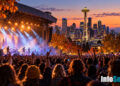
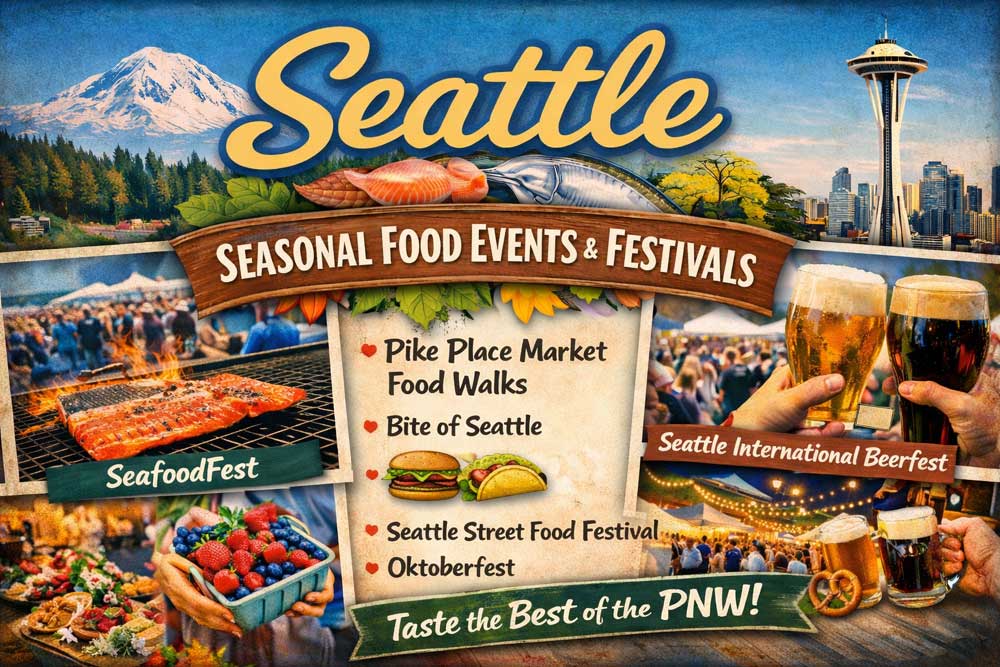
For more than four decades, The Bite has served as Seattle’s signature food festival, though its evolution reflects broader changes in the city’s culinary scene. Under new management by FoodieLand as of recent years, the festival has expanded to include more than 300 food and retail vendors, 50-plus musical artists, craft beer and wine tastings, and the Gladiator of the Grill BBQ competition.
Held at Seattle Center over a late July weekend, The Bite occupies the same grounds where the 1962 World’s Fair once showcased American optimism and technological progress. Today, the festival showcases a different kind of progress—the maturation of Pacific Northwest food culture into something recognizably distinct from other American regions.
Admission remains free, a deliberate choice that keeps the festival accessible across economic divides. What costs money are the individual food items, small-plate portions that allow attendees to sample widely rather than committing to full meals. This grazing approach transforms eating into exploration, encouraging visitors to try foods they might otherwise avoid.
The festival’s reintroduction of in-person cash and card payments—eliminating the app-only payment system that frustrated previous attendees—represents a acknowledgment that technology sometimes creates barriers rather than convenience. Not everyone owns smartphones, maintains adequate data plans, or feels comfortable navigating digital payment systems. By accepting traditional payment methods, The Bite ensures broader participation.
Ballard SeafoodFest
The Ballard neighborhood has always identified itself through maritime heritage. Its history as a Scandinavian fishing community, its working waterfront with commercial fishing vessels and shipyards, and its geographic position along Shilshole Bay all reinforce this identity. The annual Ballard SeafoodFest, held in July on the weekend following Independence Day, celebrates this heritage while acknowledging how dramatically the neighborhood has changed.
Free admission brings thousands to downtown Ballard’s Market Street and Ballard Avenue, where food vendors serve everything from traditional fish and chips to bacon-wrapped scallops that have achieved minor social media fame. The Trident Seafoods salmon BBQ plate anchors the seafood offerings, providing direct support to the Ballard Alliance, the nonprofit that produces the festival and works year-round to enhance community vitality.
Live music fills multiple stages throughout the weekend, while the Festi-Bowl skateboarding competition brings younger crowds to an event that might otherwise skew older. A lutefisk-eating contest—perhaps the world’s only competitive consumption of gelatinous preserved cod—nods to Ballard’s Norwegian roots with self-aware humor. Few attendees actually eat lutefisk regularly anymore, but the contest maintains tradition through spectacle.
What’s notable about Ballard SeafoodFest is how it navigates neighborhood gentrification. Where working-class Scandinavian families once predominated, expensive condos and craft cocktail bars now define much of Ballard’s landscape. The festival creates temporary space for community cohesion across these changes, bringing together longtime residents and recent arrivals around shared appreciation for seafood, music, and neighborhood identity.
Seattle Chinatown-International District Night Market
Summer evenings in the Chinatown-International District transform into vibrant gatherings during the neighborhood’s Night Market series. Asian street food vendors line the streets, offering everything from Filipino lumpia to Vietnamese banh mi, Japanese takoyaki to Korean fried chicken. The aromas alone—charcoal smoke, caramelizing sugar, fermented flavors—create sensory experiences distinct from typical Seattle food festivals.
This bustling market celebrates authentic Asian cuisine while supporting local businesses in a historic neighborhood facing its own pressures from development and displacement. For many Asian American families, the Night Market offers visibility and cultural celebration in a city where Asian communities have often been marginalized or overlooked.
The festival’s evening timing proves strategic. Cooler temperatures make outdoor eating more comfortable, while the hour allows working families to attend together. String lights and vendor stalls create festive atmosphere, transforming everyday streets into temporary public squares where different Asian communities intermix and share food traditions.
Bristol Bay Salmon Week
Every November, approximately forty Seattle-area restaurants participate in Bristol Bay Salmon Week, showcasing sockeye salmon from Alaska’s Bristol Bay—the world’s largest and most sustainable sockeye salmon fishery. This weeklong celebration operates differently than street festivals or fairground gatherings. Instead of concentrating activity in one location, it disperses across the city through participating restaurants.
The Bristol Bay Regional Seafood Development Association organizes this event to strengthen connections between Bristol Bay’s small-boat fishermen and Pacific Northwest chefs who serve their catch year-round. Many of the fishermen who harvest these salmon have deep roots in Washington state, making the relationship between harvest location and consumption site more intimate than typical global seafood supply chains.
Restaurants like Local Tide, Sushi Kappo Tamura, and The Walrus & The Carpenter create limited-time dishes specifically for the week, often highlighting preparation methods that showcase the salmon’s bold flavor and brilliant color. Some offer traditional preparations like cedar plank grilling, while others experiment with contemporary techniques that push boundaries while respecting the ingredient’s quality.
Fall: Harvest and Homecoming
Autumn in Seattle brings shorter days, returning rains, and the spectacular return of salmon to urban creeks. The season’s food festivals shift from summer’s exuberance to something more reflective, celebrating harvest abundance while acknowledging seasonal change.
Pike Place Market Harvest Festival
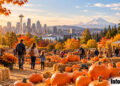
Late October sees Pike Place Market’s annual Harvest Festival transform the nine-acre district into a celebration of fall’s agricultural bounty. Live music, giant pumpkin carving, handcrafted artist demonstrations, and free market history tours fill the day, while seasonal produce takes center stage at farm tables throughout the market.
The festival highlights the PIKE BOX CSA program, which the Market’s Preservation and Development Authority created in 2013 to help local farmers grow businesses, connect urban consumers with local food sources, and provide fresh produce to anyone who needs it. A special flower wall installation showcases seasonal blooms from market farmers, serving both as photo opportunity and educational display about the CSA program.
The “Pigs on Parade” celebration—marking the Pike Place Market Foundation’s impact of raising $40 million over forty years to invest in the market community—brings decorated fiberglass pigs back to their Pike Place home. These artistic pigs, originally displayed in 2001 and 2007, represent both whimsy and serious fundraising for social services that support market residents, workers, and seniors.
The festival encourages visitors to meet the producers directly, bridging the gap between food and its agricultural origins. Many market shoppers move through their purchases transactionally, rarely pausing to learn about farming practices, seasonal challenges, or the economics of small-scale agriculture. The Harvest Festival creates space for these conversations, making visible the labor and knowledge required to bring food from soil to market stall.
Issaquah Salmon Days
Held in early October, Issaquah Salmon Days ranks as Washington’s largest two-day festival, drawing visitors from throughout the region to celebrate the annual return of salmon to Issaquah Creek. More than 300 arts and crafts booths, 70 food vendors, two beer gardens, and continuous live entertainment create carnival-like atmosphere, but the salmon themselves remain the central focus.
The Issaquah Salmon Hatchery provides educational displays showing the salmon life cycle, while the creek itself offers viewing opportunities for returning fish navigating upstream to spawn. Children watching salmon leap obstacles in the creek often experience their first direct connection to wild food systems, understanding suddenly that salmon comes from somewhere specific rather than materializing in grocery store cases.
The festival began in 1970 when the Issaquah Chamber of Commerce sought to replace a Labor Day celebration while honoring what organizers called “one of Issaquah’s greatest treasures—the annual return of the salmon.” Early attractions included Kiwanis salmon BBQ, hatchery displays, an art show, and a children’s parade. Today’s festival has expanded dramatically, but the core mission of celebrating salmon homecoming remains unchanged.
What makes this festival significant beyond its size is its environmental message. Salmon populations face existential threats from habitat loss, climate change, and development pressures. By centering a major community festival around salmon’s annual return, Issaquah makes a public statement about ecological priorities and community values, asserting that salmon matter beyond their economic or culinary value.
Carkeek Park Salmon Celebration
Seattle’s own salmon celebration happens each November at Carkeek Park, where Piper’s Creek provides spawning habitat for returning coho and chum salmon. The annual Salmon Celebration Day, held late in the month, brings together community members to witness this remarkable migration and learn about salmon ecology through interactive displays, live music, educational booths, and salmon dissection demonstrations.
Unlike Issaquah’s massive festival, Carkeek Park’s celebration maintains intimate scale, encouraging direct observation of salmon in their natural urban habitat. The creek’s accessibility—visible from multiple points along an easy walking trail—allows even young children and mobility-limited adults to witness salmon struggling upstream, their bodies visibly deteriorating as they single-mindedly pursue reproduction.
Recent years have seen strong salmon returns to Piper’s Creek, with last year’s numbers reaching record levels. Observing these returns provides counterpoint to depressing news about salmon population crashes elsewhere, offering hope that urban stream restoration can succeed even amid development pressures.
The celebration also highlights the impressive beaver dams and vibrant wetland areas within Carkeek Park, demonstrating how salmon exist within broader ecological communities. Beavers create pools and slow water movement, improving spawning habitat. Native plants provide shade that regulates water temperature. The entire system functions interdependently, with each component supporting others.
Winter: Warmth in the Cold
Seattle winters rarely bring deep snow, but they do bring darkness, persistent rain, and a collective desire for warmth, light, and community. Food festivals during this season tend toward indoor venues, hot beverages, and comfort foods that combat seasonal darkness.
Seattle Christmas Market
Since its establishment, the Seattle Christmas Market has become one of the city’s most beloved holiday traditions, drawing inspiration from traditional German Christmas markets while incorporating Pacific Northwest character. Located at Seattle Center’s South Fountain Lawn and Fisher Pavilion from late November through Christmas Eve, the market transforms the urban park into a European-style winter wonderland.
More than 80 artisan huts house vendors selling handcrafted ornaments, warm scarves, artisanal soaps, ceramics, jewelry, and specialty foods. The authentic European approach creates atmosphere distinct from typical American holiday shopping—wooden vendor stalls, string lights, the scent of roasted chestnuts mixing with mulled wine.
Food vendors offer traditional German and European specialties: bratwurst, strudel, roasted chestnuts, spätzle, raclette, and various warm pastries. Glühwein—spiced mulled wine—flows freely, providing necessary warmth for outdoor browsing. Non-alcoholic options include hot chocolate, spiced cider, and specialty coffee drinks that steam in the cold air.
Special programming includes Tuesday date nights, Wine Wednesdays with specialty pours and karaoke competitions, Themed Trivia Thursdays, and Yappy Hours when pets are welcome. A carousel provides rides for children, while manufactured snow showers add magical atmosphere. Santa Claus makes regular appearances for photos, and live musical performances fill the air with seasonal sounds.
The market requires timed-entry tickets, a system implemented to manage crowds and ensure comfortable browsing experiences. While some grumble about entry fees, the revenue supports the market’s operations and helps maintain quality vendor selection. Season passes allow frequent visitors to return multiple times throughout the holiday season.
Pike Place Market’s Magic in the Market
Pike Place Market celebrates three decades of its Magic in the Market tradition each November, transforming the historic market into a holiday destination. The event kicks off the season with free Santa photos, live reindeer, wand-making demonstrations, color-by-number holiday cards, and a scavenger hunt to find market elves hidden on shelves throughout the district.
A 21+ Market Tasting allows adults to sample holiday bites and beverages across multiple market vendors, turning shopping into culinary exploration. The “Fill a Bowl, Fuel a Day” food drive collects hearty soups and protein bars for the Pike Market Senior Center & Food Bank, connecting holiday celebration with community service.
The evening culminates with a market lighting ceremony featuring performances by Can Can dancers and a festive concert, officially marking the start of the holiday season at Pike Place. This ceremony draws hundreds to the market’s main arcade, transforming what might otherwise be a private ritual—turning on holiday lights—into public celebration.
What distinguishes Magic in the Market from other holiday events is its integration into the market’s daily commercial life. Unlike festivals that take over public spaces temporarily, Magic in the Market happens within and around the market’s regular operations. Vendors continue selling their usual products—flowers, fish, produce, crafts—while holiday decorations and special events create festive overlay.
The Great Figgy Pudding Caroling Competition
Among Seattle’s quirkier holiday traditions, the Great Figgy Pudding Caroling Competition has attracted nearly 10,000 people annually to Pike Place Market for four decades. Teams of carolers compete for prizes while raising funds for the Pike Market Senior Center & Food Bank, combining musical performance with charitable giving.
The competition format encourages creativity—teams wear costumes, create choreography, and interpret holiday songs in ways ranging from traditional to wildly experimental. Spectators line the market streets, cheering favorite performances while dropping donations into collection buckets. The festive chaos creates uniquely Seattle atmosphere, blending earnest holiday spirit with self-aware playfulness.
Seattle Center Festál: Cultural Celebrations Year-Round
Beyond these seasonal highlights, Seattle Center’s Festál series presents 25 free cultural festivals throughout the year, each offering food, music, dance, and art from different ethnic communities. These festivals—including Iranian Festival, Polish Festival, Arab Festival, TibetFest, Festival Sundiata celebrating African American culture, Live Aloha honoring Hawaiian traditions, and Italian Festival—transform Seattle Center into a stage for cultural expression and culinary discovery.
Each Festál celebration features food vendors representing their respective cultures, offering dishes rarely found in mainstream Seattle restaurants. Polish pierogi, Iranian kebabs, Hawaiian kalua pork, Tibetan momos, Italian porchetta—these festivals provide opportunities to experience authentic preparations made by community members rather than commercial operations.
The festivals serve multiple purposes beyond entertainment. They educate broader publics about cultural traditions that might otherwise remain invisible. They create economic opportunities for small food vendors and artisans. They provide spaces where ethnic communities can gather, celebrate their heritage, and pass traditions to younger generations. And they assert that Seattle’s diversity extends beyond its well-known Asian, Pacific Islander, and Latino populations to include smaller communities that also deserve recognition and celebration.
The Rhythm of Seasons
Seattle’s food festivals follow agricultural and cultural rhythms that connect urban residents to broader patterns of time and place. Spring festivals celebrate awakening and new growth. Summer brings abundance and outdoor gathering. Fall marks harvest and preparation. Winter creates space for reflection, warmth, and cultural memory.
These seasonal patterns matter in a city increasingly disconnected from agricultural reality. When most food arrives via global supply chains, enabling year-round access to nearly any ingredient regardless of season, festivals that honor seasonality become counter-cultural acts. They insist that timing matters, that food tastes better when locally grown and harvested at peak ripeness, that certain foods belong to certain seasons.
The festivals also create democratic spaces in a city struggling with inequality and displacement. Many require no admission fee or charge minimal amounts, ensuring accessibility across economic divides. They happen in public spaces—parks, market streets, neighborhood thoroughfares—rather than private venues that might exclude. And they bring together diverse populations who might otherwise never interact, creating temporary communities around shared appreciation for food, music, and cultural expression.
What emerges from Seattle’s food festival calendar is a portrait of a city still negotiating its identity. It’s no longer the sleepy Pacific Northwest town it once was, but neither has it fully embraced the tech-driven, hyper-caffeinated image sometimes projected nationally. The city’s food festivals reveal something more complex: a place deeply connected to its maritime and agricultural surroundings, committed to cultural diversity, struggling with growth and change, and using food as a vehicle for building community across difference.
As climate change alters growing seasons, as economic pressures transform neighborhoods, as global events disrupt supply chains and migration patterns, these festivals will inevitably evolve. But the fundamental human need they address—to gather, to eat together, to celebrate place and season and culture—that need remains constant. Seattle’s food festivals honor that need, creating spaces where eating becomes more than sustenance, where it becomes connection, celebration, and community.