

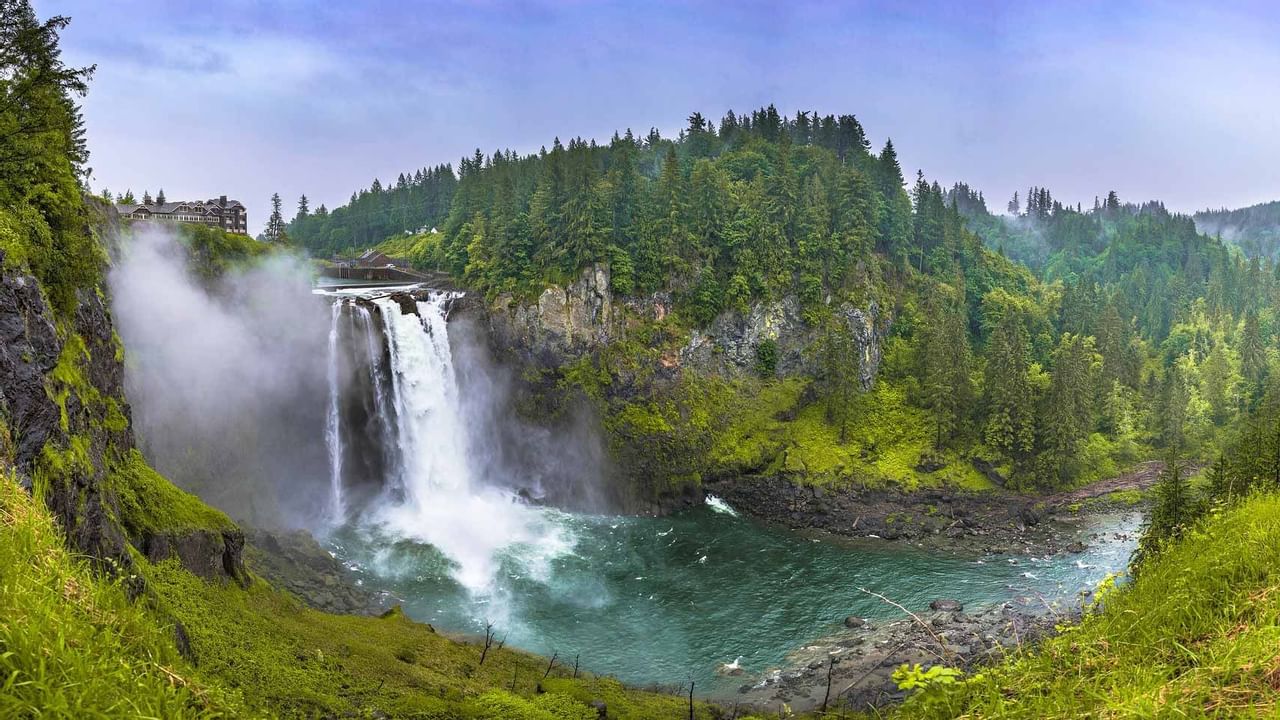
The thunder arrives before the falls come into view. A deep, resonant rumble that seems to emanate from the earth itself, growing louder with each step along the tree-lined path. Then, through the cedars and Douglas firs, the mist becomes visible—a perpetual cloud rising from the gorge below. Finally, the waterfall reveals itself: 268 feet of cascading water, broader than Niagara Falls is tall, plummeting into a emerald pool carved over millennia.
Snoqualmie Falls stands as one of Washington State’s most visited natural attractions, drawing more than 1.5 million visitors annually to this site just 30 miles east of Seattle. Yet for all its popularity, the falls retain an untamed quality that speaks to something deeper than mere scenic beauty. This is a place where geology, indigenous history, renewable energy, and raw natural power converge in ways both visible and hidden.
The Geological Genesis
The story of Snoqualmie Falls begins roughly 15,000 years ago, during the waning days of the last ice age. As the Cordilleran Ice Sheet retreated northward, it left behind a landscape fundamentally transformed. The Snoqualmie River, swollen with glacial meltwater, carved through layers of volcanic rock and sediment, seeking its path to Puget Sound.
What makes Snoqualmie Falls distinctive isn’t just its height but the specific geological circumstances that created it. The falls formed where the river encounters a layer of particularly resistant rock—a remnant of ancient lava flows that once covered this region during periods of intense volcanic activity millions of years earlier. Downstream, softer sedimentary rocks eroded more quickly, creating the dramatic drop we see today.
The erosion continues even now, though at a pace measured in centuries rather than human lifetimes. The force of the falling water, carrying suspended sediment and debris, gradually wears away at the rock face. Geologists estimate that the falls have migrated upstream several hundred feet over the past several thousand years, leaving behind the steep-walled gorge that frames the lower viewing areas.
During spring snowmelt, the volume of water increases dramatically. The river, normally flowing at around 1,000 to 3,000 cubic feet per second, can swell to 10,000 cubic feet per second or more. The character of the falls transforms entirely during these high-water events. The usual distinct curtain of water becomes a violent, churning maelstrom that sends spray hundreds of feet into the air, soaking the observation platforms and creating rainbows that arc across the gorge on sunny afternoons.
Sacred Ground: The Snoqualmie Perspective
Long before the falls became a tourist destination or power generation site, they were—and remain—a sacred place to the Snoqualmie people. The tribe’s oral traditions describe the falls as the location where their first ancestors were created. This isn’t merely historical context; it’s living spiritual reality for the Snoqualmie Tribe, who maintain deep connections to this place their ancestors have known for countless generations.
The Snoqualmie name for the falls, Sdukwalbixw, translates roughly to “moon, the transformer,” referencing creation stories that explain how the transformer figure gave the Snoqualmie people their identity and relationship with the land. The mist rising from the falls was traditionally seen as the breath of the waterfall’s spirit, and the site served as a vision quest location where tribal members would seek spiritual guidance and power.
The relationship between the Snoqualmie Tribe and the falls took a painful turn in the early 20th century when Puget Sound Power & Light (now Puget Sound Energy) built a hydroelectric facility at the site. The development proceeded without meaningful consultation with the tribe, and for decades, much of the water was diverted through underground tunnels, reducing the falls to a trickle except during peak runoff periods.
This changed partially in 2009, when new regulations required the power company to maintain minimum flows over the falls year-round. While the Snoqualmie Tribe continues to advocate for greater protections and more water to remain in the natural channel, the compromise represents at least some acknowledgment that the falls hold value beyond kilowatts generated.
Today, the tribe maintains a presence at the falls through cultural programs and advocacy efforts. Visitors willing to look beyond the postcard views can find interpretive materials that explain the site’s indigenous significance, though these often feel inadequately positioned relative to the prominence of the falls themselves—a spatial metaphor, perhaps, for how indigenous perspectives have historically been marginalized in American tourism narratives.
The Power Beneath
One of Snoqualmie Falls’ most fascinating aspects is largely invisible to casual visitors. Deep beneath the observation platforms and gift shop, a hydroelectric plant has been generating electricity since 1899, making it one of the oldest continuously operating hydroelectric facilities in the United States.
The original plant, built by Charles Baker—a Seattle entrepreneur who recognized the falls’ power-generation potential—supplied electricity to the young city of Seattle through what was, at the time, the longest high-voltage transmission line in the world. The engineering achievement was remarkable for its era: workers hand-drilled a tunnel through solid rock to divert water from above the falls to underground turbines, then returned the water to the river below the falls.
The facility has been upgraded multiple times over the past century. The current underground powerhouse, accessed through a tunnel bored through the cliff face, contains two generating units with a combined capacity of 54 megawatts—enough electricity to power approximately 16,000 homes. The plant operates as a “run-of-river” facility, meaning it doesn’t store water in a large reservoir but rather uses the natural flow of the Snoqualmie River.
This dual nature—natural wonder and industrial facility—creates an ongoing tension. Energy advocates point out that hydroelectric power produces no carbon emissions and provides reliable baseload electricity. Environmental and cultural preservationists counter that the facility diminishes the falls’ natural character and represents an inappropriate use of a sacred indigenous site.
The truth, as usual, resists simplicity. The Northwest’s electrical grid relies heavily on hydroelectric power, which has enabled the region to maintain relatively low carbon emissions compared to areas dependent on coal or natural gas. Yet there’s no escaping the fact that the falls we see today are managed, controlled, and fundamentally altered by human engineering—a pristine natural wonder with a very modern infrastructure hidden just beneath the surface.
Four Seasons, Four Falls
Snoqualmie Falls transforms dramatically with the seasons, offering entirely different experiences depending on when you visit. Those who return throughout the year witness what amounts to four distinct waterfalls.
Winter brings the falls to their most temperamental. Pacific storms roll in from the ocean, dumping rain across the Cascade foothills. The river swells, dark and powerful, and the falls become a thunderous force that can be heard from the parking lot. On the coldest nights, when Arctic air masses slip southward, ice forms along the cliff faces, creating fantastic frozen sculptures at the waterfall’s edges. The spray freezes on vegetation, encasing ferns and branches in crystalline shells. Fewer visitors brave the cold and wet, meaning those who do often have the viewing platforms nearly to themselves—a rare gift at one of Washington’s busiest attractions.
Spring extends winter’s drama but adds light. Snowmelt from the Cascades feeds the river, maintaining high flows well into June. The surrounding forest erupts in shades of green that seem almost artificially vivid after months of gray. Wildflowers bloom along the trail to the lower viewpoint: trillium, bleeding heart, vanilla leaf. The extended daylight hours of late spring create ideal conditions for photography, with golden evening light illuminating the falls and gorge.
Summer brings the crowds. Tour buses disgorge visitors from around the world, and the parking lot fills by mid-morning on weekends. The falls themselves diminish somewhat during the dry months, though they never disappear entirely thanks to regulated minimum flows. What summer lacks in water volume, it makes up for in accessibility and comfort. The weather is reliably pleasant, the trails are dry, and the extended hours of daylight mean visitors can arrive at various times and still experience good conditions.
Autumn offers a middle path between summer’s accessibility and winter’s drama. Fall rains begin to replenish the river, gradually increasing the falls’ volume. The deciduous trees scattered among the evergreens add splashes of gold and crimson to the predominantly green landscape. Most significantly, the autumn light has a particular quality—lower angle, warmer tones—that makes the falls especially photogenic during the golden hours around sunrise and sunset.
The View From Below
Most visitors experience Snoqualmie Falls from the upper viewpoints, accessible directly from the parking lot. The perspective is impressive: standing at roughly the same elevation as the top of the falls, looking across the gorge at the full drop. But those willing to descend the half-mile trail to the lower viewpoint discover an entirely different experience.
The trail switchbacks down through dense forest, descending nearly 300 feet in elevation. Western red cedars tower overhead, their trunks diameter enough that three adults couldn’t link hands around them. Sword ferns blanket the understory. During wet weather, the trail becomes a minor creek itself, with water trickling down the path.
At the bottom, the perspective shifts dramatically. The falls loom overhead, and the spray becomes tangible, coating everything in a fine mist. The sound is overwhelming—not just loud but physical, a pressure felt in the chest and bones. The pool at the base churns constantly, its color shifting between jade and turquoise depending on the light and suspended sediment.
This lower viewpoint offers something the upper platforms cannot: a sense of the falls’ actual scale and power. From above, visitors can intellectually appreciate the 268-foot drop. From below, they viscerally experience what it means for thousands of cubic feet of water to plummet that distance every second.
The pool itself, known as the plunge pool, extends about 65 feet deep at its center—carved over millennia by the erosive force of the falling water. Fish, primarily rainbow trout and salmon species, gather below the falls during migration periods, though they cannot ascend the sheer drop. Historical accounts describe enormous salmon runs before the construction of dams further downstream disrupted migration patterns.
The Human Infrastructure
The development around Snoqualmie Falls reflects more than a century of changing attitudes toward natural attractions. The Salish Lodge, perched on the cliff edge directly overlooking the falls, began as a more modest establishment in 1916 called the Snoqualmie Falls Lodge. The current building dates to 1988 and achieved unexpected fame as the exterior of the Great Northern Hotel in David Lynch’s television series “Twin Peaks.”
The lodge represents a particular approach to nature tourism: luxury accommodation positioned to offer guests spectacular views without requiring them to expend much physical effort. Rooms face the falls, restaurant tables overlook the gorge, and the spa incorporates the falls’ imagery into its marketing. It’s nature as amenity, wilderness as backdrop for comfort.
Below the lodge, a complex of gift shops and interpretive centers occupies the upper parking area. Here, the commercial aspect of the falls reaches its fullest expression. Visitors can purchase Snoqualmie Falls merchandise ranging from tasteful photography to novelty items of questionable connection to the actual site. The interpretive materials, when visitors take time to engage with them, provide valuable context about the falls’ formation, ecology, and cultural significance.
The infrastructure also includes something less visible but equally important: extensive safety features. Railings, barriers, and warning signs attempt to prevent visitors from taking dangerous risks for photographs or closer views. Despite these measures, accidents occur with tragic regularity—reminders that natural beauty often coincides with natural danger.
Conservation and Future Challenges
Snoqualmie Falls exists within a complex web of competing interests and regulatory frameworks. The falls themselves are part of a larger ecosystem that extends from the Cascade headwaters to Puget Sound. Decisions made upstream—regarding logging, development, water usage, and recreation—affect the falls and the river that feeds them.
Climate change introduces new uncertainties. The Pacific Northwest’s snowpack, which historically provided steady summer flows through gradual melting, is declining. Projections suggest the region will experience more precipitation falling as rain rather than snow, with implications for seasonal river flows. Winter floods may become more severe, while summer low-flows could diminish further, potentially affecting both the falls’ appearance and the hydroelectric facility’s output.
The surrounding forest faces pressures as well. The trees visible from the viewing platforms are protected, but the broader watershed continues to experience logging, development, and recreational impacts. Maintaining the falls’ spectacular setting requires thinking beyond the immediately visible area to the entire landscape that funnels water to this specific point.
Efforts to balance preservation, indigenous rights, power generation, and tourism continue to evolve. The Snoqualmie Tribe has gained federal recognition and strengthened its advocacy position. Environmental regulations have tightened, though enforcement remains challenging. Tourism pressure increases year by year, raising questions about carrying capacity and appropriate development.
A Place Apart
What distinguishes Snoqualmie Falls from countless other waterfalls scattered across the Northwest? Perhaps it’s the accessibility—a spectacular natural feature requiring minimal effort to experience. Perhaps it’s the setting, with the falls as centerpiece in a landscape of towering conifers and moss-draped cliffs. Perhaps it’s the subtle way the site layers different historical periods and perspectives: indigenous sacred site, industrial facility, tourist destination, ecological treasure.
Or perhaps the falls endure in public consciousness simply because water falling 268 feet never loses its capacity to inspire awe. The fundamental physics remain unchanged whether witnessed by Snoqualmie ancestors a thousand years ago or by smartphone-wielding tourists today. Gravity pulls water downward. Rock resists but ultimately erodes. Mist rises. The thunder continues.
Standing at the viewing platform, watching the Snoqualmie River launch itself into space and shatter into spray and foam far below, the mind reflexively reaches for metaphors: power, permanence, the indifference of nature to human concerns. But the falls resist easy symbolism. They simply are—a consequence of geology and hydrology, a cultural touchstone, a renewable energy source, a popular attraction, a sacred place.
The challenge, perhaps, is to hold all these truths simultaneously. To appreciate the falls’ beauty without ignoring the infrastructure that shapes it. To recognize indigenous connections without relegating them to the past. To enjoy the accessibility while understanding the impacts tourism brings. To find the sacred in a place that’s also thoroughly commercialized.
Visiting Wisely
For those planning a visit, timing matters more than many realize. Weekday mornings offer the most solitude, particularly outside summer months. The falls face roughly west, meaning they receive direct sunlight primarily in afternoon and evening—optimal for photography but also for crowds. Sunrise visits reward early risers with empty platforms and soft light, though the falls themselves remain in shadow.
The hike to the lower viewpoint, while not technically difficult, challenges those with mobility limitations or health conditions. The trail is steep, sometimes slippery, and the return climb leaves many visitors breathless. Going down is optional; coming back up is mandatory. Those who descend should allow at least 45 minutes for the round trip, more if conditions are wet or if photography is planned.
Weather varies dramatically by season. Summer visits rarely require more than light layers, but winter waterfalling demands waterproof outer layers and warm clothing. The spray reaches viewing platforms even in low-water conditions, and everything gets wet eventually. Electronics should be protected.
Most importantly, visitors should allocate more time than seems necessary. The falls can be glimpsed in five minutes, but understanding the place—its layers of meaning and complexity—requires slower engagement. Reading the interpretive materials, descending to the lower viewpoint, sitting quietly with the sound and spray, noticing the subtle changes as light shifts across the gorge: these activities transform a quick stop into an actual experience.
The Eternal Present
Snoqualmie Falls exists in a perpetual now that somehow encompasses vast stretches of time. The water falling at this instant is already gone, replaced by the next instant’s water, and the next, an endless succession that creates the illusion of permanence from constant change.
The rock face will stand essentially unchanged during any human lifetime, yet geological time will eventually reduce it to sediment. The indigenous significance stretches back beyond documentation, yet remains vitally alive in contemporary Snoqualmie culture. The hydroelectric plant is simultaneously cutting-edge 1899 technology and a functional element of the modern grid.
This temporal complexity mirrors the spatial layering—the visible natural beauty and hidden industrial infrastructure, the tourist attraction and sacred site, the accessible wonder and dangerous edge. Snoqualmie Falls refuses simplicity, which may be the most valuable thing about it in an era of reduced attention spans and curated experiences.
The falls will continue long after current debates about water rights, energy policy, and tourism management fade into history. The Snoqualmie River will keep flowing, carrying the runoff from winter storms and mountain snowmelt, launching itself into space, and crashing into the pool below. The thunder will persist, the mist will rise, and people will continue to stand at the viewing platforms, watching the water fall.
That continuity matters. In a world of accelerating change and increasing uncertainty, Snoqualmie Falls offers something increasingly rare: a connection to processes that operate on time scales beyond human comprehension, a place where the fundamental forces of nature remain visible and powerful. It’s worth the drive from Seattle, worth navigating the crowds, worth getting wet in the spray—because some things deserve to be witnessed, celebrated, and preserved not for what they provide us, but for what they simply are.
The Photographer’s Falls
Snoqualmie Falls has become one of the most photographed locations in the Pacific Northwest, and for good reason. The combination of dramatic vertical drop, accessible viewpoints, and reliably photogenic conditions makes it an ideal subject for photographers ranging from smartphone users to professionals with specialized equipment.
The upper observation deck provides the classic view—the full height of the falls framed by forest, with the gorge spreading below. This angle works particularly well in afternoon light when the sun illuminates the water directly. Long exposure photography transforms the falling water into ethereal silk, though this technique requires a tripod and neutral density filters to work effectively in bright conditions.
The lower viewpoint offers more dramatic compositions, with the falls towering overhead and filling the frame. The constant spray presents technical challenges, requiring weather-sealed equipment and frequent lens cleaning, but rewards persistence with powerful, immersive images that convey the falls’ true scale and energy.
Seasonal variations provide distinct photographic opportunities. Winter storms create dramatic skies that complement the falls’ raw power. Spring wildflowers add foreground interest to wider compositions. Summer’s longer days allow for sunset photography that would be impossible during shorter winter daylight. Autumn combines increased water flow with warm light and changing foliage.
The lodge presents compositional challenges and opportunities. Some photographers view it as an intrusion on natural beauty, carefully framing shots to exclude the building. Others embrace it as part of the falls’ character—a testimony to humanity’s long relationship with this place. Night photography can capture the lodge’s lights reflecting on the mist, creating an almost otherworldly atmosphere.
For those serious about photographing the falls, multiple visits across different conditions yield the most compelling portfolios. The falls never look exactly the same twice, and patient observation reveals moments of particular beauty: sunlight breaking through storm clouds, rainbows arcing through the mist, the rare snow dusting on surrounding cliffs, or the golden hour light that makes the water glow against shadowed rock.