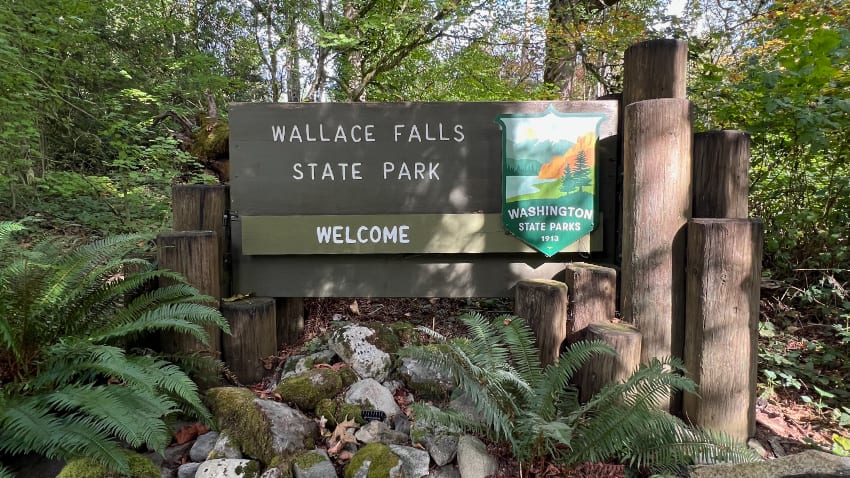
The Pacific Northwest does not lack for waterfall hikes. From the basalt-carved gorges of the Columbia River to the mist-veiled ravines of Olympic National Park, there are hundreds of places where water throws itself off stone and vanishes into foam. And yet, when Washingtonians are asked to name their go-to waterfall trail — the one they’d recommend to a visiting friend or a restless family on a Saturday morning — an overwhelming number of them point to a 1,380-acre stretch of old-growth forest tucked into the western slopes of the Cascades, just outside the tiny town of Gold Bar.
Wallace Falls State Park is not the most remote park in the state. It is not the most dramatic. It does not demand technical skill or a four-wheel-drive vehicle or an overnight permit mailed six months in advance. What it does, with remarkable consistency, is deliver. Three cascading waterfalls. Pristine backcountry lakes. A river trail so lush and varied that every season rewrites the scenery. And all of it less than an hour from the greater Seattle metro area.
That combination of accessibility and genuine wildness has made Wallace Falls one of the most popular state parks in Washington — and also one of the most interesting, once you scratch beneath the surface of its parking lot crowds and Instagram-ready viewpoints.
A Name Rooted in Indigenous History
The name “Wallace” carries a story most visitors never hear. It is not the surname of some Victorian-era explorer or a bureaucrat who signed a land deed. It is a linguistic corruption — a colonial reshaping — of the name Kwayaylsh.
Joe and Sarah Kwayaylsh were members of the Skykomish tribe, part of the broader Coast Salish peoples who have inhabited the river valleys and mountain foothills of this region for thousands of years. They were the first homesteaders in the area surrounding the falls, carving out a life along the river well before timber companies arrived with their railroad grades and springboard axes. Over time, English-speaking settlers mangled Kwayaylsh into “Wallace,” and the name attached itself to the river, the falls, the lake, and eventually the park.
The park itself sits within the traditional territory of the Coast Salish Indigenous people whose present-day descendants include members of the Tulalip Tribes, an organization formed in 1934 under the Indian Reorganization Act and composed of the Snohomish, Snoqualmie, Skagit, Skykomish, Suiattle, Samish, and Stillaguamish Tribes and allied bands. When you walk the trails here, you walk on ground that held meaning long before the state erected a trailhead sign.
The Long Road to Becoming a State Park
For decades, the land that is now Wallace Falls State Park belonged to the Weyerhaeuser Timber Company. The forests were working forests — logged, replanted, logged again. Evidence of that industrial past is still woven into the landscape. Abandoned railroad trestles rot quietly among the ferns. Disused railroad grades have been repurposed as trail beds. And if you look carefully at the massive old stumps that line the lower trails, you can still spot the telltale springboard notches where loggers once stood to fell trees by hand.
Efforts to protect the falls as public land gained momentum in the 1960s. In 1965, Washington Governor Daniel Evans signed House Bill 74, directing the state Parks and Recreation Commission to establish a park at Wallace Falls. There was a catch, though: the legislation specifically removed the right of eminent domain, meaning the state could not force Weyerhaeuser to sell. And Weyerhaeuser was not interested in selling.
Two years later, the legislature reversed course and re-established that right. By 1971, the state had acquired 513 acres from Weyerhaeuser for $425,000 — a sum that, even by 1970s standards, represented a bargain for land this spectacular. The park was officially dedicated on May 13, 1978, and the primary trail to the falls was named the Woody Trail in honor of Senator Frank Woody, a legislator from the 39th district who had championed the park’s development until his death in 1977. Woody was particularly passionate about creating opportunities for young people in the outdoors, and his advocacy for the Washington Youth Development and Conservation Corps left a legacy far beyond this single park.
In 1995, additional land acquisitions from the Department of Natural Resources and private sellers expanded the park to include the North Fork of the Wallace River and three mountain lakes. A new trail was surveyed and designed by Greg Ball, a leader with the Washington Trails Association, whose non-profit had been partnering with state agencies to perform volunteer trail maintenance since 1993. Ball passed away before the four-mile trail bearing his name was completed, but his colleagues noted that his legacy was not just the work he did, but the work he inspired others to do.
Today, the park’s broader management area encompasses roughly 4,735 acres, with shoreline along the Wallace River, Wallace Lake, Jay Lake, Shaw Lake, and the Skykomish River.
The Falls Themselves: A Three-Act Drama
Wallace Falls is not a single waterfall. It is a performance in three acts, each with its own character and its own reward for the hiker willing to keep climbing.
Lower Wallace Falls
The curtain rises at the two-mile mark on the Woody Trail, where a viewing area offers the first look at the cascade. Lower Wallace Falls tumbles approximately 212 feet in five separate tiers, its water threading through mossy rock ledges before gathering speed and dropping again. The lower falls are the most accessible and, as a result, the most photographed. On a summer weekend, the picnic area here will be crowded with families refueling on trail mix and debating whether to keep going.
They should keep going.
Middle Wallace Falls
Less than half a mile farther up the trail, the middle falls deliver what many hikers consider the crown jewel of the entire park. The main drop here plunges roughly 265 feet down a sheer face of moss-covered rock, and the viewpoint offers a sweeping panoramic that extends well beyond the waterfall itself. On a clear day, the Skykomish River Valley unfolds below like a green carpet, and the Olympic Mountains hover on the western horizon in a distant blue silhouette.
This is where most people turn around. And there is no shame in that — the middle falls viewpoint provides what is arguably the single most rewarding vista in the park, a combination of waterfall power and alpine grandeur that justifies the entire hike.
Upper Wallace Falls
For those who press on, the trail throws a parting challenge: a steep, sweat-inducing half-mile of switchbacks that climbs aggressively toward the upper falls. Upper Wallace Falls drops 240 feet in five separate tiers, though no single viewpoint reveals the entire cascade. The upper falls feel more rugged and more private — fewer people make it this far — and there is a quiet satisfaction in reaching the end of the trail at 2.8 miles, knowing you have seen all three acts.
In total, the waterfall system drops roughly 367 feet, making it one of the most impressive accessible waterfall displays in western Washington.
Beyond the Falls: Lakes, Loops, and the Backcountry
Wallace Falls State Park is, in the minds of most visitors, a waterfall hike. But the park contains 17 miles of trails, and the majority of them have nothing to do with the falls.
The Greg Ball Trail extends four miles beyond the waterfall viewpoints, winding through dense forest to reach Wallace Lake and, slightly farther, Jay Lake. These backcountry lakes are the park’s quieter reward — mountain-ringed bodies of water where the loudest sound is the occasional slap of a fish breaking the surface. Backcountry campsites at both lakes accommodate a maximum of five people per site and require a permit from the ranger station. The hike in is between four and seven miles, depending on the lake, and the solitude is near total.
For mountain bikers, the old logging roads that crisscross the park provide miles of rideable terrain, though the main Woody Trail to the falls is foot-traffic only. The trail network also includes a short quarter-mile interpretive trail near the parking area, where panels explain the local ecosystem and the geological forces that carved the falls.
And for those looking to extend their adventure beyond the park boundaries, Big Eddy State Park sits just five miles to the east along the Skykomish River, offering swimming access in slow-moving water with sandy beaches — a welcome contrast to the cold, fast-moving mountain streams inside Wallace Falls. Another twelve miles east, the granite cliffs of the Index Town Wall present over 500 rock-climbing routes rated from 5.6 to 5.14c.
Wildlife in the Shadows
A park this popular does not tend to showcase its wildlife on the main trail. The Woody Trail sees too much foot traffic for most animals to linger, and the reality, according to park rangers, is that the majority of hikers will complete the waterfall hike without a single wildlife encounter beyond the occasional bird flitting through the underbrush.
But the animals are there, just off to the sides and deeper in the woods. Blacktail deer are the most commonly spotted residents. Black bears are reported roughly a dozen times per year, usually sighted briefly before loping away from the trail. Bobcats have been observed by park staff in recent years. Cougars have been sighted multiple times near the falls over the park’s history, though encounters remain exceedingly rare. And on the rock cliffs of the Index Town Wall east of the park, peregrine falcons — those breathtaking aerial predators — have established nesting territories.
The old-growth coniferous forest that blankets the park supports a rich, layered ecosystem. Towering Douglas firs and western red cedars form the canopy, while the understory comes alive with sword ferns, salal, and huckleberry. In spring, wildflowers like violets dot the trailside, and the pink blossoms of salmonberry bushes announce the approach of warmer months.
Camping and Cabins: Staying the Night
Wallace Falls offers a range of overnight options, each suited to a different kind of visitor.
The most accessible are the park’s five cabins, which can be reserved in advance. Each cabin features a covered front porch, a picnic table, fire pit, barbecue stand, electric heat, lights, and locking doors. Inside, bunk beds sleep three and a full-size futon bed accommodates two more, bringing the maximum occupancy to five people per cabin. Two of the cabins meet ADA accessibility standards, and two allow pets with a nightly fee. All five cabins sit within walking distance of the Woody Trail, making them a convenient base camp for both waterfall hikes and lake excursions.
For those who prefer canvas over walls, two walk-in tent sites near the parking area are available on a first-come, first-served basis. They are surprisingly private — set back 20 to 50 feet from the parking lot — with picnic tables and fire rings. Two restrooms with shower facilities are close by, though the showers carry a fee.
And then there is the backcountry. The campsites at Jay Lake and Wallace Lake are for hikers willing to earn their bed. The sites are basic — picnic tables, fire rings, outhouses — but the setting is anything but. Waking up beside a mountain lake with no road noise and no cell signal remains one of the purest pleasures available in Washington’s state park system.
Practical Wisdom: Timing, Parking, and the Weekend Rush
Here is the reality that every piece of Wallace Falls promotional material now leads with: this park gets crowded. On a sunny weekend between May and October, the parking lot is typically full by 11 a.m., and the narrow county road leading to the park entrance becomes a source of frustration for both visitors and the private landowners who live along it. The park now provides a live parking lot camera on its website — a modern solution to an old problem — and strongly advises against parking along the road.
The best strategy is ruthlessly simple: arrive early. A trailhead departure before 9 a.m. on a weekend morning rewards you with a quieter trail, ample parking, and a different quality of experience altogether. Weekday visits are even better. And if you are flexible on timing, the shoulder seasons — late fall and early spring — bring fewer crowds and often more dramatic conditions. The falls swell with rain, the forest deepens in color, and the mist that hangs in the valley gives the whole place a moody, almost cinematic weight.
Summer park hours run from April 1 through September 30, with gates opening at 6:30 a.m. Winter hours shift to 8 a.m. until dusk, with limited operations and some closures on Mondays and Tuesdays from October through April.
A Discover Pass is required for vehicle access, priced at $10 for a day pass or $30 for an annual pass that covers all Washington state parks.
Why Wallace Falls Endures
There are flashier hikes in Washington. There are more remote ones, more challenging ones, more exclusive ones. But Wallace Falls occupies a rare space in the state’s outdoor culture. It is the hike people return to year after year. It is the hike families bring their kids to for the first time. It is the hike that works in almost any season, for almost any fitness level, and still manages to surprise you with the force of its central attraction — water, falling through space, meeting stone.
Part of that enduring appeal is the trail itself. The Woody Trail is not merely a path to a destination. It is consistently beautiful in its own right, winding along the Wallace River through fern-carpeted forest, past the ghosts of the logging era, and into increasingly dramatic terrain as the elevation builds. Unlike many hikes where the scenery is front-loaded or saved entirely for the summit, this trail rewards you continuously.
And part of the appeal is the park’s layered identity. Wallace Falls is a place where Indigenous history, industrial heritage, legislative persistence, and volunteer passion have all converged. The trails were built by youth corps and maintained by non-profit volunteers. The name on the map traces back to a Skykomish family that homesteaded these valleys long before the timber companies arrived. The viewpoints exist because a state senator believed in public access to wild places and a trail designer gave his time to a cause he would not live to see completed.
Every park has a trail. Not every park has a story this rich.
Final Thoughts
Wallace Falls State Park does not need to oversell itself. The waterfalls do the talking. The old-growth forest sets the mood. The backcountry lakes offer the kind of silence that most people have to drive much farther to find.
What the park does need — and what it deserves — is visitors who arrive with some understanding of what they are walking through. The history etched into the stumps. The names on the trails. The ecological complexity humming just out of sight beneath the canopy. These are not footnotes. They are the substance of the place.
So yes, go for the waterfalls. Stay for the lakes if you have the legs. But take a moment, somewhere along the Woody Trail, to simply stand still and listen. The river will fill the silence. The forest will close in around you. And for a few minutes, standing on ground that has meant something to people for a very long time, you might find that the most spectacular thing about Wallace Falls is not the falls at all.
It is everything else.